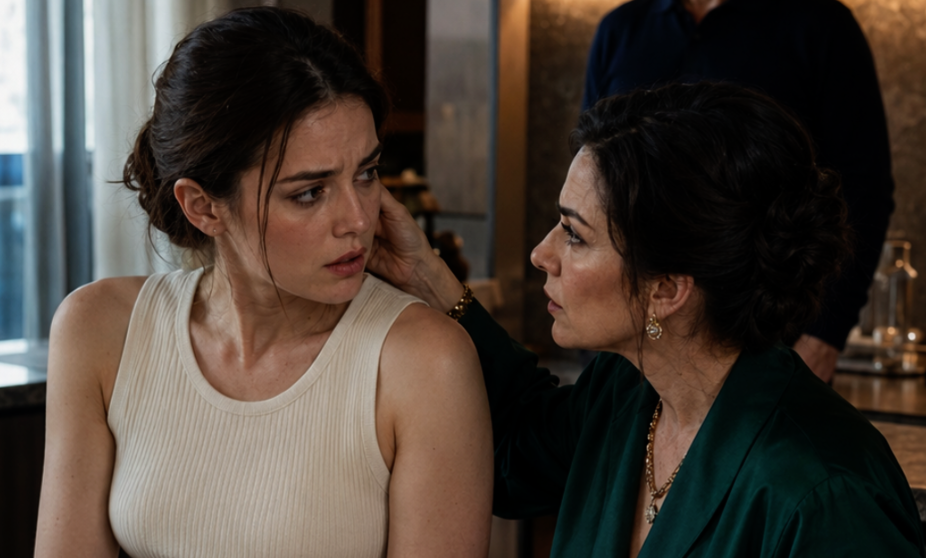
The shriek of my mother-in-law made me smile. I had waited six months for that scream. That was exactly how long my revenge had been ripening.
Three years ago, I got married. Three years — is that a long time or a short time? For love, it is an eternity. For hatred, it is a grain of sand. My love ended around the third month after the wedding, when Kirill said for the first time, “Mother should be admired, not criticized.” Back then, I kept silent. I kept silent a lot in general. An orphanage habit: don’t stick your head out, be convenient, and then they won’t throw you out. I thought I had left the orphanage behind. In reality, I had simply exchanged government walls for a mansion with columns and the smell of vanilla perfume.
Margarita Pavlovna, my mother-in-law, drenched herself in perfume so heavily that it made your head spin. The sickly-sweet trail followed her all over the house, arriving before her footsteps. It seeped into the bedroom, settled into the curtains, soaked into the pillows. I hated that smell. It suffocated me at night, even when my mother-in-law was nowhere near me.
During the first year, I believed. I honestly believed that family was a fortress. That I had been accepted, warmed, given a safe place. After all, I was an orphan. I had no one. At first, Margarita Pavlovna was sweetness itself. “My dear girl, you’re so thin, eat more,” “Alysochka, what a wonderful pie, you’re such a little homemaker.” I melted. I tried. I wanted to become part of something big and warm.
The awakening came when I accidentally overheard her talking to a neighbor in the kitchen. Margarita Pavlovna was speaking in a low voice, thinking I had gone to the store. I had lingered in the hallway because I had forgotten my wallet.
“…picked her up from the trash heap, and now she thinks she has the right to speak up. No, Lyudochka, she has nothing to her name. She came with only the clothes on her back. My Kirill is practically a saint. But don’t worry, I’ll show her where her place is.”
That was the first time I felt something snap inside me. Not my heart — my heart was strong. What snapped was the little thread holding up my faith in people. I quietly took off my shoes, tiptoed into the bedroom, and closed the door. I took out my laptop, opened a blank document, and wrote: “Bird in a cage. Begin phase one.”
There were exactly six months left until today’s scream.
The family dinner in honor of our third wedding anniversary was held in the large living room. Margarita Pavlovna had gone all out: white tablecloth, porcelain, silver cutlery. The neighbors had been invited — two overdressed ladies with teased hair and pearls. Kirill shone like a polished samovar. He was wearing a new jacket bought by his mother. A watch gifted by his mother. A tie chosen by his mother. I looked at my husband and saw not a man, but a big doll dressed up for a holiday.
“My dear daughter-in-law!” Margarita Pavlovna rose with a glass in her hand. “Accept our modest gift.”
She handed me a box tied with a ribbon. I opened it. Inside lay an apron. White with red polka dots, embroidered with the words “Homemaker of the Year.” The neighbors began smiling.
“Try it on, Alisa, try it on,” Margarita Pavlovna cooed. “The role of keeper of the hearth suits you so well. All this work, work, work… It’s time you started thinking about an heir and quit that silly job of yours.”
I pulled the apron on over my dress. I smiled. I twirled around. The neighbors clapped. Kirill poured his mother more tea and smiled the satisfied smile of a man who had everything under control. Or rather, whose mother had everything under control.
Then Margarita Pavlovna got down to business. She knew how to do it masterfully: weaving humiliation into polite conversation like thread into embroidery.
“The girls and I were discussing the family budget,” she said, dabbing her lips with a napkin. “And I remembered how my late husband, may he rest in heaven, always gave me his entire salary down to the last kopeck. Because a woman who understands household matters manages finances better. Isn’t that right, Lyudochka?”
“Absolutely true, Margarita Pavlovna,” Lyudochka agreed. “My Viktor also brings me every last kopeck. And we live quite comfortably.”
“That’s exactly what I’m saying,” my mother-in-law turned to me. “Alisa, dear, you are a creative girl — marketing, advertising… Numbers are not your element. As a former chief accountant at a factory, I’ll tell you this: money loves counting. And discipline. Do you agree?”
I nodded silently. I knew what was coming.
“Kirill,” she turned to her son. “I think we need to help Alisa. She works too much and gets tired. Why should she have the extra headache of utility bills, loans, savings? Let her give me access to her salary account. I’ll handle the family bookkeeping. Like I used to when you were little.”
Kirill beamed.
“Great idea, Mom! Alisa, really, why bother with all that? Mom knows best.”
“But I…” I started.
“But what?” Margarita Pavlovna’s eyebrows crawled upward. “Do you not trust me? I accepted you like my own daughter. You came into our family with nothing, a ragged beggar, so you’ll have to work half your life before you earn the right to have a say. Until then, be kind enough to show some respect.”
The neighbors froze. Silence hung in the air, ringing like a stretched string. I saw Lyudochka purse her lips, while the other lady lowered her eyes to her plate. They felt awkward. But nobody said a word in my defense. Nobody. Not even Kirill.
I stood up. I walked to my bag hanging on the back of the chair. I took out an envelope.
“Here is the password to my online banking,” I said. “And the access code to my personal account. Margarita Pavlovna, I trust you completely.”
My mother-in-law took the envelope. Her eyes gleamed. She had not expected everything to go so smoothly. For a moment, something like disappointment flashed in her gaze: a predator gets bored when the prey does not resist.
“That’s my clever girl,” she sang. “Wonderful. And now let’s have tea. Lyudochka, try my signature Napoleon cake.”
I excused myself to the bathroom. I locked the door, turned on the water. In the mirror, I saw a pale face with dark circles under the eyes. I looked at myself and did not recognize the woman staring back. When had I become like this? When had I learned to smile as if someone were cutting me, while I thanked them for the sharp blade?
I washed off the mask of obedience. The cold water brought me back to my senses. Then I took out my phone and wrote a message to Vera, Kirill’s older sister, whom I had met by chance six months earlier on some forum. Or rather, not by chance. She had found me herself. “Are you my brother’s wife? Beware of our mother. She will destroy you.”
“Bird in a cage,” I whispered, pressing “send.” “Begin phase one.”
A month later, I understood what hell inside a single apartment meant. The account where my salary was deposited became the “family fund.” Margarita Pavlovna started a thick ledger where she recorded expenses. She would sit enthroned at the kitchen table in glasses, with a calculator and a pen, performing her sacred ritual. Opposite her, like a guilty schoolgirl, stood me.
“So, Alisa. This month you received eighty-five thousand. Forty goes toward the mortgage payment. Another twenty for utilities and house maintenance. Ten for groceries. Five for Kirill’s pocket money. Five into the reserve fund. That leaves five. What would you like to do with it?”
“I thought… maybe I need a new coat? The old one is completely worn out.”
“A coat?” Margarita Pavlovna took off her glasses. “My dear, you stay home in your free time. What do you need a coat for? When I was your age, I wore altered old clothes. And nothing happened — I got married and had children. I’ll put those five thousand aside for unexpected expenses for now. You never know.”
The unexpected expenses appeared a week later. Margarita Pavlovna bought a new bedroom set for herself. Carved solid oak furniture, with gilding and ornate handles. I accidentally saw the receipt she had left on the table: one hundred twenty thousand. My money accounted for exactly the amount I would have saved in two years of those “set aside” five-thousand portions.
His mother gave Kirill a designer watch. He boasted about it to his colleagues, not realizing he was wearing three months of my life on his wrist. I said nothing. I silently collected documents. Statements, receipts, screenshots of messages where Margarita Pavlovna discussed with a friend the purchase of “an amazing handbag at half price — only eighty thousand.”
One evening, while Kirill was watching football, I sat down beside him. My heart was pounding, but I forced myself to speak calmly.
“Kir, we need to talk.”
“Mhm?” He did not take his eyes off the screen.
“We live like dependents. All my money goes into your mother’s accounts. I can’t even buy myself tights without her approval. I am thirty years old, I earn money, I have the right…”
“What do you have?” He abruptly muted the TV. “You should be grateful that we pulled you out of poverty! Mom is trying for your sake, handling the budget, losing sleep at night. Mother should be admired, not criticized!”
“I am not asking you to admire me. I am asking you to respect me.”
“Respect?” He jumped up from the sofa. “And what have you done to be respected? You came into our family with one suitcase. You didn’t even have a proper education until Mom paid for your courses! Have you forgotten? All you orphans are ungrateful.”
At that moment, I understood: Kirill was not just a mama’s boy. He was an accomplice. He knew everything. He approved of it. It suited him when his mother managed the money and his wife washed his socks without asking questions. He did not need a wife. He needed a maid with a salary.
I turned around and went to the garage. It was my only refuge. Margarita Pavlovna did not go into the garage because there were spiders and it smelled of gasoline. I had set up a little corner there: an old table, a chair, a heater. And a laptop.
That night, I found a letter from Vera in my mailbox. We had been corresponding for several months. She had left Russia ten years ago, cutting all ties with her family. The reason became clear from her very first letters: Margarita Pavlovna had “devoured” her in exactly the same way she was now trying to devour me.
“Alisa,” Vera wrote, “my mother will not stop until she squeezes you dry. The same thing happened to me. I opened a small café, and she insisted that the business be registered under Kirill’s name because ‘family should trust each other.’ When I refused, she forged documents. I had to leave so I wouldn’t end up in prison for debts. Kirill knew. He knew everything and kept silent. He betrayed me, and he will betray you too. Don’t repeat my mistakes. Leave. Or fight. But know this: in this family, the only one who survives is the one who strikes first.”
I reread the letter three times. Then I opened the bank’s website. The mortgage on the house was in Margarita Pavlovna’s name. But there were other loans too. Many loans. As it turned out, Kirill’s father had left the family with enormous debts, and my mother-in-law had been running a credit pyramid for years, borrowing from one bank to pay interest to another. The appearance of wealth hung by a thread. And now that thread was me. My stable income. My salary.
Vera helped me find a lawyer. I issued a power of attorney for a new financial consultant. I opened a savings account at another bank, one Margarita Pavlovna did not know about. I transferred part of the money there under the guise of “tax payments.” I thought through every step for weeks.
And then that evening happened. The evening when I asked for five thousand rubles for medicine.
An old illness had flared up — problems with my joints. The doctor prescribed a course of treatment. Nothing fatal, but the pain was so bad that in the mornings I could not straighten my fingers. I went down to the living room, where Margarita Pavlovna was laying out a game of solitaire.
“Margarita Pavlovna, I need money for pills. Five thousand.”
She raised her eyes. Slowly, like a snake, she reached for the wallet I had left on the table. She emptied the coins onto the tablecloth and began counting them.
“Five thousand?” she repeated. “Alisa, have you lost your mind? What, you don’t have money? Oh yes, that’s right, I have it. Well then: we don’t have five thousand. I just made the mortgage payment. Every last kopeck is gone.”
“But I heard you talking to the seller about a handbag. Eighty thousand.”
Silence fell over the living room. Margarita Pavlovna slowly stood up. She was half a head taller than me and knew how to loom over people in a way that became frightening.
“What are you doing, you ragged beggar? Give me access to the accounts back if you don’t know how to use them! I still have many things to buy before important guests arrive! She wants medicine… You’ll manage with nettle decoction, like my grandmother did! And I won’t allow money to be wasted on all that chemical nonsense.”
I stood barefoot on the cold parquet. Kirill appeared in the doorway. He looked at me, at his mother, at the scattered coins.
“Mom, what happened?”
“Your wife,” Margarita Pavlovna hissed, “is accusing me of theft. I lose sleep for your sake, I handle the budget, and she… Ungrateful creature.”
“Alisa,” Kirill stepped toward me, “apologize to Mom immediately. Immediately.”
I looked at them. Mother and son. Two predators, two vultures over wounded prey. Something inside me broke. Or perhaps, on the contrary, finally fell into place.
“I will not apologize,” I said. “I’m tired.”
I turned around and went to the garage. Behind me came the shouting:
“That’s how it always is! I do everything for her, and this is what I get! Kirill, do you see? Do you see whom you brought into this house?”
In the garage, I locked myself in. I turned on the heater. I opened the laptop. I logged into online banking. I blocked every card Margarita Pavlovna had access to. I revoked the authorization. I transferred the remaining money to the new account. Then I called Vera.
“I’m ready.”
“Are you sure?” Vera’s voice sounded tense.
“Yes. She called me a ragged beggar and refused to give me money for medicine. I can’t do this anymore.”
“Then we act according to plan. Are the documents ready?”
“Yes. I bought out their debt through your company. Everything is clean.”
“Good girl. Hold on. Remember: they will try to pressure you with pity. Don’t believe them. Kirill will betray you without blinking.”
The morning began with a scream. I was sitting in the kitchen, drinking coffee and looking out the window. Spring sunlight flooded the room, reflecting in the white cups. I knew everything would change in a few minutes. I knew it and enjoyed the last moments of silence.
The door flew open. Margarita Pavlovna stood in the doorway with her phone in her hand. Her face was crimson. Her red lipstick was smeared as if she had been biting her lips.
“What are you doing, you ragged beggar?” she screamed. “Give me access to the accounts! I still have so many things to buy!”
I took a sip of coffee. Put the cup on the table. Looked her in the eyes.
“Good morning, Margarita Pavlovna.”
“What do you mean, ‘good’?! You blocked the cards?! You cut off my access to the account?! Have you completely lost your mind?!”
Kirill ran into the kitchen in a wrinkled T-shirt. Apparently, his mother had dragged him out of bed.
“Alisa, what is going on?! Why can’t Mom log into the bank?!”
“Because I closed the access,” I answered calmly. “It is my account. My money. And starting today, you have nothing to do with it.”
Margarita Pavlovna froze. Her hand holding the phone trembled.
“This… this is robbery!” she whispered. “You stole our money!”
“Yours?” I raised an eyebrow. “Only my salary was in that account. Not a single kopeck of your money was there. You spent my funds on your loans, your furniture, your handbags. It is my money. And you will not get anything else from me.”
“You little bitch!” my mother-in-law lunged at me and grabbed me by the hair. I caught her hand and squeezed her wrist. Hard. Hard enough that she shrieked.
“Let go of me,” I said quietly. “Or I’ll call the police.”
“Alisa, what are you doing?!” Kirill shouted. “Let go of my mother! You’re a thief! Open the access back immediately, Mom’s heart is bad!”
“Her heart is bad?” I released my mother-in-law’s hand. “Excellent. We’ll call an ambulance. And at the same time, the police. And we’ll tell them how you spent my money for six months without my consent. How you refused to let me buy medicine. How you…”
“Shut up!” Margarita Pavlovna screeched. “Shut up, or I’ll…”
“What? Throw me out onto the street? I’ll leave myself. But before that, I want to show you something.”
I took a folder from my bag. Opened it. Spread documents across the table.
“Here are the bank statements for the last six months. Here are the transfers for your bedroom set. Here is the receipt for the handbag. Here is the payment for Kirill’s watch. And here is the estimate of my own expenses: groceries, utilities, three thousand for tights and soap. Everything else went toward your whims.”
Kirill grabbed the statements. His face changed: from anger to confusion, from confusion to fear.
“Mom, what is this? You said Alisa’s money was going toward the mortgage!”
“It was!” Margarita Pavlovna shouted. “It’s just… the mortgage wasn’t the only expense. You don’t understand, Kirill. We had to maintain our status. Your father left such debts… If it weren’t for me, we would have been living in slums long ago!”
“Debts?” I turned over a page. “Here is the loan agreement. Here is the certificate showing the house is pledged as collateral. And here is the document stating that the debt has been bought out by a third party. The creditor of this house is no longer the bank, Margarita Pavlovna.”
She turned pale. She sank into a chair. Her hands were shaking.
“Who? Who bought the debt?”
“The person whose life you ruined ten years ago. Your daughter, Vera.”
Kirill jerked as if struck.
“Vera? You’re connected with Vera?!”
“Yes. She helped me understand your schemes. She told me how you forged documents and took away her business. How you forced her to leave the country. She helped me buy out your debt. Now, Margarita Pavlovna, I am your creditor. And I decide what happens to this house.”
The kitchen became quiet. The only sound was sparrows chirping outside. Margarita Pavlovna sat staring at one point. Kirill shifted his gaze from his mother to me, trying to comprehend the scale of the catastrophe.
“And now what?” he whispered. “Will you throw us out onto the street?”
“No,” I shook my head. “I am not you. I don’t throw people onto the trash heap. The house will remain yours. But you will live on your own money. You will never see mine again.”
“Alisa…” Kirill stepped toward me. His face had changed. The anger was gone, replaced by animal fear. “Alisa, we’re family. I love you. I’ve always loved you. Let’s talk. Let’s fix everything. I’ll throw Mom out if you want. We’ll live together, just the two of us.”
“What?!” Margarita Pavlovna flared up. “You traitor! I raised you, fed you, and you…”
“Mom, be quiet!” Kirill barked. “You ruined everything! You always ruin everything! Because of you Vera left, and now Alisa is leaving! Do you want me to end up alone?”
I looked at them. Mother and son. They were ready to tear each other’s throats out right then and there. Because the object of their shared bullying had disappeared. Because the victim had left, and the predators had no one left to hunt.
“Kirill,” I said. “When I asked for money for medicine, you said Mom was having a crisis and that I needed to be patient. Did you know she bought a gold ring that day?”
He froze.
“Answer me.”
“I… I didn’t know for sure…”
“You knew. You always knew everything. You simply didn’t want to interfere. It was convenient for you. A comfortable life, an obedient wife, a domineering mother. You thought it would always be that way. But nothing lasts forever.”
I took a set of keys from my pocket. Placed them on the table. Then I took off my wedding ring. It landed on top of the bank card.
“There is exactly one hundred thousand rubles here. Exactly enough for a ticket back to my ‘ragged beggar’ life. Thank you for the lesson.”
I picked up the small suitcase I had packed during the night and left the kitchen. Behind me, Margarita Pavlovna screamed:
“One hundred thousand?! Is that all you’re leaving us after everything we did for you?! Thief! Ragged beggar!”
I did not turn around. I walked through the living room, through the hallway. I opened the front door. Spring rain lashed my face. I stepped into it without an umbrella.
A year later, I was sitting in my studio on the seventeenth floor, looking out at the city. The small marketing agency I had opened was bringing in income. Clients came, projects multiplied. I no longer wore gray. My coat was bright yellow, like a dandelion. The therapist I saw every week said I had made enormous progress. I was learning to live without looking back at other people’s opinions.
I knew little about Kirill and Margarita Pavlovna. Mutual acquaintances said the house had been taken after all because of the debts. I had not enforced the collateral, but the creditors did not sleep. My mother-in-law and her son moved into a two-room apartment on the outskirts. Kirill worked as a salesman in a mobile phone store. Margarita Pavlovna was ill, but continued telling everyone about the “ungrateful creature who destroyed the family.”
One day, I received a letter from Vera. She wrote that she was happy, that she had opened a new café in Berlin, that she had met a good man. And she also wrote about her mother. As it turned out, that designer handbag Margarita Pavlovna had bought with my money was not just wastefulness. Vera had dug up an old story: since her youth, Margarita had belonged to a toxic “club of wealthy widows,” where her own mother-in-law had once brought her. In that club, one had to constantly maintain the illusion of status, otherwise they would hound you, destroy your reputation, drive you out of town. It was not an excuse, Vera wrote. But it was an explanation. Their mother had been a hostage of the very system of showing off that she hated, yet could not escape. All her life she had feared poverty, feared becoming a “ragged beggar,” and that fear had turned her into a monster.
I finished reading the letter. I walked to the window. The city shimmered with lights. Somewhere out there, on the outskirts, in a cramped two-room apartment, lived the woman who had once called me a ragged beggar. Now she herself had been left with nothing. I should have been happy. But I wasn’t. I didn’t care. And that was my victory. Not hatred. Indifference.
The phone rang. An unknown number. I answered.
“Alisa?” The voice was old, cracked, without a shriek. “It’s Margarita Pavlovna.”
I said nothing.
“Alisa, I know you don’t want to hear me. But I… I’m asking for forgiveness. For everything. I was wrong. I ruined my family. My children. You. I… I need surgery. I’m not asking for money. Just… just forgive me. If you can.”
I was silent for ten seconds. Then I said:
“The registration office will call you. Your quota for the surgery has been approved. Goodbye.”
And I hung up.
I paid for my mother-in-law’s treatment anonymously. Not for gratitude. Not for forgiveness. I did it for myself. To prove to myself that I could give, even when everything had been taken from me. That is my currency of freedom.
I put the phone in my pocket and looked at my reflection in the glass. A woman in a bright yellow coat looked back at me. Confident, calm, strong. She was no longer a ragged beggar. She was someone who gives without expecting anything in return.
I smiled at my reflection. And it smiled back at me.