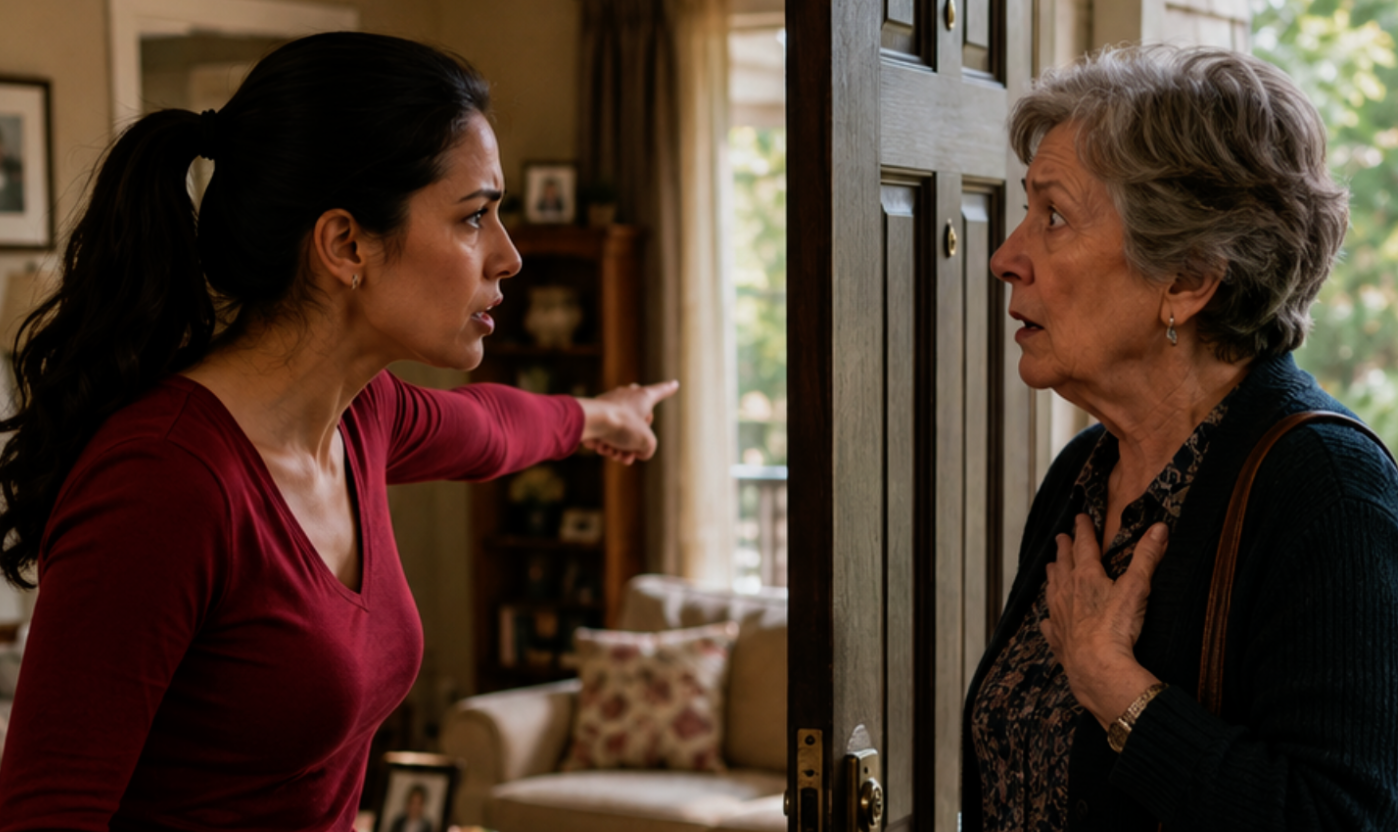
Katya’s voice rang out so sharply that the crystal vase on the shelf trembled—the wedding gift Raisa Pavlovna herself had once chosen “with taste, for the newlyweds.” Her mother-in-law stood in the middle of the living room in a faded-rose-colored robe, staring at her daughter-in-law as though she had suddenly started speaking a foreign language.
“What did you say?” she asked again, and her voice trembled not with fear, but with outrage. How dare anyone speak to her—the woman who considered herself in charge—like that?
“I said you’re the one who doesn’t belong here anymore. Pack your things.”
Kirill froze by the window, his phone in his hand. Only seconds earlier, he had been saying something entirely different to his mother—in a quiet, conspiratorial tone used by people who are certain no one can hear them.
Katya had heard.
Every word had struck her like a shard of glass, and now she stood in front of both of them, furious, indignant, and no longer capable of staying silent.
“Katyusha, you don’t understand,” Raisa Pavlovna began, taking a step forward and stretching out her hands in that particular maternal gesture that was supposed to signal reconciliation but actually meant, “Give me time and I’ll arrange everything my way.”
“I understand perfectly,” Katya snapped. “Better than you think.”
And to understand how things had reached this moment—the ringing vase, Kirill’s pale face, and the fact that the mother-in-law who had settled into their home so firmly it was as though the apartment belonged to her was suddenly hearing those words—we have to go back several months.
Back to the time when everything began with the happy anticipation of receiving the keys to their new two-room apartment.
Katya and Kirill registered their marriage in the spring, and almost immediately took out a mortgage. They did it without much hesitation, carried along by the optimism of youth and convinced that together they could handle any amount of debt and any number of years of repayments.
The apartment was small and bright, on the outskirts of the city, but it had two rooms.
The day they received the keys, Katya walked through the empty rooms, pressing her palms against the cold walls and thinking:
This is it.
The beginning of our real life.
The first few months were spent furnishing the apartment. They chose wallpaper, argued about the color of the curtains, assembled furniture together in the evenings after work, laughed when Kirill couldn’t tighten the final screw, and slept in a bed pushed against the wall because the other half of the bedroom set still hadn’t been delivered.
Katya was happy with that simple domestic happiness familiar to anyone furnishing a home of their own for the first time.
Then Raisa Pavlovna called.
“Kiryushenka, I have news for you,” her mother-in-law said. Her voice on the phone always sounded cheerful, as though she were permanently preparing to announce something wonderful. “I’m selling the dacha. I’ll give you the money. You can put it toward the apartment, at least pay off part of the mortgage early. There’s no point in me sitting there alone anymore. I’m getting older, the vegetable garden is difficult for me, and you need the help.”
Kirill was genuinely delighted.
Katya was pleased too, although she felt a faint sense of unease that she couldn’t quite explain even to herself.
The dacha was old and inconvenient, with few amenities. Raisa Pavlovna had inherited it from her late husband’s parents.
Selling it seemed perfectly reasonable. The money could be put to good use, and her mother-in-law would have fewer responsibilities.
The sale went through quickly.
Raisa Pavlovna received a decent sum for the dacha, and part of it really did go toward an early repayment on their mortgage.
Kirill was moved almost to tears. His mother had sacrificed her own little corner of the world for them—her garden beds, her summer evenings sitting on the porch.
“Mom is going to stay with us for a while,” he told Katya one evening without looking her in the eyes. “Until she decides what to do next. She doesn’t really have anywhere to live right now. The dacha is sold, and she rents out her apartment in Kuzminki. That rent supplements her pension. You understand—teachers don’t exactly get huge pensions.”
Katya nodded.
It was difficult to object. The logic seemed undeniable.
His mother had given her savings to her children. Refusing her a roof over her head, at least temporarily, would have seemed ungrateful.
But “temporarily” stretched into months.
Raisa Pavlovna moved in with all her belongings—china sets, plush blankets, framed photographs of Kirill as a baby and later as a first-grader holding a bouquet of gladioli almost taller than he was.
She arranged the photographs on the living-room shelves without asking whether Katya liked them there.
She rearranged the bathroom towels “the proper way, because it’s more convenient.”
She developed a habit of cooking breakfast for everyone, even when Katya got up first and had already made herself toast.
“My son doesn’t eat food like that,” she would say, placing a bowl of porridge on the table while Katya was finishing her yogurt. “He needs something hot in the morning, not this silly city nonsense.”
At first, Katya tolerated it.
She told herself that her mother-in-law meant well, that older generations had their own habits, and that she had to show respect.
But the rules multiplied imperceptibly, like cracks spreading across a ceiling. First there was one thin line, then a web of fractures, and eventually a chunk of plaster came crashing down onto your head.
Raisa Pavlovna began lecturing Katya about how a household should be managed, which laundry detergent was good and which was “nothing but chemicals.”
She criticized Katya for coming home too late from work and spending too much time with her friends. A good wife, she said, should be at home waiting for her husband.
“That’s how things were done in our family,” she repeated with a smile containing not the slightest hint of irony—only absolute confidence that she was right.
Kirill tried not to interfere.
He loved his mother and he loved his wife, and that divided loyalty turned him into a man who always lowered his eyes precisely when he needed to take someone’s side.
Katya noticed this weakness in him, and it made her angry—not so much at her mother-in-law as at her husband, who allowed his mother to run their home as if it belonged to her.
“Kirill, this is our apartment,” Katya whispered to him at night so Raisa Pavlovna wouldn’t hear them through the thin wall. “We bought it. We’re paying the mortgage. Why does your mother get to decide which curtains we hang and what I should cook?”
“She helped us financially, Kat,” he replied wearily. “I can’t just throw her out. Give it some time. She’ll move out herself once she figures out what she wants to do.”
But Raisa Pavlovna was in no hurry to figure anything out.
The tenants in her Kuzminki apartment paid regularly, kept the place tidy, and caused no problems. She had no intention of giving up that source of income.
And she liked her children’s bright, newly renovated two-room apartment far more than her own run-down Khrushchev-era flat with cracked pipes and alcoholic neighbors on the other side of the wall.
Katya felt herself slowly but inevitably losing control over her own life.
She would come home and barely recognize her apartment.
One day the curtains were different.
Another day the dishes had been rearranged.
New groceries appeared in the refrigerator—things Katya hadn’t bought—while the food she had purchased mysteriously disappeared.
Raisa Pavlovna was settling in so thoroughly that Katya sometimes caught herself wondering:
Who exactly is the mistress of this house?
Katya overheard the conversation that changed everything entirely by accident.
She returned home from work earlier than usual because an evening meeting had been canceled.
She quietly opened the front door out of habit, not wanting to wake her mother-in-law if she happened to be sleeping during the day, and heard voices coming from the living room.
Kirill and his mother were sitting at the table.
There was a particular tension in the air—the kind that always precedes an important and unpleasant conversation.
“Son, you need to understand me properly,” Raisa Pavlovna was saying quietly but insistently. “I don’t wish you any harm. I want things to be good for you. But it isn’t going to work out with that girl. I can see it. Your personalities just aren’t compatible.”
“Mom, we’ve only been married for a year,” Kirill said wearily.
But he wasn’t really objecting. He seemed to be resisting only halfheartedly.
“A year is long enough to understand these things. Listen to what I’ve thought of. You two get divorced quietly, without any scandals. You exchange or divide the apartment—she takes her share, you take yours. Then I’ll recover through the courts the money I invested in your mortgage. A lawyer I know already explained everything to me. I have proof that I contributed money. Then I’ll buy another dacha—not some rundown shack like the old one, but a better place, with a sauna. And we’ll have everything we want—you, me, the dacha. Later you can buy yourself another apartment too, without all these burdens and without strangers living in the house.”
Katya froze in the hallway.
Her handbag slipped from her hand and landed softly on the floor.
She didn’t even notice.
“What about your place in Kuzminki?” Kirill asked almost inaudibly.
“I’ll keep renting it out, obviously. I’ll have the income, the dacha, you’ll have your apartment, and we’ll be a family again, just as we’re supposed to be. Without strangers.”
Strangers.
That word, directed at her—at Katya—hurt more than anything else.
A year of marriage.
A mortgage they shared.
Dreams of building a home together.
And apparently, throughout all of it, this woman had never considered Katya a daughter-in-law.
She had been nothing more than a temporary, unnecessary element in someone else’s plan—something that could be removed once it became inconvenient.
Katya didn’t stop to think.
She didn’t give herself even a second to choose her words.
She stepped into the living room.
“You’re the one who doesn’t belong here anymore!” she shouted, looking straight into her mother-in-law’s face.
Raisa Pavlovna flinched and turned around.
For an instant, something resembling fear appeared on her face, but it was immediately replaced by outrage—the offended expression of a person accustomed to giving orders and completely unaccustomed to being contradicted.
“Katyusha, you don’t understand,” she began, rising and extending her hands in a conciliatory gesture.
“I understand perfectly,” Katya said without taking a single step backward. “Better than you think.”
Kirill stood by the window, pale as though all the blood had drained from his face.
The phone in his hand stubbornly remained silent. It didn’t ring, didn’t give him a distraction, didn’t offer him an excuse to escape responsibility for the fact that he had sat there listening to his mother’s plan without stopping her at the very first sentence.
“Kirill,” Katya said, turning toward her husband. Her voice shook, but not from weakness—from rage demanding release. “Did you hear what she was suggesting? Divorcing me so you can keep the apartment and she can get another dacha? And you said nothing. You just sat there listening while your mother divided up my life as though I were a piece of furniture that could simply be thrown out.”
“Katya, I…” he began.
But the words became stuck somewhere halfway out.
“You didn’t say anything to her!” Katya shouted.
That cry contained all the pain accumulated over the previous months—the rearranged furniture, the unwanted breakfasts, the lectures about laundry detergent, the чужие photographs filling the shelves of their shared apartment, and now this final and most terrible betrayal, spoken behind her back in her own home.
Raisa Pavlovna tried to regain control of the situation, as she always did whenever she felt the ground slipping away beneath her feet.
“Katya, you misunderstood,” she said with artificial gentleness. “I was simply thinking out loud about what might happen if things didn’t work out between you. A mother has to look after her son, just in case.”
“Just in case?” Katya gave a bitter laugh. “You invested the money from your dacha into our mortgage, and now you want to recover it through the courts, divorce us, and buy yourself a better dacha? That isn’t concern, Raisa Pavlovna. That’s a plan to make sure you come out with everything while sacrificing me like a pawn.”
Silence hung in the room, heavy and suffocating, like the air before a thunderstorm.
Kirill finally forced himself to speak.
“Mom, did you really say that? Everything Katya heard?”
Raisa Pavlovna remained silent.
And that silence was more revealing than any answer.
“I want what’s best for both of you,” she finally managed to say. “I just see that you’re constantly arguing over little things, and I thought…”
“Little things?” Katya interrupted. “You rearrange our furniture, cook food I never asked you to make, tell me how I should live with my own husband—and you call those little things? You decided this apartment was your territory and that I was only a temporary guest who could be thrown out whenever a more convenient arrangement came along.”
Kirill walked toward his mother.
There was something decisive in his movement, an effort Katya hadn’t seen from him in a long time.
“Mom, you can’t behave like this,” he said quietly but firmly. “I love Katya. I’m not going to divorce her so you can get your dacha back.”
“Kiryusha, you don’t understand. I’m thinking about you…”
“I understand. You were thinking about yourself. About having the apartment, a dacha, and rental income from Kuzminki. You didn’t think about Katya and me at all.”
Raisa Pavlovna opened her mouth to argue but could find no words.
For the first time in a long while, her son was looking at her not as an unquestionable authority, but as a person who had made a serious mistake.
And then Katya said what she had really entered the room to say.
She wouldn’t allow the conversation to continue.
She wouldn’t give her mother-in-law time to persuade her son, invent new arguments, or build a new defense.
“You’re the one who doesn’t belong here anymore. Pack your things, Raisa Pavlovna. Today.”
“This is my home too!” her mother-in-law burst out, losing the last of her composure. “I put money into it!”
“Money that we never asked you to return because you gave it voluntarily, as a gift,” Katya said more calmly now, which only made her words sound more forceful. “If you want to go to court, go to court. But you will not live here while scheming behind my back and destroying my marriage from the inside. Never again.”
Kirill remained silent.
He didn’t try to soften what was happening.
He didn’t step forward to defend his mother.
That silence became the strongest argument of all.
His mother understood that, on this particular issue, her son was not on her side—and that continuing to resist would only make her position worse.
Raisa Pavlovna moved out a week later.
She packed her china sets, plush blankets, and framed photographs of Kirill as a baby and as a first-grader in silence, making no attempt to conceal her resentment.
The tenants in her Kuzminki apartment weren’t particularly happy to learn they would have to leave, but they understood. Their lease was coming to an end, and the owner had no intention of renewing it.
Returning to the run-down Khrushchev-era apartment she herself had rented out for years to supplement her pension felt like a genuine humiliation to Raisa Pavlovna.
The apartment smelled of other tenants, of other people’s lives.
It needed repairs that had been postponed for years.
But she had no other choice.
There was no dacha to return to, and none of the comfortable future she had imagined while constructing her plan for a divorce and division of property.
Kirill called his mother, but her visits to their apartment stopped.
A cold, polite distance developed between him and Raisa Pavlovna—the kind that appears between people when one has betrayed the other’s trust, and the other isn’t ready to forgive completely but isn’t prepared to sever the relationship entirely either.
Katya and Kirill were left alone in their two-room apartment—the same apartment for which they had taken out the mortgage, the same apartment around which they had built their dreams of a shared future.
Gradually, it began to feel like their own space again.
Raisa Pavlovna’s photographs were put away in a box.
The furniture returned to its original places.
The curtains were once again the ones Katya had chosen.
Sometimes, lying in the darkness at night, Katya remembered that moment—the ringing of the vase, her husband’s pale face, her mother-in-law’s offended expression—and thought about how close she and Kirill had come to the edge.
Their marriage could have collapsed like a house of cards because of someone else’s selfish scheme.
But Katya hadn’t allowed it to happen.
She had walked into the room at exactly the right moment, spoken exactly the words that needed to be said, and refused to let her mother-in-law’s destructive influence seep into every corner of their shared home.
“You’re not angry with me because I was so harsh with Mom that day, are you?” Kirill asked her one evening as they washed dishes together, shoulder to shoulder, just as they had during the first few weeks after moving in.
“No,” Katya replied, without regret in her voice. “I’m angry that you didn’t tell her ‘no’ immediately. But I’m glad that eventually you did.”
Kirill embraced her from behind.
There was more warmth in that embrace than there had been during all the months they had lived under the same roof as his mother—a woman who had presented her interference as care while secretly planning to destroy their marriage.
The apartment became their home again.
Without someone else’s rules.
Without unwanted breakfasts.
Without quiet conversations behind their backs in which someone else decided their future.
And although the price of that peace had been high—a damaged relationship with Kirill’s mother and resentment that might never fully disappear—Katya knew she had done the right thing.
Because a home should remain a home for the people who live there through love and trust, not become an arena for someone else’s calculations.