— I’m your wife, not your mother’s personal assistant! If you send me to her one more time, this marriage will end the same way your life in my apartment will!
“Anya, get up. Mom needs the pipes painted. I already bought the paint,” Kirill’s voice, cheerful and irritatingly businesslike, broke the morning silence of the bedroom. He stood in the doorway, already dressed in jeans and a T-shirt, smelling of shower gel and self-satisfaction. A bunch of keys swung from his hand as though he were a construction foreman giving orders to a crew rather than a husband speaking to his wife.
Anna didn’t answer. She simply opened her eyes and stared at the ceiling. This was already the tenth time in less than a month that her morning had begun not with the smell of coffee or plans made together, but with another assignment from the “headquarters” their apartment had become. Headquarters for the “pre-sale renovation” of Galina Ivanovna’s two-room apartment—a project Kirill had enthusiastically dumped onto Anna’s shoulders.
Slowly, with an almost detached grace, she pushed the blanket aside. No rushing, no fuss. Her movements were measured and precise, like those of someone who had already made a decision and was now simply following an internal script. Without saying a word, she walked past her husband, who watched her with a puzzled expression, and disappeared into the bathroom.
Kirill shrugged and went to the kitchen, already anticipating his well-deserved rest. In his head, he was arranging to meet his friends while his endlessly accommodating wife spent the day breathing paint fumes for what he considered the common good.
When Anna entered the kitchen, Kirill was already sprawled on the small sofa with his phone in his hands. On the table stood a can of harsh white paint and a brand-new brush still wrapped in cellophane—a visual summary of what her day was apparently supposed to look like.
Anna ignored both him and the paint. She took her favorite cup from the cabinet, poured beans into the coffee machine, and started it. The room filled with the rich, sharp aroma of freshly brewed espresso.
“What’s taking you so long?” Kirill drawled lazily without looking away from his screen. “Mom’s already waiting. I told her you’d come over first thing in the morning.”
Anna picked up her cup and took a small sip, savoring the bitter, burning taste. She set it on the counter and only then turned toward her husband. Her face was completely calm, almost peaceful.
And that calm was more frightening than any shouting.
“Kirill,” she said quietly and evenly, her voice cutting through the morning silence like a scalpel.
Kirill finally looked up from his phone. There was something new in his wife’s eyes, something cold and steely that he had never seen before.
“What?”
“I’m your wife, not your mother’s personal assistant! If you send me to her one more time, this marriage will end the same way your life in my apartment will!”
Kirill froze.
He stared at her as though his brain had simply stopped processing information. It was like a system error. He had expected anything—pleading, tired sighs, maybe even a small argument—but not this cold, perfectly sharpened ultimatum.
“Have you completely lost your mind?” he finally managed, putting his phone aside. His face slowly began turning red. “You have no conscience! You don’t respect my mother! We’re doing all this for her—for our family!”
Anna took another sip of coffee. She didn’t raise her voice or get drawn into an argument. She simply watched him the way a scientist might observe a chemical reaction in a test tube.
“You’re doing it?” She raised one eyebrow slightly. “I was the one scraping off wallpaper soaked with decades of someone else’s life. I was the one carrying bags of junk down from the storage shelves while you were ‘taking care of things’ with your friends. I was the one washing windows that hadn’t seen a rag since the first Olympics. And you, Kirill, were lying on this very sofa resting. Your contribution was buying the paint and waking me up early.”
She finished her coffee, rinsed the cup, and placed it on the drying rack. Every movement was deliberately calm. Then she glanced at the clock on the wall.
“You have two hours. You can spend them going to your mother’s place and starting to paint the pipes yourself. Or you can spend them finding somewhere else to live. Your time starts now.”
With those words, she left the kitchen, walked into the living room, sat down in her favorite armchair by the window, and opened a book she hadn’t managed to finish for six months.
Everything about her posture made it clear that the conversation was over.
As far as she was concerned, Kirill no longer existed in the room.
Kirill jumped up from the sofa. His face turned crimson. He opened his mouth, ready to unleash accusations of selfishness, ingratitude, and cruelty. He wanted to shout and prove that he was right.
But when he encountered her icy, completely detached gaze directed at the book, the words died in his throat.
He suddenly realized that shouting would be like shouting into empty space.
Anna had built a wall between them, and that wall was stronger than concrete.
In powerless rage, he grabbed his jacket from the coat rack, shoved his feet into his sneakers, and stormed out of the apartment.
He had to show her who was really in charge.
And he had to return with reinforcements.
The smell of the old apartment hit him the moment Kirill turned the key in the lock. It was a thick, stale mixture of dust, dried wood, and something vaguely medicinal. It was the smell of his childhood—and, as he now understood it, the source of his current problems.
Galina Ivanovna met him in the hallway, already wearing her usual flower-patterned housecoat, although her hair was perfectly styled despite it being Saturday morning. Her gaze was sharp and assessing. She studied her son and instantly understood that something had happened.
“What’s wrong? You look terrible,” she said instead of greeting him, letting him inside.
Kirill walked into the kitchen, which was cluttered with stacks of old newspapers and assorted jars, and dropped heavily onto a stool that creaked beneath his weight.
He hadn’t come there to work.
He had come to headquarters—to his only true ally.
“She refused,” he breathed, staring at the peeling linoleum. “Can you imagine? She just refused to go. Made a whole scene.”
Galina Ivanovna silently placed the kettle on the stove. She didn’t fuss or gasp. She behaved like an experienced investigator allowing a suspect to talk so she could later assemble the full picture from his words.
She poured filtered water into a cup, added some tea, and pushed it toward her son.
“Start from the beginning,” she said calmly, although there was steel beneath her voice.
And Kirill began telling the story.
In his version, he was the hero who cared about his mother and the future of the family, while Anna was a selfish rebel who refused to appreciate his efforts. He vividly described how he had bought the paint, how politely he had woken her, and how she had responded to his kindness with icy silence and an unfair ultimatum.
Naturally, he failed to mention that during the entire past month he hadn’t lifted a finger to help and that every dirty job had been done exclusively by his wife.
In his world, those details didn’t matter.
What mattered was the fact that she had rebelled.
“She said you’re my mother, not hers, and that she isn’t your assistant,” he finished bitterly. “And she said if I ask her again, she’ll throw me out of her apartment. Her apartment! Do you understand?”
Galina Ivanovna took a sip from her cup.
The kettle on the stove began to whistle softly.
She stared at the wall, where the faded outline of a long-removed calendar was still visible. Her face showed neither anger nor hurt.
It showed the deep concentration of a strategist evaluating a changed battlefield.
“I see,” she finally said, and those two words carried more weight than any angry speech. “She wasn’t refusing you, son. She was putting me in my place. As if to say that I’ve barged into her happy life at the wrong time with my apartment and my pipes.”
She had skillfully shifted the focus.
This was no longer an argument between husband and wife over household chores.
Now it was a personal attack by Anna against her, Galina Ivanovna.
Kirill immediately embraced that interpretation. It made him feel better. Now he wasn’t merely a husband whose instructions had been ignored—he was a son defending the honor of his insulted mother.
“That’s exactly what I told her! That she doesn’t respect you! And she just sits there reading her book as if I don’t even exist!” His voice began growing louder again.
“Of course you’re right,” Galina Ivanovna said gently but firmly. She stood and turned off the kettle. “But shouting at her is useless. That’s exactly what she wants. She wants you to look like a hysterical fool while she sits there like some calm, sensible queen. We need to handle this differently.”
She looked directly at her son.
There was no maternal sympathy in her eyes.
Only cold calculation.
Selling this apartment was her goal, her project for improving her own life. Anna had gone from being a useful tool to an obstacle.
And obstacles had to be removed.
“We’re going to her place. Right now,” she decided. “Together. And we’ll talk.”
Kirill blinked in confusion.
“Why? She already—”
“Because saying something like that to you when she’s alone with you in her apartment is one thing. Saying it directly to my face, in front of her own husband, is another. We’ll see whether she has the nerve.”
There was flawless, ruthless logic in her plan.
They would arrive together.
A united front.
She would play the role of the unfairly offended elderly woman.
He would be her loyal defender.
They would corner Anna not by shouting, but simply through the weight of their united presence.
Kirill felt a surge of confidence. The fog of confusion in his head disappeared, replaced by anticipation of righteous revenge.
He was no longer alone.
He had a commander.
And together, they had a plan.
He straightened his back.
“Let’s go,” he said firmly.
Galina Ivanovna nodded and slowly headed toward her room to exchange her housecoat for battle attire—a strict dress and cardigan.
She wasn’t preparing for reconciliation.
She was preparing for an invasion.
The doorbell rang exactly one hour and twenty minutes later.
It was sharp and demanding, designed to make someone jump, worry, and rush to answer.
Anna didn’t jump.
She finished reading the page, carefully placed a bookmark inside the book, and set it on the armrest.
She knew who was outside.
And she knew he wouldn’t be alone.
Their predictability stripped the visit of any surprise, turning what they imagined would be a dramatic confrontation into a rehearsed, rather pathetic performance.
Anna walked calmly to the door and looked through the peephole.
Just as expected, beside Kirill’s flushed, self-righteous face stood the tight-lipped, severe expression of Galina Ivanovna.
She was wearing her best “battle dress,” a dark burgundy outfit, and staring straight ahead as if posing for a portrait of a grieving yet unbreakable mother.
Anna silently turned the lock and opened the door.
She didn’t say a word.
She simply stepped farther into the hallway, allowing them to enter.
That silent invitation disarmed them more effectively than any hostile greeting could have.
Kirill stepped inside first, carrying himself like the master of the house returning to restore order.
Behind him came Galina Ivanovna, moving with the dignity of an offended duchess.
Anna gently closed the door behind them without slamming it.
The trap had shut.
They simply didn’t understand it yet.
“Hello, Anya dear,” Galina Ivanovna began as soon as they entered the living room. Her voice contained a carefully measured mixture of sympathy and reproach. She looked Anna up and down. “You don’t look very well. You must be tired. Kirill and I are worried about you.”
That was the first shot.
A flanking maneuver.
An attempt to portray Anna as unhealthy, exhausted, and therefore perhaps not entirely rational in her decisions.
Kirill immediately joined in, crossing his arms.
“I told you you were pushing yourself too hard. Mom came to support you. And you…”
Anna calmly shifted her clear gaze toward her mother-in-law.
Every part of her posture radiated composure.
She had no intention of justifying herself or defending herself.
“I’m fine, Galina Ivanovna. Thank you for your concern.”
Those few simple words, spoken in an even tone, completely destroyed their carefully prepared performance.
They had expected excuses, complaints, emotions.
They received nothing.
Galina Ivanovna lost her rhythm for a fraction of a second, but quickly found another angle of attack.
“You see, we thought this was something we were all doing together,” she said, gesturing around the room as though somehow including it in her argument. “Helping me, an elderly woman, get everything done. After all, the apartment is part of your future with Kirill too. We want everything to work out well for you both. But the way you behave… it’s as if we’re forcing you.”
That blow was stronger.
An accusation of ingratitude and shortsightedness wrapped in the language of concern for “the family’s future.”
Kirill immediately joined in again, sensing that his mother had found a weak point.
“Yes! We’re not doing all this for strangers! She’s my mother! You should understan
“Anya, get up. Mom needs the pipes painted. I bought the paint,” Kirill’s voice, cheerful and obnoxiously businesslike, burst into the morning silence of the bedroom. He stood in the doorway, already dressed in jeans and a T-shirt, radiating the smell of shower gel and self-satisfaction. A bunch of keys swung from his hand as though he were a foreman giving orders to a work crew rather than a husband speaking to his wife.
Anna did not answer. She simply opened her eyes and stared at the ceiling. This was already the tenth time in less than a month that her morning had begun not with the smell of coffee or plans they had made together, but with another assignment from the “headquarters” their apartment had become. Headquarters for the “pre-sale preparation” of Galina Ivanovna’s two-room apartment—a project Kirill had enthusiastically dumped onto her, Anna’s, shoulders.
image
Slowly, with an almost detached grace, she pushed back the blanket. No hurry, no fuss. Her movements were measured and precise, like those of someone who had already made a decision and was now simply following an internal script. Without a word, she walked past her husband, who watched her with a puzzled expression, and disappeared into the bathroom.
Kirill shrugged and headed to the kitchen, already anticipating his well-deserved day off. In his mind, he was arranging to meet friends while his ever-reliable wife breathed paint fumes for what he considered the common good.
When Anna entered the kitchen, Kirill was already sprawled on the small sofa with his phone in his hands. On the table stood a can of harsh white paint and a new brush still wrapped in cellophane—a visual summary of what her day was supposed to look like.
Anna ignored both him and the paint. She took her favorite cup from the cupboard, poured beans into the coffee machine, and started the program. The room filled with the rich, bitter aroma of freshly brewed espresso.
“What’s taking you so long?” Kirill drawled lazily without looking up from the screen. “Mom’s already waiting. I told her you’d come over first thing this morning.”
Anna picked up the cup and took a small sip, savoring the bitter, scalding taste. She set the cup on the counter and only then turned toward her husband. Her face was perfectly calm, almost serene.
And that calm was more frightening than any shouting.
“Kirill,” she said quietly and evenly, her voice cutting through the morning silence like a scalpel.
Kirill looked up from his phone. There was something new in his wife’s eyes, something steely that he had never seen before.
“What?”
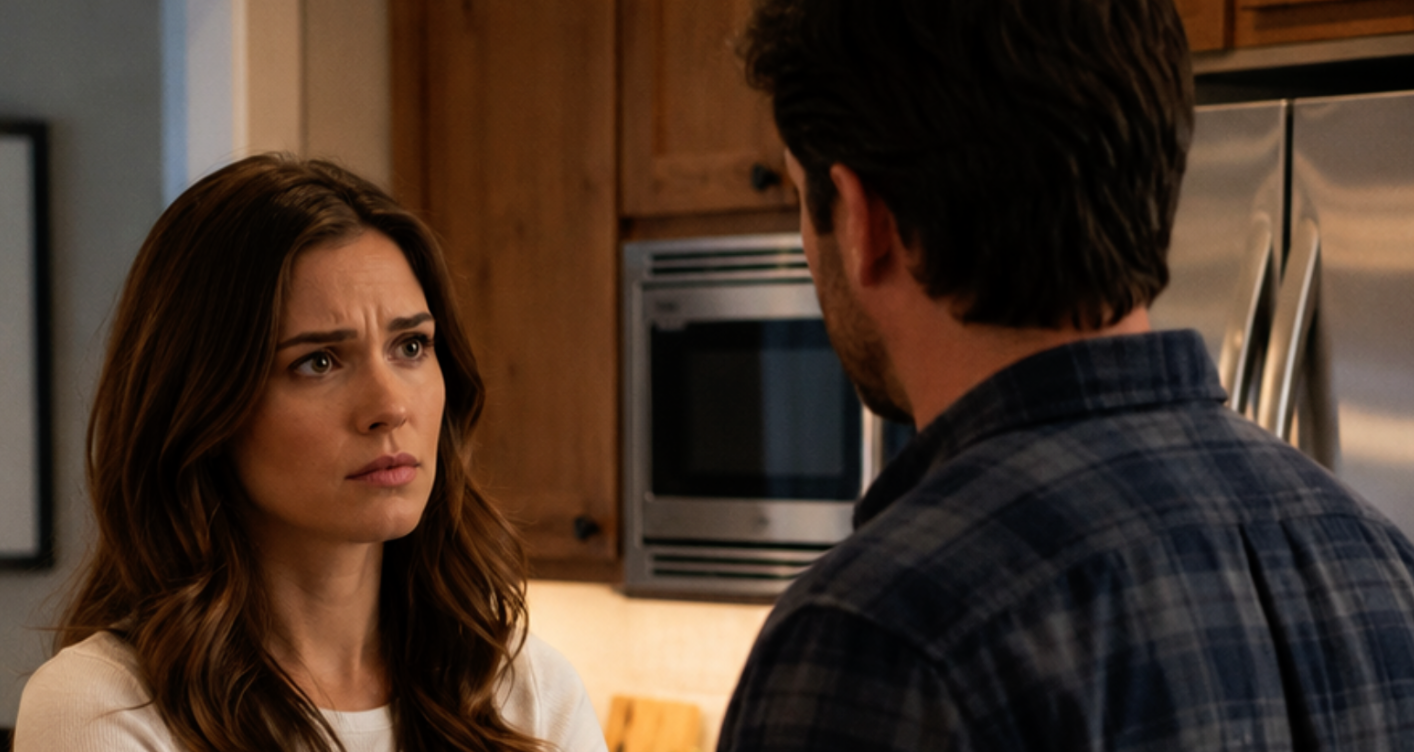
“I’m your wife, not your mother’s personal assistant. If you send me over there one more time, this marriage will end the same way your life in my apartment will.”
Kirill froze. He stared at her, his brain refusing to process what he had just heard. It was like a system malfunction. He had expected anything—pleading, weary sighs, perhaps even a minor argument—but not this cold, polished ultimatum.
“Have you completely lost it?” he finally managed, putting his phone aside. His face slowly began to redden. “You have no conscience! You don’t respect my mother! We’re doing this for her—for our family!”
Anna took another sip of coffee. She did not raise her voice or argue. She merely watched him, the way a scientist observes a chemical reaction in a test tube.
“You’re doing it?” She raised one eyebrow slightly. “I was the one scraping off wallpaper soaked in decades of someone else’s life. I was the one carrying bags of junk down from the storage shelves while you were ‘sorting things out’ with your friends. I was the one washing windows that hadn’t seen a cleaning cloth since the first Olympics. And you, Kirill, were lying right there on that sofa, resting. Your contribution consisted of buying paint and waking me up early.”
She finished her coffee, rinsed the cup, and placed it on the drying rack. Every movement was deliberately calm.
Then she glanced at the clock on the wall.
“You have two hours. You can spend them going to your mother’s and starting to paint the pipes yourself. Or you can spend them finding somewhere else to live. The clock is ticking.”
With that, she walked out of the kitchen, went into the living room, sat in her favorite armchair by the window, and opened a book she had been unable to finish for six months. Her entire posture made it clear that the conversation was over.
As far as she was concerned, he no longer existed in that room.
Kirill jumped up from the sofa. His face turned crimson. He opened his mouth to unleash a stream of accusations about selfishness, ingratitude, and coldheartedness. He wanted to shout, to prove that he was right, but when he encountered her icy, completely detached gaze directed at the book, the words died in his throat.
He suddenly understood that he would be shouting into empty space.
She had erected a wall between them, and that wall was stronger than concrete.
In helpless fury, he grabbed his jacket from the hook, shoved his feet into his sneakers, and stormed out of the apartment. He had to show her who was in charge.
He had to come back with reinforcements.
The smell of the old apartment hit him the moment Kirill turned the key in the lock. It was a thick, stubborn mixture of dust, dried wood, and something faintly medicinal. The smell of his childhood—and, as he now understood it, the source of his current problems.
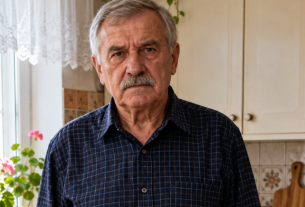
Galina Ivanovna met him in the hallway, wearing her usual flower-patterned housecoat, though her hair was perfectly styled for a Saturday morning. Her gaze was sharp and assessing. She scanned her son and instantly read his condition.
“What happened? You look terrible,” she said instead of greeting him, stepping aside to let him in.
Kirill went into the kitchen, cluttered with stacks of old newspapers and various jars, and dropped heavily onto a stool that creaked under his weight.
He had not come there to work.
He had come to headquarters—to his only true ally.
“She refused,” he breathed, staring at the peeling linoleum. “Can you imagine? She just refused to go. Made a whole scene.”
Galina Ivanovna silently put the kettle on the stove. She did not fuss or gasp. She behaved like an experienced investigator allowing a suspect to talk so she could later assemble the complete picture from his words.
She poured filtered water into a cup, added tea, and slid it toward her son.
“Start from the beginning,” she said calmly, though there was steel beneath her tone.
And Kirill began.
In his version of events, he was the hero caring for his mother and the family’s future, while Anna was the selfish rebel who did not appreciate his efforts. He described in vivid detail how he had bought the paint, how politely he had awakened her, and how she had responded to his concern with icy silence and an unfair ultimatum.
Naturally, he omitted the fact that he had barely lifted a finger to help during the entire past month and that all the dirty work had been done exclusively by his wife.
In his world, those details were irrelevant.
What mattered was her rebellion.
“She said you’re my mother, not hers, and that she’s not your assistant,” he finished bitterly. “And she said that if I ask her again, she’ll throw me out of her apartment. Her apartment! Do you understand?”
Galina Ivanovna took a sip from her cup. The kettle on the stove began to whistle softly. She stared somewhere at the wall, where the faint outline of a long-removed calendar could still be seen.
Her face showed neither anger nor hurt.
It showed the deep concentration of a strategist assessing a changed battlefield.
“I see,” she finally said, and the words carried more weight than any angry tirade. “She wasn’t refusing you, son. She was putting me in my place. As if to say that I, with my apartment and my pipes, have intruded into her happy little life at the wrong time.”
She skillfully shifted the focus.
This was no longer a quarrel between husband and wife over household responsibilities. It was now a personal attack by Anna against her, Galina Ivanovna.
Kirill seized on the idea immediately.
He felt better.
Now he was not merely a husband whose instructions had been ignored. He was a son defending the honor of his insulted mother.
“That’s exactly what I told her! That she doesn’t respect you! And she just sits there reading a book as if I don’t exist!” His voice began to rise again.
“Of course you’re right,” Galina Ivanovna said softly but confidently. She stood and turned off the kettle. “But shouting at her is useless. That’s exactly what she wants. She wants you to look like a hysterical fool while she sits there like some calm, reasonable queen. We need to handle this differently.”
She looked directly at her son.
There was no maternal sympathy in her eyes.
Only cold calculation.
Selling this apartment was her goal, her project for improving her own life. Anna had gone from being a useful tool to becoming an obstacle.
And obstacles had to be removed.
“We’re going to her place. Now,” she decided. “Together. And we’re going to talk.”
Kirill blinked in confusion.
“Why? She…”
“Because saying those things to you alone in her apartment is one thing. Saying them to my face, in front of her own husband, is another. Let’s see if she has enough nerve for that.”
There was flawless, ruthless logic in her plan.
They would arrive together.
A united front.
She would play the role of the unfairly mistreated elderly woman.
He would play her loyal defender.
They would corner Anna not by shouting, but simply through the force of their combined presence.
Kirill felt a surge of strength. The fog of uncertainty in his mind cleared, replaced by the anticipation of righteous revenge.
He was no longer alone.
He had a commander, and together they had a plan.
He straightened his back.
“Let’s go,” he said firmly.
Galina Ivanovna nodded and leisurely headed toward the bedroom to change from her housecoat into her battle attire—a severe dress and cardigan.
She was not preparing for reconciliation.
She was preparing for an invasion.
The doorbell rang exactly one hour and twenty minutes later.
Sharp and demanding, it was designed to make someone jump, become anxious, and rush to the door.
Anna did not jump.
She finished the page she was reading, carefully placed a bookmark inside the book, and set it on the armrest.
She knew who was there.
And she knew he would not be alone.
Their predictability stripped the visit of any element of surprise, turning it from a drama into a pre-rehearsed, if rather pathetic, performance.
She walked calmly to the door and looked through the peephole.
As expected, beside Kirill’s face, flushed with righteous anger, stood the stern, tight-lipped Galina Ivanovna. She was wearing her best “battle” dress, dark burgundy, and staring straight ahead as though posing for a portrait of a grieving yet unbroken mother.
Anna silently turned the lock and opened the door.
She said nothing.
She simply stepped back into the hallway, allowing them to enter.
That silent invitation was more disarming than any hostile shout.
Kirill stepped inside first, carrying himself like the master of the house returning to restore order.
Behind him, with all the dignity of an offended duchess, came Galina Ivanovna.
Anna closed the door smoothly behind them without slamming it.
The trap had closed.
They simply did not understand it yet.
“Hello, Anya dear,” Galina Ivanovna began as soon as they entered the living room. Her voice was saturated with a carefully measured mixture of concern and reproach. She looked Anna up and down. “You don’t look very well. You must be tired. Kirill and I are worried about you.”
That was the first shot.
A flanking maneuver.
An attempt to portray Anna as unhealthy, exhausted, and therefore perhaps not entirely rational in her decisions.
Kirill immediately joined in, folding his arms across his chest.
“I told you that you were pushing yourself too hard. Mom came over to support you, and you…”
Anna turned her calm, clear gaze toward her mother-in-law. Her entire posture expressed composure.
She had no intention of explaining herself or defending herself.
“I’m fine, Galina Ivanovna. Thank you for your concern.”
Two simple sentences, delivered evenly, destroyed their carefully rehearsed opening.
They had expected excuses, complaints, emotions.
They received nothing.
Galina Ivanovna faltered for a fraction of a second before immediately changing her angle of attack.
“We thought this was something we were all doing together,” she said, gesturing around the room as though somehow incorporating it into her argument. “Helping me, an older woman, get everything done. After all, the apartment represents your future with Kirill too. We want things to be good for you. And you act as though we’re forcing you.”
This was a heavier blow.
An accusation of ingratitude and shortsightedness wrapped in concern for “the family’s future.”
Kirill jumped in again, sensing that his mother had found a vulnerable point.
“Exactly! We’re not doing this for strangers! She’s my mother! You should understand that…”
“A shared responsibility,” Anna interrupted without raising her voice, but every word dropped into the silence like a stone.
She looked first at her mother-in-law, then directly at her husband.
“A shared responsibility in which clearing out thirty years’ worth of junk, breathing dust, and scrubbing ingrained dirt somehow falls entirely to me. Meanwhile, your part of this ‘shared responsibility,’ Kirill, consists of lying on the sofa and occasionally asking why I’m working so slowly.”
Kirill flushed.
It was a direct hit, without hints or detours.
The truth, spoken aloud in front of his mother.
“You… you will speak respectfully to my mother!” he shouted, resorting to the only argument he had left—volume.
At that moment, Galina Ivanovna realized the plan was failing.
Direct confrontation clearly put them at a disadvantage.
So she brought out the heavy artillery: the role of the martyr.
She sighed heavily and pressed a hand to her chest.
“Don’t, Kirill dear, don’t shout. I understand everything now. Apparently, I’m burdening you with my problems. I’m not asking for much… I thought at least my son and daughter-in-law would help me, since I’m all alone now. But never mind. I’ll manage. I’ll ask the neighbors, pay someone… I won’t ruin your lives.”
It was a masterful move designed to make Anna feel guilty and ignite Kirill’s fury as his mother’s defender.
And it worked.
Halfway.
Kirill turned toward Anna, his face twisted with rage.
“Did you hear that? Are you happy now? Look what you’ve done to my mother!”
But Anna was looking only at him.
She completely ignored Galina Ivanovna’s performance.
Her calm had turned to ice.
“I gave you two hours, Kirill. That was one hour and forty minutes ago. You have twenty minutes left. You can spend them shouting. Or you can start packing your things. Your choice.”
Anna’s words, spoken without the slightest trace of emotion, landed in the middle of the room and exploded into deafening silence.
Kirill stared at his wife, his mind frantically searching her face for some sign of a bluff, a joke, a passing emotional whim.
There was nothing.
Standing before him was a completely unfamiliar woman who had just pronounced his sentence.
“Twenty minutes?” he repeated, genuine bewilderment in his voice, as though she had suggested he fly to the moon. “You’re giving me a time limit in my own home?”
At that moment, the mask of noble sorrow fell from Galina Ivanovna’s face.
Realizing that her subtle manipulation had shattered against her daughter-in-law’s granite composure, she launched a direct attack. Her voice, previously soft and insinuating, became sharp and shrill.
“Who do you think you are to order him around? You freeloader! He took you in with one suitcase, brought you into his family, and now you’re giving him conditions? I always knew you were empty inside, Anya. Pretty wrapping, nothing underneath. No warmth, no comfort, no respect for your elders. Nothing but arrogance and selfishness.”
“So he took me in with one suitcase… into my own apartment?” Anya gave a humorless laugh.
“What difference does that make? What matters is family! And you can’t even build that! Selfish woman!”
She advanced toward Anna, narrowing the distance, trying to batter through her defenses with words.
Kirill, empowered by such strong support, immediately regained his confidence.
He was no longer alone against her.
Now there were two of them.
“You hear that? Mom is telling you the truth! You never appreciated us! You only thought about yourself! I worked two jobs so you could have everything, and you can’t even help my mother paint a few miserable pipes! Ungrateful woman!”
Their voices blended into a discordant chorus of accusations.
They paced the room, gesticulating, pouring out everything that had accumulated over the years—small grudges, unspoken resentments, hidden envy.
They hurled words at her like stones, waiting for her to break, cry, or start screaming back at them.
But Anna stood motionless like a statue.
She did not answer.
She did not even look at them.
Her gaze remained fixed on the large second hand of the wall clock as it relentlessly counted down the final moments of their life together.
Every word they spoke only confirmed that she had made the right decision.
She looked at the shouting man spraying angry words across the room and could no longer recognize the Kirill she had once married.
All she saw was his mother’s spoiled, petulant son, furious because his toy had refused to obey him.
And beside him stood the woman who had created him, the conductor of this grotesque orchestra, her face distorted with spite.
The second hand completed its final circle.
Time was up.
Anna turned slowly, with an almost unnerving smoothness.
Without saying a word, she walked past them as they froze at her sudden movement and headed toward the front door.
She did not yank the handle or tear the door open.
She simply turned it and opened the door wide, revealing the stairwell beyond.
Then she stood beside it, leaning lightly against the doorframe.
Her posture embodied calm, unyielding banishment.
She said nothing.
She simply waited.
Kirill and Galina Ivanovna fell silent in mid-sentence.
The open door was more eloquent than any words.
This was the end.
Final and irreversible.
“What… what are you doing?” Kirill stammered.
There was no anger left in his voice now, only confusion.
He still could not believe what was happening.
“You think we’re actually going to leave?” Galina Ivanovna challenged, though her confidence had visibly faded.
Anna did not answer.
She simply looked at her mother-in-law’s son.
And in her gaze, he finally read his sentence.
He understood that this was not an argument.
It was an amputation.
“You’ll regret this!” he shouted, grabbing his mother by the arm.
He needed to save face, to walk out with his head held high, even if it was only a pathetic imitation of dignity.
“You’ll come crawling back to me! I’ll return when you’ve calmed down!”
He dragged his mother across the threshold.
Already standing on the landing, he turned around to deliver one final, poisonous remark.
But he never got the chance.
The door closed.
Not loudly.
Not with a slam.
Simply and inevitably.
One lock clicked.
Then came a dull, heavy thud as the massive bolt of the upper lock slid into place.
For a moment, silence reigned.
Then a new sound came from the other side of the door.
A thin, piercing shriek of metal biting into metal.
It was the sound of a power drill.
Kirill froze and listened.
At first, he did not understand.
Then he did.
A chill ran down his spine.
She was not merely locking the door.
She was drilling out the lock cylinder from the inside.
She was not simply preventing him from returning that evening.
She was physically destroying the very possibility that his key would ever fit that door again.
This was not a tantrum.
It was an execution.
Cold, methodical, and absolutely merciless in its finality…