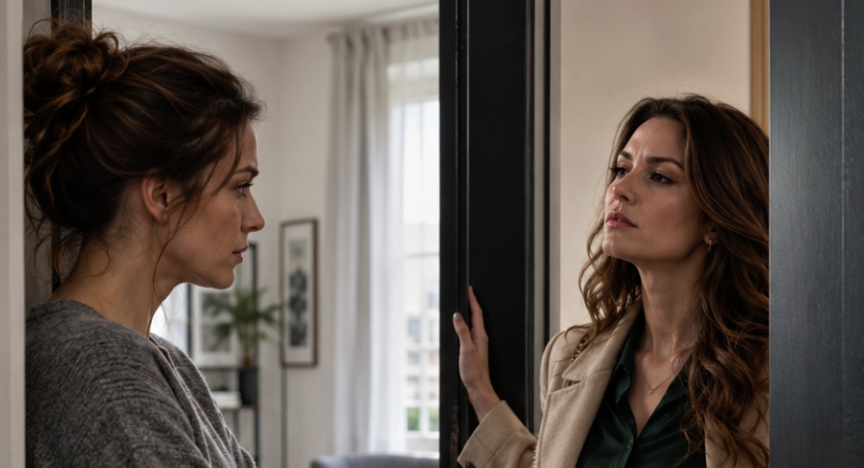
“Valeria, start packing your things. Gleb said that after the divorce, half the apartment will belong to him, and he has given us permission to use his share,” Larisa announced, dragging the first bag into the entryway.
Behind her stood fifteen-year-old Ksenia, carrying a backpack and another travel bag. The girl stared at the floor rather than at Valeria, as if she already understood that her mother had brought her somewhere they were not welcome.
It was a Saturday morning in late August. Valeria had been preparing to go grocery shopping, so she was already wearing jeans and a light jacket. The doorbell rang while she was standing near the mirror in the entryway. She expected to see a courier, but instead found her sister-in-law on the landing, prepared not for a brief conversation but for a full-scale move.
“Are you planning to live here?” Valeria asked.
Larisa adjusted the strap of her bag and looked around purposefully.
“Temporarily. Until Gleb officially registers his half. Then we’ll decide how best to divide the rooms.”
“You’ve already divided them?”
“Of course. Ksyusha and I need two rooms. You can use the small one for now, and then you can find somewhere more suitable.”
Valeria partially closed the front door, preventing Larisa from going any farther than the entryway.
“Where is Gleb now?”
“At Mom’s. He said you might start arguing, so he decided not to come right away.”
Larisa said this without embarrassment, as though Valeria’s husband had merely asked her to collect an order or retrieve some forgotten documents. She placed the second bag beside the first, unzipped her jacket, and reached toward the shoe rack.
“Don’t take your shoes off,” Valeria stopped her.
“What?”
“You’re not staying here.”
Larisa raised her chin.
“Let’s not make a scene. You’re getting divorced. Half the apartment goes to my brother, and he’s allowed us to move in. Everything has already been decided.”
Valeria looked at the two bags, at Ksenia’s tense face, and then at her sister-in-law.
“Wait here.”
She went into the living room and returned a minute later carrying a blue folder. She had prepared it several days earlier and kept it in a cabinet with the other documents she had gathered for the divorce.
The apartment had come into her possession long before Gleb entered her life.
Her grandmother had died when Valeria was twenty-seven. After the funeral, the usual inheritance proceedings began. Valeria submitted the necessary documents to a notary, waited the required six months, received her inheritance certificate, and registered the apartment in her own name.
The three-room apartment was located in an old brick building. It was spacious, but after her grandmother’s death, it required substantial investment. The electrical wiring worked intermittently, the pipes had needed replacing for years, the kitchen cabinets were barely holding together, and the wooden windows let in the cold.
Valeria did not try to finish everything in a single summer. She worked as a food-production technologist and saved money gradually. First, she hired an electrician. The following year, she replaced the pipes and plumbing fixtures. Later, she ordered new windows, doors, and a kitchen.
She paid for every stage herself. She took out no renovation loans and asked none of her relatives for help. Sometimes she had to postpone buying furniture or household appliances, but at least Valeria knew that she owed nobody anything.
She met Gleb six years earlier at a mutual friend’s birthday party. He worked as a technician at a service center, repairing industrial equipment, and could easily find something to discuss even with someone he had just met.
Gleb did not try to impress her with grand promises. He was attentive, arrived on time, remembered their arrangements, and did not offer unsolicited advice.
Eight months later, Valeria suggested that they move in together. By then, Gleb was renting a room from an acquaintance but spending most of the week at her apartment.
Before he moved in, they calmly discussed household matters. Valeria immediately told him that she had inherited the apartment. Gleb replied that he understood perfectly and had no claim to it.
During their first year together, they had no serious conflicts. He paid part of their everyday expenses, bought groceries, and repaired small appliances. Valeria did not treat him like a guest, but neither did she hide the ownership documents.
A year later, they applied at the registry office and were married.
Nothing changed after the wedding. Gleb did not become an owner of the apartment because marriage did not transform his wife’s inherited property into jointly owned marital property. He had known this from the beginning and, for several years, had never pretended otherwise.
The changes began gradually.
At first, Gleb started telling acquaintances:
“Come visit us at our apartment.”
Valeria did not attach any importance to it. In everyday conversation, spouses often referred to the place where they lived as their shared home, even if the documents were registered in only one person’s name.
But then the phrase “our apartment” began appearing more confidently in conversations with his relatives.
“We have three rooms.”
“We don’t live far from the city center.”
“We’ve almost finished the renovations.”
Valeria particularly disliked that last statement. She had completed the main renovations before she even met Gleb. During their years together, he had helped replace a faucet, installed several light fixtures, and once paid to have the washing machine repaired. Calling it a joint renovation was rather bold.
“Why do you talk as though the apartment belongs to both of us?” Valeria asked after another family dinner.
Gleb shrugged.
“We live here together. What am I supposed to call it—your apartment?”
“You can simply say ‘the apartment.’ There’s no need to invent a share that you don’t have.”
“No one is inventing any shares.”
His relatives, however, had already drawn their own conclusions.
Gleb’s older sister, Larisa, became comfortable with the idea especially quickly. She was raising her daughter alone, and the two of them lived in a small studio apartment. There had been enough room when Ksenia was a child, but by her teenage years, sharing the same room had become inconvenient for both of them.
Larisa complained about it whenever they met.
“Ksyusha has nowhere to study. I can’t even turn on the television in the evening. She sits there with her textbooks, gets annoyed, and asks me not to make any noise.”
Valeria sympathized but did not see how she could help. Larisa did not want to exchange her apartment, was afraid to take out a mortgage, and considered renting a larger place a waste of money.
Gradually, her complaints took an unpleasant turn.
“You have three rooms, but only two people live here,” Larisa remarked one day. “One bedroom is almost completely empty.”
“My desk and cabinets are in there,” Valeria replied.
“It’s still a luxury. Some families have three people living in a single room.”
“That isn’t a reason to move them into my home.”
Larisa laughed as if she had heard a good joke, but her expression remained serious.
Several months later, Valeria’s mother-in-law decided to say aloud what Gleb’s family had apparently already been discussing behind Valeria’s back.
They had gathered at Tamara Semyonovna’s home for lunch. She waited until Ksenia had gone to the store before bringing up her daughter’s housing difficulties.
“The girl is growing up. She needs a room of her own.”
“She does,” Valeria agreed.
“That’s what I was thinking. You and Gleb could move into a smaller apartment. The two of you don’t need much space. You could leave this apartment to Larisa and Ksyusha.”
At first, Valeria thought her mother-in-law had made a poor joke. But Tamara Semyonovna continued looking at her expectantly.
“Which apartment exactly are we supposed to leave to Larisa?”
“This one. The three-room apartment.”
“My apartment?”
“Don’t get hung up on words. After the wedding, it became family property. Gleb has the right to make decisions too.”
At that moment, Gleb suddenly became absorbed in his phone. He did not openly support his mother, but neither did he tell her that she was talking nonsense.
Valeria rose from the table.
“There is nothing to discuss.”
“Why are you taking that tone?” Tamara Semyonovna protested. “I suggested a reasonable solution.”
“It only seems reasonable to the people who have decided to solve their problems at my expense.”
On the way home, Gleb said that his mother was merely worried about her granddaughter.
“Then let her help her granddaughter with her own apartment.”
“Mom only has two rooms.”
“Then she can give one of them to Ksenia and move in with Larisa herself. According to your logic, that would be perfectly convenient.”
Gleb frowned.
“There’s no need to be sarcastic.”
“I repeated your mother’s proposal and merely replaced my apartment with hers. Why does it suddenly sound like a bad idea?”
He did not answer.
After that conversation, their relationship deteriorated more rapidly.
Gleb visited his mother more and more often. At first, he helped her with shopping. Then he began staying there until late in the evening. On weekends, he found urgent things to do at his sister’s home or in an acquaintance’s garage. He returned home only to sleep.
Valeria asked several times what was happening.
“Nothing,” he replied. “I’m tired of the constant arguments.”
“We hardly speak.”
“Because every conversation ends up being about the apartment.”
“I wasn’t the one who brought up the subject.”
Gleb would immediately fall silent or leave the room.
This continued for several months. By early August, the spouses had become nothing more than roommates. They made no plans together, rarely had dinner with each other, and never knew in advance where the other would spend the weekend.
One evening, Valeria waited for Gleb to return from his mother’s home and said:
“We need to get divorced.”
He took off his shoes, went into the kitchen, and only then asked:
“Are you sure?”
“Yes.”
Valeria expected a long conversation. After all, they had lived together for more than five years. But Gleb agreed far too quickly.
“All right. If we both agree and don’t have children, we can submit the application through the registry office.”
“When would be convenient for you?”
“We can do it this week.”
He did not ask whether they could save the marriage. He did not suggest living separately for a while. He did not ask what would happen to his belongings or when he should move out.
His calmness seemed suspicious to Valeria.
Two days later, they submitted the divorce application together. Since they had no minor children and did not intend to divide any jointly owned property, they did not need to go to court. They only had to wait for the legally required period before the divorce could be registered.
Gleb continued sleeping at Valeria’s apartment, but he spent almost all his remaining time at his mother’s home.
The reason for his cooperation came to light by accident.
Valeria returned from work earlier than usual. She heard her husband’s voice on the landing before she even opened the door. Gleb was speaking on the phone in the entryway and did not notice the key turning in the lock.
“Mom, don’t worry. After the divorce, half the apartment will be mine. I’ll temporarily give my share to Larisa. She and Ksyusha can live there until she sorts out her situation.”
Valeria stopped behind the door.
“No, Valeria won’t be able to do anything. She’ll have to accept it. After all, we were married for several years.”
He walked into the living room, continuing the conversation.
“Of course the renovations count. I invested money too. She can’t possibly keep everything for herself.”
Valeria closed the door slightly louder than usual.
Gleb immediately ended the call and came into the entryway.
“How long have you been here?”
“I just arrived.”
She walked past him, removed her jacket, and went to wash her hands. She did not ask a single question about the apartment.
Gleb watched her all evening, waiting for a conversation, but Valeria went about her usual business. She had no intention of giving a grown man free lessons in basic property law, especially when he had already disposed of a nonexistent share and promised it to his sister.
The next day, Valeria took out her documents.
The inheritance certificate confirmed the legal basis on which the apartment had become hers. The date of ownership registration was several years before she met Gleb. Her husband had no share in it whatsoever.
Valeria also ordered a recent extract from the property register. It listed her as the sole owner.
She placed the documents in a folder and put it in the cabinet. Then she continued with the divorce proceedings without warning Gleb about his mistake.
Meanwhile, her husband became increasingly confident. He began sorting through his belongings, but removed only his clothes and work tools. He left several boxes in the room, as though he intended to retain access to the apartment even after the divorce.
“When are you taking the rest?” Valeria asked.
“Later. There’s no hurry.”
“You won’t be living here after the divorce.”
Gleb smirked.
“We’ll sort it out.”
“What exactly are you planning to sort out?”
“Don’t start.”
He left for his mother’s home again.
Larisa arrived on Saturday.
Now she stood in the entryway facing the folder of documents, still trying to maintain her businesslike expression.
“What are those papers you brought?” she asked.
Valeria placed the inheritance certificate on the table.
“The apartment passed to me after my grandmother died. I accepted the inheritance and registered my ownership long before I met your brother.”
She placed the recent property-register extract beside it.
“This lists the sole owner.”
Larisa picked up the document and reread the first page several times. Then she turned it over, as though the half her brother had promised her might be recorded on the back.
“But you’re married.”
“For now.”
“Then the property belongs to both of you.”
“An inheritance does not become jointly owned marital property. It wouldn’t matter whether I had received the apartment before or during the marriage. But in my case, it belonged to me before I even met Gleb.”
Larisa looked at the date.
“He renovated this place.”
“The main renovations were finished before he moved in. Paying some everyday expenses and making a few minor repairs does not turn a person into an apartment owner.”
“Gleb told me something different.”
“Then you need to continue this conversation with Gleb.”
Larisa pulled out her phone and immediately called her brother.
“Where are you?” she demanded sharply. “Come to Valeria’s apartment.”
She listened to his reply and raised her voice.
“Because there are documents here! You don’t own half the apartment!”
Ksenia sat down on the edge of the entryway cabinet. The girl looked tired and irritated.
“Mom, I told you we should check everything first.”
“Stay out of this.”
“You made me pack my things this morning.”
Larisa turned away from her daughter and spoke into the phone again.
“No, she’s showing me a property-register extract. It only has her name on it. Come here and deal with this yourself.”
After ending the call, she placed the documents on the table.
“Gleb will be here soon.”
“Wonderful. In the meantime, take your bags out onto the landing.”
“Why?”
“Because I don’t want them standing in my entryway.”
“But we’re already here.”
“I noticed. That doesn’t give you the right to move in.”
Larisa placed her hands on her hips.
“Couldn’t you at least let us stay temporarily? Ksenia really does need a separate room.”
“There is no spare room in my apartment for your family.”
“You have three rooms!”
“And all of them belong to me.”
“You’re going to be living here alone. Why do you need so much space?”
Valeria tilted her head slightly and studied her sister-in-law.
“Why do you need your studio apartment when you could move in with your mother?”
“Mom’s place is cramped.”
“And I don’t want to live with you and your daughter. The only difference is that I don’t arrive at your mother’s apartment with a suitcase and demand that she vacate a room.”
Larisa looked away but did not move the bags.
Gleb arrived twenty minutes later. He let himself in with his key and saw his sister, Ksenia, and the open folder on the table.
“What’s going on here?”
“You’re the one who needs to explain,” Larisa demanded. “You promised me half the apartment.”
Gleb looked at the documents.
“Valeria, why are you doing this in front of a child?”
“I didn’t invite anyone. Your sister brought her daughter along while she tried to evict the owner.”
“No one is evicting you.”
Larisa turned sharply toward her brother.
“I told her to pack her things as soon as I arrived. You said half the apartment would be yours.”
Gleb grimaced.
“I said the matter would be resolved after the divorce.”
“How?” Valeria asked. “Show me a document stating that you own a share.”
“We lived here for several years.”
“That isn’t a document.”
“I contributed to the expenses.”
“You paid part of the utility bills and bought groceries because you lived here. That does not give you ownership rights.”
Gleb pulled out a chair and sat down, even though no one had invited him to make himself comfortable.
“All right. Let’s say the apartment is yours. Larisa has already packed, and Ksyusha has prepared herself for the move. Surely you can let them stay temporarily.”
Ksenia raised her head.
“I didn’t prepare myself for anything. Mom told me everything had already been decided.”
Larisa waved her hand irritably.
“Ksyusha, be quiet.”
Valeria closed the folder.
“No.”
“Why are you saying no immediately?” Gleb asked. “They aren’t strangers.”
“As far as living in my apartment is concerned, they are uninvited occupants.”
“Larisa is in a difficult situation.”
“Then solve it at your own expense.”
“I can’t afford to rent a place for them right now.”
“Then don’t promise them something you don’t own.”
Gleb stood up.
“You could show some compassion.”
“You should have shown some compassion before deciding what to do with someone else’s apartment. You knew I inherited this place from my grandmother. You knew I registered it before we met. Yet you told your mother and sister a convenient fairy tale about owning half of it.”
“I was certain that after several years of marriage, I had a right to it.”
“You could have checked before sending Larisa here with her bags.”
Gleb rubbed his forehead and looked at his sister.
“Larisa, let me take you to Mom’s for now. We’ll figure something out later.”
“Figure out what?” Her face flushed red. “You’ve already figured everything out! I arranged to have the cabinet emptied, warned the neighbor, and Ksyusha unpacked all her things. You told us we would get two rooms.”
Valeria looked at her husband.
“You even assigned them two rooms?”
Gleb did not answer.
“And where were you planning to put me?”
Larisa answered before her brother could.
“We thought you would rent a small apartment for yourself. Gleb was planning to live with Mom anyway.”
The entryway fell silent.
The plan had been worked out in far greater detail than Valeria had imagined. While she was dealing with the official divorce proceedings, her husband’s relatives had already decided which rooms they would occupy, where the owner would go, and how Ksenia’s belongings would be arranged.
Valeria walked to the front door and threw it open.
“Take your bags.”
Gleb frowned.
“Don’t overreact.”
“Your sister came here to evict me from my own apartment, and you came to persuade me to give her two rooms. This conversation is over.”
“We still have to live here until the divorce.”
“You don’t have to wait. You already spend all your time at your mother’s. You’ll take your essential belongings today and collect the rest within the next few days.”
“You can’t simply throw me out.”
“The apartment belongs to me. After what happened, we’re no longer living together. Neither of us wants a scandal, so pack your things calmly.”
Larisa grabbed one of the bags.
“Come on, Ksyusha. We don’t need her rooms.”
“You never had them,” Valeria replied.
Her sister-in-law spun around sharply, but her daughter had already picked up the second bag.
“Mom, let’s go.”
Ksenia was the first to step onto the landing. Larisa followed, continuing to say something to her brother about his promises and her ruined move.
Gleb remained in the entryway.
“Are you satisfied?”
“No. I’m astonished by how confidently the three of you divided up something that didn’t belong to you.”
“I made a mistake.”
“You didn’t merely make a mistake. You decided to give my apartment to your sister first and confront me with it afterward.”
“I thought the law was on my side.”
“Ignorance of the law doesn’t give you the right to dispose of someone else’s property.”
Gleb went into the room and began packing his clothes into a travel bag. Valeria neither helped nor interfered. She stood near the door and made sure he took only his own belongings.
Half an hour later, Gleb carried out the first bag. Then he returned for his tools and a box containing his documents.
“I’ll collect the rest tomorrow.”
“By the evening.”
“I won’t have time.”
“Then come on Monday after work. Let me know beforehand.”
He was about to argue but changed his mind.
Larisa and her daughter were waiting by the car. Gleb placed the bags in the trunk, got behind the wheel, and drove away with them.
Valeria closed the door and checked the entryway. A store receipt that had fallen from Larisa’s bag and one of Ksenia’s plastic hair clips remained on the floor. Valeria put them into a bag with the rest of Gleb’s belongings, which he was supposed to collect later.
Her husband arrived at the agreed time on Monday. He collected his clothes, books, tools, and old computer. Valeria walked through the rooms with him to make sure he did not forget anything.
“Leave your key,” she said at the door.
“The divorce hasn’t been finalized yet.”
“You don’t live here anymore.”
Gleb looked at his keyring, removed the apartment key, and placed it on the cabinet.
“So this is how it ends?”
“It ended when you promised my home to your sister.”
He left without arguing further.
Several weeks later, Valeria and Gleb went to the registry office together to finalize the divorce. They had no minor children together and officially made no claims against each other’s property. The apartment was not part of their jointly acquired marital property and remained Valeria’s.
Gleb moved in with his mother. Larisa refused to speak to him for some time because she had already planned out her new life. She had imagined Ksenia occupying a room of her own, where her bed would go, and what kind of cabinet they would need to buy. Abandoning those plans proved more unpleasant than admitting her own audacity.
After the divorce was finalized, Valeria replaced the cylinder in the front-door lock herself. Although Gleb had returned his key, she did not know whether he had made a copy for his mother or sister.
She had purchased a suitable cylinder in advance. She removed the old one, installed the new one, and tested the keys. She kept one on her keyring and placed the spare with her documents.
None of her former relatives were entitled to a key anymore.
Larisa called once more several days later.
“You could at least let Ksyusha study at your place after school,” she began. “She needs somewhere quiet.”
“No.”
“Are you really that possessive about your rooms?”
“I’m not possessive about my apartment. I simply have no intention of sharing it with people who once came here to evict me.”
“I lost my temper.”
“You arrived with two bags and had already assigned the rooms. That wasn’t some accidental remark.”
Larisa sighed heavily.
“Gleb deceived us.”
“He told you what you wanted to hear. But you could have checked the documents too.”
Valeria ended the conversation after that.
The apartment became peaceful again. Gleb’s belongings had disappeared from the cabinets, his boxes no longer occupied the corner of the room, and his relatives were no longer making plans for someone else’s property.
Her sister-in-law had arrived that Saturday convinced that she was going to evict her former brother’s wife. She had brought her daughter, her bags, and a completed plan for how they would settle in.
But there was no one to evict.
The true owner had no intention of leaving the apartment she had inherited from her grandmother, registered in her own name, and spent years renovating with her own money.
That was why the uninvited prospective occupants were the ones who went home that day.
They left with their bags, their shattered plans, and Gleb’s promise—which had been worthless from the very beginning.