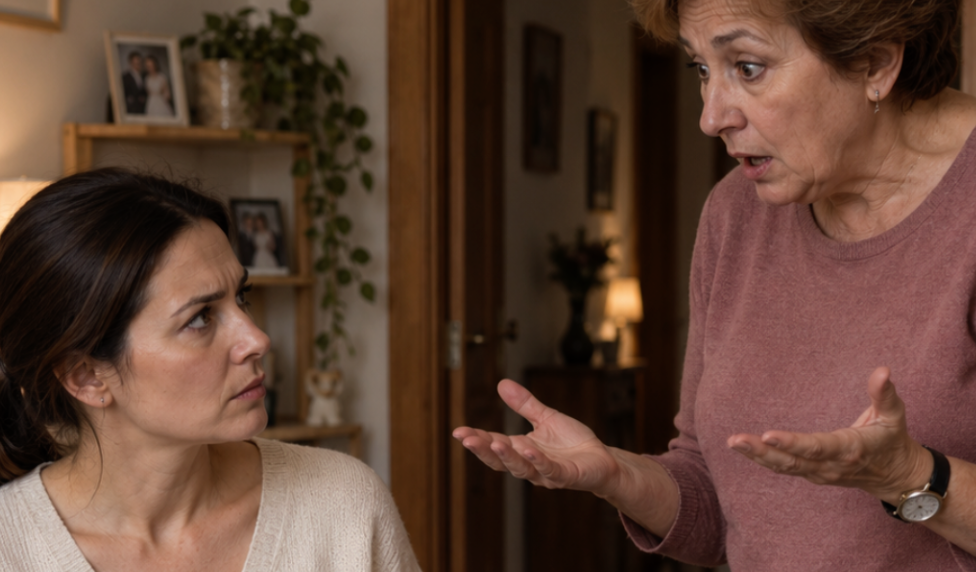
“Fedot, why are my winter clothes in boxes by the front door?”
Valeria spoke quietly, but so clearly that her husband immediately stopped pretending he did not understand the question. She had just returned home after a long day at work and had not even taken off her shoes. Two large cardboard boxes stood in the hallway, almost blocking the passage. The sleeve of her down jacket protruded from one, while a folded note lay on top of the other:
“Winter clothes. You can take them to your new apartment later.”
Valeria read it twice. She immediately recognized Tamara Konstantinovna’s handwriting.
Valeria was not looking for a new apartment. She had never discussed moving, browsed rental listings, or even joked about leaving her own three-bedroom apartment. Instead of unpacking the boxes, she called her husband.
Fedot answered only on the second attempt.
“What boxes?” he asked after a pause.
“The ones your mother packed my clothes into.”
“Oh…”
That drawn-out sound was enough for Valeria to realize that this was not news to him.
“Fedot, speak clearly. What’s going on?”
“Is Mom home?”
“I don’t see her. What is happening?”
Her husband sighed heavily.
“She wanted to talk to you herself.”
“Judging by the boxes, she’s already started the conversation.”
“Val, don’t get worked up.”
“I’m standing in my own hallway asking why someone packed my belongings. Answer me.”
Fedot finally confessed. His mother had decided to remain in their apartment permanently. Tamara Konstantinovna intended to rent out her country house and suggested that her son and daughter-in-law move into a rented apartment closer to work. Supposedly, it would be more convenient for them.
At first, Valeria thought he was joking.
“And what did you tell her?”
“I said I would talk to you.”
Valeria looked at the boxes.
“I see.”
“What do you see?”
“Why she has already packed my things.”
She ended the call before Fedot could ask her not to make a scene.
Tamara Konstantinovna had moved in with them at the beginning of June. At the time, everything had seemed different. The heating system in her country house needed repairs. Pipes had to be replaced, old equipment dismantled, and workers admitted several times.
Fedot had asked Valeria to let his mother stay for a month.
The apartment had three rooms, so there was enough space. Valeria and Fedot used one as their bedroom, another as Valeria’s study, and the third as a guest room.
“I won’t get in your way,” Tamara Konstantinovna promised. “A month will fly by.”
At first, it did.
She woke early, shopped for groceries, occasionally cooked dinner, and spent much of her time visiting a friend who lived nearby. Valeria did not mind having a third person in the apartment.
The problems began when the promised month ended.
The repairs were completed during the first half of July. Fedot personally inspected the house. The heating worked, the debris had been removed, and the damaged flooring had been restored. The house was entirely suitable for living.
Valeria expected her mother-in-law to pack.
Instead, Tamara Konstantinovna said, “I’ll stay here a little longer. The repairman still needs to check something.”
A week later, she found another excuse.
“It’s terribly hot. How can I move all my things in this weather? I’ll go when it cools down.”
Then she explained that it was easier to take care of her business in the city while staying with her son.
Fedot always gave the same answer:
“Let her stay a little longer.”
Valeria initially did not argue. July was hot, and her mother-in-law was not causing serious trouble. Starting a family dispute over a few extra days seemed foolish.
But the days quietly became weeks.
By August, Tamara Konstantinovna no longer looked like a temporary guest.
One day, Valeria came home and discovered three more bags in the guest room.
“What are these?”
“My things.”
“Why did you bring them here?”
“So I don’t have to keep going back and forth.”
Then a small television appeared, followed by boxes of shoes, blankets, a table lamp, and decorations. Tamara Konstantinovna hung some of her clothes in the shared hallway closet.
“Are you planning to return home?” Valeria finally asked.
“Of course.”
“When?”
“When I’ve settled everything.”
She could not explain what still needed to be settled.
Around that time, Valeria overheard her talking to a neighbor.
“I live in Fedya’s three-bedroom apartment now,” Tamara Konstantinovna said. “The city is much more convenient. Shops, the clinic, and public transportation are all nearby.”
The neighbor noticed Valeria first.
“And here comes the owner!”
Tamara Konstantinovna quickly corrected herself.
“Well, I live with Fedya and Lera.”
Valeria said nothing. She thought arguing over one careless phrase would be pointless.
As it turned out, she should have asked what her mother-in-law meant by “Fedya’s apartment.”
The apartment had never belonged to Fedot.
Valeria had purchased it four years before meeting him. She had saved money for years while renting a small one-bedroom apartment. After her grandfather died, she inherited his room in a communal apartment. She eventually sold it and added the proceeds to her savings.
That gave her enough money to buy a good three-bedroom apartment near the subway. She deliberately chose a home large enough that she would not need to move again later.
The property was registered solely in her name. There were no loans, relatives’ shares, or other owners.
Four years later, she met Fedot at a mutual acquaintance’s anniversary celebration. He initially seemed too talkative, but beneath that noisy exterior was a sensible, calm man.
They dated for ten months before he moved into her apartment.
“Let’s avoid the situation where someone arrives with one toothbrush and, a month later, acts as though the apartment belongs to him,” Valeria told him.
Fedot laughed.
“I don’t need what belongs to you.”
At the time, she liked that answer.
They married almost a year later. Fedot had always known who owned the apartment. He had contributed nothing toward its purchase and had no ownership share.
Even Tamara Konstantinovna knew that her son had moved into his wife’s home. However, after the wedding, her wording gradually changed.
First, she said, “I’ll come visit you both.”
Then it became, “I’ll visit Fedya.”
Several years later, she began calling it her son’s apartment.
“Fedya has three rooms. Why would we need a hotel?”
“There’s plenty of space at Fedya’s.”
“Fedya’s apartment isn’t far away.”
Sometimes Valeria corrected her.
“The apartment is mine.”
Her mother-in-law waved dismissively.
“What difference does it make after marriage?”
Valeria once explained that marriage did not transfer ownership from one spouse to another.
“I don’t understand legal technicalities,” Tamara Konstantinovna replied.
Valeria decided not to turn every family gathering into a lecture about property law. What difference did the wording make as long as no one seriously claimed the apartment?
Now, with two boxes by the door, the difference had become obvious.
Valeria carried them back into the bedroom and opened the closet. About a third of her winter clothes were gone. The newly freed space was already filled with Tamara Konstantinovna’s belongings.
Valeria removed her mother-in-law’s clothes, placed them on the bed in the guest room, and returned her own things to the closet.
Then she noticed a measuring tape near the wall and a note on the windowsill.
“Chest of drawers: 126 × 48.”
Valeria read it and gave a bitter smile.
Her mother-in-law was not planning to remain for another week. She was already adapting the apartment for permanent residence.
Tamara Konstantinovna returned around eight in the evening. She let herself in with her key and immediately noticed the boxes beside her room.
“Why did you take everything out again?”
Valeria was sitting in the kitchen.
“First explain why you packed my belongings.”
“Didn’t Fedya tell you?”
“I want to hear it from you.”
“I’ve decided to rent out my house,” Tamara Konstantinovna said calmly. “Why should it stand empty? People look for houses there in summer and winter. It’s more convenient for me here.”
“Here, meaning in my apartment?”
“Lera, stop clinging to that word ‘my.’ You’ve been married for years.”
“Continue.”
“It will be easier for the two of you to find a nice apartment. You can rent something closer to work. You’re always complaining about the commute.”
“I said traffic was worse during the summer.”
“Exactly. So this will be even better.”
She spoke like someone who had found a profitable solution for everyone and could not understand why nobody was thanking her.
“You two can rent somewhere else, and I’ll stay here. Finding a good place is easier for you, while moving back and forth is difficult at my age.”
Valeria stared at her.
“Are you seriously suggesting that I rent an apartment and leave my own home?”
“Don’t be dramatic. Nobody is throwing you into the street.”
“How reassuring to hear that in my own home.”
“You’re starting again.”
The front door closed. Fedot had returned. One look at his wife’s face told him the conversation had begun.
“Let’s discuss this calmly,” he said.
“Your mother is proposing that we move out,” Valeria told him.
“I know what she’s proposing.”
“And?”
“Mom, I told you I would speak to Lera first.”
“I prepared everything so we wouldn’t waste time,” Tamara Konstantinovna replied.
“What exactly did you prepare?” Valeria asked.
“I cleared some space. I was going to bring my chest of drawers tomorrow.”
Fedot noticed the measurements.
“What chest of drawers?”
“Mine. It’s wooden and perfectly good. It will fit beside that wall.”
“Wait a minute,” Valeria said.
Fedot immediately became nervous.
“Val, please don’t make a scene.”
“I’m getting the documents.”
She returned with a folder and placed a recent extract from the Unified State Register of Real Estate in front of her mother-in-law.
“Read the line naming the owner.”
“I’ve seen property documents before.”
“Then it shouldn’t take long.”
Tamara Konstantinovna reluctantly pulled the page closer. After reading it, she returned to the top and stared at the name again.
“Why is only Valeria listed here?” she asked her son.
“Because the apartment belongs to her.”
“How can it belong only to her?”
“She bought it before we met. I’ve told you that countless times.”
“But you’re married.”
“So?”
“Then you don’t own anything here?”
“What do you mean?”
“You don’t have a share?”
“No.”
She turned toward Valeria.
“And after all these years, you haven’t transferred anything to your husband?”
“Was I supposed to?”
“At least part of it.”
“Why?”
“He lives here.”
“You don’t need to give someone half an apartment for them to live in it.”
Fedot raised a hand.
“Mom, enough. I knew everything from the beginning.”
Valeria took back the document.
“So is the question of our moving closed?”
“You reduce everything to paperwork,” Tamara Konstantinovna complained.
“Because we’re discussing an apartment.”
“I’m your husband’s mother!”
“I know.”
“I’m not twenty years old. I can’t keep moving from place to place.”
“You own a house.”
“Outside the city!”
“A house where you lived for years.”
“I want to be closer to my son now.”
“Then come and visit.”
“Can’t you show any respect for your husband’s mother?” Tamara Konstantinovna demanded.
The argument had changed remarkably quickly. Before seeing the document, she had spoken as though she had a right to remain. Now the issue was supposedly respect.
“You’ve lived here since early June,” Valeria said. “It is now the second half of August. For two and a half months, you have occupied a separate room, used the apartment, and stored your belongings here without paying anything. I never rushed you while your house was genuinely being repaired.”
“You make me sound like a lodger.”
“You were a guest, and I treated you like one.”
“Were?”
“Exactly.”
Fedot intervened.
“Let’s not make emotional decisions.”
“I’m perfectly calm,” Valeria replied.
“Can’t we think about it for a few days?”
“Think about whether I should leave an apartment that belongs to me? No. There is nothing to consider.”
“You have a city apartment, so it’s easy for you to talk,” Tamara Konstantinovna said.
“And you have a house.”
“The house could be rented profitably.”
“Excellent idea. Rent it out.”
Her mother-in-law looked pleased, but Valeria continued.
“You have two options. Return to your fully repaired house and live there as before, or rent it out and use the income to rent your own apartment in the city.”
“And what about this apartment?”
“This apartment is not an option.”
“So you’re throwing me out?”
“I’m asking you to end the temporary stay that began in June. The reason for it disappeared long ago.”
“Fedot!”
“Mom, Lera is right about one thing. We agreed on one month.”
“You said you would talk to her!”
“Talking doesn’t mean agreeing. And I was wrong to give you hope. I should have immediately told you that we weren’t moving anywhere.”
“So your mother is a burden now?”
“Nobody said that.”
“You’re telling me to pack and leave!”
“Your house has been ready for a month.”
“I wanted to rent it out.”
“Then rent it and find a place here if you want to live in the city.”
“Why move money from one pocket into another?”
Valeria could not resist.
“But making us pay rent while you collected income from your house and lived here for free made more sense?”
“I haven’t taken anything from you!”
“Today you packed my clothes into boxes.”
Tamara Konstantinovna had no answer.
“You didn’t even ask whether I intended to move. You simply decided the owner would make room for you.”
“I thought Fedot had explained everything.”
“He cannot explain a decision I never made.”
Her mother-in-law went to the guest room and shut the door.
Valeria then turned to her husband.
“Now you explain why your mother thought ‘I’ll talk to Valeria’ meant she could start clearing the closet.”
“I didn’t think she would interpret it that way.”
“How else was she supposed to interpret it?”
“I wanted to buy time.”
“For what?”
“She had been talking about the idea for several days. I told her you wouldn’t agree, but she kept saying it would be more convenient for us to live closer to work and that living alone outside the city was difficult.”
“And once again, you didn’t say no.”
“I didn’t want an argument.”
“So you decided I would have the argument instead.”
“I didn’t think of it that way.”
“That’s exactly what happened. You didn’t refuse her. You promised to speak to me, so she assumed it was almost settled.”
Fedot admitted that arguing with his mother was difficult.
“I don’t enjoy explaining to an adult woman why she cannot evict me from my own apartment either,” Valeria replied.
“Nobody was evicting you.”
“Did you see the boxes?”
He fell silent.
“No more saying, ‘I’ll speak to Valeria,’ when you already know you disagree with something. If your mother proposes something impossible, tell her yourself. Don’t say we’ll see, we’ll discuss it, or you’ll ask your wife. Just say no.”
Fedot nodded.
“You’re right.”
The next morning, Tamara Konstantinovna announced that she could leave the day after next.
“Fine,” Valeria replied.
Her mother-in-law had clearly expected her to soften and ask her to remain another week, but that did not happen.
Over the next two days, Tamara Konstantinovna packed. She had accumulated far more belongings than Valeria realized: three suitcases, boxes of shoes, bags, a television, dishes, documents, and a folding drying rack.
At the door, she stopped.
“Well, are you satisfied?”
“That everything has returned to our original agreement? Yes.”
“I never knew you were so uncompromising.”
“And I never expected to find my clothes packed into boxes.”
After they left, Valeria noticed a key beside the hallway cabinet. Soon afterward, Fedot called.
“Mom apparently had a second set. She says she accidentally made two copies.”
“What do you mean, made?”
“A copy of the key.”
They had given Tamara Konstantinovna one spare key in June, but nobody had authorized her to make additional copies.
“I’ll take both from her,” Fedot said.
“That won’t be necessary.”
“Why?”
“Because I’m changing the lock cylinder today. One unauthorized copy already existed. I have no intention of investigating how many there really are.”
Valeria installed a new cylinder herself and gave Fedot the second key that evening.
“No more copies for your mother.”
“I understand.”
“You don’t trust me?”
“I trust you. I don’t yet trust your ability to refuse your mother in time.”
Fedot smiled involuntarily, then became serious.
“I deserved that.”
They discussed the previous weeks again. Fedot admitted that his mother had repeatedly mentioned moving in. At first, it sounded like a joke:
“Wouldn’t it be nice if I stayed here?”
Then came suggestions about them living closer to work and renting out her house.
Fedot always knew Valeria would refuse, but instead of ending the conversation, he answered evasively. He assumed his mother would forget the idea without immediate encouragement.
The opposite happened. Tamara Konstantinovna interpreted every failure to say no as another step toward agreement.
“She was already measuring the space for her chest of drawers,” Valeria said. “She wasn’t fantasizing. She was preparing. If I had kept quiet to avoid an argument, her furniture would have been here within a week. Two weeks later, she would have asked when we were beginning our apartment search.”
Fedot agreed.
Valeria did not ask him to choose between his wife and mother. She did not forbid him from visiting or helping Tamara Konstantinovna.
But she made one thing perfectly clear.
“You can help your mother as much as you wish—drive her places, buy things, or take care of her house. But nobody is allowed to include my home in that help.”
A week later, Tamara Konstantinovna informed her son that she had decided to remain in her house.
She no longer wanted to rent it out.
The reason was practical: suitable apartments in the city were expensive, and she disliked the cheaper options. She did not want to spend nearly all the income from her house on somebody else’s apartment.
When Fedot told Valeria, she raised an eyebrow.
“How surprising.”
“What?”
“When she had to pay the rent herself, the idea immediately became less attractive.”
Her plan had only been convenient on one condition: other people had to bear the expense. She wanted to collect rent from her country house while living free of charge in her daughter-in-law’s city apartment. Meanwhile, Valeria and Fedot were supposed to pay for rented accommodation elsewhere.
The funniest moment came in September.
Fedot visited his mother to help with a small repair. During lunch, she complained about a friend who had asked to stay for several weeks.
“Can you imagine? She says the room is empty anyway. Why would I want another person in my house?”
Fedot stared at her silently.
“What?”
“Nothing.”
“Why are you smiling?”
“I was just thinking that an empty room doesn’t necessarily mean free accommodation.”
She understood the hint immediately.
“Are you going to remind me of this for the rest of my life?”
“No—if it doesn’t happen again.”
Relations with Tamara Konstantinovna gradually returned to normal. Valeria did not want the August incident to become a lifelong family war. Her mother-in-law could still visit, but she always called first. She no longer stayed overnight unnecessarily, and she had no keys.
The most important change happened not in her, but in Fedot.
One day, his mother suggested storing several boxes in their apartment until winter.
“No, Mom,” he replied immediately. “We aren’t storing them here.”
“At least ask Lera.”
“I won’t. I don’t want our apartment turned into a warehouse.”
Valeria heard the conversation from the next room and said nothing.
That was exactly the answer she had wanted—not because she wanted her husband to become harsh or quarrel with his mother, but because an adult should be able to say no when he already knows his answer instead of hiding behind his spouse.
By the end of August, the two boxes that had started everything were long gone. Valeria’s winter clothes were back in her closet. Tamara Konstantinovna’s chest of drawers remained in the country house. Nobody searched for a new apartment for Valeria or discussed where she should move.
Sometimes she remembered the note:
“Winter clothes. You can take them to your new apartment later.”
What amazed her most was not merely the audacity of the idea, but the confidence with which it had been written. Tamara Konstantinovna had already mentally rented out her house, moved into her son’s three-bedroom apartment, installed her chest of drawers, and sent the married couple away to rent another home.
Her plan would have worked perfectly—except for one small detail.
“Fedot’s three-bedroom apartment” did not belong to Fedot.
The moment the property document bearing the sole owner’s name appeared on the kitchen table, the carefully planned relocation collapsed within minutes.
Tamara Konstantinovna had wanted to earn money from her house while living free of charge in her daughter-in-law’s apartment and forcing its true owner to rent somewhere else. The plan seemed convenient only until the documents appeared and revealed that the one person who definitely did not need a new address had been standing in front of her all along.