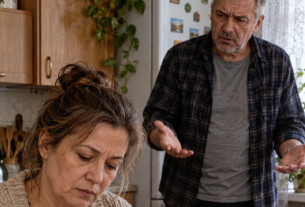
— Who’s this with you? — She looked at Mykhailo, at the chrysanthemums, at her mother’s lipstick. — Have you no shame left? I told you tomorrow there’s no one to watch the kids, and you said, “I can’t, Katya, I have things to do.” Are these your “things”?
* * * *
The dress hung in the closet for nine days before Maria dared to put it on. Dark blue, with long sleeves and a soft drape at the waist. Three thousand six hundred hryvnias. She cut off the price tag that same evening but kept it in her purse for months, as if it were a receipt for something she might have to justify someday.
The last time Maria bought herself new clothes not on sale was when Katya was in fifth grade. That was over twenty years ago. It wasn’t that she didn’t have money; there was always something more important: Katya’s graduation, Katya’s wedding, curtains for Katya’s new apartment, a winter snowsuit for the oldest grandchild.
Maria was a seamstress and had spent her life sewing for others. Skirts for her neighbors, a wedding dress for her goddaughter, bunny and kozachok costumes for her grandchildren. But in all those years, not even an apron for herself.
Now she stood in front of the hallway mirror, with a new hairstyle from the salon across the street, and barely recognized the woman staring back.
— Well, Maria, — she said aloud. — Sixty years old. Too late to be embarrassed now.
She’d bought cherry lipstick just yesterday. Put it on, wiped it off, then put it on again. Her hands were trembling a bit, like a girl before her first dance.
* * *
She met Mykhailo standing in line at the post office in early September. The terminal was down, people were growing anxious, someone asked for the second time if there was any point in waiting. Maria was clutching a receipt for a box: winter boots for her youngest grandson, size twenty-eight. Katya had ordered them and asked her to pick them up because “it’s on your way anyway.”
The man ahead of her turned around. Tall, gray-haired, wearing a checkered cap, with a neatly folded newspaper under his arm.
— Are you in a hurry? — he asked. — Because I’m pretty sure I’m not. Retirement means the line at the post office is now entertainment.
Maria laughed. She didn’t expect that from herself.
By the time it was their turn, Maria already knew his name was Mykhailo, he was sixty-three, he’d spent forty years working as an engineer at a crane-design plant, and that he’d been alone for three years. He knew less about her; mostly, she talked about her grandkids.
When Maria came out with the box, a fine September drizzle was falling. Mykhailo silently took the load from her and carried it to the stop.
— Is that for you? — he nodded at the box.
— For my grandson.
— When was the last time you ordered something for yourself?
Maria opened her mouth and closed it again. She had nothing to say.
He called three days later. Then came walks in the park, chestnuts crunching underfoot, coffee in paper cups by the river, long conversations about everything. Mykhailo listened so well that Maria wanted to keep talking. At the end of September, he said:
— Maria, I’d like to take you to a real restaurant. With tablecloths. This Saturday. But don’t say you have the grandkids.
This Saturday, the grandkids were at her daughter-in-law’s, Vlad’s mom. That only happened once every few months, and for the first time, Maria was glad about it—not for the quiet in her apartment, but for herself.
* * *
The little restaurant was on the riverside. Mykhailo waited at the entrance with a bouquet of chrysanthemums, staring at her so intensely that Maria forgot how to hold her purse.
— You… — he began, but fell silent. — I wanted to say something smart. Didn’t work. You look wonderful.
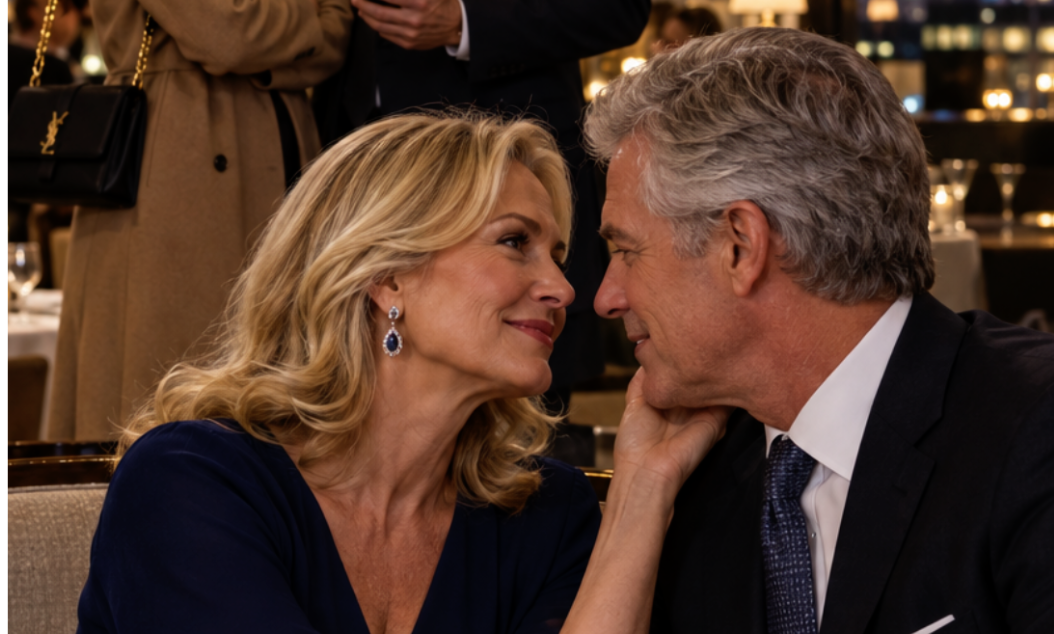
They got a table by the window. Darkness was falling outside, lanterns glimmered on the water. Mykhailo told stories—about a business trip to the south when he lost his suitcase and wore the same shirt for two weeks. Maria laughed so hard the waitress turned around. They ordered fish with roasted vegetables, and he was as happy as a child when warm bread with garlic butter arrived.
Mykhailo had just covered her hand with his when the door opened.
Maria recognized the voice before she saw the face.
— Mom?!
Katya was standing in the middle of the room in a beige coat, Vlad behind her with a phone in hand. They were celebrating Vlad’s promotion. Maria knew; Katya had been bragging since Wednesday. But there were only so many good restaurants in their small town.
Katya walked up to the table, her cheeks splotched red.
— Who’s this with you? — She looked at Mykhailo, the chrysanthemums, her mother’s lipstick. — Have you no shame? On Wednesday I told you I have no one to leave the kids with, and you said, “I can’t, Katya, I have things to do.” These are your things?
— Katya, that’s enough, — Vlad touched her elbow.
— Enough? Mom, at your age you should be taking care of grandkids, not eating in restaurants with men!
Conversations at the next table stopped. Maria stared down at the tablecloth. There was a tiny wine stain there, and she looked at it the way she used to look at a crooked seam: it should be ripped out and redone, but she had no strength left.
All her life, she’d lived for others. First for her husband, gone nine years now. Then for Katya. The last seven years for her grandchildren. Mondays, Wednesdays, Fridays—kindergarten and school. Saturday if Katya and Vlad needed a break. Sunday if Vlad went fishing and Katya had a manicure. Maria never said no. She didn’t even know what that sounded like.
Mykhailo kept his hand over hers. Instead, he gently squeezed her fingers.
— Excuse me, Kateryna, — he said calmly, without a hint of anger. — We haven’t met, so let me introduce myself: Mykhailo. Your mother is not a free babysitter. She’s a woman. And I really hope she’ll be happy.
Katya snorted.
— Oh, so you’ll just take her away? Wonderful. And who will watch the kids then? You?
And then Maria lifted her head…
The dress hung in Maria’s closet for nine days before she finally got the courage to put it on. Deep blue, with long sleeves and a soft drape at the waist. Three thousand six hundred hryvnias. She cut off the price tag that same night, but carried it in her wallet for a long time after, as if it was a receipt for something she’d eventually have to account for.
The last time Maria bought herself something new not on sale was when Katya was in fifth grade. That was more than twenty years ago. It wasn’t really about not having money. There was always something more important: Katya’s graduation, Katya’s wedding, curtains for Katya’s new apartment, a winter snowsuit for the oldest grandchild.
Maria was a seamstress and had spent her whole life sewing for others. Skirts for neighbors, a wedding dress for her goddaughter, bunny and Cossack costumes for her grandchildren. Over all those years, she hadn’t even made herself an apron.
Now she stood in front of the hallway mirror, sporting a brand new hairstyle from the beauty salon across the street, and hardly recognized the woman looking back at her.
«Well, Maria,» she said to herself out loud. «Sixty years old. Too late to be shy now.»
She bought the ripe cherry lipstick just yesterday. Put it on, wiped it off, put it on again. Her hands trembled slightly, like a girl before her first dance.
* * *
She met Mykhailo in line at the post office, at the beginning of September. The terminal wasn’t working, people were getting restless, someone asked for the second time if it was worth waiting at all. Maria was holding a receipt for a box: winter boots for her youngest grandson, size twenty-eight. Katya had ordered them and asked Maria to pick them up, since «it’s on your way anyway.»
The man in front of her turned around. Tall, gray-haired, wearing a checkered cap, with a neatly folded newspaper under his arm.
«Are you in a hurry?» he asked. «Because I don’t think I am anymore. Retirement is when standing in line at the post office becomes your main entertainment.»
Maria laughed. She hadn’t expected that from herself.
By the time their turn came, she already knew his name was Mykhailo, he was sixty-three, had worked forty years as an engineer at a crane design plant, and had been alone for three years. He knew less about her. She mostly talked about her grandchildren.
When Maria left with the box, a fine September drizzle was falling outside. Mykhailo silently took the package from her and carried it to the bus stop.
«Is that for you?» he nodded toward the box.
«For my grandson.»
«And when was the last time you ordered something for yourself?»
Maria opened her mouth and closed it. She didn’t have an answer.
He called three days later. Then came walks in the park, with chestnuts crunching underfoot, coffee in paper cups on a bench by the river, conversations about everything under the sun. Mykhailo could listen in a way that made you want to keep talking. At the end of September, he said:
«Maria, I’d like to invite you to a restaurant. A real one, with tablecloths. This Saturday. And don’t tell me your grandkids need you.»
The grandkids were with Vlad’s mom—her in-law—that Saturday. That only happened once every few months, and for the first time, Maria was happy about it for a reason other than how quiet the apartment would be.
* * *
The little restaurant was on the riverbank. Mykhailo was waiting at the entrance with a bouquet of chrysanthemums, looking at her in a way that made Maria forget how to hold her purse.
«You…» he started and then fell silent. «I wanted to say something clever. Didn’t manage. You look beautiful.»
They were seated at a window table. The evening was getting darker outside, and the lanterns shimmered across the water. Mykhailo shared a story about how he once lost his suitcase while on a business trip down south, and had to wear the same shirt for two weeks. Maria laughed so hard even the waitress glanced over. They ordered fish with roasted vegetables, and he was as delighted as a child when the warm bread with garlic butter arrived.
Mykhailo had just covered her hand with his when the door opened.
Maria recognized the voice before she saw the face.
«Mom?!»
Katya stood in the middle of the restaurant in a beige coat, Vlad behind her with his phone in hand. They were celebrating Vlad’s promotion—Maria knew about it, Katya had been bragging all Wednesday. There were only a handful of good restaurants in their little town.
Katya walked up to their table. Her cheeks were blotched red.
«And who is this with you?» She glanced from Mykhailo to the chrysanthemums to her mother’s lipstick. «Have you no shame left at all? I told you on Wednesday that I’d have no one to leave the kids with tomorrow, and you told me, ‘I can’t, Katya, I have things to do.’ These are your things to do?»
«Katya, lower your voice,» Vlad touched her elbow.
«Lower my voice? Mom, at your age you should be taking care of your grandchildren, not going out to restaurants with men!»
The nearby table fell silent. Maria dropped her eyes to the tablecloth. There was a small wine stain there, and Maria looked at it the way she used to look at a crooked seam: it needs to be ripped out and redone, but she just doesn’t have the strength.
Her whole life she had lived for someone else. First for her husband—gone now for nine years. Then for Katya. The last seven years, for her grandchildren. Monday, Wednesday, Friday—preschool and school runs. Saturday—if Katya and Vlad needed a break. Sunday—if Vlad went fishing and Katya had a nail appointment. Maria never refused. She didn’t even know what that word sounded like.
Mykhailo didn’t move his hand away. Instead, he gently squeezed her fingers.
«Excuse me, Kateryna,» he said, his voice calm, without a hint of anger. «We haven’t met, so let me introduce myself: Mykhailo. Your mother is not a free nanny. She’s a woman. And I very much want her to be happy.»
Katya snorted.
«Oh, so you’re going to take her then? Great. So who’s going to watch the kids? You?»
And at that moment, Maria lifted her head.
She didn’t raise her voice. She simply straightened her back, for the first time in years, and placed her napkin on the table.
«Sit down, Katya.»
Her daughter was so surprised, she sat down. Vlad remained standing.
«Do you remember Olena Borysivna?» Maria asked.
«Which Olena Borysivna?»
«I used to sew costumes for her when you were fourteen. She ran a bridal salon in the city. She saw me making a dress for her daughter and offered me a job. Head seamstress. She promised to pay my first year’s apartment rent, and after three years, she’d let me start my own dress line. I barely slept at night back then. I bought a sketchbook and drew designs for hours.»
Katya said nothing.
«And you cried,» Maria said. «You said you wouldn’t go anywhere, that your friends, your school, your dance club were all here. That I didn’t love you if I made you go. So I turned it down. I sewed workwear at the factory for another twenty years. Gray jackets, Katya. Thousands of the same gray jackets.»
«I… I don’t remember,» Katya said softly.
— I know. And I’m not asking to be remembered. I don’t regret being by your side. But all my life I waited for my turn. And it never just comes—you have to take it.
Maria took a deep breath.
— I love my grandkids. I’ll be with them on Tuesdays and Thursdays. And any day when you truly, honestly need help. But not just because it’s more convenient for you. From now on, Saturdays are mine. On Saturdays, I go on dates.
The silence was so intense, you could hear a plate clink in the kitchen.
Vlad was the first to break the silence. He cleared his throat, put his phone away, and said something Maria didn’t expect:
— Katya. Let’s go. Mom’s right. — He glanced at Mykhailo and gave an awkward nod. — Enjoy your meal. And sorry about us.
Katya stood up in silence. At the door, she turned as if she wanted to say something, but didn’t.
Maria let out a breath and only then noticed her eyes were wet.
— I’m sorry, — she whispered to Mykhailo. — I ruined your evening.
— Ruined? — He smiled. — Maria, I spent forty years calculating how much weight a steel beam could take. And tonight, I saw a person finally set down a burden they’d carried their whole life. I haven’t had a better evening in years.
* * *
Katya called at half past eleven at night. Maria was still awake, sitting in the kitchen with tea, looking at chrysanthemums in a pickle jar—because she couldn’t find a vase big enough in the house.
— Mom, — Katya’s voice was hoarse. — Why didn’t you tell me then? I mean, later, when I grew up?
— Why would I? So you’d feel guilty?
There was a long silence on the other end.
— I feel guilty anyway, — Katya finally said. — Mom… Is he a good man?
Maria smiled into the darkness.
— He carried a shoebox for your little one for me to the bus stop in the rain. And he asked when was the last time I bought something for myself.
— And when was it?
— Last week. A dress.
— The blue one? — Katya suddenly let out a short laugh through tears. — It really suits you! I noticed right away. I just… got angry.
* * *
Not everything changed overnight. But it did change.
Vlad agreed with his mom that she’d take the grandkids one Sunday each month. Katya found an education student through a neighbor, who now picks up the kids from daycare twice a week and takes them out until evening. Turns out, it wasn’t even that expensive—plus, the kids love her because she can make paper boats that don’t sink in puddles.
Tuesday and Thursday remained granny’s days. And Maria noticed something strange: now she looked forward to those days. Because no one dropped the kids off at 7 a.m. anymore with a quick ‘Mom, please help out’.
In November, she took her sewing machine down from the top shelf. Mykhailo cleaned, fixed, and oiled it, telling her it would probably outlast both of them. Maria first sewed herself a simple wool skirt. Then a blouse with a bow. Then the neighbor from the fifth floor saw the blouse and asked for one just like it. Then that neighbor’s friend wanted one too.
The pattern album that had sat at the bottom of a drawer for thirty years now lives on the kitchen table. Next to it is a second cup—for Mykhailo. He visits on Saturdays with coffee and poppy seed rolls, and then they go out together: sometimes to the movies, sometimes just walking along the river. And in spring, they’re planning a trip to the Carpathians.
Last week, Katya came to visit. She arrived without the kids, without any bags, and she wasn’t in a hurry. She sat quietly on a stool, watching her mom fiddle with a piece of tailor’s chalk for a long time before she finally asked, a bit shyly:
«Mom, could you sew me a dress? Like the one you once made for Olena Borysivna. For New Year’s.»
Maria draped the measuring tape around her neck and looked at her daughter over her glasses.
«Of course. Come by on Tuesday for a fitting.»
«Why not Saturday?»
Maria didn’t say anything, just smiled. Katya looked at her, then at the blue dress hanging on the wardrobe door, and smiled, too.
«I get it,» she said. «You’re busy on Saturday.»