Valentyna Stepanivna noticed the dripping faucet on the second day.
It wasn’t running, just dripping steadily and slowly, as if someone was counting in the sink: one, two, three. Underneath, there was a cup with a broken handle to muffle the sound.
“How long has it been like this?” she asked her daughter-in-law.
“Oh, about two weeks now,” Iryna waved her hand. “Vadym says it’s just a five-minute fix, just needs a new gasket. He keeps saying he’ll get around to those ‘five minutes’.”
She laughed, and Valentyna Stepanivna smiled too. But she made a mental note of that cup under the faucet.
* * *
She arrived on Monday, taking the regular bus, with two bags: one filled with treats for the family, the other a gift for her grandson. Nazar would turn nineteen on Friday, and for the first time he’d promised to introduce his girlfriend to his grandma.
“Grandma, just don’t scare her with too many questions,” he laughed over the phone.
At the bus station, Iryna met her. Alone.
“Where’s Vadym?”
“At work, mom, they’re finishing a project and he barely leaves the construction site. But we’ll manage the bags ourselves.”
And they did. Iryna took the heavier bag without asking, and talked the whole way in the mini-bus about the latest news: which neighbor bought an apartment in the new building, how potatoes were cheaper at the market, and how Nazar searched for a present for Zlata and called his mom three times for advice.
Valentyna Stepanivna listened and watched her daughter-in-law. Twenty-six years ago, her son brought home a skinny girl with a long braid and said, “Mom, this is Ira. She makes borscht so good you’ll be asking her for the recipe.” Valentyna Stepanivna pursed her lips in indignation back then. After all, she had spent thirty-two years at the stove in the school cafeteria, and she had no intention of asking a young girl for a recipe.
But then she tasted it—and ended up asking for the recipe anyway. A bit grudgingly, because the borscht really was better than her own.
That’s how they became friends. Whenever Vadym called his mother, Ira would always take the phone—not just for show, but to chat. She’d ask how the garden was doing, whether the wind had broken any currant branches, what’s new with the neighbors. On holidays she’d send homemade sausage in the mail. And when her friends on the bench would start complaining about their daughters-in-law, Valentyna Stepanivna would just shrug:
“I got lucky. I don’t have just a daughter-in-law, but a daughter. She just came through my son.”
* * *
Vadym came home at seven. He kissed his mother on the cheek, asked how her trip was, and sat down at the table.
“Ira, where’s the bread?”
Iryna set the bread on the table.
“Ira, do we have any mustard?”
Iryna brought the mustard.
There was nothing really wrong with this. He wasn’t rude, didn’t raise his voice. He even said “thank you” when she poured him more tea—though he said it to his phone as he scrolled through the news.
Valentyna Stepanivna visited them once a year, if that. That’s why she noticed things that those around every day never did. It’s like with other people’s kids: a mother doesn’t see her own child growing, but the neighbor comes by every few months and exclaims—look how much he’s grown.
Something had changed here, too, while no one was paying attention.
There was a time when Vadym would bring Iryna flowers just because. Valentyna Stepanivna remembered how, in those first years, he’d come running to her with daisies he picked in the field by the river: “Mom, can you give me a jar? Iryna’s still on her shift and they’ll wilt.” Back then, he’d fix everything that squeaked or leaked even before Iryna had a chance to ask. On Sunday mornings, he’d make her cottage cheese pancakes—burnt and lopsided, but he still made them.
Now he only brought flowers on March 8 and on her birthday. The same bouquet from the kiosk by the bus stop, always in cellophane, always the same. The tap had been dripping for two weeks. And Iryna was the one frying pancakes herself at seven in the morning to make it to her shift.
“He’s not a bad man,” thought Valentyna Stepanivna one night, lying on the fold-out couch in the living room. “He’s just gotten used to things. Like that cup under the tap.”
* * *
Iryna worked as a cook in a small restaurant not far from the central park. The menu was simple: borscht, dumplings, potato pancakes with cracklings, and on weekends, they hosted weddings and anniversaries. She’d started there prepping vegetables, peeling onions and carrots, but now she ran the entire hot kitchen. Head chefs changed, owners came and went—yet Iryna stayed. Regulars would even ask the waiters if she was on shift today.
On Wednesday she came in late, acting a little off. She spent a long time washing her hands in the bathroom before sitting at the kitchen table across from her mother-in-law and speaking in a whisper, frequently glancing toward the room where Vadym was watching football:
“Mom, they want me at ‘Panorama.’ A new restaurant by the river, with a glass veranda. As a sous-chef. Their head chef’s been coming to our place for lunch for weeks, and today he said, ‘Mrs. Iryna, I need someone who won’t mess up dumplings.’ Can you imagine? The kitchen’s like from the movies, brand new ovens, all Italian equipment. The responsibility would be completely different—I’d be managing people.”
Her fingers were trembling. Valentyna Stepanivna covered them with her hand.
“What about Vadym?”
“I haven’t told him yet. I’ll tell him at dinner.”
She did tell him at dinner. Vadym listened without looking up from his plate.
“A sous-chef? That’s late hours. And weekends. Are we supposed to eat dinner by ourselves now?” He laughed and slid his plate closer. “Ira, can you give me more potatoes? Seriously, why bother with all that running around? Isn’t it fine here?”
He didn’t say it with anger. It was gentle, like the way you talk to a child who’s wished for a star in the sky. And somehow, that made it feel even worse.
“No, it’s fine,” Iryna said as she got up and gave him more potatoes. “I was just mentioning it.”
She stood at the stove with her back to the table, carefully stirring a sauce no one had asked for anymore.
* * *
On Friday, Nazar and Zlata arrived.
Zlata turned out to be a quiet girl with freckles and big gray eyes. She brought a homemade cake and was so shy about it you’d think she’d brought something inappropriate.
“It kind of sank in the middle,” she explained. “I had to redo the frosting twice.”
“It’s fine,” Nazar muttered. “Zlat, just put it down already. Don’t treat it like a crystal vase.”
Grandma glanced at her grandson. He was already sprawled out on the chair exactly like his father, reaching for the salads:
“Mom, pass the Olivier salad. And why is there so little peas? I told you.”
“Oh, I forgot, son, just a second…”
And Iryna was already getting up.
Meanwhile, Zlata was quietly slicing her own cake and giving herself a shy little smile, since no one had complimented it. Then Valentyna Stepanivna ate a piece and announced loudly to the whole table:
«Zlata, dear, your cream is worthy of a real pastry chef. I haven’t tasted anything like it at a school graduation in thirty years.»
The girl blushed with happiness. Nazar looked at his grandmother in surprise, as if realizing for the first time that someone actually baked the cake.
Small things. But Valentyna Stepanivna knew all too well how those little things can grow. Today it’s just, «pass the Olivier,» tomorrow it’s, «don’t hold it like a vase,» and in about twenty years this freckled girl will be standing by the stove with a ladle, and someone will say, «So, are we supposed to make our own dinner?»
* * *
On Saturday, she tried to talk to her son alone. She followed him out to the garage, where he was sorting through some wires.
«Vadym, why did you treat Iryna like that? About the restaurant.»
«Treat her how?» He honestly didn’t understand. «Mom, I didn’t say anything bad. She knows herself it’s not all sunshine there. She’s fine here, too.»
«Did she tell you she’s fine here?»
«Mom,» he wiped his hands with a rag and smiled that same smile he used as a kid to beg for a second sweet. «Don’t start. We’ve been together twenty-six years. I know her.»
And he left, because his phone rang.
Valentyna Stepanivna was left standing among boxes and old tires. That’s when she realized: alone, he won’t listen. Alone, it’s just a mom-and-son talk, and in those, the son is always right, because the mom always forgives.
She’s leaving on Sunday, and if she doesn’t speak up now, she never will.
She might not be back for a year. And in a year, Iryna will have convinced herself that «she’s fine,» and at «Panorama» they’ll have found someone else.
* * *
For the farewell lunch, Iryna started cooking early in the morning. Stuffed cabbage rolls, because her mother-in-law loved them. Aspic, which had been setting on the balcony since last night. Apple pie. Nazar and Zlata had stayed on from Friday, so everyone was gathered around the table. The bus was at half past five; the bags were already in the hallway.
Vadym tasted the cabbage roll and grimaced—not out of spite, but by habit:
«Ir, why are they so sour? Did you get the wrong cabbage again?»
«No, it’s the same… Maybe I used too much tomato. I’ll go get some sour cream…»
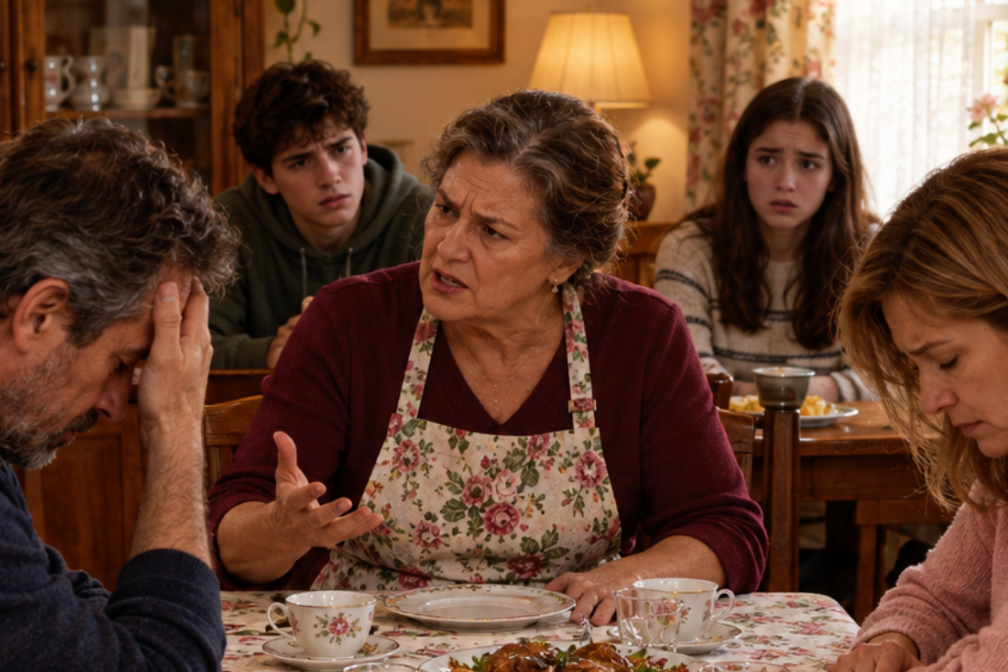
«Iryna, sit down,» Valentyna Stepanivna said.
She didn’t say it loudly, but her daughter-in-law froze before she could stand up.
Her mother-in-law dabbed her lips with a napkin, folded it into quarters, and placed it beside her plate.
«I’m leaving today. So I’ll say this now, because things like this shouldn’t be said over the phone.»
Vadym put down his fork.
«Mom, what is it?»
«Just be quiet for a moment. You’re a good son. I know it, and everyone at this table knows it. You don’t drink, you don’t run around, you bring money home, you raised Nazar. I’ve never been ashamed of you.»
She paused.
«But this week I was.»
The room went so quiet, you could hear the faucet dripping in the kitchen. One, two, three.
«Do you hear that?» she nodded toward the kitchen. «It’s been dripping for two weeks. Vadym, you’re not mean. You’ve just gotten comfortable, like loosening your belt after a holiday feast. You’ve gotten used to bread just appearing on the table, shirts ironing themselves, aspic setting on the balcony all by itself. But it doesn’t—it’s Iryna who was boiling it last night until midnight, after a whole day standing over someone else’s stove. And nobody asked her if she was tired.»
«Mom, but I…»
«When was the last time you brought her flowers? Not for International Women’s Day. Just because.»
Vadym opened his mouth, then closed it again. Iryna stared down at the tablecloth.
«I don’t remember either. But I do remember wild daisies. You used to run to me with them so they wouldn’t wilt. Where did that boy go?»
She turned to her daughter-in-law, her voice growing softer.
«She’s being invited to the best restaurant in town. She cooks so well that another chef came for weeks just to have lunch at her place. And you say: ‘So what, are we supposed to make dinner ourselves?’ Of course, you’ll figure something out! You have hands, and there’s a frying pan. I taught you to fry eggs when you were ten, don’t sell yourself short.»
Nazar snorted with laughter but stopped at once because Grandma turned her gaze on him.
«And you, don’t laugh. Yesterday you poked Zlata twice right in front of me. And you scolded your mom for the peas, even though you’ve never chopped that salad yourself in your life. You think it’s nothing? Well, these small things add up. Your father once thought they didn’t matter either.»
Zlata sat there gripping her napkin, looking at Valentyna Stepanivna as if she had just reached down something very important from a high shelf, something Zlata couldn’t reach herself.
«I’m not scolding you,» Valentyna Stepanivna said more quietly. «You’re all good people. You just got a little too comfortable because life with her is so nice. So you stopped noticing things. But remember, I’m only going to say this once: I won’t let anyone hurt this daughter-in-law of mine. Not even my own son.»
Vadym sat there blushing, red blotches creeping up his neck just like when he was a child caught with a bad grade. He wanted to say something, maybe «you’re overdoing it,» but when he looked at his mother, then at his wife, he stayed silent.
Iryna suddenly laughed softly through her tears and covered her mouth with her hand.
«Mom, why… did you have to do this? In front of everyone.»
«And he says things to you in front of everyone,» replied her mother-in-law. «So he’ll listen in front of everyone, too.»
* * *
That day Nazar did the dishes. All on his own, without reminders. Zlata dried them, the two of them whispered to each other about something, and at one point he seemed to put his arm around her shoulders.
Vadym disappeared for about twenty minutes. He came back with a little bag of pads from the hardware store across the street and quietly crawled under the sink. By five o’clock, the faucet had finally stopped dripping.
Iryna stood in the doorway of the kitchen, listening to the silence as if it were music.
«Ira,» Vadym called out from under the sink, his voice muffled like he was in a well. «Call that chef tomorrow. Say yes. We’ll manage dinner ourselves.»
«I already called,» Iryna replied. «On Thursday. After that dinner.»
Vadym stuck his head out and looked up at her. He looked at her for a long while.
«And?»
«Starting from the first.»
He nodded. Then nodded again.
«Good for you,» he said. And then, barely above a whisper: «I’m sorry.»
* * *
They all went together to the bus station. Vadym carried both bags: his mother’s and an empty one that had once held treats and now had a jar of jellied meat and half a pie that Iryna had packed inside.
Before getting on, Iryna hugged her mother-in-law so tightly that something in the older woman’s back cracked.
«Thank you, Mom.»
«No need to thank me, dear. You’re not just my daughter-in-law—you’re like a daughter to me. And I’d even speak up to my own son if it’s for my daughter.»
The bus drove away. Valentyna Stepanivna looked out the window at the four people standing on the platform until they disappeared around the corner.
Just outside the city, her phone chimed in her bag. A message from Iryna. The photo showed a kitchen table, and on it, a big glass jar filled with pink chrysanthemums, still wrapped in cellophane. The note said: «Bought them at the kiosk while we walked from the bus. He said, just because.»
Valentyna Stepanivna stared at the screen for a while. Then she put the phone away and turned toward the window so her seatmate wouldn’t see her face.
An ordinary bouquet from the kiosk, wrapped in cellophane, just like always. Only this time, it wasn’t for International Women’s Day.