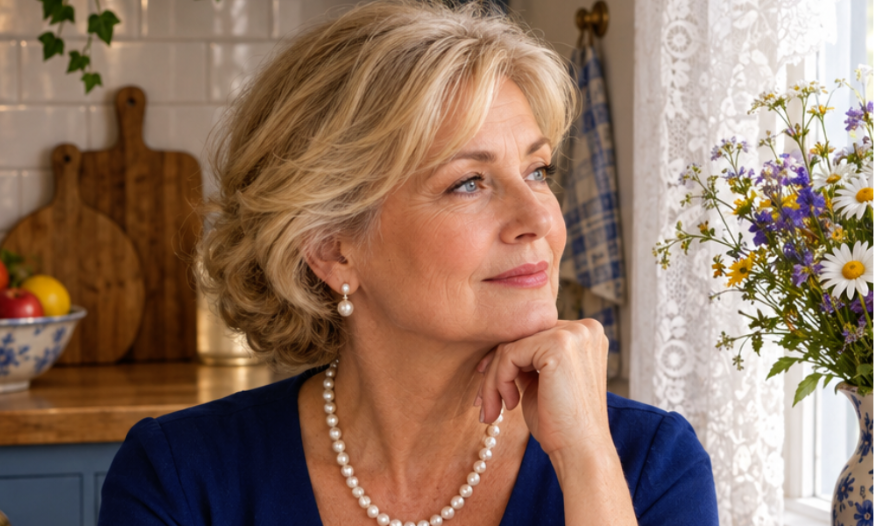
My daughter decided I didn’t belong at her milestone birthday, so I respected her rules and tried to stay out of the way.
She returned the dress on the third day.
She’d bought it on Wednesday—a deep blue one with a tiny button at the collar from the little shop near the bus stop, where the saleslady tells every woman that everything really suits her.
Olha Mykolayivna had spent a long time in front of the mirror, turning so and so, thinking: you can’t show up at your daughter’s 40th in just anything.
Then on Thursday, Veronika called.
She rarely phoned—usually it was just short messages: «how are you,» «did you check your blood pressure?» But this time her voice was energetic, quick, as if already thinking ten steps ahead.
«Mom, let me get straight to it. Some colleagues and I decided to do my birthday at a café—just about twenty people. I realized… you really wouldn’t fit in. It’s a young, loud crowd; it’d be hard for you. Plus, our topics are all work stuff. You’re not offended, right?»
«No, I’m not offended,» Olha Mykolayivna replied. «Celebrate however you like.»
«Are you sure? You sound weird.»
«I’m fine. I’ve got water on the stove.»
There was no water on the stove.
Her voice never wavered. Thirty-two years teaching Ukrainian language and literature, twenty of those as class supervisor—at a parents’ meeting you learn to talk so nobody can tell what’s going on inside.
She ironed that dress that evening, just out of habit—if you buy it, it should hang neatly. But on Saturday, she put it back in the bag, found the receipt—she always kept them, even for socks—and took the minibus to return it to the shop.
«Didn’t fit?» the shopkeeper asked.
«Didn’t fit,» Olha Mykolayivna agreed.
* * *
After that, she stopped being the one to call first.
She used to phone her daughter every two or three days, asking what she cooked, how work was, whether she should bring her some jarred salad—this year the cucumbers were so good, there was nowhere left to store them. Now she asked nothing. Not out of spite, but out of respect for Veronika’s wishes. Or so she told herself. If someone says you don’t belong, you shouldn’t keep popping up.
The birthday was on a Saturday. That morning, almost without realizing it, Olha Mykolayivna took down the mixing bowl and started to knead dough.
She’d baked honey cake for Veronika every year since her daughter turned seven. Eight thin layers, each rolled out on parchment and baked for four minutes—any longer and they’d burn. The cream was only sour cream, never condensed milk, just the way Veronika had liked it as a child. Back then, she’d hover around waiting for the crispy trimmings—the tastiest part.
The cake turned out tall and even. Olha Mykolayivna put it—whole and unsliced—on the top shelf of the fridge. She thought, I’ll bring it on Monday. Then thought: bring it where?
That evening she broke her promise to herself and went on social media. The photos from the café were already posted. A long table, balloons, Veronika in a cream blouse Olha had never seen before. Young faces, wine glasses, someone at the center with a funny hat.
The third photo showed Liudmyla—Ivan’s mother, Veronika’s friend. Sixty-three, laughing among the girls, her hand resting on her cheek.
Olha Mykolayivna stared at that picture for a long time. Then she locked her phone, put it facedown, and went to clean the kitchen window, though it was already spotless.
* * *
Nine days later, Veronika called. It was Sunday, seven in the evening, already dark outside, wind stripping the last chestnut leaves and chasing them among the garages.
«Mom, where have you been?» Veronika greeted her. «I call and call. Don’t you even care how I’m doing?»
«You called once, on Tuesday, and I answered,» Olha replied calmly. «And I don’t call because you said I don’t fit in. I don’t want to be a bother. If you need me, you know my number.»
The line went quiet. Then Veronika sighed:
«Oh, come on, Mom.»
And said she had something boiling on the stove; she’d call back. She didn’t that night, or the next.
* * *
Olha Mykolayivna wouldn’t let herself sit and stew. She knew she had a knack for sorting every moment from the past thirty years, one by one, like picking lentils. So she didn’t.
On Thursday, she went to the district library, where the patchwork club met twice a month. It wasn’t her love of sewing, but it was something to get her out. Neighbor Valentyna Petrivna had once dragged her there, and now came by every time, knocking exactly at 1:30.
That day the women at the table argued over seam allowances, someone brought homemade cookies, someone else finally got their washing machine fixed—and told it like it was a wedding. No one asked about her daughter. She didn’t mention it, either.
Upstairs, one of the neighbors was drilling again—their renovation had been dragging on for three months.
«You’re quiet today,» Valentyna commented on the way home.
«Just tired,» Olha answered. «Got to go to the clinic for a referral tomorrow.»
* * *
Five days later, Veronika called. Olha was zipping her jacket, about to go to the clinic.
«Mom, I miss you,» her daughter said, voice tired and softer than usual. «Can you just talk to me? Not in this ‘I won’t bother you’ mode, but just like a person.»
Olha Mykolayivna took off her jacket and sat on the shoe bench.
«I miss you, too,» she admitted. «But now I don’t know how to talk to you so I don’t end up being the extra again.»
«Extra? No way!» Veronika almost shouted. «I invited coworkers, not family. Who would you have sat with? My department head? The girls talking about their reports all evening?»
«Then who did Liudmyla sit with?»
The pause was long…
She returned the dress on the third day.
She bought it on Wednesday—a deep blue dress with a tiny button up at the collar, in that little shop by the bus stop where the saleswoman tells every woman how lovely she looks. Olga Mykolayivna spent a long time in front of the mirror, turning her shoulders this way and that, thinking: for your own daughter’s 40th birthday, you don’t show up in everyday clothes.
Then, on Thursday, Veronika called.
Her calls were rare; she usually just texted—short and to the point: ‘How are you’, ‘Did you check your blood pressure?’. But this time, it was her voice—cheerful, quick, as if her mind was already jumping ten steps ahead.
‘Mom, I’m calling because… We decided to celebrate my birthday with my coworkers. We’ll rent a room in a café, about twenty people. I thought… you probably wouldn’t fit in. It’s a young, lively crowd, it might be hard for you. And our conversations are all about work stuff. You’re not upset, are you?’
‘I’m not upset,’ Olga Mykolayivna said. ‘Celebrate however you like.’
‘Are you sure? You sound a little off.’
‘I’m fine. I have water on the stove.’
There wasn’t any water on the stove.
Her voice didn’t waver once. Thirty-two years teaching Ukrainian language and literature, twenty of those as a homeroom teacher. At parent-teacher meetings, you learn to speak so that no one guesses what’s really going on inside.
That evening, she ironed the dress. Just out of habit—if you buy something, it should hang straight. But by Saturday she had folded it back into the bag, found the receipt—she always kept receipts, even for socks—and took the minibus back to the shop.
‘It didn’t suit you?’ the saleswoman asked.
‘It didn’t suit me,’ Olga Mykolayivna agreed.
* * *
She stopped calling first.
She used to call her daughter every two or three days. Ask what she cooked, how work was going, if she should bring over a jar of salad since the cucumbers were so plentiful this year there was nowhere left to put them. Now she didn’t ask anything. Not out of resentment, but out of respect for her daughter’s decision—or at least, that’s how she explained it to herself. If someone says you don’t fit in, there’s no point being constantly visible to them.
The birthday fell on a Saturday. That morning, almost without realizing it, Olga Mykolayivna took down a bowl from the shelf and started kneading dough.
She had baked a honey cake for Veronika every year since her daughter turned seven. Eight thin layers, each rolled out on parchment and baked for exactly four minutes—any longer and they’d burn. The cream was sour cream-based, without condensed milk; that’s how her daughter liked it since childhood. When Veronika was little, she would hover by her mother’s elbow, waiting for the crispy trimmings—they were always the tastiest parts.
The cake turned out tall and even. Olga Mykolayivna set it whole, uncut, on the top shelf of the fridge. She thought, I’ll bring it on Monday. And then she thought—who am I really bringing it to?
That evening, she logged into social media, even though she’d promised herself not to. The café photos had already been posted. A long table, balloons, Veronika in a cream blouse her mother had never seen before. Young faces, glasses, someone in the center wearing a silly hat.
And in the third photo—there was Lyudmyla. The mother of Veronika’s friend Ivanka. Sixty-three years old, sitting among the girls, laughing, with her hand propping up her cheek.
Olha Mykolaivna stared at the photo for a long time. Then she locked her phone, placed it face down, and went to clean the kitchen window—even though the window was already spotless.
* * *
Veronika called nine days later. It was Sunday, seven in the evening, already dark outside. The wind was ripping the last leaves off the chestnut trees and tossing them around near the garages.
«Mom, where have you been?» she asked right away. «I keep calling and calling you. Don’t you even care how I’m doing?»
«You called once, on Tuesday, and I answered,» Olha Mykolaivna replied calmly. «And I haven’t been calling because you told me I don’t fit in. I don’t want to get in the way. If you need me—you know my number.»
There was silence on the line. Then Veronika exhaled:
«Wow, Mom. You really know how to surprise me.»
Then she said she had something cooking on the stove and would call back. She didn’t call that evening, nor the next.
* * *
Olha Mykolaivna didn’t let herself sit and overthink things. She knew she had a tendency to recall every tiny detail from the last thirty years and go through them one by one, like sorting buckwheat. So she didn’t let herself do it.
On Thursday, she went to the district library, where a patchwork sewing club met twice a month. She didn’t go because she loved sewing—she went to avoid being cooped up at home. Her neighbor, Valentyna Petrivna, once dragged her there by force, and since then always stopped by for her, ringing the doorbell precisely at one thirty.
That day, the women at the table were having a heated debate about seam allowances, someone brought homemade cookies, someone else finally got their washing machine fixed—and told the story as if it were a wedding. No one asked about her daughter. She didn’t tell anyone anything.
Upstairs, on the second floor, someone was drilling—the neighbors were renovating, and it had been going on for the third month.
«Olha, you’re especially quiet today,» Valentyna Petrivna remarked on the way home.
«I’m just tired,» she replied. «Tomorrow I have to go to the clinic for a prescription.»
* * *
Veronika called again five days later. Olha Mykolaivna was in the hallway, buttoning up her jacket, getting ready to head to that clinic.
«Mom, I’ve missed you,» her daughter said. Her voice was tired, not as lively as usual. «Can you just talk to me? Not in your usual ‘I don’t want to bother you’ mode, but really talk?»
Olha Mykolaivna took off her jacket and sat down on the shoe cabinet.
«I’ve missed you too,» she admitted. «But now I just don’t know how to talk to you without feeling out of place again.»
«Out of place? No way!» Veronika almost shouted. «I invited my coworkers, not my family. Who would you have even talked to there? My department manager? The girls who spend all night talking about reports?»
«Who did Liudmyla talk to, then?»
There was a long pause. Olha Mykolaivna even wondered if the call had dropped.
«She came with Ivanka,» her daughter finally said. «I couldn’t just tell them not to come.»
«But you could say it to me.»
Olha Mykolaivna heard her daughter swallow. And suddenly, she felt sorry—not for herself, but for her.
«Veronika, listen. I never made you the center of my world—I had my job, my friends, my own life. But you were my only one. Your father left long before you ever started school, my own parents have been gone a long time. So when you say ‘you won’t fit in,’ I don’t hear you talking about some café. What I hear is: you don’t fit into my life.»
«That’s not what I meant.»
«I believe you. But the words are already out there. And I can’t un-hear them now.»
They said goodbye calmly. Olga Mykolayivna did end up walking to the park and treating herself to a hot coffee from a kiosk, even though she’d told herself that morning she wouldn’t.
* * *
Veronika showed up on Friday, without any warning.
She was carrying a paper bag with cutout handles. She took off her shoes and set them by the door with the toes pointing out—a habit she’d had since ninth grade, one Olga Mykolayivna could recognize anywhere.
«Here,» her daughter said. «It’s a cake. And don’t tell me you don’t eat sweets. They had one like this at the anniversary and I immediately thought of you.»
Inside the box was a honey cake. Store-bought, with perfectly even layers and a little cream rose on the side. Olga Mykolayivna thanked her and opened the fridge to put the box away.
On the top shelf sat her own cake. Two weeks old. The cream had darkened at the edges, the layers had gone crusty and dry, and the berry she had used as decoration in the center had shriveled up.
Veronika stood behind her, watching everything.
«Mom,» she said in a strange voice, «what’s that?»
«That’s yours,» replied Olga Mykolayivna without turning around. «I baked it on Saturday. Out of habit.»
She closed the fridge door and stood there for a moment, her hand resting on the handle.
When she finally turned around, her daughter was sitting on the stool with her face in her hands. Her shoulders were shaking—silently, the way only adults who are ashamed of their tears cry.
Olga Mykolayivna came over and put her hand gently on her daughter’s head. The hair felt rougher than she remembered, and had a faint smell of hairspray.
«That’s enough,» she said. «Enough, Veronika. I’m not dead.»
«I didn’t know you still baked,» her daughter said through her hands. «I thought… I thought you’d stopped a long time ago.»
«I bake every year.»
«And every year, I don’t come.»
Olga Mykolayivna didn’t reply to that. She put the kettle on and got out two cups.
* * *
That night, they stayed up talking until half past eleven.
Veronika told her she was looking at moving closer to work because traffic in her district made mornings impossible; that someone gave her a gift certificate to a beauty salon for her birthday, but she probably wouldn’t use it, she never does; that the thing that touched her most at the party wasn’t the loud company, but how a quiet girl from accounting got up and said a few words about her—simply, with no big toast.
Olga Mykolayivna listened. She didn’t pry. Just once, out of old teacher’s habit, she corrected Veronika’s pronunciation of the word «vypadok,» and they both laughed, because it was so familiar it almost hurt.
Later her daughter left. She called a taxi, waited in the entryway and, for some reason, didn’t head out right away.
«I’ll call you tomorrow,» she said from the elevator. «Just promise you’ll pick up.»
«I will.»
Olga Mykolayivna went back to the kitchen. She took her old honey cake out and threw it away—plate and all. She left the store-bought one and even ate a slice, standing right there out of the box. It was fine. Sweeter than it needed to be.
* * *
After that, she didn’t change her daughter—she changed herself.
I stopped waiting to see who would call first. Now I have a new rule: every four or five days, I pick up the phone and call myself—to check in about health, about work, and not to keep someone long if they’re busy. Turns out, this feels much more peaceful.
Veronika always answered eagerly, and sometimes she would drag out the conversation herself—telling stories about how her office pass stopped working, or about finally buying a decent hair dryer to replace the old one that sounded like a tractor.
They didn’t bring up the anniversary anymore. Well, except once—when Olha Mykolayivna mentioned that it was once considered bad luck to celebrate turning forty, and her own grandmother Lyuba wouldn’t even let guests in the house on that day.
“Maybe it really is true,” Veronika said on the phone. “Because my anniversary turned out kind of… off.”
* * *
The first snow fell at the beginning of December, on a Sunday. It was wet snow, immediately clumping onto branches in heavy lumps.
At ten in the morning, the doorbell rang. Olha Mykolayivna opened the door—her daughter was standing on the doorstep, wearing a hat, shoulders wet, holding a plastic bag. Inside was a one-liter jar of honey, which, judging by the label, had been bought at the central market.
“Teach me,” Veronika said from the doorway. “I don’t know how many cake layers we need or why yours are so thin when mine always turn out like shoe soles. Teach me, Mom.”
They kneaded the dough together. The daughter moved too quickly, rolled the layers unevenly, and the third layer did, in fact, get a little burnt at the edge. Olha Mykolayivna broke off the burnt bit, shook off the flour, and handed it to her:
«Here. You always loved these best when you were a kid.»
Veronika took it and ate it standing up, just like she did when she was six. Still chewing, looking out the window where the snow was falling, she said:
«I’m taking a three-day vacation in March. Let’s go somewhere. To the Carpathians, or wherever you want. You’ll be my roommate.»
«I’ll think about it,» said Olha Mykolayivna.
She considered it for exactly thirty seconds. But she couldn’t immediately say yes—not because she didn’t want to, but because she wasn’t quite ready inside. To know you’re needed and to feel it are two different things. The first comes with words. The second comes much later—if it ever comes at all.
That day, the honey cake turned out a little wonky. They cut it even before it had time to soak and ate it warm, which definitely wasn’t the way it was supposed to be. Both said it tasted wonderful.