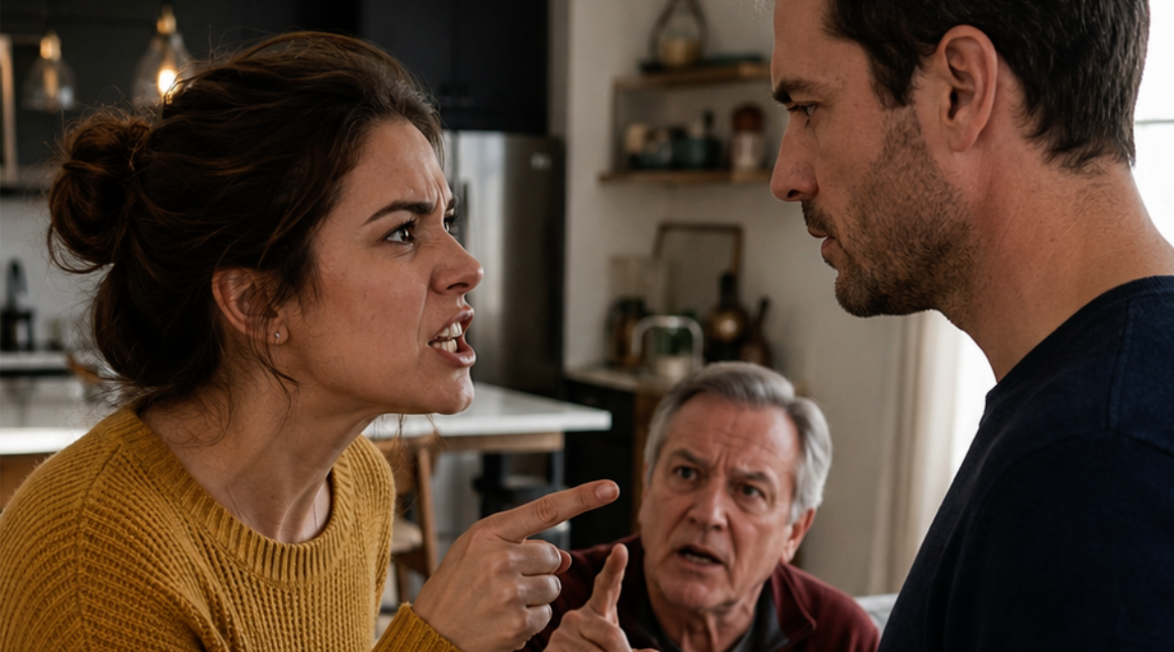
“Sveta, come on, don’t act like a stranger. Dasha won’t be staying long.”
Svetlana would remember those words for a very long time—because Dmitry said them while standing in the entryway beside a wheeled suitcase that had clearly not been packed for a single night. Behind her husband stood his younger sister, Darya, shifting from foot to foot and smiling as though she already knew they were going to let her stay.
Svetlana had not even had time to remove her apron. She had been chopping vegetables in the kitchen for dinner when the lock clicked and the suitcase rolled into the apartment. She put down the knife, wiped her hands, and only then slowly asked:
“What do you mean, she’s going to stay here? For how long?”
“Oh, about three weeks.” Dmitry was already taking off his shoes as though nothing unusual were happening. “They’re sorting something out with her dormitory. She’ll crash here in the meantime.”
Three weeks.
Svetlana looked at the suitcase, then at Darya, then at her husband—and realized that nobody had asked her anything. They had simply presented her with a fact, as casually as placing a plate on the table.
And the apartment was hers. Not in some vague or figurative sense, but literally hers, down to the last square meter.
Svetlana worked as a department head at a large company, specializing in logistics, and earned good money—around two hundred thousand rubles a month, sometimes more with bonuses. She had bought this three-bedroom apartment in a new building herself. She had paid for most of it with money she had saved over the years and with the proceeds from selling her grandmother’s apartment in the city center. Her grandmother had been gone for several years—may she rest in peace—but the memory of her lived on in every ruble Svetlana had carefully preserved. Svetlana had covered the remaining amount with a small mortgage, which she paid from her own salary.
Everything was registered in her name. Dmitry had contributed almost nothing to the purchase. He worked as a sales manager and earned around eighty thousand rubles. He helped with ordinary household expenses, but it was Svetlana who carried the financial burden of the apartment.
When they first moved in, Svetlana had been genuinely happy. She had chosen every detail herself: the cocoa-colored sofa she had searched for all over the city, the heavy curtains, the lamps, the dishes. She had spent hours in stores, agonized over the exact shade of the tiles, argued with the designer, and moved the kitchen island by a single centimeter.
It was her home, her nest—hard-earned and deeply loved.
Dmitry had seemed happy too. He walked through the rooms with a satisfied expression, praised everything, and said that at last they were living like normal people.
But Dmitry quickly began to interpret “living like normal people” in his own way.
He grew accustomed to the space and comfort and started behaving as though he had earned all of it with his own hands. Like the owner. The man of the house. An equal master of everything.
At first, Svetlana did not attach much importance to it. After all, it was good that her husband liked the apartment and felt at home there. Only later would she understand where that confidence was leading.
Darya moved into the guest room—the very room Svetlana had furnished with the intention of turning it into a home office.
The young woman was not malicious, but she was hardly considerate. She almost never washed her dishes, stayed up late, and occupied the bathroom in the mornings when Svetlana needed to get ready for work.
Svetlana endured it. She clenched her teeth and endured it because she did not want to quarrel with her husband’s family so soon. She did not want to be branded as the stereotypical daughter-in-law who refused to let her husband’s relatives into the house.
Darya nevertheless sensed the owner’s displeasure. She became offended, started speaking to Svetlana through pursed lips, and complained to her brother that Sveta was always looking at her strangely.
“Sveta, why are you mistreating my sister?” Dmitry lectured his wife one evening. “She can feel it, you know.”
“I’m not mistreating her. I’m simply asking her to wash her own dishes.”
“Oh, come on. Those are minor things. Be patient. She’ll be leaving soon.”
Svetlana was patient. For all three weeks, to the very day.
When Darya finally rolled her suitcase out of the apartment, Svetlana breathed such a deep sigh of relief that it felt as though something heavy and cumbersome had been removed from the house.
The office became an office again. The bathroom was hers again in the mornings.
Svetlana decided that the whole episode was over and should be forgotten. The important thing was that the home once again belonged to her and her husband—and no one else.
The peace lasted for about a month and a half.
One day, Svetlana came home from work and heard an unfamiliar male laugh coming from the kitchen before she had even left the hallway.
She walked in and saw some man sprawled across her beloved cocoa-colored sofa, drinking tea from her favorite cup. He was one of Dmitry’s cousins.
“Oh, Sveta, meet Kostya,” Dmitry announced cheerfully. “He’s going to stay with us for a little while. He’s looking for work in the city.”
Svetlana slowly removed her coat.
This time, she did not even ask how long he would be staying. She already knew the answer would be, “Oh, not long.”
Kostya lived with them for two weeks.
During that time, Svetlana walked through her own apartment like a guest, stepping around size-eleven sneakers scattered across the floor, scrubbing the sink after someone else’s dirty dishes, and listening late into the night as her husband and his cousin watched football at full volume.
Once again, she remained silent.
But this was a different kind of silence—not patient silence, but accumulating silence. It felt as though something inside her was slowly filling to the brim.
When Kostya moved out, Svetlana waited until evening, when she and her husband were finally alone, and began a conversation. Calmly and without shouting—at first.
“Dima, we need to talk about the way you bring people into our home.”
“What’s wrong with it?” Dmitry did not even look up from his phone.
“What’s wrong is that you never ask me. Not once. You simply present me with a decision after it has already been made. First Darya, then Kostya. I only find out when the person is already sitting on my sofa with a suitcase.”
“But they’re family, Sveta. They need help. What am I supposed to do, throw them out onto the street?”
“I’m not telling you to throw anyone out. I’m telling you to ask me first. This is my home too.”
Dmitry finally raised his eyes, and what Svetlana saw in them was not understanding, but irritation.
“It’s my home too. I live here as well, in case you’ve forgotten. I also have the right to decide whom I let in.”
The confidence with which he said “my home too,” speaking like the unquestioned owner, struck a nerve. But Svetlana still restrained herself. She was still trying to explain things reasonably.
“Dima, I put my whole heart into this apartment. I furnished it. I chose every little detail. I wanted us to have a real home—not a railway station where someone is constantly spending the night.”
“Oh, now you’re exaggerating. A railway station? Two people in six months. What is it? Are you too stingy to help my family?”
“I’m not being stingy!” Svetlana began to lose her temper. “I’m asking for something basic—respect! Ask me. Just ask before you move someone in!”
“What’s there to ask?” Dmitry dismissed her with a wave of his hand. “Family is family. You just don’t like my relatives, so you’re inventing excuses.”
The conversation went nowhere.
Svetlana talked about boundaries, while Dmitry heard, “I hate your relatives.” She talked about respect, while he accused her of being too harsh and unwilling to help people close to them.
It was as though they were speaking different languages.
Svetlana went to bed with a heavy head and a bitter feeling in her chest. She had failed to get through to him calmly, and she did not yet know how to do it any other way.
For several days, Dmitry walked around sulking. He answered in monosyllables and made it clear through every gesture that he, Dmitry, was the injured party—the man who had been reminded that he was not the one in charge.
Svetlana waited. She hoped he would think things over, come to his senses, and understand. She was even prepared to be the first to make peace.
Dmitry chose a different approach.
On Friday evening, Svetlana came home early. She wanted to prepare a quiet dinner, reconcile with her husband, and talk again without anger.
She rode up in the elevator carrying a bag of groceries and imagining a peaceful evening.
When she opened the door, the smell of unfamiliar cologne struck her, and two male voices drifted from the living room.
A large travel bag stood in the entryway.
It was not one she recognized.
Svetlana entered the living room.
Dmitry was sitting on the sofa—once again, on her cocoa-colored sofa—and beside him was another guest.
This one Svetlana knew. It was Yevgeny, Dmitry’s older brother, a balding man with a loud voice. He had made himself comfortable, one leg crossed over the other, and was enthusiastically telling some story.
“Oh, Sveta!” Dmitry jumped up from the sofa a little too quickly. “Look, Zhenya is here. He’ll stay with us for a while. They’ve started renovations at his place, so he has nowhere to live at the moment.”
Svetlana placed the grocery bag directly on the hallway floor.
She set it down very carefully.
She felt blood rush to her face and her cheeks begin to burn, but when she spoke, her voice was surprisingly calm.
“Dima, may I speak to you in the kitchen for a minute?”
“Just say it here. What’s the big secret?”
“In the kitchen. Please.”
Something in her tone made Dmitry get up after all.
The moment they entered the kitchen, Svetlana turned toward him, and her composure vanished.
“What did we talk about a week ago?” Her voice rang sharply. “One week ago! I asked you for one single thing—to ask me first. And what do you do? You drag your brother in here with a bag without even mentioning it to me!”
“But this is Zhenya. He’s my own brother…”
“He could be the king for all I care!” Svetlana was no longer holding herself back. “It isn’t about who he is! It’s about the fact that you made another decision for me! Do you even regard me as a human being?”
“Keep your voice down. He’ll hear you,” Dmitry hissed, glancing at the door.
“Let him hear! Let everyone hear!” She stepped closer. “I’m tired, do you understand? I’m tired of being treated like furniture in my own home! Every one of your relatives behaves like the owner here, while I’m their servant!”
“Oh, here we go again.” Dmitry folded his arms and adopted his usual offensive posture. “You’re starting the same thing all over again. I happen to be an owner of this apartment too, and I have every right to—”
At that moment, Svetlana gave a brief, humorless laugh that made Dmitry stop in the middle of his sentence.
“We bought this apartment with my money, yet you’re the one giving orders here? Haven’t you confused anything?” his wife said with a mocking smile.
Silence settled over the kitchen.
The muffled noise of the television drifted in from the living room. Yevgeny had already managed to turn it on.
Dmitry’s face turned crimson.
“So that’s how it is. You’ve decided to throw the money in my face, have you? I knew you would remind me of it sooner or later. And now you finally have.”
“Am I wrong?” Svetlana held his gaze. “I bought this apartment. With my own money, with my grandmother’s money, and with the mortgage I’m paying myself. I didn’t want to use that against you, Dima. Honestly, I didn’t. But you’re leaving me no choice. You give orders here as though you earned this place yourself, yet you don’t even consider it necessary to ask me.”
“So now I’m nobody? Just some freeloader you allow to live here?”
“I didn’t say that. I’m saying this is my home. And until you learn to respect that, I will remind you of it. Every time. Do you hear me? Every single time you bring another suitcase through that door without asking.”
Dmitry remained silent, breathing heavily.
Svetlana turned around, walked into the living room, and addressed the guest directly. Her voice was even and not deliberately rude, but it made it clear that arguing would be pointless.
“Yevgeny, I’m sorry, but you will not be staying here tonight. Dmitry and I had no such agreement, and decisions will no longer be made in my home without consulting me. I can call you a taxi if you need one.”
Yevgeny blinked, looking from his sister-in-law to his brother.
Dmitry stood in the kitchen doorway without saying a word. Yevgeny apparently interpreted that silence correctly. He grumbled, got to his feet, and picked up his bag.
“You two have quite a situation here,” he muttered. “Fine. I’ll go to Vitya’s place.”
The moment the door closed behind his brother, Dmitry exploded.
“Do you have any idea what you’ve done? You just threw my brother out! You humiliated me in front of my family!”
“You humiliated yourself,” Svetlana snapped. “You brought him here knowing that I was against it. I warned you, Dima. I said it directly. You decided to see whether I was bluffing. Now you know.”
The argument that evening was long and exhausting.
Dmitry accused his wife of being heartless, of refusing to accept his family, and of valuing money more than people. Svetlana defended herself and explained for the tenth time that it was not about money or even about the guests themselves. It was about the fact that her opinion had ceased to matter in her own home.
“I would have accepted Darya, Kostya, and Zhenya without a problem,” she said wearily, lowering herself into a chair. “All you had to do was say, ‘Sveta, this is the situation. Would it be all right?’ I would have agreed. Do you understand? I don’t begrudge anyone a roof over their head. What hurts is that I don’t seem to exist. Nobody considers my opinion in my own home.”
“It’s my home too!” Dmitry repeated stubbornly.
And in that phrase—“It’s my home too”—which he must have repeated ten times that evening, Svetlana suddenly heard everything.
She understood that her husband still had not grasped the point. To him, this was an argument about square footage and about which of them was more important.
To her, it was about whether he saw her as a person at all.
Svetlana barely slept that night.
She lay staring at the ceiling of the new apartment while the headlights of cars passing far below sent streaks of light crawling across it.
She did not think about the apartment. She thought about herself.
She thought about how, morning after morning, she had been waking up in the home she had worked so hard for with the feeling that she was merely a guest there.
She realized that she was not tired of Darya, Kostya, or Yevgeny.
She was tired of never being asked.
She was tired of no longer being noticed.
The next morning, over breakfast, Svetlana spoke calmly—so calmly that Dmitry became more tense than he had been during the previous evening’s shouting.
“I think we need to separate, Dima.”
“What?” Dmitry choked on his coffee. “Because of Zhenya? Are you serious? Because I let my brother stay for a couple of days?”
“Not because of Zhenya.” Svetlana set her cup aside. “Because in six months, you have not asked for my opinion once. Not about the guests, not about anything. Because to you, I’m an empty space in this home. It isn’t about one evening, Dima. It’s about everything.”
“Oh, stop it. You’re just emotional! We’ll make up, like we always do!”
“Not like we always do.” She shook her head. “I’m tired of making up. Every time we reconcile, I end up receiving exactly the same treatment again. I don’t want to do it anymore.”
For a long time, Dmitry did not believe her.
He thought she was only trying to scare him and would eventually calm down.
But Svetlana did not calm down. She was not the kind of person who threw words around in the heat of an argument. Once she had made a decision, she followed through with it.
The divorce was finalized within several months.
There was essentially nothing to divide. The apartment belonged entirely to Svetlana. It was registered in her name, had been purchased with her money, and she paid the mortgage herself.
Dmitry moved out. Ironically, he initially went to stay with his brother Yevgeny, whose renovations had finally been completed.
And then something strange happened.
Svetlana had expected the apartment to feel empty and lonely after the divorce.
Instead, it felt spacious.
Not in terms of square meters, but in some other, more genuine sense.
For the first time in a long while, she walked through the rooms and felt that this was her home again. Completely hers.
No one would arrive unannounced with a suitcase. No one would occupy the bathroom in the morning. No one would sprawl across the cocoa-colored sofa in dirty outdoor shoes.
Svetlana did not change the furnishings. She still loved everything in the apartment. Every detail had been selected with care, and that love had not disappeared.
The office finally became a real office. She placed a large desk inside, put up shelves, and moved all her work documents there.
She converted the guest room where Darya had once stayed into an art studio. She had dreamed of returning to painting since her university days, but there had never been enough time. There had always been guests, other people’s problems, and someone else’s circumstances.
Dmitry’s relatives disappeared from her life on their own. Neither Darya, Kostya, nor Yevgeny ever appeared at her door again.
At first, Svetlana almost expected some kind of trick—a telephone call, a complaint, or another confrontation.
But nothing happened.
It became quiet.
Quiet in the best possible way.
Sometimes in the evenings, after finishing her work and watching the lights come on in the neighboring apartment buildings outside her window, Svetlana would sit down at her new desk, arrange her paints, and begin to paint.
Nothing complicated. Just something simple for herself.
And in those moments, she felt remarkably peaceful.
Not because she had defeated anyone or proved anything to anybody.
But because she was once again the owner of her own home—not merely in words, but in reality.
There was no longer anyone she needed to ask for permission simply to live the way she wanted.