Part 1. The Workshop of Time and Sound
The room had a distinctive smell: a mixture of dry wood shavings, expensive polish, and old time itself. Philip ran his finger across the soundboard of an eighteenth-century cello, checking the smoothness of the varnish. He was a luthier—a restorer of stringed instruments. It was a rare profession requiring silence, concentration, and almost inhuman patience. At that moment, his patience was cracking like dried-out spruce.
The three-room apartment in an old building, with high ceilings and thick walls, had been a gift from his father. Igor Petrovich had spent his entire life working in the north as a geological engineer. After suffering a spinal injury, he sold his enormous country house. It was a solid cedar home, and the money was enough to buy the spacious apartment. His father had originally planned to live there himself, but he quickly realized that being alone in those echoing rooms was depressing. He returned to his familiar two-room apartment and handed the keys to his son.
“Phil, have you seen my, uh… curling iron?” Larisa asked, unceremoniously throwing open the workshop door and peeking inside.
Philip slowly exhaled, carefully placed the sandpaper on his workbench, and turned around. Larisa, the older sister of his wife, Valeria, had already been living with them for three weeks. What had begun as “staying overnight before a clinic appointment” had smoothly turned into “living here while the youngest gets massage treatments,” and then into “our pipes burst during renovations.” Her three children—two noisy boys and a spoiled little girl—had turned Philip and Valeria’s daily life into chaos.
“Larisa, do not touch my tools, and do not enter the workshop. We discussed this,” Philip said evenly, though cold sparks flashed in his eyes.
“As though I need your precious things,” his sister-in-law scoffed, adjusting a robe that was clearly too small for her. “Have you seen Lera? Mom called. She said she’s coming this evening. She wants to talk. It’s serious.”
Philip felt a spring tighten inside him. His mother-in-law, Tamara Igorevna, rarely visited, but every appearance felt like a tax-police raid during the lawless 1990s. She never asked for anything—she demanded it, hiding behind a mask of “caring about the family.”
Valeria, his wife, worked as a perfume technologist. She created fragrances for a small but prestigious company. Her world consisted of delicate nuances, fragile formulas, and absolute harmony. Now that harmony was being destroyed by the crude intrusion of her relatives. Philip saw how pale Lera became whenever her sister used her creams without permission or when the nephews drew on the hallway wallpaper with felt-tip pens. But Lera had never been taught how to put her relatives firmly in their place. She loved them through some old, childish inertia.
“Then this evening it is,” Philip said quietly, locking the workshop door.
Part 2. The Kitchen of Judgment Day
Dinner resembled a military council. Tamara Igorevna sat at the head of the table as though she were on a throne. Larisa sat on her right, nervously twisting a napkin in her hands. Valeria poured the tea, trying not to look at her husband. She knew what the conversation would be about, and she was ashamed.
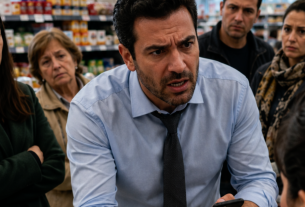
“Philip,” his mother-in-law began without even touching the pie. “The situation is critical. Larochka is having problems with her paperwork. For the boys to be accepted into a good school, and for the youngest to attend a kindergarten near you—the schools and kindergartens are better here—they need to be officially registered at this address. Permanently.”
Philip slowly placed his cup on its saucer. The clink of porcelain sounded like a gong.
“And?” he asked, staring directly at the bridge of his mother-in-law’s nose.
“What do you mean, ‘and’?” Tamara Igorevna exclaimed indignantly. “You need to register your nephews here. Just the three of them. And Larisa too, of course, as their legal guardian, so there won’t be any questions.”
“No,” Philip replied briefly.
A silence fell over the table, thick and sticky like spoiled honey.
“What do you mean, ‘no’?” Larisa’s face became covered in red blotches. “We’re not claiming ownership of anything! It’s just a stamp in a passport! A formality!”
“A legal ‘formality,’” Philip said, leaning back in his chair and crossing his arms. “Minor children cannot simply be deregistered without another address before they turn eighteen. Moreover, once I register them here, I am required to provide them with a place to live. And because you, Larisa, are their mother, you have every right to live with them. Which means your entire horde would legally settle here for at least the next fifteen years. And knowing your husband, he would appear here a week later too.”
Valeria froze. She knew that her husband understood the law, but she had not realized the situation was so serious.
“Do you think we’re con artists?” his mother-in-law shrieked. “She is your wife’s sister! Your own family!”
“Blood is a liquid that carries oxygen,” Philip replied coldly. “An apartment is property.”
“I’ll write a signed statement!” Larisa shouted. “I’ll state that I make no claim to the apartment!”
“You could only use a statement like that to light a fireplace,” Philip said with a smirk, although his eyes remained cold. “It has no legal force when the rights of minors are involved. Child protective services would tear me apart if I tried to evict you.”
Tamara Igorevna rose, pressing her fists against the table. Her face twisted into an expression combining resentment and greed.
“You are obligated to help! You have three rooms for only two people! You live in luxury while your sister and her children suffer in cramped conditions! You must register them here because we are family!”
At that moment, Philip stopped being polite. He stood up. He was a head taller than his mother-in-law, and his calmness was more frightening than any shout.
“Why should I do that? Are they my children?” Philip asked his mother-in-law, then looked at his sister-in-law.
His gaze was so contemptuous and searching that Larisa shuddered.
“You… miser!” Tamara Igorevna spat. “Lera, do you hear him? He wants to leave your nephews homeless! Say something to him!”
Valeria raised her eyes. There was no longer fear or embarrassment in them. Instead, they contained the same fire used to brew the most poisonous potions. Anger. The cold, rational anger of a woman who had finally realized that she was not loved—she was being used.
“Mom,” Valeria said quietly but clearly. “Philip is right. There will be no registration. Pack your things. You have one hour.”
Part 3. The Laboratory of Cold Calculation
This room was a kingdom of glass bottles and measuring cylinders. Valeria usually rested her soul here while blending essences. Today, however, she was mixing poison—figuratively speaking.
A month had passed since the scandal. Her relatives had declared a boycott against her. Larisa had blocked her everywhere. Her mother refused to answer her calls. They believed they were punishing her with silence.
How naive.
They were giving her freedom.
But yesterday, Tamara Igorevna had called her herself. She began indirectly, complaining that her health was deteriorating and that Larisa was struggling in her mother’s two-room apartment with three children. Larisa’s husband, an eternally unemployed “businessman,” was also hanging around there.
“Lera, you must influence your husband. Or give us money. Your sister needs a bigger home.”
Valeria stared at a bottle of bitter almond oil.
The scent of cyanide.
“There is no money, Mom. We’re planning to have a child,” she lied about the money, but not about the child.
“Selfish girl!” her mother hissed through the phone. “Larisa is a heroic mother, and you… What are we supposed to do? If Larisa had a home of her own, she could use it as collateral for a mortgage and buy something bigger…”
At that moment, an idea struck Valeria.
The plan formed instantly. It was cruel and ruthless—but fair.
She knew her sister. Larisa was greedy and foolish. And her mother… her mother loved Larisa with blind, self-sacrificing devotion.
“Mom,” Valeria said, her voice becoming soft and persuasive. “I’ve been thinking. Philip is stubborn, of course, but I want to help. Do you know why Larisa is so nervous? She has no confidence in the future. The apartment where you live is registered in your name.”
“Yes.”
“Exactly. Larisa is afraid that if something happens to you, God forbid, you’ll leave the apartment to me. Or divide it between us. And she has children.”
“I would never…”
“She doesn’t know that. Mom, if you want to prove to Larisa that you will always stand by her, transfer the apartment to her. Sign it over as a gift. Then she’ll become the legal owner. Maybe she can sell it and buy a larger house for all of you. She’ll calm down, and you’ll finally live together in peace. As for me… I’ll sign away any claim to it. I don’t need anything from you.”
There was silence on the other end of the line. Tamara Igorevna was thinking.
“You won’t be offended?”
“No, Mom. I want everything to be good for all of you. Sign the apartment over to Larisa. It will be your great maternal sacrifice.”
Valeria ended the call.
She knew exactly what she was doing. She was throwing a piece of meat into a tiger’s cage while knowing that the animal trainer was still inside.
Once Larisa gained control, she would not buy a new house.
She would simply get rid of the burden.
Part 4. The Old Apartment on the Outskirts
Six months passed. The wallpaper in the hallway of the old two-room apartment had yellowed and was peeling away in places. The smell of fried onions and unwashed clothes had soaked into the walls.
Tamara Igorevna sat on a sagging sofa in the walk-through living room. She stared at the document her eldest daughter had just thrown onto her lap.
“We’re selling the apartment, Mom,” Larisa announced while chewing an apple. “Vadik found an investment opportunity. We’ll buy a house in the suburbs.”
“But, sweetheart, what about me? Where will we go?”
“We’ll move into the house when it’s built. Until then… Vadik has arranged something. You can stay with his aunt in the village. The air is fresh there, and she has a vegetable garden. It will be good for you.”
“What village? It’s in another region! Three hundred kilometers away! They don’t even have a medical assistant there!” Tamara Igorevna clutched her chest.
“Don’t start your performance,” Vadik, Larisa’s husband, barked as he emerged from the kitchen wearing only his underwear. “The apartment belongs to Larisa, doesn’t it? It does. You signed it over yourself. We’re family, and we need to make things work. It’s too cramped for us here.”
Tamara Igorevna remembered Valeria’s words:
“Sign it over. It will be your sacrifice.”
She understood.
Her younger daughter had known.
She had known what Larisa would do.
It had not been an offer of help. It had been a trap—a snare Tamara Igorevna had willingly stepped into, driven by her desire to please her beloved eldest daughter.
She tried calling Valeria.
“The subscriber is temporarily unavailable or has added you to their blocked list.”
She tried again.
The call was immediately disconnected.
She was alone.
Completely alone in an apartment that no longer belonged to her, surrounded by people who saw her as nothing more than an obstacle.
Part 5. The Perinatal Center
The enormous windows of the new medical building reflected the spring sunlight. Philip stood on the lawn with his head tilted upward. Other new fathers milled around him with balloons and flowers. Philip appeared calm, although his heart was pounding wildly.
A third-floor window opened.
“Philip!” called a voice he would have recognized among thousands.
He cupped his hands around his mouth.
“Did you give birth?”
“Yes!” Valeria shouted, glowing despite her exhaustion.
“Is it a boy or a girl?” Philip froze.
“A boy!” her voice rang through the air.
Strangers nearby began to applaud. Philip broke into a broad smile, but then he felt the urge to make a joke. The nervous tension needed an outlet.
“Who does he look like?” he shouted.
Valeria disappeared for a moment, then leaned out again and called back with a laugh:
“You don’t know him!”
Laughter swept across the entire lawn outside the maternity hospital. Philip laughed louder than anyone, wiping away tears of happiness.
At that moment, his phone vibrated in his pocket. Valeria had sent him a photograph.
A tiny, wrinkled bundle wrapped in swaddling clothes.
His son.
Philip looked at the screen, then raised his eyes toward his wife in the window. She nodded to him. They had already decided how they would put a final end to the story. Not out of malice, but to draw a definitive boundary—to make sure the ghosts of the past never dared disturb their future.
Philip selected the contact labeled “Mother-in-law Tamara” on his phone. He knew that Tamara had not blocked him, unlike Valeria. Lera had deliberately left that channel of communication open for one final message.
He attached the photograph of the baby and added the caption Valeria had dictated:
“My daughter.”
Philip hesitated, trying to remember the words from his wife’s plan, but then realized that he had become confused in his thoughts. Of course, the photograph represented a new life, but the caption… the caption was supposed to be a blow.
Wait.
It was a son.
But Valeria had asked him to write exactly what they had agreed upon, to demonstrate their complete estrangement.
No. That was ridiculous.
Philip simply sent the photograph of his son and wrote:
“Our son has a home. We have a home too. But you no longer have either one. Goodbye.”
In a dimly lit room, sitting on top of her suitcases because Larisa had ordered her to empty the closets by evening, Tamara Igorevna received the message. Her smartphone screen was the room’s only source of light.
She stared at the photograph of the baby.
Her newborn grandson, whom she would never hold in her arms.
A second message followed—a screenshot from a real-estate website. It showed the listing for her former apartment.
The listing was marked:
“Sold.”
Tamara Igorevna raised her eyes toward Larisa, who was busily packing away the expensive dinner set—the same one Tamara had treasured for thirty years.
“Mom, why are you just sitting there? Put things into the boxes. The car will be here in an hour,” Larisa grumbled. “You’re going to that village. It’s perfectly fine there. You’ll learn how to heat the stove.”
Denial.
Anger.
Bargaining.
Tamara passed through all of them in a single second.
She had been left with nothing. She had been betrayed by the very people for whom she had betrayed the daughter who might once have become her support.
“This isn’t true,” she whispered. “Things like this don’t happen. I’m their mother…”
But the cold phone screen continued to glow, confirming that they did.
Entitlement had been punished with indifference.
Greed had been punished with poverty.
Tamara let out a long, terrifying howl as she finally understood that the “cold calculation” she had once proudly boasted about to her friends had become a weapon aimed directly at her.
She had willingly delivered herself to the slaughter.
Valeria had simply chosen not to interfere.
And that was the most frightening part.
Valeria had merely stepped aside and allowed justice to take its course.