Raisa Lvovna arrived at the banquet hall earlier than everyone else and immediately found things to criticize. First, she disliked the napkins. Then, it was the color of the tablecloths, and after that, the table by the window where the administrator placed a small table for Daria’s parents. The mother-in-law leaned toward the girl with a tablet and quietly but clearly asked her to move two chairs closer to the exit. She said the elderly guests would feel more comfortable there, not having to sit among Sergey’s bosses and acquaintances. Daria overheard all this as she was pulling candles from a box for the cake and froze for a moment, a thin white candle in her fingers.
«Don’t start,» Sergey said, appearing beside her so quickly it was like he’d been waiting for just where the first crack would show. «Mom means well. It’s my birthday, Dasha. Can’t we have just one peaceful evening?»
Their ‘peaceful evenings’ had been going on like this for seven years. They always began the same way: Raisa Lvovna said something extra, and by the end, Daria was the one apologizing—for her sharpness, her tiredness, her poor tone. Sergey was a gentle man, polite, convenient for everyone except his own wife. He didn’t argue with his mother—not because he agreed with her out loud, but because his silence let her make all the decisions. Daria used to call this delicacy, then habit, but lately she was searching for a word that felt both more accurate and more honest.
Her parents arrived right at six. Pavel Stepanovich wore his gray suit, saved for rare occasions, and Lidiya Semyonovna carried a homemade cake and a small bag with a gift for her son-in-law. In front of the door, her mother stopped, smoothed her dress sleeve with her hand, and asked if it looked too plain. Daria kissed her cheek, assured her that nobody would look lovelier today. Her father offered a brief smile, but his eyes stayed serious. The inner pocket of his jacket was pulled down by a folder, the same one he’d mentioned to his daughter that morning: «We’ll talk after the party. I don’t want to spoil Sergey’s day.»
Daria knew that what was in that folder was definitely not a greeting card. The night before, Pavel Stepanovich received a call from the bank’s credit department asking him to confirm some details on Sergey’s loan application. He didn’t understand and asked them to send over the documents. By evening, he’d received the loan agreement to open a pick-up point. In the contract, Daria was listed as the future guarantor, her apartment as collateral, and her parents as contacts supposedly ready to confirm the family’s income. No signatures were on the documents yet, but Sergey had already told the bank his wife would sign them after his birthday. Daria had stared at the printout for a long time, thinking not about the money, but about how calmly her husband planned to spring this on her at the festive table.
Raisa Lvovna greeted Daria’s parents as if she was doing them a favor. Her eyes drifted over the box with the cake, to her father’s shoes, to her mother’s old purse, and she offered a thin smile.
«Ah, you made it. You’d better give the cake straight to the kitchen—there’s a catered dessert here. No need to mix homemade with a proper table.»
Lidia Semyonovna hugged the box to her chest and looked at her daughter with confusion. Darya wanted to say something in response, but her father gently touched her elbow. He’d worked his whole life as a foreman, was used to talking to people calmly, and never felt the need to argue when it was better to save face. But this time, Darya sensed that his patience wasn’t from weakness, but from one last bit of respect for her marriage.
The first few toasts went smoothly. Sergey was all smiles, receiving congratulations, cracking jokes with his coworkers from the delivery service, and insisting that forty-five isn’t an age—it’s a great start. Raisa Lvovna sat beside her son, fussing with his collar as if he were still a schoolboy getting ready for class. Darya watched her parents. Her mother barely ate, and her father held his cup with both hands, even though the drink had long grown cold. They weren’t placed by the door only because Darya had rearranged the place cards herself, but even so, the two seats next to Sergey were still taken by his mother-in-law’s friends.
When the manager came over to confirm the main course, Raisa Lvovna scanned the table, then announced loudly:
«Just smaller portions for our elderly guests. They’re simple people, these dishes are unusual for them.»
A few people pretended they hadn’t heard. Lidia Semyonovna blushed, and Pavel Stepanovich slowly set his cup on its saucer. Sergey was talking to a man by the bar at that moment, but Darya saw the tension in his shoulders. He had heard. He just chose, once again, to act as if he hadn’t.
«Raisa Lvovna,» Darya said, struggling to keep her voice steady, «my parents can decide for themselves what they want to eat.»
«Of course, dear,» her mother-in-law replied. «I’m not forbidding anything. I’m just warning, so no one feels uncomfortable. Everyone has their own environment, and that’s perfectly normal.»
She said the word «environment» with a tone that made it sound like she was talking about dirt on shoes. Sergey finally came over, leaned down, and quietly asked his wife not to make a scene. She looked at him, at his neat shirt, at the watch her parents were planning to give him, and she could almost physically feel the last hope fading inside her—that he would at least stand up for her today.
The gift-giving started closer to the end of the evening. Some people gave certificates, others household appliances, and Sergey’s coworkers presented him with a toolbox for his future pick-up point. Raisa Lvovna watched all this with the satisfied look of a hostess who had already distributed enough gratitude among the right people. Lidia Semyonovna waited for a pause, then stood up and handed her son-in-law a small package. Inside was a watch with a sturdy strap—not expensive, but chosen with care. Pavel Stepanovich then placed an envelope on the table and said he and his wife wanted to contribute to the new venture, if Sergey was truly set on working for himself.
Raisa Lvovna didn’t even try to hide her smirk.
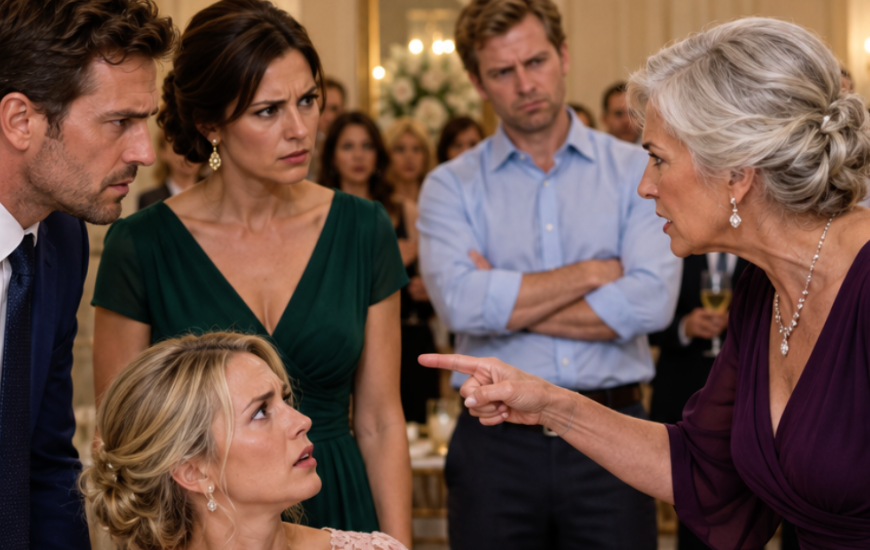
«Contributing?» she repeated loud enough for the whole room to quiet down. «You’d be better off keeping it for yourselves. Your pennies won’t help Sergey, and frankly, you look ridiculous right now. Your parents are poor—let them stay in their village instead of pretending they’re equals in our family.»
Lidiya Semyonovna sat down so abruptly that the cake box slid toward the edge of the table. Pavel Stepanovich stood up but didn’t say a word. The room filled with an awkward tension. The waiter paused by the wall, Raisa Lvovna’s friends exchanged glances, Sergey turned pale, and the first thing he did was reach for his mother’s hand instead of his wife’s.
“Mom, that’s enough,” he muttered. “Dasha, please take your parents out into the corridor. Everyone just needs a moment to calm down.”
Darya heard him and calmly set her glass on the table. She felt that if she started yelling now, she’d just be giving Raisa Lvovna exactly what she wanted—a confirmation of her legend about the rude bride from the wrong family. So instead, Darya simply walked over to her father and quietly asked him for the folder.
“I didn’t want to do this in front of everyone,” Pavel Stepanovich said as he pulled it from his inside jacket pocket. “But if we’re being treated as outsiders here for everyone to see, then let everyone see the papers, too.”
He placed on the table first a receipt for the banquet hall’s advance payment. His last name was on it—he’d been the one to pay for the reservation when Sergey called two weeks ago and asked for help because his bank transfer was ‘stuck,’ and he didn’t want to spoil the surprise for Darya. Then her father took out a printed copy of their correspondence, showing Sergey thanking him and asking him not to tell anyone. Next came the loan agreement documents. Darya didn’t look at the guests; she watched her husband. Sergey seemed to shrink, his shoulders slumped, and his hands searched for pockets that just weren’t there in his dress pants.
“Here,” Pavel Stepanovich ran his finger along the line, “is my daughter’s apartment. Here is her consent—consent she didn’t give. And here, Lidiya Semyonovna and I are named as the ones supposedly vouching for your integrity. And now we’ve just been shown where we belong.”
Raisa Lvovna lunged toward the papers, but Darya covered them with her hand.
“You called my parents poor, while your son asked them to pay for the event and wanted to use their names to secure his loan,” she said. “This isn’t just an awkward family moment anymore. This is documentation.”
“These are just drafts,” Sergey began to speak quickly. “I was going to explain everything. After the anniversary. You’d see for yourself—it’s an opportunity for us.”
“For us?” For the first time that evening, Darya smiled, and her smile unsettled Sergey more than any yelling could have. “The contract lists your mother as the tenant. You’re taking the loan. I’m the one at risk. Where’s the ‘us’ in all this?”
Raisa Lvovna rose from her seat, steadying herself on the back of her chair. Her face turned as hard as a lacquered jewelry box.
“A good wife helps her husband,” she declared. “Not dragging family papers around the hall. You’ve always wanted to be above him, and now you’re happy.”
“A good mother doesn’t teach her son to hide behind someone else’s apartment,” Darya answered. “Or throw out the people her son asked for money.”
The administrator, who had been silent near the entrance until now, carefully approached with the payment terminal and mentioned that there was still a second payment due for the banquet. Raisa Lvovna instinctively reached for her purse, but Sergey stopped her with a look, only then realizing too late that he had planned to pay with Darya’s card—the one she had taken out of their shared app that very day. Darya took out her card and paid for only her own order, then asked for the remaining balance to be billed separately to Sergey. She said it calmly, almost routinely, yet it was this very ordinariness that revealed a new boundary.
The guests began to leave quickly, offering only brief goodbyes. No one discussed what had happened out loud, but Raisa Lvovna knew that tomorrow, people would remember her beautiful anniversary not for the music or the cake, but for Pavel Stepanovich’s receipt and the contract for her daughter-in-law’s apartment. Lydia Semyonovna quietly took her homemade cake out of its box and cut it for those still sitting at the table. A few people thanked her for the treat. Pavel Stepanovich sipped his tea, avoiding eye contact with his mother-in-law, since everything important had already been said.
Darya went home with her parents. No one spoke for a long time in the car. Her mother held the empty cake box on her lap, her father kept his eyes on the road. Sitting in the back seat, Darya read Sergey’s messages. At first, he wrote that he hadn’t meant to hurt her parents. Then he asked her not to act rashly. Then he insisted that his mother had overstepped and that he was just confused. Darya turned off her phone and, for the first time in a while, didn’t try to find a response that wouldn’t hurt anyone.
The next morning, she went to the bank with her father. Sergey’s application was canceled after she submitted her written refusal, account access was changed, and old powers of attorney were revoked. Darya didn’t feel like a winner—more like someone who had slept too long in a room with an open door and finally turned the key. After the bank, she took her parents home and stayed with them until evening, helping her mother put away the dishes. Only over tea could she finally say what had been stuck in her throat all day.
“I’m sorry that I kept asking you to be patient.”
Lydia Semyonovna put her cup down on the table and hugged her daughter. Pavel Stepanovich turned to the window, spent a long time adjusting the curtain—which was already hanging straight—and then said:
“We weren’t being patient for her sake. We did it for you. But now, that’s enough.”
Sergey came by a day later. He stood at the door with a bag of his shirts that Darya had packed in advance, and he looked not angry, but lost. He said he had spent the night at his mother’s, that she wasn’t feeling well, and that he was ashamed. Darya let him in only as far as the hallway. His mug by the kettle, his jacket on the rack, and his slippers under the bench were all gone from the apartment. Those small details spoke louder than any words ever could.
“I’ll cancel everything,” he said. “The loan, the rent, the conversations. We can start over.”
“You can start over,” Darya replied. “But not with me.”
He spent a long time explaining that he just wanted to be independent, that his mother pressured him, and that he always thought Darya would agree because she always had before. There was an honest truth in his words that even he didn’t notice. In the past, she really did agree. She agreed to his mother’s key to their apartment, to her mother-in-law’s comments, to requests for money from Darya until her pension came in. She even put up with his endless ‘let’s talk about it later.’ Only before, she thought she was making these sacrifices for the sake of the family. Now she realized her compromises had just become a comfortable routine for them.
The divorce went through without any arguments. The lawyer helped Sergei draw up paperwork stating he had no claims to any property, and Pavel Stepanovich simply asked for the advance payment on the event hall to be returned. Sergei didn’t give it back all at once—he sent it back in small sums, each with a short, dry message. Raisa Lvovna called Lidiya Semyonovna once and said this whole story could have stayed in the family if only Darya had been wiser. Her mother listened and replied, unexpectedly firm:
“Wisdom isn’t about staying silent when your child gets stuck with someone else’s debt.”
After that, the phone calls stopped. Sometimes Darya would see Sergei in the yard, when he came by to pick up another box. He seemed quieter, thinner, and no longer looked over people’s heads. Maybe, without his mother’s voice behind him, he had to hear his own for the first time. Darya didn’t wish him any harm, but she also wasn’t going to take back someone who only realized things after losing his comfortable life.
In the spring, her parents finally got the roof redone. The money that had been sitting in that very envelope went toward materials, Darya chipped in for the rest, and came by to help pick out a color. Pavel Stepanovich argued with the workers, Lidiya Semyonovna set the table outside, and the homemade cake took center stage again—only this time, nobody asked for it to be taken back to the kitchen. As Darya watched her parents, she realized that respect isn’t measured in suits, big venues, or someone else’s friends around the table. You can see it in how a person carries themselves when someone tries to tear them down.
That evening, as gentle rain tapped on the new roof, her father raised his cup and said:
“Here’s to making sure no one ever moves our chairs.”
Lidiya Semyonovna smiled, Darya laughed, and for the first time in months she felt a sense of ease. Not noisy, not festive, just a simple, homely peace you can build a life on. She hadn’t gotten that anniversary back, and she couldn’t erase Raisa Lvovna’s words from memory, but she had reclaimed her right not to excuse someone else’s arrogance. Her parents were close, the house was sturdy, the roof kept out the rain, and ahead was finally a life where Darya alone chose who could take a seat at her table.