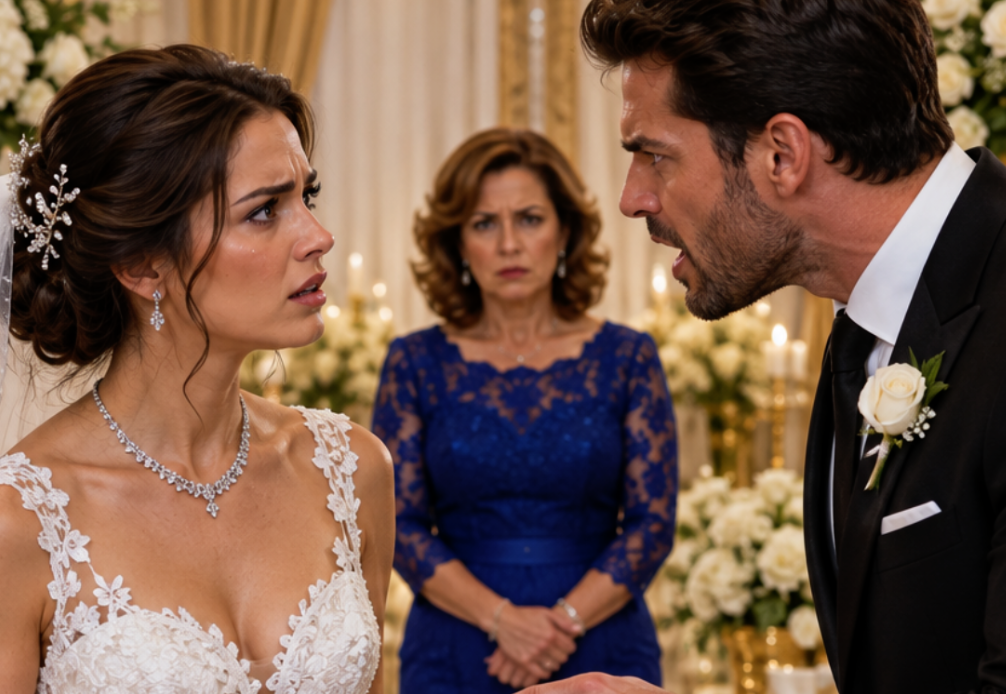
He placed the pen next to the folder before I even sat down at the table. It was blue, with a gold band—clearly not ours, not from our apartment.
«It’s nothing big,» Artyom said as he slid the folder across the table to me. «Just a formality. My mom found a lawyer, everything’s by the book.»
Valentina Sergeevna was sitting on the couch by the window, scrolling through something on her phone. She didn’t look at the table at all. In fact, she seemed to be deliberately avoiding it.
I opened the folder. It smelled like printer ink and freshly unwrapped plastic sleeves. Eight pages, small font, one and a half line spacing.
«Eight pages of formality,» I said.
«Well, that’s lawyers for you,» Artyom smiled. «They just want to fill it up. Don’t read too deep, it’s standard stuff. Apartment, car—just so everything’s fair in case anything happens.»
He poured himself some tea. Didn’t pour any for me, even though the teapot was closer to him.
«The wedding’s in three weeks, Ksyusha,» he added softly. «Let’s not waste time on paperwork. You never liked these boring documents anyway.»
That’s when I started reading slowly.
Not because I was offended. I read boring documents every day. Eight years in publishing, the last four focused on contracts and legal editing. I handle ten of these a week: author agreements, licenses, all kinds of stuff. I know where the important parts are hidden. They always tuck them in the middle, where your attention slips.
Artyom didn’t remember that. Or didn’t think it mattered. Once, he asked what I did for work, I said, «I edit texts at a publishing house,» and he nodded: «Ah, commas.» Since then, that’s what it’s been—commas.
Clause 1. The apartment on Smolnaya is his pre-marital property and stays his in case of divorce. Makes sense, since he bought it before I entered the picture.
Clause 2. The car—his, too. Also from before me.
Clause 3. I got to the third one and stopped.
***
«Still reading?» Artyom glanced into his cup and stirred with a spoon. «You’re taking a while. There’s really nothing special in there.»
«Yeah,» I said.
Clause 3 was titled «Management of the Household.» Nice wording. It said that during marriage, maintenance of the home, cleaning, cooking, and organizing daily routines fall to the wife. And that «the wife’s fulfillment of these duties does not generate property claims and has no monetary value during division of assets.»
I read it twice. Not because I didn’t get it the first time—I understood immediately. I just wanted to make sure it really said that and I wasn’t imagining it.
«Artyom,» I looked up. «Did you read clause three?»
«Which one’s that,» he didn’t look up from his phone. «The housekeeping one? It’s just so it’s clear who does what at home. Mom says it’s good to sort this stuff out upfront so there’s no fighting later.»
Valentina Sergeevna turned a page on her phone on the couch. Not a sound from her.
«Who does what,» I repeated. «And what do you do, according to this part?»
«Well, I bring in the money,» he finally looked at me. «Makes sense, right? I earn, you handle the house. It’s classic.»
I went back to the folder. Clause 4. Clause 5. I read quickly now, because I knew exactly what to look for.
***
Clause 6 stuck with me word for word, even though I only read it once.
«If a child is born, the wife takes on primary care until the child turns three. During this time, the wife does not claim compensation for lost income or professional opportunities.»
I closed the folder and rested my hand on top of it.
«Artyom.»
«Hm?»
«It says here that if we have a child, I’ll stay home with them for three years, and if I lose my job and my career because of it, that’s my problem. Is that right?»
He sighed. The kind of sigh you give when you feel you have to explain something obvious to someone who just doesn’t get it.
«Ksyusha. Well, how else could it be? You’ll take maternity leave anyway. Everyone does. I didn’t make this up, that’s just how life works. The lawyer said it’s better to put it in writing, so there aren’t any surprises.»
«Whose lawyer is it?»
A pause. Brief, but I caught it.
«A friend of my mom’s,» Artyom said. «Why?»
Valentina Sergeyevna finally put down her phone, folded her hands in her lap, and looked at me—calmly, kindly, like someone watching a girl struggle way too long with an easy question.
«Ksyushenka,» she said. «Don’t overthink it. This isn’t against you. It’s just to keep things fair, like a real family. That’s always how it is in our family: the man provides, the woman keeps the house. I raised Artyom all by myself, believe me, I know what I’m talking about.»
«Have you seen this agreement?» I asked. «Before today.»
She smiled just a bit.
«I helped write it. Otherwise, would you really understand all those legal articles on your own? You’re our resident comma queen.»
There it was. Comma queen.
***
I just sat there, my hand on the closed folder. Artyom finished his tea, got up, put his cup in the sink—not washed, just put it there. He turned back around.
«So, are we signing? The pen’s right there. I’ve got a meeting at seven, let’s not drag this out.»
I thought I would feel angry. But I didn’t. Instead, it felt like someone handed me a manuscript, pretending it was one book, but inside was something completely different—and the author was staring at me, waiting for my stamp of approval because they hoped I was too lazy to actually read it.
I opened the folder again. Flipped to the last page.
«Artyom, did you actually read the whole agreement? From start to finish?»
«Like I said, it’s standard.»
«That’s not an answer.»
He went quiet.
«I skimmed through the main parts. My mom and the lawyer checked everything, why should I dig into it?»
«So you didn’t actually read it.»
«Ksyusha, why are you getting worked up?» he sat back down, his expression changed now. «I thought you’d just sign it and that would be it. You never… Look, you don’t like arguing. That’s what I like about you—everything’s calm with you.»
«Calm,» I repeated.
Calm. Meaning convenient. He wasn’t even trying to hide it. He was sure he could hand me eight pages, I’d flip through them, spot the words «apartment» and «car,» decide it was all fair, and sign with a fancy blue pen. Because I’m a comma queen. Because things are calm with me. Because I don’t like boring paperwork.
For four years, I’ve been reading paperwork like this so people don’t accidentally sign something they shouldn’t. And here he is, putting it right in front of me and expecting I’ll be the one who falls for it.
«Valentina Sergeyevna,» I asked. «Can I ask something? In item six—about me not claiming lost income. Did you come up with that wording or was it the lawyer’s?»
«What difference does it make, dear?»
— It’s a big one. The lawyer wrote that the law allows it. But that line, ‘does not claim professional possibilities,’ is not about the law. It’s about making me give up my career in advance so I’d never dare remember it existed. No lawyer would write that on their own. That line—someone added it.
She stopped smiling.
— What exactly are you implying?
— Nothing. I’m just reading. Out loud. Like you wanted—being honest.
Artyom’s gaze shifted from me to his mother. For the first time that evening, he looked like he was actually reading the contract—the one he brought himself.
— Clause eight, — I continued, turning the folder toward him. — Right here. Read it. Yourself.
He took it. Leaned in. His lips moved silently as he read.
Clause eight stated that if the marriage ended on the wife’s initiative, she would leave the shared home within a month—no compensation for any renovations or furnishings. By the way, we’d planned the renovation and furnishings together for the new apartment. The one we were going to buy together, with a mortgage—I’d already saved up the first payment from my own (itemized, every comma) salary.
— That’s not… — Artyom looked up. — That’s probably just a template, leftover from—
— Leftover from what, Artyom? From your last fiancée?
Silence. Valentina Sergeyevna got up from the couch.
***
— That’s enough, — she said. — Stop the dramatics. The contract is standard. Every decent person has one. You’re blowing this out of proportion. Artyom, tell her.
But Artyom said nothing.
He sat there, staring at page eight in silence. And that silence felt worse than the entire contract. The contract, at least, had been written by someone else’s lawyer. But the silence—it was his. The same person who, in three weeks, was supposed to stand beside me and say ‘I do.’ He could’ve said now, ‘Mom, enough, this really is too much, let’s remove that.’ Just one sentence. He didn’t say it.
He chose not to argue. Not with his mother. It was easier to stay quiet with me.
I closed the folder. Pushed the blue pen to the middle of the table, toward him.
— I’m not signing, — I said.
— Ksyusha, let’s talk about this tomorrow when we’ve both slept on it, — Artyom said quickly. — You’re tired, I understand…
— I’m not tired. I finished reading.
— So you finished, — Valentina Sergeyevna interrupted. — These are just standard papers. You were just looking for something to argue about. If you don’t want to get married, say so—why make a scene?
— I do want to, — I said. And was surprised myself to realize it was already past tense. — I wanted to. Until page six.
***
I stood up, grabbed my jacket from the back of the chair. The hallway was dark; it took me a moment to find the light switch. Behind me, Artyom was mumbling about ‘sleeping on it,’ ‘my mom didn’t mean it that way,’ and ‘we’re adults, after all.’
Adults. An adult brought his fiancée a paper that—right from the start—made her a servant with no voice, and was so sure she wouldn’t read it that he didn’t even read it himself.
I turned around in the doorway.
— Artyom. Did you really think I wouldn’t read it?
He hesitated.
— I thought… well… usually with things like this, you…
— Ignore them. Go ahead and say it.
He didn’t finish. From the other room, Valentina Sergeyevna shouted that I’d regret this, that men like her Artyom are rare finds, and that at my age I couldn’t afford to be picky.
At my age—I’m thirty-one. I closed the door, and on the stairs, realized I was breathing freely for the first time in six months.
***
I called off the wedding the very next day. I phoned the restaurant—deposit lost, but whatever. I sent out the same short message to all the guests: there won’t be a wedding, please don’t ask for details. I left the ring in its box on Artyom’s windowsill—dropped by when he wasn’t home, and handed the key to his neighbor.
Artyom called me. At first he tried to persuade me, then he blamed me, and then switched back to persuasion. He sent a long voice message, saying he’d torn up that contract, that I totally misunderstood, and that his mother was ‘her own person, and we are our own.’ I listened through to halfway. He sounded sorry until that point. After that, it was all about how much money he’d spent on the wedding and who would now look awkward in front of his family.
Looking awkward. That’s what really got to him. Not that I left. But that now his uncles and aunts would need an explanation for why the bride ran away three weeks before the wedding.
***
When I told my mom, she was silent on the phone for a long time.
“Maybe,” she said cautiously, “you could have just crossed out those points? Rewrote it normally and stayed? After all, paper is just paper. What matters is people living together.”
I thought about that. Honestly, I did. The points could really be crossed out. It would take a lawyer an hour to fix.
But you can cross out lines—not the fact that he gave it to me, confident I would just swallow it. Or the way he stayed silent when his mother described me ‘by the commas.’ The contract just put into words what they both thought of me. I’d cross out the points and marry the people who came up with them.
“Mom,” I said. “He didn’t write the points wrong. He wrote everything about me right. It’s just that I’m not that person.”
She was silent again.
“Well, it’s your choice,” she finally said. “Just don’t regret it later.”
***
I don’t regret it. Almost.
Sometimes, late at night, I catch myself remembering there were good things. He knew how to make coffee just the way I like it. He remembered I don’t eat cilantro. He drove me to the sea for my thirtieth birthday, and never once complained when I slept the whole way.
And then I remember the blue pen with the gold band that he put on the table in advance. He either bought it specially or borrowed it from his lawyer—we never had one like that at home. He thought of everything. He thought about the pen. But it never occurred to him that I could read.
Now at work, whenever an author brings in a contract and says, ‘it’s the standard form, you don’t have to read it,’ I always read it. And I always find a clause six. There’s nearly always one. Most people just never get that far.
But now, I always read to the end.
***
Valentina Sergeevna messaged me a month later. Just one message, no greetings. ‘You ruined my boy’s life over a technicality. I hope you’re not ashamed.’
I read it again. Not because I didn’t understand. I got it right away.
I didn’t feel ashamed. But I did have a question, and I even typed it out to her, but then I deleted it before sending.
The question was simple: if it really was just a formality, why did you try so hard to make sure I didn’t read it?