Here is the translation of the full story.
Mother left on Wednesday afternoon and told her daughter not to go outside. When Polinka went to bed, the stove was still hot, but by morning, the house had already cooled down.
Mother wasn’t there; the little girl got out from under the blanket, put on her felt boots, and ran to the kitchen. Nothing had changed here.
On the table sat a pot covered in soot. Inside, Polinka remembered, there were four potatoes boiled in their skins. She had eaten two of them the night before, before going to bed. There was also nearly a bucketful of water on the floor.
Polinka peeled two potatoes and had her breakfast, dipping them in salt and washing them down with water. A cold draft was coming from the basement, so the girl slipped back under the covers.
She lay under the blanket, listening to the noises coming from outside. Polinka was waiting for the moment when the door would close and her mother would return. She would light the stove, and the house would become warm. Mom would cook potatoes and spread them out on the table, and Polinka would roll them around so they would cool down faster.
Last time, Mom had brought back two sauerkraut buns, and Polinka had eaten them with hot tea. But now, there were no buns, no tea, and worst of all, it was already getting dark outside and Mom still hadn’t returned.
While it was still light, the girl crept into the kitchen and finished the remaining potatoes, took a glass of water, and placed it on a chair near the bed. Then she put on her mother’s old jacket, pulled the hood over her head, and lay down again under the blanket.
It was dark outside and cold in the house. Polinka, a six-year-old girl, lay under an old quilted blanket, trying to get warm, waiting for her mother to return.
In the morning, nothing had changed, except that the house was even colder and there was nothing to eat.
Polinka dragged five logs from the hallway—she had to make two trips for that. Then she pulled a stool near the stove, climbed onto it, and opened the stove door with the poker. It wasn’t easy, and bits of soot and dust fell onto her.
Polinka had seen her mother light the stove many times, and she tried to do exactly like her. First, she put two logs into the stove, tore a few sheets from an old newspaper, crumpled them up, and placed them between the logs, then put dry bark on top, followed by another log. Then, she lit the paper and the bark. And when the logs caught fire, she added two more logs and closed the door.
Then, Polinka washed about ten raw potatoes, put them in a cauldron, poured water into it, and, standing on the stool, placed it on the stove.
The girl was tired after all that, but she felt the room becoming warmer. Now she had to wait for the stove to heat the house well and for the potatoes to cook.
Once, Polinka had a dad, but she didn’t remember him. He had gathered his things and gone to the city because Mom often went to visit her friends and, as Grandma used to say, «she drowned her eyes in alcohol.»
While Grandma was alive, Polinka lived well. The house was always clean, warm, and smelled of pies. Grandma often made pies with sauerkraut, carrots, or berries.
She also made delicious semolina porridge in a cauldron—she would put a plate in front of Polinka, along with a glass of warm milk.
Back then, the house had a television. And Polinka would watch cartoons, while Grandma watched movies, which she strangely called «series.»
Without Grandma, everything became much harder. Mom would leave during the day and come back at night, when Polinka was already asleep. There was often no food in the house, and the girl made do with boiled potatoes and bread.
Last spring, Mom hadn’t planted a garden, so this year, there were few potatoes. Polinka didn’t know what had happened to the TV. She had never seen Mom leave for as long as this time.
The house was warm, the potatoes cooked. Polinka found a bottle of sunflower oil in the kitchen cupboard. There wasn’t much oil—only a tablespoon—but hot potatoes with oil were much better than cold ones with nothing.
She brewed some raspberry leaves in a cup and drank hot tea, suddenly feeling warm. She took off her mother’s old jacket, lay down in bed, and fell asleep.
She woke up hearing voices. Neighbors were in the room—Grandma Masha and Grandpa Egor, as well as another unknown man.
«Zakharovna,» the stranger said to Grandma Masha, «you can take the girl to your place for a few days; I called her father, he’ll come on Sunday. The investigators and the doctor are arriving soon. I’ll wait for them here.»
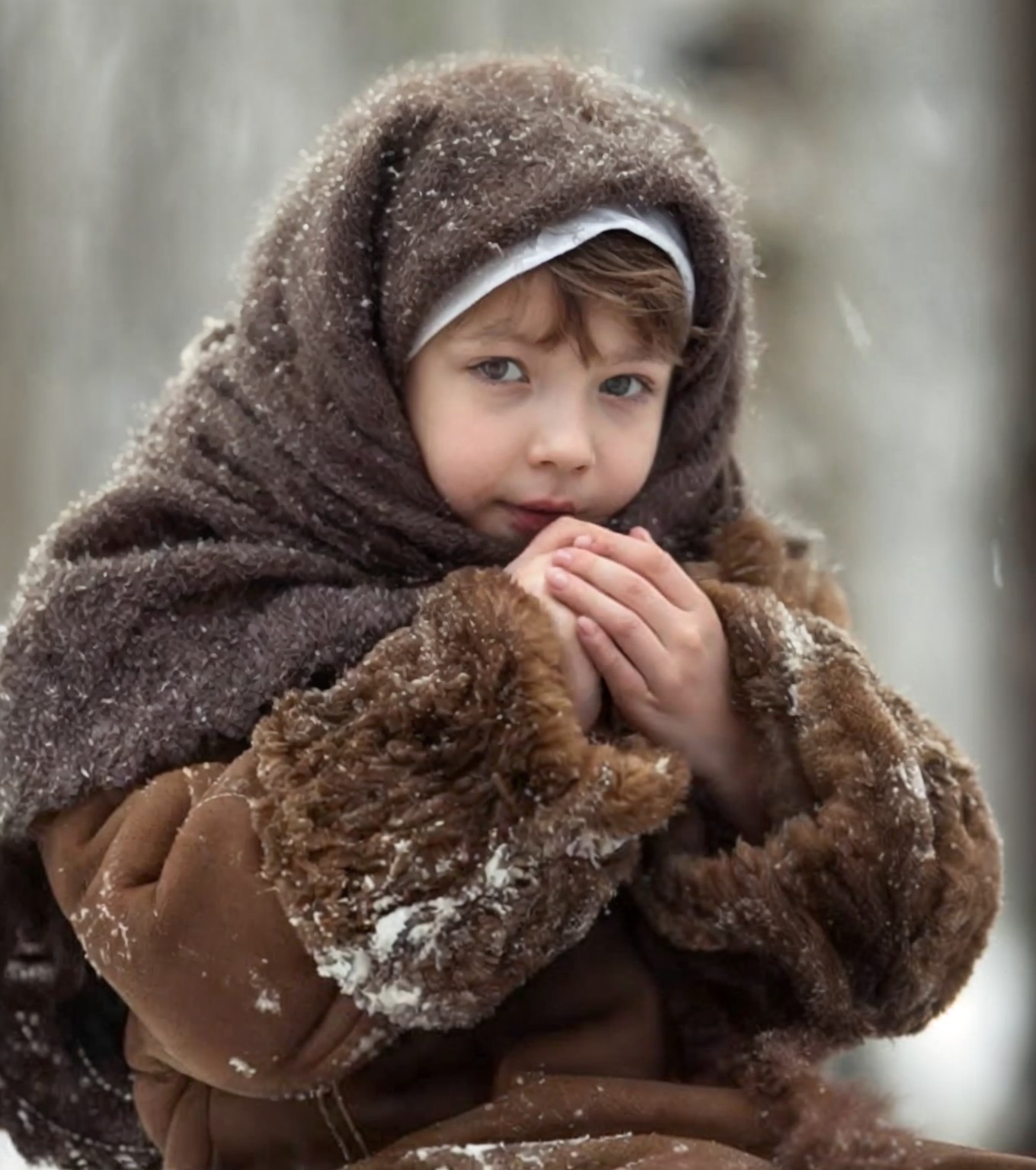
Grandma Masha looked for something to dress Polinka in, but finding nothing, she put her mother’s old jacket on her and tied one of her grandmother’s scarves on her head.
When they went out into the hallway, Polinka saw something near the woodpile, covered with two sacks. Under one, a foot wearing one of her mother’s boots was sticking out.
Grandma Masha took Polinka to her house and told her husband to prepare the bathhouse. She washed the girl, bathed her in hot water with a birch whisk, wrapped her in a large towel, put her in the dressing room, and told her to wait. A few minutes later, she returned with clean clothes.
Polinka sat at the table in flannel pajamas with wool socks. A white scarf with blue polka dots was tied around her head. In front of her was a plate of borscht.
A woman entered the room, looked at Polinka, and sighed deeply.
«Here, Maria Zakharovna,» she said, handing Grandma Masha a large bag, «some clothes for the girl. Mine have outgrown them. There’s even a winter coat. What a tragedy.»
«Thank you, Katya,» replied Grandma Masha, then turned to Polinka, «have you eaten? Come on, I’ll put on a cartoon for you in that room.»
That day and the next, several women came to Maria Zakharovna’s house. From snippets of conversation, Polinka understood that her mother had been found frozen in a snowdrift, completely by accident. And also, someone had called her father, and he would arrive soon.
Polinka felt sorry for her mother and missed her. At night, she cried silently, hidden under the blanket.
Her father arrived. Polinka looked at this tall, dark-haired man whom she didn’t remember at all. She was a little afraid of him, so she stayed away. He also looked at her carefully and, when they met, he awkwardly patted her on the head.
Her father couldn’t stay long, so they left the next day. Before leaving, he closed the shutters, boarded up the windows and doors, and asked the neighbors to watch the house.
Grandma Masha said goodbye to Polinka:
«Your father has a wife, Valentina. She will be your mother. Listen to her and help her around the house. Then she will love you. Apart from your father, you have no one, and you have no other home than your father’s.»
But Valentina never loved Polinka. The woman had no children, and she probably didn’t know what it was like to love children. But Valentina didn’t mistreat the little girl. She made sure Polinka was always clean and well-dressed, although new things were rare, making do with what colleagues and acquaintances gave her.
As soon as her father brought Polinka home, Valentina took charge of her and enrolled her in kindergarten. In the morning, she took her there, and in the evening, she picked her up after work. At home, she immediately started preparing dinner or attending to other household chores, and Polinka stayed in her room, looking out the window or drawing.
Her father didn’t talk often to his daughter, thinking that everything she needed was done: she was fed, clothed, shod—what more could she ask for?
When Polinka started school, she caused no trouble for either her father or Valentina. She studied properly, mostly getting good grades in general, and average grades in math, physics, and chemistry. But the teachers said she was doing her best, although the exact subjects didn’t come easily to her.
But she was the first in practical classes, especially when the girls sewed, knitted, or embroidered. Even the teacher was surprised to see how Polinka succeeded at everything with ease. Olga Yurievna only had to show a new stitch or pattern, and Polinka followed it, as if she already knew it all.
So, Polinka lived in her father’s family: from the age of ten, she did the cleaning, ironed a mountain of laundry, and at thirteen, she cooked for the whole family. She communicated mostly with Valentina about household chores, but Polinka felt that was all she needed.
After ninth grade, Polinka announced that she wanted to go to college and become a seamstress and pattern maker. Her father accompanied her to the industrial-economic technical college, they submitted the documents, and in September, Polinka began her studies.
She continued to do a lot of housework, but now she started sewing. Valentina had an old sewing machine; Polinka fixed it, and now she had no trouble hemming towels, sewing curtains, or repairing clothes. She did everything herself. Neighbors started asking her to hem pants or sew bed sheets of non-standard sizes. She charged little but didn’t spend the money she earned—she saved it.
Three years passed without her realizing it. Her studies finished, Polinka turned eighteen.
Suddenly, to her father’s surprise, the girl announced that she wanted to return to her native village.
«Aren’t you happy here? Why are you leaving?» her father asked.
«You raised me, and I am very grateful to you. But now, I must manage on my own.»