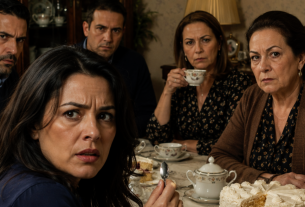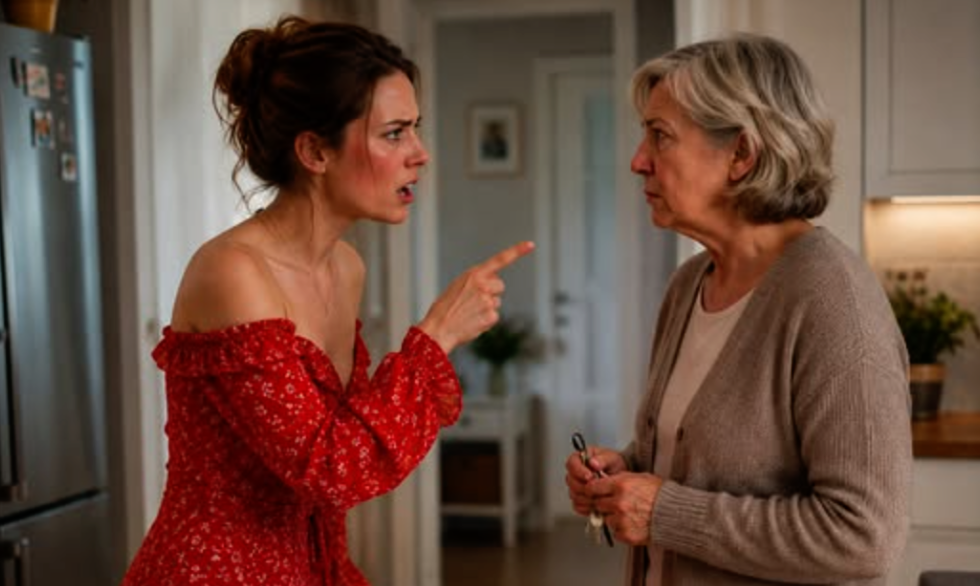
“Put the key on the nightstand, Zoya Nikolaevna. And don’t unpack your suitcase.”
Olesya said it quietly, although inside her it was already rumbling like an elevator shaft when someone throws an empty bottle down it. On the doormat by the door stood two checkered duffel bags, a Lenta shopping bag with a frying pan sticking out of it, and a pot with a wilted geranium. Her mother-in-law, without even taking off her coat, was confidently opening the hallway closet and pushing Olesya’s boots into the corner.
“What do you mean, don’t unpack?” Zoya Nikolaevna turned around, holding spare hangers between her teeth. “I didn’t come to stay at a hotel. Artyom said you had settled everything.”
“The only thing Artyom and I settled was that he would buy cat litter today. Apparently, on the way, he also decided what to do with my living space.”
“Don’t start. I’ve just come off the train, my blood pressure is up. Let a person come in like a human being.”
“You’ve already come in. With your own key. That’s exactly what interests me.”
Zoya Nikolaevna took the keys out of her bag and jingled them almost ceremoniously.
“My son gave them to me. What’s the big deal? Is his own mother a stranger to him now? For your information, I’ll be helping you with the payments from now on. I didn’t come here to sit on your neck.”
Olesya looked at the geranium: soil was already spilling onto the laminate floor, the one she had chosen herself back when the apartment had still seemed like an impossible luxury.
“What payments?”
“The mortgage payments. Artyom will explain everything. I’m not going to interfere between the two of you.”
“You’re standing in my hallway with duffel bags and a frying pan. The only thing left is official registration.”
“He’ll be here in forty minutes. Until he arrives, your things stay here. Don’t carry them into the room.”
“Have you decided to start giving me orders?”
“In my own apartment — yes. Get used to unpleasant news gradually.”
Zoya Nikolaevna flushed, but instead of shouting, she kicked off her boots and went into the kitchen. There she familiarly looked into the refrigerator, grimaced at the container of buckwheat, and took out the milk.
“You won’t even offer a person tea?”
“After you answer my question, I’ll offer you tea and valerian. What did you sell? Your apartment?”
“What I sold is none of your business.”
“If you plan to live in my home, it is.”
Her mother-in-law took a cup from the top shelf, that very white one with the blue rim that Olesya protected from everyday use, and set it loudly on the table.
“I sold the garage. And closed my deposit account. I transferred eight hundred thousand to Artyom. He said things were hard for you, the interest was suffocating you, and you needed to make an early repayment. And since I’m investing in the family, it’s only fair that I live here. I’m not supposed to help you from the street, am I?”
Olesya slowly sat down on the stool. The refrigerator hummed and fell silent. The apartment became so quiet that she could hear someone in the neighboring entrance dragging a metal toy along a radiator.
“Eight hundred thousand?”
“Seven hundred eighty-five. I kept fifteen for myself. I’m not completely without a head. Artyom said he would pay it into the bank yesterday. Well, don’t thank me right away; your pride always runs ahead of your brain.”
“I wasn’t planning to thank you. This morning, the mortgage balance was exactly the same as it was a month ago.”
“How do you know? Men usually handle financial matters.”
“Because the mortgage is in my name. The bank app is mine. The deductions are mine. And every month the payment comes out of my salary, not out of some magical male nightstand.”
Zoya Nikolaevna blinked. Then she quickly, almost angrily, stirred her sugar.
“So he just hasn’t had time yet. You love arranging inspections the very moment a person comes home.”
“He hasn’t come home yet. And the inspection is already over.”
The door opened at half past eight. Artyom came in, pressing his phone to his shoulder, said to someone, “Yes, tomorrow, I understand,” and froze when he saw the duffel bags in the hallway. He was wearing a new gray jacket, the one he had explained a month ago as a discount and a bonus, although, according to him, their bonuses had once again been delayed.
“Mom? You’re already here?”
“Already,” Olesya said. “We even managed to discuss family finance. Take off your shoes, financial director.”
“Les, not right from the doorway. I wanted to talk normally.”
“Normally is before a suitcase appears. After a suitcase, it’s called damage assessment.”
“Why are you getting worked up again? Mom needs to live here for a while. She helped us with money.”
“Us?”
“Well, yes, the family. I was going to put it toward the mortgage.”
“You were going to do it yesterday. When did she give you the money?”
Zoya Nikolaevna, sensing that the conversation had finally shifted to her son, straightened up.
“On the twenty-second. I transferred it straight from the bank.”
“Today is the twenty-ninth, Artyom. Did the money walk to the mortgage account on foot through Vladivostok for seven days?”
“I’ll sort it out. It’s not that simple.”
“No, it’s actually very simple. You open the app and press ‘partial repayment.’ Even a person who can’t remember for a year where the clean socks are kept can handle it.”
“Don’t insult me in front of my mother.”
“Then don’t steal from your mother in front of your wife.”
The word hung in the kitchen. Zoya Nikolaevna sharply set down her cup. Tea splashed onto the tablecloth.
“Olesya, watch your tongue. Artyom is not a thief. I gave the money voluntarily.”
“For a specific purpose. If he used it for something else and decided to move you into my apartment as a receipt for payment, that isn’t help. That is deception.”
Artyom walked into the kitchen, rubbed his forehead, and opened the refrigerator, as if somewhere between the sour cream and pickles there might be a suitable answer.
“I got into a situation. I wanted to fix it before you found out.”
“In numbers, Artyom.”
“I was laid off in the spring. I invested with Seryoga in restoring cars. I took out a loan. He disappeared with the money.”
Zoya Nikolaevna slowly took off her glasses.
“In the spring? And you came to me with a story about the interest on your mortgage.”
“Mom, I’ll pay everything back.”
“How much do you owe?” Olesya asked.
“One million two hundred. Approximately. I used Mom’s money to close the most expensive credit cards.”
The phone on the table lit up: “MCC ‘BystroRubl.’ Overdue: 96,840 rubles.”
“A payday loan?” Zoya Nikolaevna sat down. “You said it was only the bank.”
“I had to cover the payment.”
“You weren’t covering a payment, you were stuffing my money into your own mouth to shut yourself up,” she said. “And you brought me here so your wife would already be arguing with me, not with you.”
“So I’d be less nervous?” Olesya laughed, and she herself disliked the sound of that laugh. “You lost your job, racked up loans, begged almost eight hundred thousand out of your mother, lied to her about my mortgage, and handed out the key to my apartment without my consent. And you decided to treat my nerves by making me live together with a woman who last autumn rearranged my grains alphabetically and threw out my colander because ‘the holes were too big’?”
“Don’t drag the colander into this,” Zoya Nikolaevna said, offended. “It really was useless.”
“See? Even now the colander is being defended better than I am.”
Artyom slammed his palm on the table.
“Enough! I’m your son and your husband, and the two of you have arranged an interrogation. I made a mistake, yes. But I didn’t drink it away, I didn’t gamble it away. I was trying to earn money for the family.”
“For the family, people don’t create a secret entrance with a mother’s key and an exit through her bank deposit. For the family, people tell the truth first, even when they’re ashamed of it.”
He flinched, as if the slap had not come from her words, but from the calm with which Olesya said them.
“Fine. What do you suggest? Throw Mom out with her bags? She rented out her one-room apartment, by the way.”
Olesya turned to her mother-in-law.
“You rented out your apartment too?”
Zoya Nikolaevna looked away.
“For eleven months. To a girl with a child, through acquaintances. Artyom said there was no point in the apartment standing empty while I was helping you. I took the first and last month’s rent. I gave half of it to him for… for furniture in the future, as he said.”
“How much?”
“Sixty thousand.”
“Tyom,” Olesya looked at him now without surprise, like a doctor looking at an X-ray where everything is already clear and only the patient keeps talking about a draft. “You took your mother’s rent too?”
“I didn’t take it. I borrowed it temporarily. I have payments tomorrow.”
“What payments?”
“On the loans.”
“And what were you planning to tell me tomorrow? That we have a new tenant, but at least she makes tasty cutlets and has passive income from a one-room apartment?”
“Don’t twist my words. I was counting on finding work.”
“Where?”
“There are options.”
“Name at least one.”
“An interview at a service center on Monday.”
“Salary?”
“At first, sixty thousand.”
“My mortgage payment is forty-three. How much are your loans per month?”
“Enough for you to be left without both your mother and your wife,” Zoya Nikolaevna said instead of her son.
Olesya stood up, pulled the tablecloth with the tea puddle off the table, and threw it into the sink. Her hands were shaking, but the domestic motion unexpectedly helped: a wet tablecloth was a problem that could be solved immediately, without psychologists or court.
“Here’s how it will be tonight. Zoya Nikolaevna, you may spend the night on the sofa. Tonight only, because I won’t send you out with bags in the dark. Tomorrow you deal with your apartment, or your sister, or a hotel, or whatever else. You leave the key now.”
“I have nowhere to go,” her mother-in-law said sharply, and for the first time there was no masterful certainty in her voice. “Nina has a two-room place, her grandson is there after surgery. And I promised the tenants. They’ve already brought a crib.”
“I understand. But I and my bedroom will not be the solution.”
“Les, this is my mother,” Artyom said. “You can’t do this.”
“I can. Your mother has an apartment, even if it was rented out at your instruction. You have a mother you lied to. And I have an apartment with a debt for seventeen years and a husband who tried to turn it into collateral for his manly silence.”
“You keep emphasizing everything is yours: my apartment, my mortgage, my rules. Then what was the point of marriage?”
“I’ve been thinking about that today too.”
He turned pale.
“You’re going to divorce me over money?”
“No. Because money turned out to be the only thing you accidentally told the truth about: it really doesn’t exist.”
Zoya Nikolaevna put the set of keys on the table. Not gently, not repentantly — she threw them down in offense.
“There you go. Three pieces of metal turned out to be more valuable than a person.”
“Not more valuable. It’s just that keys shouldn’t be passed off as love.”
That night, Artyom left “to get some air” and sent one message: “I’m at a friend’s. Don’t wind Mom up.” Zoya Nikolaevna stayed on the sofa, because Olesya still did not know how to send a woman with duffel bags out into the darkness.
In the morning, her mother-in-law placed her phone in front of her.
“He sent me a bank agreement. I only just noticed: the logo is crooked, and your surname is spelled wrong.”
On the screen was a file about “mortgage restructuring” and Olesya’s signature, forged by a lazy hand.
“He forged my signature.”
“I thought you had agreed,” Zoya Nikolaevna whispered. “It was convenient for me to think that you were proud and didn’t want to ask. That made me a savior, not a fool.”
“Forward everything to me. We’re going to the bank and to a lawyer.”
“To file a report against my son?”
“You can decide after the bank. And I’m changing the lock today.”
“He is your husband.”
“For now, yes.”
The doorbell rang at half past nine. Olesya thought Artyom had forgotten his set of keys and had come back with a guilty head. But on the landing stood a short man in a work jacket, holding a transparent folder.
“Does Artyom Sergeevich live here?”
“He lived here until last night. Who are you?”
“Dmitry. We had an arrangement about the cars. He turned off his phone. I’d prefer to speak to him, of course, but since you’re his wife… He said you were selling the apartment and that after the deal he’d pay everyone back.”
Zoya Nikolaevna appeared behind Olesya’s shoulder so quickly it was as if she had again become that energetic woman who could wash an entire entrance hall and argue with the management company at the same time.
“What apartment is being sold?”
“This one, I suppose. He showed a photo of the listing: two-room apartment, Podolsk, renovated, owner is his wife. Said there would be an advance payment in June and we’d settle everything. I gave him four hundred thousand for the purchase of a Solaris. I have a receipt.”
Olesya felt her fingers go cold.
“Show me the listing.”
The man opened the messages. The photo showed her living room: light curtains, gray sofa, orchid on the windowsill. Artyom had taken the picture on the day he had insisted he was photographing “coziness for the family chat.” The description read: “Selling due to relocation, one adult owner, quick deal possible.” The phone number was his.
“He isn’t the owner,” Olesya said. “And I wasn’t planning to sell anything.”
“Damn it,” Dmitry lowered the folder. “So he wasn’t just feeding me empty promises.”
“Who else?”
“Two guys from the service center. And one woman, his mother, I think, but I didn’t get involved.”
“The woman is here,” Zoya Nikolaevna said dryly. “And you really shouldn’t have stayed out of it. Then there would already be three of us with our eyes open.”
Artyom answered only when Olesya sent him a screenshot of the listing and wrote: “Dmitry is here with a receipt. At eleven we meet at the bank.”
“Why are you bringing strangers home?” he shouted into the phone.
“Better start with the signature and the listing.”
“I wanted to sell the apartment and buy a three-room place. Mom would live with us. Everyone would win.”
“Except the owner, whom you forgot to ask.”
“Give Mom the phone.”
Olesya put him on speaker.
“Mom, don’t listen to her. I was doing everything for us. It’s hard for you alone.”
“Tyoma, did you sign Olesya’s name?”
“A formality. She would have agreed.”
“You weren’t building a family, son. You were building yourself a shelter out of two women: you took money from one, an apartment from the other, and told each of them that you were protecting her.”
“Mom, you yourself wanted to move!”
“I did. That’s why I dragged myself here with a suitcase. But that doesn’t make your lie the truth.”
“At eleven at the bank,” Olesya said. “With the agreements, receipts, and list of debts. Or else we continue this conversation through official complaints.”
At eleven, Artyom did not come. He wrote that his blood pressure was up and that he would not tolerate this “trial.”
“His blood pressure improves when he’s near money,” Dmitry remarked and put the receipt back into the folder.
At the bank, they confirmed that not a single kopeck had been paid into Olesya’s mortgage, and the document was fake. After the bank, they filed reports. Olesya expected Zoya Nikolaevna to back out at the last moment, to ask her not to “ruin the boy.” But she only signed with a trembling hand.
“I love him,” she said outside. “But if I cover for him now, tomorrow he won’t sell your apartment — he’ll sell my old age.”
The locksmith replaced the lock cylinder in twenty minutes.
“Kicking out tenants?” he asked, seeing the duffel bags.
“Relatives.”
“Those are harder.”
Zoya Nikolaevna laughed shortly and then immediately began to cry.
“I hated your curtains, Olesya. I looked for things to criticize, to prove that my son was better off with me. And he was simply using the fact that we couldn’t stand each other.”
“You’re not staying here.”
“I know. A neighbor has a room available. I’ll arrange it. And I won’t ask for a key again.”
In the evening, Artyom came with sushi rolls and a wet bouquet from the supermarket. The new key would not turn in the lock, and he rang for a long time until Olesya opened the door on the chain.
“I can’t get into my home.”
“Not anymore.”
“You filed a report? Against your husband?”
“Against the person who posted a listing to sell my apartment and forged my signature.”
“It’s just a piece of paper! I would have returned everything. I need time.”
“You had time since March. You spent it on lies.”
Zoya Nikolaevna came out of the kitchen with a charger in her hand.
“I signed a report too, Tyoma.”
“Mom, did she brainwash you? Is a strange woman more important to you than your son?”
“My son is not a stranger to me. That’s why I stopped helping him avoid responsibility for what he did.”
“Excellent. Both of you are so righteous.”
“No,” Olesya said. “Before, you used to set us against each other. Today, for the first time, we’re looking at the place where the real problem is.”
He pulled the door. The chain rattled.
“You will not enter this apartment again. You’ll come for your things with a witness, you’ll answer for the money with documents, and anyone who pities you will do it only at their own expense.”
“You erased nine years so easily?”
“You carried them out yourself: first the truth, then the money, then the key. All I had left to do was close the door.”
Artyom left. He left the bag of sushi rolls on the windowsill. Five minutes later, a teenager from the neighboring apartment took it, and that turned out to be the fairest distribution of property that day.
The following weeks did not become liberation set to music. Olesya went to work, checked the bank app more often than the weather forecast, and packed Artyom’s shirts into boxes. He wrote to her: sometimes repenting, sometimes accusing her of destroying the family. She forwarded the messages to her lawyer.
Zoya Nikolaevna now began every phone call with the question:
“May I speak? I’m not barging in?”
“You may.”
“The police called. I confirmed everything. Artyom came to Lida’s with flowers, but she didn’t let him in.”
“He knows how to look miserable.”
“I taught him that. If he fell, the floor was to blame; if he got a bad grade, the teacher was to blame; if he lied to his wife, the wife was to blame. His first wife once told me, ‘Your son confesses only when there’s no one left to make guilty.’ I threw her out. I should have written it down.”
“Are you going to withdraw your claims?”
“No. I love him, but my money was real too.”
On Saturday, Artyom collected his things in the presence of Olesya’s friend. He threw his ring onto the nightstand and said, “Sell it — you’ll pay off three kopecks of the mortgage.” Olesya answered, “Fine,” and it was the absence of tears that offended him most of all.
A month later, a realtor called: a client had saved the apartment listing. Olesya asked her to send the screenshots to the investigator. Artyom’s lies kept crawling out of the cracks even after he himself was no longer in the home.
That same evening, Zoya Nikolaevna was standing at the door. Without a key, without duffel bags, and without the geranium. In her hands were a folder and a small paper bag.
“May I come in for five minutes?”
“Come in.”
Her mother-in-law carefully took off her shoes and stopped on the doormat, waiting to be invited farther in.
“They opened a fraud case. Dmitry found another victim. Artyom says it was a failed business, but the investigator will explain the difference to him. I rented a room from Lida officially. I didn’t kick the tenants out of my apartment. There’s a child there. They have nothing to do with this.”
She took a cup out of the bag: white, with a blue stripe and an inscription on the bottom that read: “Don’t touch. Belongs to the owner.”
“I saw it and thought: either you’ll throw me out, or you’ll laugh. Both options are more honest than my pies.”
Olesya smiled.
“Would you like tea?”
“I would. Just tell me where the sugar is. I won’t go digging through the cabinets myself.”
Over tea, Zoya Nikolaevna said:
“I asked whether it was possible to withdraw the report if my son starts paying the money back. The investigator replied, ‘Many things are possible, but first stop helping him avoid responsibility.’ An unpleasant phrase, but a true one.”
“I’m filing for divorce tomorrow.”
“That’s right.”
“You’re not even going to argue?”
“I already decided for you once how you should live. The result is lying in that folder.”
They drank tea in that same kitchen where, a month earlier, Artyom had stood between two women and insisted he had deceived them for the common good. Outside the window, a May drizzle was falling, delivery couriers were moving through the yard, and someone downstairs was arguing about parking. No triumphant finale arrived: the mortgage did not disappear, loneliness did not turn into a vacation, and betrayal did not transform into a useful lesson with one click.
But when Zoya Nikolaevna got ready to leave, she did not ask for a spare key and did not leave slippers behind “just in case.” Already at the door, she awkwardly adjusted the strap of her bag.
“Olesya… I didn’t come because of the tea. I wanted to say: you have a good apartment. Not because my son lived here. But because you made it a home yourself. I couldn’t admit that before.”
“A home doesn’t begin with the person who was given a key. A home begins with someone who knows how to knock.”
Zoya Nikolaevna nodded and left. Olesya closed the door, turned the new lock, and for the first time heard neither war nor revenge in that sound. Just the click of a mechanism working properly.
A new cup was drying in the kitchen. On her phone lay a court notification that her divorce petition had been accepted. In the bank app, the enormous remaining mortgage balance still hung there, honest down to the last kopeck. Olesya looked at it and suddenly felt not fear, but a strange calm: the debt was large, but it was hers; life was difficult, but it was no longer forged with someone else’s signature.
She turned off the hallway light, adjusted the pale curtains, and left the window slightly open. From outside came the smell of wet asphalt and lilacs by the entrance. That smell did not turn into other people’s promises. But in her apartment, she could breathe again.
The end.