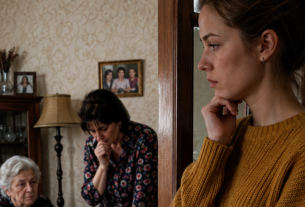
“You sit on my neck and still dare to reproach me for buying the wrong sausage?! You should be kissing my feet for feeding you, you freeloader! From today on, you’ll eat plain buckwheat until you bring home your first paycheck!”
“Again with this cheap sausage. Couldn’t you buy normal ham? I asked you yesterday. This is impossible to chew; it tastes like pressed cardboard with spices.”
Igor disdainfully speared a pale pink slice with his fork, smeared in tomato sauce, and twirled it in front of his face as if examining some exotic insect. He sat at the kitchen table in a fresh, neatly ironed T-shirt, smelling pleasantly of expensive aftershave. His face showed the highest degree of gastronomic disappointment.
Natalya froze with her fork raised over her plate. She had just worked a ten-hour shift, spent an hour in a packed bus, stopped by the supermarket for discounted groceries, and then spent the last forty minutes standing by a hot stove to make dinner. Fatigue weighed down her shoulders like a lead shell, and her feet throbbed as if a steamroller had driven over them. She looked at her hands, at the chipped polish on her nails, then shifted her gaze to her well-groomed, rested husband.
“Decent ham costs eight hundred rubles for half a kilo, Igor,” she said evenly, without any emotion. “This sausage was two hundred and fifty on the yellow discount label. A difference of five hundred and fifty rubles. And I saved that money today so we’d have something to pay the electricity bill with at the end of the month.”
“So what now, are we supposed to poison ourselves with substitutes?” Igor threw his fork onto the table in irritation. “I spent the whole day working on my résumé, monitoring the market, analyzing vacancies. My brain is boiling. I need quality protein, Natasha, not soy with dye. I’m not asking you to serve me marbled beef steaks. Just a piece of normal meat. These are the body’s basic needs!”
Natalya slowly put down her fork. She did not argue. She did not remind him that her logistics salary was not endless, and that from that money she paid the utilities, groceries, household supplies, and his unlimited internet. She simply got up from the table, walked over to Igor, and with one decisive movement took the plate right from under his nose.
“Hey, what are you doing?” he said indignantly, leaning back in his chair and crossing his arms over his chest. “Put it back. I didn’t say I wouldn’t eat it at all. I just made a comment so that in the future you’d plan the budget more intelligently and stop buying every piece of junk.”
Natalya walked to the sink and forcefully pressed the pedal of the trash bin with her foot. The plastic lid snapped open.
“The restaurant is closed. The menu for the unemployed is canceled,” she said in an icy voice and turned the plate over.
The hot pasta, mixed with sauce and chopped sausage, flew straight into the bag with potato peels with a wet, squelching sound. Igor opened his mouth; his face instantly became blotched red with outrage. He lunged forward, nearly knocking over the chair.
“Are you out of your mind?! I’m hungry! I haven’t eaten properly since morning. I was waiting for dinner!”
Natalya tossed the empty plate into the metal sink and slowly turned toward her husband. Her gaze was heavy, focused, and completely merciless.
“You sit on my neck and still dare to reproach me for buying the wrong sausage?! You should be kissing my feet for feeding you, you freeloader! From today on, you’ll eat plain buckwheat until you bring home your first paycheck!”
Igor jumped to his feet. His nostrils flared with anger.
“What kind of market-woman tone is that, Natasha?!” he tried to regain control of the situation with his usual bossy intonation. “I’m not a freeloader! I’m going through a temporary career crisis. I’m looking for a position as head of a logistics department, not as some errand boy. And instead of supporting a man during a difficult period, you’re making a scandal over a piece of cheap meat. You’re acting petty and stupid!”
“Temporary is when a person sits without work for a month. Maybe two,” Natalya replied, enunciating every word. “But a year is already a lifestyle, Igor. For exactly twelve months you’ve been in a ‘difficult period.’ You wake up at noon, drink coffee that I bought, wash yourself with shower gel that I bought, then sit down at the computer and watch YouTube videos, calling it ‘market analysis.’ Your crisis is costing me too much. I walk around in winter boots that leak so you can lecture me about quality protein!”
“I can’t go work as a courier or a shop assistant!” His voice broke into a squeal. “I have a specialized higher education! Management experience! If I accept a low position with a pathetic salary now, I’ll ruin my résumé forever! You simply don’t understand how modern recruiting works!”
“What’s ruining your résumé is a year-long gap,” Natalya shot back, not moving even a millimeter. “In that entire year, you haven’t been invited to a single decent interview. Not one! And do you know why? Because you’re a lazy coward. You hide behind high standards just so you don’t have to lift your backside off the couch.”
“Shut up!” Igor roared, clenching his fists. “You don’t understand anything about my field!”
“But I understand math perfectly. There are three packs of the cheapest groats on the shelf in the cupboard. That’s your diet for the next few days. I’m giving you exactly one week. Seven days. If by next Monday you haven’t found work—even sweeping streets as a janitor, even loading boxes at the warehouse around the corner—I’ll put your things out on the landing.”
“You have no right!” Igor jabbed a finger in her direction. “This is our family! I’m your lawful husband!”
“My husband earned money and shared responsibility with me. You’re a tenant who stopped paying rent. The apartment belongs to me, so I do have the right. The clock is ticking, Igor.”
Natalya turned away toward the sink, picked up a sponge, and turned on the cold water. The old refrigerator in the corner began to rumble steadily, as if confirming her words.
“And now get out of the kitchen,” she threw over her shoulder as she began scrubbing the sauce from the discarded plate. “I want to finish eating my cheap food in peace.”
“Don’t touch that. It’s my breakfast for work. Put it back.”
Natalya stood in the kitchen doorway with her arms crossed over her chest. It was two o’clock in the morning. She had woken up to quiet, creeping sounds: the creak of the refrigerator door and the rustle of packaging. She did not turn on the light—the streetlamp shining through the tulle was enough, casting deathly pale stripes across the kitchen and pulling her husband’s silhouette out of the darkness.
Igor froze with a sandwich near his mouth. In one hand he held a piece of white bread generously spread with processed cheese; in the other, a stick of smoked sausage that Natalya had bought for a coworker’s birthday so she would not have to chip in money but could bring something to the table instead. He had not even bothered to slice it—he was simply biting straight from the loaf like a barbarian.
“Are you spying on me?” he hissed with his mouth full, hastily swallowing an unchewed bite. “Are you a prison guard now? Do you sleep and dream about starving me to death?”
“I see you stealing food,” Natalya replied calmly, stepping into the kitchen and flicking on the switch.
The bright light struck their eyes, making Igor squint. Chaos reigned on the table: crumbs, an open jar of expensive coffee she had hidden deep inside the cupboard, and that same pot of buckwheat. The porridge in it had stood untouched for three days. It was covered with a dry, cracked crust, gray and lifeless, just like their relationship.
Igor finally chewed the bite and looked at his wife defiantly. There was no guilt in his eyes—only irritation and some childish, capricious resentment.
“I’m not stealing, Natasha. I’m taking food in my own home. This is absurd! You’ve turned into some petty market hag who counts every kopeck and every gram. I’m ashamed of you. Ashamed that my wife has sunk to such bestial behavior.”
“You’re ashamed?” Natalya walked over to the table, picked up the coffee jar, and deliberately screwed the lid back on. “And I’m ashamed that my husband, a healthy thirty-five-year-old grown man, secretly stuffs his face at night because during the day he proudly turns up his nose at normal food. What’s wrong with buckwheat? It’s fresh. It was fresh three days ago.”
“I can’t eat plain groats!” Igor flung the half-eaten sandwich onto the table. The cheese slapped butter-side down, leaving a greasy stain on the tablecloth. “It gives me heartburn. I need vitamins, fats! I can feel my memory weakening, my concentration dropping. How am I supposed to pass interviews if my hands are shaking from hypoglycemia? Did you think about that? Or do you not care about my health?”
“Interviews?” Natalya gave a bitter laugh. “What interviews, Igor? I checked the browser history yesterday. You spent three hours watching a stream of some game walkthrough, then read football news, and then slept. The only thing you’re ‘passing’ is levels in your little tank game.”
“That’s called emotional decompression!” he exploded, jumping up from his chair. “I’m not a robot! I need to switch off so I don’t burn out completely! You, with your primitive office job, will never understand how the mind of a person engaged in intellectual work functions. Logistics is systems, numbers, not mindless execution. And I’m a strategist! A manager! I need inspiration, resources!”
Natalya silently looked at him. Before, these speeches had made her doubt herself: maybe she really did not understand something? Maybe he truly needed time and a special atmosphere? But now, looking at the greasy stain on the tablecloth and the gnawed stick of sausage, she saw before her not an unrecognized genius, but an ordinary parasite.
“Your ‘resources’ cost me thirty thousand a month on food alone,” she said dryly. “Plus five thousand for utilities, two thousand for the internet you use for ‘decompression.’ Altogether, almost forty thousand. That’s my salary for two weeks of hard labor. Do you understand that you are eating up half my life? Literally. I work for you. Not for us, not for our future, but so you can play games and talk about lofty things.”
“You’re reproaching me over a piece of bread…” Igor shook his head, portraying deep disappointment. “How low. You know, in normal families, when one person has problems, the other offers a shoulder. They don’t set conditions and count expenses. You’re mercenary, Natasha. All you have in your eyes is a calculator. Where is your femininity? Where is your support? I will find a job, I’ll get a position with a salary three times higher than yours! And what will you say then? How will you look me in the eye?”
“When you find one, then we’ll talk,” Natalya cut him off. “Until then, the rules remain the same.”
She took the sausage from the table, wrapped it in a bag, and put it in the refrigerator. Then she picked up the coffee jar.
“I’m taking this with me in my bag. Sugar too. You have tea—the cheapest kind in bags. I’ll buy bread by half a loaf and bring it in the evening. If you eat my dinner or lunch, I’ll put a lock on the refrigerator. I’m not joking, Igor. I’ll buy a chain and a padlock. And you’ll look like a complete idiot in front of your friends if they suddenly drop by.”
“You’re sick…” Igor whispered, staring in horror at her calm, determined face. “You’re a psychopath. You need treatment. This is domestic violence, do you realize that? Economic violence!…”
Continuation just below in the first comment.
“Again with this cheap sausage. Couldn’t you buy normal ham? I asked you yesterday. This is impossible to chew; it tastes like pressed cardboard with spices.”
Igor disdainfully speared a pale pink slice with his fork, smeared in tomato sauce, and twirled it in front of his face as if he were examining some exotic insect. He was sitting at the kitchen table in a fresh, ironed T-shirt, smelling pleasantly of expensive aftershave lotion. His face expressed the highest degree of gastronomic disappointment.
Natalya froze with her fork raised over her plate. She had just worked a ten-hour shift, spent an hour in a crowded bus, stopped by the supermarket for discounted groceries, and spent the last forty minutes standing at the scorching stove to cook dinner. Fatigue weighed down her shoulders like a lead shell, and her feet throbbed as if a steamroller had run over them. She looked at her hands with chipped nail polish, then shifted her gaze to her well-groomed, rested husband.
“Normal ham costs eight hundred rubles for half a kilo, Igor,” she said evenly, without any emotion. “And this sausage was two hundred and fifty with the yellow discount tag. That’s a difference of five hundred and fifty rubles. And I saved that money today so we’d have something to pay the electricity bill with at the end of the month.”
“So what now, are we supposed to poison ourselves with substitutes?” Igor threw his fork onto the table irritably. “I spent the whole day working on my résumé, monitoring the market, analyzing vacancies. My brain is boiling. I need quality protein, Natasha, not soy with dye. I’m not asking you to serve me marbled beef steaks. Just a piece of normal meat. These are the body’s basic needs!”
Natalya slowly put down her fork. She did not argue. She did not remind him that her salary as a logistics specialist was not endless, and that from that money she paid for utilities, groceries, household chemicals, and his unlimited internet. She simply got up from the table, walked over to Igor, and with one decisive movement took the plate right from under his nose.
“Hey, what are you doing?” he said indignantly, leaning back in his chair and crossing his arms over his chest. “Put it back. I didn’t say I wouldn’t eat it at all. I just made a comment so that in the future you’d plan the budget more intelligently and stop buying every kind of trash.”
Natalya walked to the sink and forcefully pressed the pedal of the trash bin with her foot. The plastic lid snapped open sharply.
“The restaurant is closed. The unemployed menu is canceled,” she said in an icy tone and turned the plate over.
Hot pasta mixed with sauce and chopped sausage flew straight into the bag with potato peels with a wet, squelching sound. Igor opened his mouth; his face instantly became blotched red with outrage. He jerked forward, nearly knocking over the chair.
“Are you out of your mind?! I’m hungry! I haven’t eaten properly since morning. I was waiting for dinner!”
Natalya threw the empty plate into the metal sink and slowly turned toward her husband. Her gaze was heavy, focused, and absolutely merciless.
“You’re living off me and still dare to complain that I bought the wrong sausage?! You should be kissing my feet for feeding you, you freeloader! From today on, you’ll eat only plain buckwheat until you bring home your first paycheck!”
Igor jumped to his feet. His nostrils flared with anger.
“What kind of market-woman tone is that, Natasha?!” he tried to take control of the situation with his usual bossy intonation. “I’m not a freeloader! I’m having a temporary career crisis. I’m looking for a position as head of a logistics department, not as some errand boy. And instead of supporting a man during a difficult period, you’re making a scandal over a piece of cheap meat. You’re behaving in a petty and stupid way!”
“Temporary is when a person sits without work for a month. Maybe two,” Natalya replied, enunciating every word. “But a year is already a lifestyle, Igor. For exactly twelve months, you have been in a ‘difficult period.’ You wake up at noon, drink coffee that I bought, wash yourself with shower gel that I bought, then sit down at the computer and watch YouTube videos, calling it ‘market analysis.’ Your crisis is costing me too much. I walk around in winter boots that leak so you can talk about quality protein!”
“I can’t go work as a courier or a shop assistant!” His voice broke into a squeal. “I have a specialized higher education! Management experience! If I accept a low position with a pathetic salary now, I’ll ruin my résumé forever! You simply don’t understand how modern recruiting works!”
“What’s ruining your résumé is a year-long gap,” Natalya shot back, not moving even a millimeter. “In this entire year, you haven’t been invited to a single decent interview. Not one! And do you know why? Because you’re a lazy coward. You hide behind high standards just so you don’t have to lift your backside off the couch.”
“Shut up!” Igor roared, clenching his fists. “You don’t understand anything about my field!”
“But I understand math perfectly. There are three packs of the cheapest groats on the shelf in the cupboard. That is your diet for the next few days. I’m giving you exactly one week. Seven days. If by next Monday you haven’t found work—even sweeping streets as a janitor, even loading boxes at the warehouse around the corner—I’ll put your things out on the stairwell landing.”
“You have no right!” Igor jabbed a finger toward her. “This is our family! I’m your lawful husband!”
“My husband earned money and shared responsibility with me. And you are a tenant who stopped paying rent. The apartment belongs to me, so I do have the right. The clock is ticking, Igor.”
Natalya turned away toward the sink, picked up a sponge, and turned on the cold water. The old refrigerator in the corner began to rumble steadily, as if confirming her words.
“And now get out of the kitchen,” she threw over her shoulder as she began scrubbing the sauce off the discarded plate. “I want to finish eating my cheap food in peace.”
“Don’t touch that. That’s my breakfast for work. Put it back.”
Natalya stood in the kitchen doorway with her arms crossed over her chest. It was two o’clock in the morning. She had woken up to quiet, creeping sounds: the creak of the refrigerator door and the rustle of packaging. She did not turn on the light—the streetlamp shining through the tulle was enough, casting deathly pale stripes across the kitchen and pulling her husband’s silhouette out of the darkness.
Igor froze with a sandwich near his mouth. In one hand he held a piece of white bread generously spread with processed cheese; in the other, a stick of smoked sausage that Natalya had bought for a coworker’s birthday so she would not have to chip in money but could bring something to the table. He had not even bothered to slice it—he was simply biting straight from the loaf like a barbarian.
“Are you spying on me?” he hissed with his mouth full, hastily swallowing an unchewed piece. “Are you a prison guard now? Do you sleep and dream about starving me to death?”
“I see you stealing food,” Natalya replied calmly, stepping into the kitchen and flicking on the light.
The bright light hit their eyes, making Igor squint. Chaos reigned on the table: crumbs, an open jar of expensive coffee that she had hidden deep in the cupboard, and that same pot of buckwheat. The porridge in it had stood untouched for three days. It was covered with a dry, cracked crust, gray and lifeless, just like their relationship.
Igor finally chewed the bite and looked at his wife defiantly. There was no guilt in his eyes—only irritation and some childish, capricious resentment.
“I’m not stealing, Natasha. I’m taking food in my own home. This is absurd! You’ve turned into some petty market hag who counts every kopeck and every gram. I’m ashamed of you. Ashamed that my wife has sunk to such beastliness.”
“You’re ashamed?” Natalya walked over to the table, picked up the coffee jar, and demonstratively screwed the lid back on. “And I’m ashamed that my husband, a healthy thirty-five-year-old grown man, secretly stuffs his face at night because during the day he proudly turns up his nose at normal food. What’s wrong with buckwheat? It’s fresh. It was fresh three days ago.”
“I can’t eat plain groats!” Igor threw the half-eaten sandwich onto the table. The cheese slapped butter-side down, leaving a greasy stain on the tablecloth. “It gives me heartburn. I need vitamins, fats! I can feel my memory weakening, my concentration dropping. How am I supposed to pass interviews if my hands are shaking from hypoglycemia? Did you think about that? Or do you not care about my health?”
“Interviews?” Natalya gave a bitter laugh. “What interviews, Igor? I checked the browser history yesterday. You spent three hours watching a stream of someone playing a game, then read football news, and then slept. The only thing you’re ‘passing’ is levels in your little tank game.”
“That’s called emotional decompression!” he flared up, jumping from his chair. “I’m not a robot! I need to switch off so I don’t burn out completely! You, with your primitive office job, will never understand how the mind of a person engaged in intellectual labor works. Logistics is systems, numbers, not mindless execution. And I’m a strategist! A manager! I need inspiration, resources!”
Natalya silently looked at him. Before, these speeches had made her doubt herself: maybe she really did not understand something? Maybe he truly needed time and a special atmosphere? But now, looking at the greasy stain on the tablecloth and the gnawed stick of sausage, she saw before her not an unrecognized genius, but an ordinary parasite.
“Your ‘resources’ cost me thirty thousand a month on food alone,” she said dryly. “Plus five thousand for utilities, two thousand for the internet you use for ‘decompression.’ Altogether, almost forty thousand. That’s my salary for two weeks of hard labor. Do you understand that you are eating up half my life? Literally. I work for you. Not for us, not for the future, but so you can play games and talk about lofty things.”
“You’re reproaching me over a piece of bread…” Igor shook his head, portraying deep disappointment. “How low. You know, in normal families, when one person has problems, the other offers a shoulder. They don’t set conditions and count expenses. You’re mercenary, Natasha. All you have in your eyes is a calculator. Where is your femininity? Where is your support? I will find a job, I’ll get a position with a salary three times higher than yours! And what will you say then? How will you look me in the eye?”
“When you find one, then we’ll talk,” Natalya cut him off. “Until then, the rules remain the same.”
She took the sausage from the table, wrapped it in a bag, and put it in the refrigerator. Then she picked up the coffee jar.
“I’m taking this with me in my bag. The sugar too. You have tea—the cheapest kind, in bags. I’ll buy bread by half a loaf and bring it in the evening. If you eat my dinner or lunch, I’ll put a lock on the refrigerator. I’m not joking, Igor. I’ll buy a chain and a padlock. And you’ll look like a complete idiot in front of your friends if they suddenly drop by.”
“You’re sick…” Igor whispered, staring in horror at her calm, determined face. “You’re a psychopath. You need treatment. This is domestic violence, do you realize that? Economic violence!”
“Violence is making me work for two while you wear out the couch,” Natalya took a rag and wiped the greasy stain from the table. Her movements were sharp and mechanical. “That’s it. The conversation is over. Either eat buckwheat or drink tap water. Good night.”
She turned and headed for the exit. At the doorway, she stopped without turning around.
“And by the way, Igor. Tomorrow, half the deadline is up. Three days have passed. There are five janitor vacancies in our district. I saw the notices on the apartment entrances. If your pride won’t let you sweep courtyards, go wash floors at Pyaterochka. They’re hiring too.”
“I’m not going to wash floors!” he shouted at her back, his voice trembling with powerless rage. “I didn’t find myself in a dump!”
“Too bad,” Natalya threw back, switching off the hallway light. “Judging by your behavior, that’s exactly where you belong.”
She went into the bedroom and shut the door firmly. Igor was left in the dark kitchen. He heard the refrigerator humming, the water dripping from the tap he had never fixed, though he had promised to do it six months ago. His stomach treacherously growled, demanding the banquet continue, but there was no more food. On the table, in the moonlight, the pot of dried-out buckwheat sat there black and lonely.
Igor walked over to it and lifted the lid with disgust. The smell of cold, plain porridge hit his nose, making him nauseous. He slammed the lid back down with a crash.
“Bitch,” he whispered into the darkness, clenching his fists so tightly his knuckles turned white. “Fine. You’ll dance for me yet. You’ll regret talking to me like that. I’ll give you an ‘economic miracle.’”
He grabbed the mug on the table, which still had some unfinished sweet tea in it, and angrily splashed the contents into the sink. Droplets scattered over the clean tiles Natalya had scrubbed on the weekend. It was a small, nasty revenge, but it brought him a second of relief. He was not going to give up. He was not going to humiliate himself by becoming a cleaner. He would find a way to make her feel guilty. He would break this stupid blockade of hers, and she herself would bring him normal food on a little plate.
The key turned in the lock with difficulty, as if the apartment itself resisted the return of its owner. Natalya pushed the door open and immediately grimaced: a wave of stuffy, damp air hit her face, saturated with the smell of something burned and cheap air freshener. But worse than the smell was the sound. The television in the living room was blaring at maximum volume—some talk show was on, where people were shouting over one another, creating an unbearable cacophony.
Natalya dropped her bag on the shelf and froze. The light was on in the hallway. The light was on in the bathroom. The light was on in the kitchen too. From the half-open bathroom door came the sound of running water.
“Igor!” she shouted, trying to be heard over the screams from the television.
No one answered. She stepped into the bathroom. The faucet was turned on full blast; hot water was pouring into the sink, overflowing over the edge and rushing into the drain, which could not handle the pressure. The steam was so thick the mirror had fogged up. Natalya twisted the valve shut forcefully, feeling cold rage boil inside her. The meters. He was deliberately running up the meters.
She went into the living room. Igor was lying on the sofa in nothing but his underwear, his legs thrown over the backrest. Beside him on the floor were empty chip bags, crumbs, and dirty socks. He did not even turn his head when she entered, continuing to hypnotize the screen.
“What are you doing?” Natalya walked over to the cabinet and yanked the television cord from the socket. The screen went dark, and in the sudden silence she could hear the hum of her own tension. “Why did you turn on the water? Why are the lights on in the whole apartment? Have you decided to bankrupt me?”
Igor slowly sat up, scratching his stomach. His face expressed the absolute, impenetrable calm of a man who had decided to declare war on common sense.
“I need atmosphere,” he drawled lazily, looking at her with a cloudy gaze. “I was trying to create a working mood. Creative thinking needs light, space, sound. And the water… the sound of water calms the nerves. You drove me to a nervous breakdown with your ultimatums.”
“Are you mocking me?” Natalya gestured around the room. “You burned through hundreds of rubles’ worth of electricity in one evening. You poured cubic meters of hot water down the drain for nothing! While I was busting my back to buy you that same buckwheat, which, by the way, you still haven’t eaten!”
“I can’t eat that filth, I told you,” Igor yawned, demonstratively opening his mouth wide. “And anyway, Natasha, let’s dot the i’s. You want me to look for a job? Fine. I’m looking. But job searching is work too. And the household is your duty. You’re a woman. The keeper of the hearth. And look what you’ve turned the home into. Dirt, dust, an empty refrigerator. How can I focus on my career development strategy in a pigsty?”
Natalya choked with outrage. She walked into the kitchen, and what she saw there made her stop. The sink was piled with a mountain of dishes. But it was not just dirty dishes—it was every plate, cup, and pot in the house. Grease, dried ketchup residue, macaroni stuck from three days ago. It seemed he had deliberately dirtied everything he could so he would not have to wash even a single spoon.
“You sat at home all day,” she said quietly, feeling her hands tremble. “You couldn’t wash your own cup? You waited until I came home from work at nine in the evening and stood at the sink?”
Igor appeared in the kitchen doorway, leaning his shoulder against the frame. He looked at her with an insolent smirk that radiated triumph.
“I didn’t hire myself out to be your maid, dear. We have a partnership marriage, remember? I handle global issues, you handle current ones. Washing plates is not within my level of competence. It’s primitive labor that kills the leader in me.”
“Leader?” Natalya turned toward him, clutching the rag in her hand so tightly her knuckles turned white. “You’re not a leader, Igor. You’re a parasite. An ordinary domestic parasite. You don’t work, you don’t help around the house, you only consume resources. You devour my time, my money, my nerves. Did you send even one résumé today?”
“I was studying trends!” he barked, and his feigned calm cracked. “Don’t you dare control my every step! I can’t send résumés into the void! I need to prepare the ground!”
“What ground?!” Natalya threw the rag into the sink. Dirty water splashed onto the countertop. “You’ve been preparing the ground for a year! In that year, you could have learned Chinese or mastered a new profession! And all you’ve learned is how to lie masterfully and make a mess in your own apartment!”
“Don’t raise your voice at me!” Igor took a step forward, looming over her. He tried to use his height and weight to suppress her, to make her shut up. “It’s your fault! You created an unbearable atmosphere in this home! I’m depressed because of you! Your greed, your petty counting of kopecks over sausage—it all kills my self-esteem! If you supported me, I would have been a director long ago!”
“Oh, so it’s my fault?” Natalya looked him straight in the eye. There was no fear or pity in her gaze anymore, only cold contempt. “It’s my fault that you’re a lazy nobody? Fine. If I’m such a bad wife, it won’t be hard for you to find a better one. But while you are here, you will live by my rules.”
She walked over to the table, where his favorite mug stood—the only clean thing in the kitchen, which he had apparently saved for himself.
“You said washing dishes wasn’t your level? Excellent. That means you won’t have clean dishes.”
Natalya took the mug and slammed it into the sink, right onto the pile of dirty plates. The sound of breaking ceramic rang out. Igor flinched as if he himself had been struck.
“You’re sick…” he hissed. “That was a gift mug!”
“It was my mug, Igor. I bought it. Just like everything in this apartment. And you know what? I’m not washing this. I’ll wash one plate and one fork for myself. And you’ll eat from a dirty one. Or from your palms. Or straight from the frying pan, like an animal. Because you behave like a pig, so you’ll live in a pigsty.”
“I won’t allow myself to be treated like this!” he screamed, his face blotching red. “You’re humiliating a man! You’ll regret this! I’ll leave!”
“The door is there,” Natalya pointed toward the hallway. “Straight ahead and to the right. Should I pack your things? Or will you go like that, in your underwear? It’s warm outside, you won’t freeze.”
Igor froze. He breathed heavily, his nostrils flaring. He understood that he was bluffing. He had nowhere to go. His friends had long stopped lending him money, his parents lived in a tiny one-room apartment in another city and did not want to hear anything about his “crises.” He was trapped in a cage he had built himself, but admitting that meant losing completely.
“I’m not going anywhere,” he hissed through his teeth, changing tactics. Aggression gave way to poisonous spite. “This is my apartment too. I’m registered here. And I’ll do whatever I want. I’ll turn on the lights, the water, the music. I’ll invite guests. And you won’t do anything. Because you’re weak. Without me, you’ll howl from loneliness within a week. Who needs you, an old, always dissatisfied hag with a penny salary?”
Those words were supposed to hit where it hurt, to humiliate her as a woman. But Natalya only gave a bitter smile.
“I’d rather howl from loneliness in a clean apartment with a full refrigerator than live with a bedbug that drinks my blood,” she said quietly. “You haven’t understood, Igor. This isn’t a quarrel. This is war. And you’ve already lost it, because you have no resources. You have nothing. Not even pride.”
She turned away and began methodically pulling her small salad bowl out of the pile of dishes. She washed it under a thin stream of cold water, trying not to look at her husband.
Igor stood behind her for another minute, puffing with anger. He wanted to hit her, break something, shout, but he ran into a wall of complete indifference. His methods no longer worked. And from that helplessness, he decided to do the only thing left to him—to make as nasty a mess as possible.
“Well, all right,” he suddenly said in a completely calm, cheerful voice that made goosebumps run down Natalya’s back. “If it’s war, then it’s war. You don’t want to wash dishes? Don’t. You don’t want to buy food? Don’t. I’ll find a way to get what’s mine. I have methods too. We’ll see what tune you sing tomorrow.”
He turned sharply and left the kitchen, deliberately dragging his feet loudly. A second later, the television in the living room started blaring again—even louder than before. The walls trembled from the bass of some advertisement.
Natalya closed her eyes, leaning her hands against the edge of the sink. Her head was splitting. She understood this was not the end. He was not just lazy—he was vindictive. He had decided to punish her for daring to stop being convenient. Tomorrow would be the final day of her ultimatum. And judging by his mood, he was preparing something grand. Something that was supposed to finally break her will.
But she would not break. Beneath the layer of exhaustion, a cold fire of determination was igniting inside her. She dried the plate, put it into the cupboard, and went to the bedroom, mentally pulling imaginary earplugs out of her ears as she walked. Let the television scream. Let the water run. Tomorrow everything would end. One way or another.
“Well, why are you frozen in the doorway? Come in, hostess, don’t be shy. As you can see, we’re having a board of directors meeting here. Discussing start-ups and global markets.”
Igor’s voice was drawn-out, loose, and soaked in that special sticky courage alcohol gives to a cowardly man. He sat in the kitchen, sprawled in a chair so heavily that it creaked miserably under his weight. Opposite him sat some unfamiliar man—skinny, with shifty little eyes, wearing a stretched-out hoodie.
Natalya slowly lowered her bag to the floor. The heavy smell of alcohol breath mixed with tobacco smoke hit her nose—they had been smoking out the small window, but the smoke still hung under the ceiling in a bluish cloud. But she was not looking at the guest or at her husband. Her gaze was fixed on the round-bellied bottle of cognac standing in the center of the table among dirty plates with dried buckwheat and sausage ends.
It was twelve-year-old Hennessy. A gift from the general director for successfully closing the quarter. She had been saving it for six months. She had hidden it in the back cabinet, dreaming that someday she and Igor would open it for a special occasion—on their anniversary or when he finally found a job. Now the bottle was three-quarters empty.
“This is Vadik,” Igor carelessly waved toward his drinking buddy, nearly knocking over a shot glass. “An old university friend of mine. A very smart man, by the way. Not like some people who can’t see beyond invoices. We’re developing a strategy here.”
Vadik gave an uncertain giggle and tried to hide his eyes by staring into his glass. He was clearly uneasy under the heavy, dead stare of the apartment’s owner.
“Strategy?” Natalya repeated quietly. She walked into the kitchen without taking off her shoes. Dirt from her outdoor boots remained on the light laminate, but she did not care. “A strategy for drinking someone else’s property?”
“Oh, here we go!” Igor rolled his eyes and theatrically threw up his hands. “Vadik, look at her. This is exactly what I was telling you about. Pettiness! Total pettiness. I’m treating a friend, and she’s counting grams. Natasha, it’s cognac! It was made to be drunk, not worshiped like an icon. You’re behaving like a petty bourgeois.”
“That cognac cost ten thousand rubles, Igor,” she said in an even, emotionless voice. “That is half of what we spend on food in a month. And you poured it down the throat of a man I’m seeing for the first time in my life, using my last sausage as a snack.”
“I’m not ‘some man’!” Vadik suddenly spoke up, clearly emboldened by the alcohol. “For your information, I’m a promising crypto investor! Igor and I are working on something…”
“Get up and get out,” Natalya interrupted him. She did not shout. She spoke the way one speaks to annoying insects before swatting them with a slipper. “Both of you.”
“You don’t dare kick out my guests!” Igor slammed his palm on the table. The shot glass jumped and fell, rolling across the tablecloth. “I live here! I have a right to personal space and socialization! If you don’t like it, go to the bedroom and lock yourself in. Don’t interfere with men talking.”
Natalya walked right up to the table. She picked up the unfinished bottle of expensive cognac. Igor jerked as if to snatch it from her, but he was too late. Natalya calmly turned the bottle upside down over the sink. The amber liquid gurgled and disappeared down the drain, mixing with dirty greasy water.
“What the hell are you doing, bitch?!” Igor shrieked, jumping from his chair. His face twisted with rage. “That’s money!”
“That’s not money. That’s my nerves melted into glass,” Natalya set the empty bottle on the table with a loud thud. “Vadik, you have exactly thirty seconds to disappear from my apartment. Otherwise I’ll call the police and say you stole valuables. And believe me, they’ll believe me, not two drunk unemployed men.”
The “crypto investor” Vadik instantly assessed the situation. The drunken fog vanished from him like husk. He mumbled something unintelligible, grabbed his jacket from the back of the chair, and, without saying goodbye, slipped sideways into the hallway. The front door slammed.
Igor was left alone. He stood in the middle of the wrecked kitchen, breathing heavily, and looked at his wife with hatred mixed with animal fear. He understood he had gone too far, but the alcohol demanded the banquet continue.
“So what did you achieve?” he hissed, narrowing his eyes. “Humiliated me in front of my friend? Showed who’s boss in the house? You think I’ll crawl on my knees now? Just look at yourself! You’re a gray mouse! A twitchy, old, boring woman. Who needs you except me? I tolerated your nasty character, your greed, your lack of taste… I lived with you out of pity!”
“Out of pity?” Natalya gave a bitter laugh. “You lived with me out of greed, Igor. Out of convenience. Because I was your feeding trough, laundry woman, and mommy all in one.”
She turned and went into the bedroom. Igor staggered after her, continuing to spit insults at her back.
“I’ll find myself a younger, prettier woman tomorrow! One who will value me! One who won’t count pieces of sausage! And you’ll rot here alone with your reports! You’re empty! You’re nobody without me! I gave you the status of a married woman!”
Natalya entered the room and pulled a large wheeled suitcase down from the storage shelf. She unzipped it with a sharp sound like tearing fabric.
“Status?” She began raking his things from the shelves and throwing them into the suitcase haphazardly: wrinkled T-shirts, jeans, socks. “The status of a parasite’s wife? Thank you, I’ve had enough. Your week is over, Igor. You didn’t find a job. You didn’t bring in a single kopeck. You didn’t even try. You just drank and waited for me to break.”
“Hey, don’t you dare touch my things!” He tried to snatch a sweater from her, but Natalya forcefully pushed his hand away. “I’m not going anywhere! This is my apartment!”
“This is my grandmother’s apartment, which I inherited before marriage,” she reminded him sharply, continuing to methodically stuff his junk into the suitcase. “You are nobody here. You have no share and no rights. You’re just a guest who overstayed his welcome.”
“I’ll sue! I’ll claim half the property! I’ll prove that I invested in the renovation!”
“The only thing you invested was your backside into the sofa,” Natalya cut him off. “Try it. Hire a lawyer. Oh, right, you don’t even have money for the subway. What are you going to sue with, ‘strategist’? Vadik’s money?”
She zipped up the suitcase, which bulged from the carelessly packed things, and stood it upright. Then she took his laptop from the nightstand and shoved it into his hands.
“Take your ‘self-searching’ tool. And leave. Right now.”
Igor stood there, clutching the laptop to his chest, and suddenly realized this was not a game. This was not another quarrel after which they could make up in bed or stay silent for a couple of days. This was the end. His cozy world with free food, internet, and a soft sofa was collapsing before his eyes.
The expression in his eyes changed. His arrogance disappeared, replaced by panic.
“Natasha… wait. What are you doing? So we drank a little, so what? It happens,” he tried to smile, but it came out as a pathetic grimace. “Let’s talk calmly. Tomorrow. I love you. We’re family. I promise, from Monday… honest, I’ll go to an interview.”
“No, Igor,” Natalya rolled the suitcase into the hallway. The wheels knocked hollowly against the floor, beating out the rhythm of the end of their marriage. “There will be no Monday. And there is no family anymore. There is me, and there is a strange man who reeks of alcohol.”
She opened the front door and placed the suitcase on the stairwell landing.
“Go out.”
“Natasha, where am I supposed to go at this hour?” he whined, shuffling on the threshold. “I don’t have a kopeck, my phone is dead. Have a conscience! At least let me spend the night!”
“Go to Vadik. Or to your mother. Or to the train station—it’s warm there and full of the same kind of ‘unrecognized geniuses,’” Natalya pressed her hand against his back and forcefully pushed him out onto the stairwell landing.
Igor stumbled but kept his balance. He turned around, and his face twisted with malice again. Realizing that pleading did not work, he decided to strike as painfully as possible one last time.
“Damn you!” he shouted so loudly that the echo spread through the whole building entrance. “You’ll die alone, you unwanted bitch! I’ll rise up! I’ll become rich, and you’ll crawl back to me, begging, but I won’t even look in your direction! You’ll regret this!”
“The only thing I regret is the year I wasted and the sausage you ate,” Natalya answered coldly.
She slammed the door right in front of his nose. The lock clicked. Then the second one. Then she put on the chain, although she knew he had no keys—she had taken them from his jacket while packing his things.
For a couple more minutes, there were thuds of fists and drunken curses behind the door, but Natalya was no longer listening. She leaned her back against the cold metal of the door and slowly slid down to the floor. A ringing silence hung in the apartment, but it was not the kind of silence that crushes. It was the kind that heals.
The kitchen reeked of alcohol fumes and cheap cigarettes. A mountain of dishes towered in the sink. Crumbs lay on the table. But Natalya knew that tomorrow she would clean it all. She would wash the floor, air out the rooms, throw away the old sofa. And she would buy herself two hundred grams of the most expensive ham.
And she would eat it alone, in silence and peace, enjoying every piece of her life—now truly only hers.