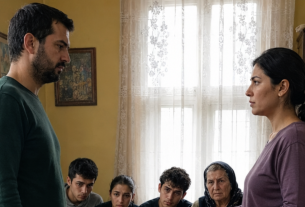
“If you don’t want to help Alina, then move out of the apartment by the end of the month,” Galina Ivanovna said so calmly, as if she were asking someone to pass the sugar bowl.
Vera did not even immediately understand the meaning of what had been said. On the table stood cups of cooling tea, a plate of sweet cheese buns, and a small bowl of jam. In the next room, six-year-old Masha was sitting on the sofa, coloring a paper doll she had cut out of an old magazine.
Anton froze with a spoon in his hand.
“Mom, are you serious right now?”
“What’s wrong?” Galina Ivanovna adjusted the napkin on the table. “You’ve been living in my apartment for six years, paying only the utilities, and when it comes time to help your own sister, suddenly you don’t have any money. So don’t be offended. The apartment is mine. I decide what to do with it.”
Vera looked at her husband. His face looked as if he had been struck with something heavy and blunt. He was always slow to grasp things in conversations like this. Not because he was stupid. He simply kept hoping, until the very last moment, that close relatives would not say out loud what they had long been holding in their minds.
But Vera understood everything immediately.
She had been expecting this conversation since the day Galina Ivanovna called on Wednesday and said in an overly cheerful voice:
“Come over on Saturday, all of you. We’ll sit down and discuss a little family matter. I’ll make pancakes for Mashenka.”
Whenever her mother-in-law said “as a family,” it never meant just tea and pancakes. It meant that she had already decided everything, assigned everyone their roles, and all that remained for the others was to nod at the right time.
They drove to the dacha in silence.
Masha sat in the back seat, talking about kindergarten, about her friend Polina, who drew butterflies better than anyone, and about the song they were learning.
Anton nodded and answered at random. Vera looked out the window and thought about the one million two hundred and forty thousand they had in their account. Three years without a vacation. Three years without spontaneous purchases. Three years of expense spreadsheets, refusing everything unnecessary, and saying, “Not now, later.”
That money was not just money. It was the down payment on their own apartment.
Galina Ivanovna lived at the dacha almost all year round.
The house was solid, insulated, with a gas boiler, a small bathhouse, and two greenhouses. Six years earlier, she had “given the young couple” her two-room city apartment.
That was exactly how she described it to neighbors and relatives. But from the very first day, Vera understood the difference between “gave it to them” and “let them live there.” According to the documents, the owner of the apartment was Galina Ivanovna. And no one else.
During lunch, her mother-in-law first asked her granddaughter about school, then complained about grocery prices, and then smoothly shifted the conversation to her younger daughter.
“My Alina is such a clever girl,” she said with that special pride Vera had been hearing for many years. “She has golden hands. She sews so well you can’t tell her work from store-bought things. If only she could open her own business instead of working for someone else for pennies.”
Alina was sitting nearby, thin, lively, with a new haircut and a manicure the color of baked milk. She was twenty-six. For the past five years, she had alternately gotten jobs at a curtain salon, quit, sewn children’s dresses to order, and then given up because “clients were exhausting.”
Now, as it turned out, she had a new dream.
“I found a place near the market,” Alina said, brightening. “It’s small, but there’s a lot of foot traffic. I want to open an atelier for clothing repair and alterations. Plus curtain sewing. It’s all very in demand right now. People are buying fewer new things and altering more old ones.”
Vera listened silently. The idea itself was not crazy. People really did hem trousers, replace zippers, shorten curtains. The question was something else: who was going to pay for the start-up costs?
“How much do you need?” Anton asked.
Galina Ivanovna seemed to have been waiting for exactly that question.
“Six hundred thousand. Sewing machines, a serger, a table, a sign, two months’ rent, and all sorts of small things. It’s manageable for you. You have savings.”
Vera slowly set down her cup.
“How do you know how much we have saved?”
Her mother-in-law looked not at her, but at her son.
“Anton told me. What’s wrong with that? Should he hide things from his mother?”
Vera turned her gaze to her husband. He guiltily looked away.
“I didn’t think the conversation would come to this,” he said quietly. “I just said we were saving.”
“And named the amount,” Vera replied just as quietly.
Alina rolled her eyes.
“Oh my God, can we not do this? I’m not asking forever. I’ll pay it back. Not tomorrow, of course, but gradually. Are we family or not?”
“We are family,” Vera nodded. “That’s why I’m asking. Alina, have you calculated your break-even point?”
“Your what?”
“How many orders a month do you need just to cover the rent? Not to make a profit, but simply not to go into the red.”
Alina fell silent.
“Well, I have a rough idea.”
“Roughly is not a number. How much is the rent?”
“Fifty-two thousand. But it’s a good location.”
“Plus a deposit for one month?”
“Yes.”
“Plus renovation, electricity, supplies, a cash register. If you’re planning to hire a second seamstress, self-employed status won’t work anymore. You’ll need to register as an individual entrepreneur. Have you calculated taxes and insurance contributions too?”
“Vera, you’re always like this,” Alina grimaced. “It’s impossible to discuss anything with you like a normal person. It’s all horror stories with you.”
“Not horror stories. Numbers. Six hundred thousand isn’t the same as buying a napkin.”
Galina Ivanovna exhaled loudly.
“That’s enough interrogating the girl. We’re not at a bank. We need help from you, not an audit.”
“Help comes in different forms,” Vera said. “We can help make a plan, check the lease agreement, explain taxes. But we can’t give away half our savings for a business that hasn’t been properly calculated.”
“You can’t?” her mother-in-law repeated. “Or you don’t want to?”
Anton rubbed his forehead.
“Mom, it really is a large amount. We need to think.”
“What is there to think about?” Galina Ivanovna raised her voice. “I’ve kept you in my apartment for six years. Six years! If you’d been renting, you would have already paid millions in rent. And during all these years, you managed to build a cushion for yourselves, and now you’re turning up your noses.”
“We’re not turning up our noses,” Anton said. “We’re saving for our own home.”
“Your own?” his mother smirked. “You already live in a home. Or is my apartment not good enough for you?”
That was when Vera finally said what she had been keeping inside for a long time.
“Galina Ivanovna, we do not live in our own home. We live in your home. And today you have made that perfectly clear.”
The table fell silent.
And then her mother-in-law said the very phrase:
“If you don’t want to help Alina, then move out of the apartment by the end of the month.”
And now, a few seconds after those words, everything had already changed.
Vera was the first to rise from the table.
“All right,” she said. “We’ll move out.”
Galina Ivanovna blinked.
“I didn’t say today.”
“You’re right. The apartment is yours. Which means it’s time for us to live on our own terms.”
“Vera, wait,” Anton said hoarsely.
But she had already gone to the room to get Masha.
The road home was long.
Masha fell asleep in the car, her head resting on a soft toy. Anton drove in silence, gripping the steering wheel so tightly his fingers turned white. Vera was silent too. Not from resentment. From exhaustion. Sometimes a conversation ends not when everything has been said, but when there is nothing left to explain.
At home, after putting Masha to bed, they sat down in the kitchen.
“Did you do that on purpose?” Anton finally asked.
“Do what exactly?”
“Say, ‘All right, we’ll move out.’ As if you had already decided everything.”
“I didn’t decide today. I decided long ago. I just hoped it wouldn’t come to this.”
He lowered his eyes.
“This is my fault. I shouldn’t have told my mother about the money.”
“This isn’t only about the money, Anton. It’s about the fact that your mother has considered the apartment a lever of manipulation all this time. It was simply convenient for her to stay silent before.”
“She got carried away.”
“No. She said what she thinks. In moments like that, people don’t misspeak. They reveal themselves.”
He was silent for a long time, then asked quietly:
“So what now?”
“Now we find a rental for a couple of months and take out a mortgage. We have the down payment. We have maternity capital. Yes, it will be hard. But at least no one will remind us anymore how much their ‘kindness’ costs.”
Anton sat, staring at the table. Vera could see how much it hurt him. Her husband was not a mama’s boy. He did not run at every call.
But inside him lived an old childhood habit: mother must be protected, mother must not be upset, mother only wants what is best.
“Do you really want to leave?” he asked.
“I want to open the door with my own key and know that no one can throw us out because of someone else’s whims.”
A week later, they found a rental apartment.
It was not near the kindergarten, not as bright as they would have liked, and it had no dishwasher, which Vera had already gotten used to. But it had a separate room for Masha.
They packed in the evenings. Vera put dishes into boxes and labeled them with a marker: “Kitchen,” “Books,” “Masha’s toys.”
Anton took the keys to his mother alone. He came back late, gray-faced and red-eyed.
“What did she say?” Vera asked.
“That I’m ungrateful. That you turned me against my family. That at least Alina is trying to achieve something, while we only think about ourselves.”
“And you?”
“For the first time in my life, I didn’t try to justify myself.”
The first month in the rental apartment was difficult.
In the mornings, Vera took Masha to kindergarten, then went to work in accounting. In the evenings, she picked up her daughter, cooked, and calculated expenses.
Anton took extra jobs. He worked as a technician installing air conditioners and ventilation systems, and the season had just begun. They were both so tired that they fell asleep the moment their heads touched the pillow.
But the money in the account did not disappear. And when the bank manager laid out the mortgage options before them, Vera suddenly felt not fear, but relief.
“The monthly payment will be thirty-one thousand,” the employee said, sliding the printout toward them. “Taking into account your down payment and maternity capital. The term is twenty years.”
Twenty years sounded frightening. But even more frightening was depending again on someone else’s mood.
They did not find an apartment right away. Vera toured half the city with a realtor and looked at countless options. In the end, they settled on a small two-room apartment in a new building on the outskirts. A bit far away. No designer renovation. But the windows faced the courtyard, and the children’s room had space not only for a desk and a bed, but also a wardrobe.
They almost never spoke about Galina Ivanovna. Not out of generosity. They simply had no strength left to chew over the same thing again.
Sometimes she called Anton. The conversations became shorter and shorter. Without the former confidence, without lectures. Once Vera accidentally heard him say:
“No, Mom, we don’t have any spare money. We have a mortgage.”
And for the first time, there was neither guilt nor a plea for understanding in those words.
They learned about Alina’s atelier in the autumn.
Vera ran into her mother-in-law’s former neighbor near a shop, and they started talking. The woman told her everything.
Alina had rented the space after all. Galina Ivanovna had taken out a consumer loan, added her own savings, and hurriedly rented out the city apartment, hoping the rent would cover the monthly payment.
There was foot traffic near the market, but not the kind they had hoped for. People came in, asked the price, and left. Custom curtains were rarely ordered. Hemming trousers, replacing zippers—yes, but that was not enough to cover fifty-two thousand in rent.
After three months, the second seamstress quit. A month later, the serger broke. Alina shut the business down.
The tenants were no blessing either.
One family moved out without paying for the final month. Another left behind unpaid utility bills and a burn mark on the kitchen windowsill. For the first time in many years, Galina Ivanovna looked at her “lifesaver” not as a family trump card, but as a source of endless trouble.
She called in January.
Vera was cutting salad, Masha was playing, and Anton was assembling new stools.
“It’s Mom,” he said, looking at the screen.
Vera said nothing.
He went into the room, but part of the conversation still carried through.
“Yes, Mom… I understand… No, I can’t take over the payment… No, not because I don’t want to… Because I have a family and obligations… Mom, enough already, don’t…”
A few minutes later, he returned and sat down at the table.
“She’s asking me to help find decent tenants. Says she’s tired.”
“And what did you tell her?”
“I said I’d ask my colleagues. That’s all.”
Vera nodded. That was right. Not letting himself be dragged back in, but not taking revenge for the past either.
“Do you feel sorry for her?” she asked.
Anton thought for a moment.
“I do. But I think I finally understood one thing. Pity shouldn’t cost you your own interests.”
Vera smiled faintly.
“You understood it late, but at least you did.”
He chuckled.
They had dinner in their own kitchen. Snow was falling outside the window. In the children’s room, a small house-shaped lamp glowed on the windowsill, the one Masha turned on every evening. The refrigerator hummed quietly, the kettle clicked, and Anton got up to pour tea.
An ordinary evening. An ordinary family. Only now no one could come and say, “Move out.”
Sometimes Vera still remembered Galina Ivanovna’s face at the moment Vera calmly said, “All right, we’ll move out.”
Her mother-in-law had probably been sure until the very end that her son would start pleading, her daughter-in-law would burst into tears, and everything would end with the usual obedient, “All right, Mom, whatever you say.”
But the strongest dependence can be broken by a single decision, after which people simply pack their boxes and leave for their own life.
And perhaps the most difficult question in a family is not even about money. It is about the moment when gratitude must end so that it does not turn into a lifelong tribute.