— Did you really give her the keys? To my apartment? Anton, just say yes or no, without that “well, listen” of yours.
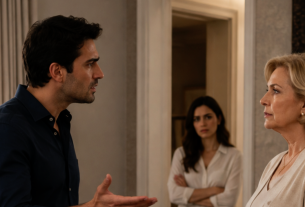
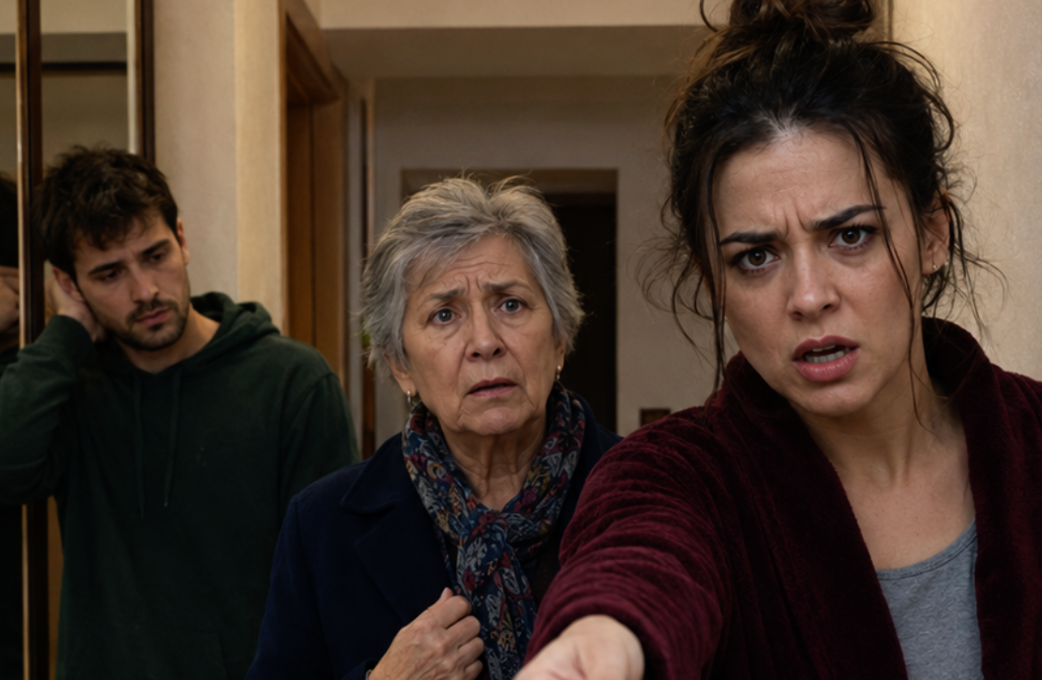
Anton stood barefoot in the middle of the hallway, wearing stretched-out house pants, with the face of a man who had not been woken up on a Sunday morning, but summoned to a confrontation. Behind him, near the mirrored wardrobe, his mother, Raisa Pavlovna, shifted from foot to foot. A Perekryostok grocery bag hung from her elbow, with a loaf of bread, dill, and a plastic container of something greasy sticking out of it. Wet footprints from her boots had already appeared on the floor: outside it was March, that very Moscow March when snow technically still exists, but in reality it is just mud pretending to be a season.
— Lena, I’ll explain everything now, — Anton began.
— I don’t need an explanation. I asked a very simple question.
— Yes, I gave them to her, — he exhaled. — But don’t work yourself up. It’s not the way you’ve imagined it.
Lena laughed quietly. Not even laughed — she breathed out through her nose, like a person who, instead of an answer, had just been shown a magic trick in which common sense disappeared.
— Then how is it? You gave my mother-in-law the keys to the apartment my grandmother left me, and that is “not the way it is”?
Raisa Pavlovna immediately came to life. Until then, she had pretended she was almost not there, as if she had simply been blown in by a grocery-store wind. Now she lifted her chin.
— First of all, not “mother-in-law,” but the mother of your husband. Second, I did not break in. I opened the door with the key my son gave me. Everything was perfectly civilized.
— Civilized is when you ring the intercom, Raisa Pavlovna. Or at least warn someone. Not when you walk in at nine in the morning on a Sunday while the owner of the apartment is sleeping.
— The owner, — she repeated, drawing out the word as though tasting it and finding it sour. — That’s exactly where it all begins. “My apartment,” “my rules,” “my peace and quiet.” You don’t build a family like that.
Lena looked at Anton. He stood between them, already tired in advance, though the day had only just begun. He had this habit — getting tired before anything actually had to be decided. A very convenient trait: you could look exhausted and avoid taking responsibility.
— Anton, when you moved in with me, do you remember what I said?
— I remember.
— Repeat it.
— Lena, why turn this into an exam right now?
— Repeat it.
He rubbed his face with his palm.
— That the apartment is important to you. That you don’t like unexpected guests. That after work you need quiet. That things stay in their places. That keys are not given to anyone.
— There. See? Your memory works. Where was your conscience?
Raisa Pavlovna snorted.
— He has a conscience, all right. He thought about his mother. I’m not a young girl, by the way, to stand by the entrance with bags. Your elevator works only every other time, and the intercom squeaks like a wounded chicken. I came to help.
— Help whom?
— You. A young family. To cook borscht, make cutlets, iron Antosha’s shirts. He’s always walking around looking like a programmer who just came from the train station.
Anton twitched.
— Mom, don’t start.
— What do you mean, don’t start? I’m telling the truth. You’ve lost weight, your eyes look tired, you eat who knows what. She has grains in little labeled jars in the kitchen, and only one proper pot. A family woman should understand that a man won’t last long on salad leaves.
Lena slowly tied the belt of her robe. Everything inside her was trembling, but outwardly she suddenly became very calm. Dangerous calm, familiar to her since childhood: when her grandmother, who had survived a blockade childhood, never raised her voice, but could stop any family nonsense with one look.
Lena had inherited this apartment from her grandmother Galya — a two-room flat in an old brick building not far from the Universitet metro station. Not an elite new development, no underground parking or café in the lobby, but it had solid walls, a quiet courtyard, linden trees under the windows, and a balcony where in summer it smelled of dust, rain, and the neighbors’ petunias. Her grandmother had lived here for forty years, knew all the janitors by name, and kept jars of buttons in the pantry because “everything comes in handy around the house.”
After her grandmother’s death, Lena renovated the apartment not for magazine-style beauty, but so she could finally stop living inside someone else’s pain. She threw out the carpet with deer on it, took down the heavy curtains, replaced the wallpaper, installed a light-colored kitchen, ordered a wardrobe up to the ceiling, and bought a sofa without ornate armrests. Books stood on the shelves, in the bathroom there was one towel for the face and one for the body, and by the entrance there was a neat shoe rack. No random bags, no “I’ll sort it out later,” no household dump that for some reason many people call coziness.
Lena worked as a project manager in a small design studio. All day long she listened to clients who wanted things to look “expensive but on a budget,” designers suffering from other people’s taste, and contractors who disappeared at the most crucial moment. So at home she wanted only one thing — for no one to intrude. Not into her soul, not into her closet, not into her refrigerator, not into her Sunday morning.
Anton had appeared in her life almost casually. They met at a mutual acquaintance’s birthday party in a bar near Kitay-Gorod. He was not a poster-handsome man, just a pleasant one: slightly stooped, wearing glasses, with a soft voice and an ability to listen. He worked as an analyst at a bank, earned decently, had a dry sense of humor, and did not try to look like the alpha male of the neighborhood. Back then Lena thought, “Normal. Already a rarity.”
They dated for eight months. He brought coffee to her at work, could come late in the evening to pick her up from the studio, and did not make scenes when she said, “I don’t want to see anyone today.” She liked that with him she did not have to defend herself. That was exactly where she was wrong: she decided that the absence of pressure was respect, not a temporary state until the first convenient opportunity.
He was the one who suggested moving in, on a rainy October evening when they were sitting in her kitchen eating buckwheat with chicken. Anton twisted his fork in his hands for a long time, then said:
— Len, every day I travel from Novogireyevo to your place and then back again. Two hours on the road there and back, the metro, the minibus, people constantly shoving backpacks into my face. Maybe we could try living together? I understand the apartment is yours. I’m not claiming anything. I just want to be near you.
She did not answer right away. She put the kettle on and wiped the table, though it was already clean.
— Anton, my place is not a dormitory for love. I don’t know how to live in noise. It matters to me that home remains home, not a public passageway.
— I’m quiet.
— Everyone says that until the first football match on a laptop without headphones.
— I’ll wear headphones.
— My bedroom is not storage for your things. My kitchen is not a place for your mother’s supervision. Guests only by agreement. Keys — to no one. Even if the person is a saint, carrying pies and good intentions.
Anton had smiled then.
— My mother is no saint, don’t worry. But I’m not going to give keys to anyone. I’m not an idiot.
That was the phrase Lena remembered most often afterward. “I’m not an idiot.” As it turned out, it was not a promise, but an advertising slogan.
For the first few months, they really did live peacefully. Anton took up little space, made syrniki on Saturdays, did not scatter socks, washed his shirts himself, and even learned not to leave a wet sponge in the sink. Lena sometimes caught herself thinking that with him, it was possible. Not perfect, not like in the movies, but possible: not to be irritated by another person breathing beside her.
Raisa Pavlovna came for the first time a month after they started living together. Anton persuaded Lena for a long time:
— Let’s just let you two get properly acquainted. She’s sharp, but she’s not evil.
— People usually say that about vinegar.
— Lena.
— Fine. But one evening only. And no inspections of my fridge.
Raisa Pavlovna arrived in a burgundy coat, with a hairstyle that looked like a disciplined helmet, and with an expression that said she already knew there would be nothing good here, but she had to see it anyway. Her husband, Viktor Sergeyevich, trudged behind her with a bag of tangerines and the look of a man who had chosen silence many years ago as a survival strategy.
— Well, hello, — Raisa Pavlovna said, looking around the hallway. — It’s clean. But there’s no proper rug; it’s inconvenient to wipe your feet.
— Hello, — Lena replied. — Come in.
— And where are your guest slippers?
— We don’t use slippers.
— Interesting. Just like in a hotel. A cold one.
During dinner, Raisa Pavlovna spoke almost without pause. Lena’s salad was “a bit empty,” the fish was “not as juicy as it could have been,” the table was “too small for a family,” and the paintings on the walls were “for a very specific taste, of course.” Viktor Sergeyevich ate silently, sometimes raising his eyes to Lena with guilty sympathy, but he did not intervene. Anton nervously poured everyone tea and tried to change the subject.
— Mom, Lena did the renovation herself. She likes it this way.
— Am I arguing? Nowadays everyone likes things without soul. Gray, white, beige. Like a clinic after renovation.
— Raisa Pavlovna, — Lena said, — I feel comfortable exactly this way.
— Comfortable for one person, perhaps. But now you and Anton are a family. A man needs a home, not an exhibition of neatness.
— A man can also take part in creating a home.
— He can, if the woman doesn’t drill him into shape.
Anton coughed.
— Mom, no hints.
— What hints? I’m speaking plainly. Lena is a modern, independent girl. That is good. Only sometimes women’s independence turns into a fence with barbed wire.
Lena did not argue then. She simply said evenly after dinner, when the guests were getting ready to leave:
— I want to make one thing clear right away so there are no hurt feelings later. I don’t like unexpected visits. At all. Even from close people. If you want to come over, call in advance and we’ll agree on it. If it’s convenient for us, we’ll meet. If not, we’ll move it.
Raisa Pavlovna froze with her scarf in her hands.
— So now I need an appointment to see my son?
— To enter this apartment, yes.
— Anton, do you hear this?
Anton turned red.
— Mom, Lena is just explaining what makes her comfortable.
— And what makes you comfortable? Or are you now an accessory to her comfort?
That was when Lena understood: this woman did not quarrel. She set hooks. Small, sharp, almost invisible ones. Once they caught, you had to drag her offense around on yourself until your skin tore.
Three months later, Anton proposed. Not ceremoniously, without a restaurant or a violinist, but at home on a Friday evening, while Lena, in sweatpants, was sorting utility bills. He took a small box out of his pocket and said:
— I know you don’t like circus acts. So I’ll just ask. Will you be my wife?
She looked at the ring and thought not about a dress, not about a wedding, not about a surname. She thought that he did not irritate her in the mornings. That he bought milk without reminders. That he knew how to be silent beside her. That maybe this was adult love — not a fire, but wiring that worked properly.
— I will, — she said.
They had a modest wedding, the way Lena wanted: the registry office, a restaurant for twenty people, parents, close friends. Raisa Pavlovna tried to push for a banquet for eighty guests, a toastmaster with contests, and a ceremonial loaf because “people won’t understand.” Lena replied:
— People will survive.
Raisa Pavlovna spent a month wearing the face of offended culture, but at the wedding she held herself together. She smiled for the photographer, straightened Anton’s collar, and told the guests, “We accepted dear Lena as one of our own.” Lena heard it and thought, “As one of your own — apparently with the right to criticize without trial or investigation.”
After the wedding, everything did not seem to collapse. Anton did not turn overnight into a domestic tyrant, Raisa Pavlovna did not sleep outside their door, and Viktor Sergeyevich sent short holiday greetings in messenger. Lena even relaxed. In vain, of course. In family life, relaxing often means someone is already quietly opening the emergency entrance.
First came the phone calls. Anton talked to his mother every day. Sometimes for five minutes, sometimes for forty. He went out onto the balcony and closed the door. Lena did not interfere: everyone has their own degree of attachment — some call their mother, some tell their news to the cat. But one day she heard through the glass:
— Mom, I can’t discuss this now. Lena is home. No, keys are not a topic. I said later.
When he came back into the kitchen, Lena asked:
— What keys?
Anton poured himself water too quickly.
— It doesn’t matter. Mom lost the keys to the dacha and asked me to find out where she could make a duplicate.
— Uh-huh.
— What does “uh-huh” mean?
— Nothing. I just wonder why, for dacha keys, it matters that I’m home.
He smiled crookedly.
— You’re looking for a hidden meaning again.
— Anton, people usually look for a hidden meaning when the obvious one is already leaking.
He got offended. For three hours he walked around in demonstrative silence, then came to make peace himself. Lena decided not to dig further. And that was her second mistake. The first was believing the phrase “I’m not an idiot.”
And then that Sunday happened.
Raisa Pavlovna opened the door with her own key at nine in the morning. Lena woke up from the click of the lock; at first she thought Anton had gone out for bread, but then she heard a woman’s voice:
— Antosha, are you asleep or what? I brought you cottage cheese! The intercom isn’t working again. Good thing I have the keys.
The word “keys” lifted Lena out of bed faster than a fire-station alarm clock.
And now they stood in the hallway: Lena in her robe, Anton barefoot, Raisa Pavlovna with dill, wet boots, and the expression of a winner at a district-level intrusion olympiad.
— In my home, you cannot appear through the lock as though I’ve died and you’ve come to accept the inheritance.
Raisa Pavlovna blinked.
— What a comparison. I came to living people.
— Exactly. You knock before entering the homes of living people.
— Lena, that’s enough, — Anton intervened. — Mom really wanted to help. She called yesterday and said she’d baked a casserole and that it was awkward for her to wait by the entrance. I thought it was nothing terrible. It’s not like she’ll come every day.
— How often, then?
— Well… when needed.
— Needed by whom?
— God, Lena, why are you picking at words?
— Because words usually hide the main thing. “When needed” — is that when your mother feels like checking what we eat? Or when she’s bored? Or when she decides that after the wedding my apartment became a branch of her kitchen?
Raisa Pavlovna loudly put the bag on the floor.
— There it is. I told Antosha right away: she clings too tightly to what’s hers. She got married, but in her head it’s still “mine, mine.” You can’t live like that in a family. Family means everything is shared.
— Shared is what people voluntarily make shared. Not what one person secretly gives a second person keys to.
Anton raised his hands.
— It wasn’t secret! I just didn’t tell you because I knew you would start.
— So you understood in advance that I was against it, and you did it anyway?
He fell silent. That silence was worse than any confession. It contained everything: fear of his mother, the desire for his wife to somehow endure it, and the hope that boundaries were some feminine whim that could be bypassed if you did not look it in the eye.
— Return the keys, — Lena said.
Raisa Pavlovna pressed a hand to her chest.
— This is already rude.
— No. Rude is coming without an invitation. The keys.
— Anton, tell her.
Anton stared at the floor.
— Mom, give them back, please.
— Oh, so that’s how it is? Now you’re on her side?
— Mom, don’t make this harder.
— I’m making it harder? I gave birth to him, raised him, took him to clubs, didn’t sleep at night when he had bronchitis. And now I’m supposed to hand over the keys like a cleaning lady after a shift?
Lena smirked.
— Are you really weighing bronchitis from twenty years ago against my right to close my own door?
— What kind of person are you? — Raisa Pavlovna threw up her hands. — Cold, cruel. Her apartment, her order, cups lined up with a ruler. Do you even love your husband, or is he just a tenant with a hugging function?
Lena felt something crack inside her. Not break — on the contrary, fall into place.
— Anton, answer honestly. Do you think I should apologize?
He hesitated.
— I think you could have been softer.
— Softer about what? Softer about finding your mother in my hallway?
— Lena, she’s not a stranger.
— Not to you. To me, she is a person who violated my rules with your help.
Raisa Pavlovna pulled a key ring out of her pocket. On it was her old charm shaped like a golden fish and a new key with a green plastic head. Lena immediately understood: the duplicate had been made recently, at a kiosk near the metro. Fast, convenient, almost unnoticed. Here was family, here was trust — two hundred fifty rubles and three minutes.
Her mother-in-law tossed the keys onto the small cabinet.
— Take them. Choke on your fortress.
— Thank you. Now leave.
— What?
— Leave.
— Lena, — Anton said quietly, — maybe not in front of Mom?
— In front of whom, then? A notary?
Raisa Pavlovna grabbed the bag so sharply that the loaf fell to the floor.
— Anton, get ready. You’re coming with me. I will not leave you with a woman who throws your mother out the door.
Lena looked at her husband. Very carefully. He needed to take only one step — not heroic, not cinematic. Simply say, “Mom, go home. Lena and I will sort this out ourselves.” One adult step. He did not take it.
— Lena, I need some air, — he muttered. — I’ll go to Mom’s for a couple of hours. Then I’ll come back and we’ll talk calmly.
— Don’t come back with keys you considered yours. You may return only with respect. And today you carried that out of this home along with the trash.
Anton flinched.
— You’re going too far.
— No. For the first time, I’m speaking exactly.
— So you’re kicking me out?
— I’m asking you to go where people consider your decisions normal.
He began to say something, but Raisa Pavlovna was already tugging him by the sleeve.
— Come on, son. Let her cool down. She’s proud. Life will break her, and she’ll come running.
Lena opened the door.
— Wipe your shoes, please. You’ve already left enough dirt for me.
When they left, the apartment did not immediately become quiet. The smell of someone else’s perfume, wet leather, dill, and cheap triumph still hung in the air. Lena sank onto the stool in the hallway and suddenly noticed the loaf on the floor. She picked it up, put it in a bag, and placed it by the door. Then she washed the floor. For a long time, thoroughly, as if she could wash away not the dirt, but the very fact that someone had entered her home against her will.
Anton returned in the evening. Without his mother, but with her voice in his intonations.
— We need to talk.
— Talk.
— I understand that I made a mistake. But you also have to understand: Mom is lonely. My father is like furniture; he never says a word. I’m her only son. It’s hard for her to accept that I now have my own family.
— Your own family begins with not handing her an entry pass to someone else’s apartment.
— There you go again, “someone else’s.” I’m your husband.
— A husband is not a co-owner of my life.
— Lena, you can’t be so harsh. In marriage, people compromise.
— They compromise when choosing wallpaper, a movie, a brand of laundry detergent. Not when it comes to boundaries.
— Are you ready to destroy a marriage over one key?
She looked at him and almost felt sorry for him. Not because she loved him less. But because he truly did not understand. For him, the key was a piece of metal. For her, it was a door he had opened in the wrong direction.
— Anton, a key does not destroy a marriage. What destroys a marriage is the moment when one person knows the other will be hurt and does it anyway because it is more convenient for his mother.
He sat opposite her.
— I was afraid to refuse her. She pressured me. Said you were cutting me off from my family, that I had become a stranger. I got tired of listening.
— And decided it would be easier to betray me?
— Don’t call it that.
— What should I call it? Conflict optimization?
He hit the table with his palm, not hard, more out of helplessness.
— You always talk like you’re running a trial! Can’t you be human? Can’t you understand that people make mistakes?
— I can. But a mistake is forgetting to buy bread. A week ago, you made a duplicate, gave it to your mother, and kept silent. That is not a mistake. That is a decision.
He turned away toward the window.
— And now what?
— Now you pack your things and leave. For a while or forever — you’ll decide yourself. But I will not live with a person who first violates an agreement and then asks me to be gentler because he feels ashamed.
— Are you serious?
— Absolutely.
He packed slowly, demonstratively, as though every folded sweater were an argument in his favor. He put away his laptop, charger, a couple of shirts. Then he approached the bookshelf and took a volume of Dovlatov that he had given her.
— May I take this?
— Take it. Just don’t confuse it with my dignity. That stays here.
He gave a tired little laugh.
— You’re cruel.
— No. I’m simply no longer polite where people are trying to push through me.
He left around ten in the evening. This time the door closed without a slam. Lena stood in the middle of the room and waited for hysteria to crash over her. It did not. Emptiness came instead — large, even, like a snow-covered field beyond the Moscow Ring Road. That emptiness was frightening, but clean.
The next day she called a locksmith to change the locks. The locksmith turned out to be talkative, wearing a blue jacket with a sealant stain.
— Lost your keys? — he asked, unscrewing the cylinder.
— No. They were handed out to the wrong people.
— Happens. The most dangerous beast is a relative with a key.
Lena smiled for the first time in twenty-four hours.
Anton wrote every day. At first he apologized: “I understand everything now.” Then he explained: “You could also have been softer.” Then he took offense: “I never thought you were like this.” Then he apologized again. Raisa Pavlovna called from different numbers, but Lena did not answer. Once she sent a long message: “You are destroying a family because of pride. A woman must be wiser.” Lena read it and deleted it. For some reason, wisdom was always demanded from the person whose throat had already been stepped on.
Two weeks later, Anton came to pick up the rest of his things. He looked thinner, unshaven, with red eyes. Lena opened the door, but did not let him beyond the hallway.
— I can pack them myself.
— I already packed them. They’re in boxes.
— Even like that.
— Even like that.
He looked at the new locks.
— You were quick.
— Yes. Some things are better done right away, before someone talks you into enduring them.
— Lena, I can’t function normally without you. At Mom’s it’s impossible. She gets into everything. Yesterday she said my underwear had to be washed separately because “Lena must have trained you into nonsense.” Father is silent. I’m there like I’m in childhood, except now I pay a mortgage on other people’s expectations.
— I’m sorry.
— That’s all?
— What do you want to hear?
— That we’ll try. That I’ll come back. I really understand how it looked.
— Looked? Anton, it didn’t look like that. It was that.
He crouched down beside the box and lowered his head.
— I’ve been between you two my whole life. Mom pressures me, you demand things. I can’t handle it.
— I did not demand that you choose between me and your mother. I demanded that you not give away the keys to my apartment. Those are different levels of difficulty. The first is family therapy. The second is basic decency.
— I can change.
— You can. Just not in my home as an experiment.
He left with the boxes. The divorce was finalized three months later. Without division of property, without children, without courts. At the registry office, a tired woman with borscht-colored nails asked them whether they had changed their minds. Anton looked at Lena. Lena looked at the stamp. No one had changed their mind.
After the divorce, Lena did not feel victory or relief right away. During the first weeks, she came home from work, put her bag on the chair, and listened: would the sofa creak, would the shower turn on, would someone say from the kitchen, “I ordered pizza”? Then she got used to it. The apartment became hers again. Not a fortress, as Raisa Pavlovna had sneered, but a place where she could breathe deeply and not explain every breath.
Her friend Yulia, practical to the point of cruelty, said over wine:
— Listen, maybe you really were too harsh? So he gave her keys. He’s an idiot. Men are often idiots, that’s not news.
— Yul, an idiot is someone who buys the wrong yogurt. Here, a person knew my rules and decided they interfered with his mother.
— But you loved him.
— I did.
— And that’s it?
— Love does not cancel the lock on the door.
Yulia swirled her glass.
— Sounds beautiful, but lonely.
— But honest.
Meanwhile, work continued with its own life. Clients argued over shades of green, designers sent layouts at the last moment, and once a courier delivered a banner to the wrong shopping center, so Lena spent half a day talking to security, proving that no, she was not trying to hang an advertisement for yogurt on the façade of the Gamma business center for her own personal pleasure. Everyday life heals no worse than a psychologist: when your siphon is leaking and the neighbor’s cat food runs out after you promised to feed it, suffering beautifully becomes impossible.
One evening in July, Viktor Sergeyevich called her. She did not recognize the number at first. He spoke quietly, as always, as if he was afraid of taking up too much space even through the phone.
— Lena, hello. This is Anton’s father. May I see you? Briefly. Not at home. Somewhere near the metro.
She wanted to refuse. But there was something in his voice that did not resemble a family attack. Not a request to reconcile, not a reproach. More like exhaustion that had reached its limit.
They met near a small square, by a coffee stand. Viktor Sergeyevich arrived in an old windbreaker, holding a small paper bag.
— I won’t take long, — he said. — I just have to give you this.
Inside the bag lay a key. The same green one as the key Raisa Pavlovna had thrown onto the cabinet.
Lena felt her fingers grow cold.
— What is this?
— A second duplicate. Raisa made two. She showed you one and kept the other. I found it in her bag when I was looking for documents.
Lena was silent. Somewhere nearby, teenagers were laughing, a scooter rider was arguing with a woman about a dog, and the coffee machine hissed as though it, too, had an opinion.
— Did she come? — Lena asked.
— No. She didn’t have time. You changed the locks.
— How do you know?
— Anton told me. He… changed a lot after that. At first he was angry at you. Then at his mother. Then, I think, for the first time, at himself.
Viktor Sergeyevich crushed his coffee cup slightly in his hand.
— I stayed silent my whole life, Lena. I thought that was how I preserved peace in the house. But it turned out I was simply passing on an instruction to my son: stay silent when someone is breaking you, and hope it will somehow resolve itself. It didn’t resolve itself.
Lena looked at him more attentively. Standing before her was not just the quiet husband of a loud woman. He was a man who had realized his part in someone else’s misfortune late, very late, but still realized it.
— Does Anton know you’re giving this to me?
— No. And Raisa doesn’t know either. I left her a month ago. I rented a room from an acquaintance in Odintsovo. Funny, isn’t it? At sixty-two, learning how to close your own door.
Lena did not know what to say.
— I am not asking you to go back to Anton, — he continued. — And I did not come to justify my son. He is guilty. Raisa is guilty. So am I. I simply wanted you to know: you are not crazy. You did not imagine it. She really was planning to come. She said, “It’s fine, the girl will get used to it. Everyone gets used to it.” I stayed silent then. I should have said at least one human word.
— Sometimes a family collapses not because of shouting, but because of those who spend years standing silently beside someone else’s shouting.
Lena took the key. It was light, almost weightless. Funny: a piece of metal, and around it so much human cowardice, control, fear, and late remorse.
— Thank you for bringing it.
— Thank you, — Viktor Sergeyevich said.
— For what?
He smiled sadly.
— For throwing her out the door that day. At first I thought it was rude. Then I realized I had dreamed of doing the same thing my whole life, only in my own life.
A week later, Anton wrote her a letter. Not a messenger text, not “hi, how are you,” but a proper letter by email. Lena opened it in the evening after work, sitting in the kitchen with a plate of dumplings. He did not ask her to come back. He did not write that he loved her more than life. He did not accuse her. The letter was short and unusually adult.
“Lena, Father told me he gave you the second key. I didn’t know about it, but that doesn’t remove my responsibility for the first one. I thought being a good son meant not upsetting my mother. Now I understand that I was simply afraid of her. And I wanted to make you convenient for my fear. Forgive me. I’ve made an appointment with a psychologist. Not to get you back. To stop living in someone else’s voice.”
Lena reread it twice. Then she closed the laptop. It did not make her feel better the way it happens in films, where the hero has realized everything, the music rises, and someone can run through the rain. No. It was just that one knot inside her loosened. It did not come undone, exactly — it simply loosened.
In the autumn, she accidentally ran into Anton near Auchan in a shopping center. He was wearing an ordinary jacket and carrying a bag with laundry detergent and apples. He looked calmer than before. Not happy, not broken — simply like a separate person.
— Hi, — he said.
— Hi.
— How are you?
— Fine. Work, home, life. You?
— I rented a studio near Sokol. Small, but mine. Mom hasn’t been there even once.
Lena nodded.
— A good start.
— Father visits me sometimes. By agreement, imagine that? He calls and asks whether it’s convenient.
— Progress in one individual family.
Anton smiled.
— I’m not going to ask for a second chance. I just wanted to say… You didn’t destroy our marriage then. You showed that it was already cracked. I was only offended because the crack ran through me.
Lena looked at him for a long time. Inside her, neither old love nor anger flared up. Only calm sadness for what might have been if both of them had become adults sooner.
— Take care of yourself, Anton.
— You too.
They parted near the self-checkout counters, where a woman was arguing with the machine over a bag, and the security guard pretended to philosophically accept the imperfection of the world.
That evening, Lena returned home. She took off her boots, put the apples in a bowl, and turned on the kettle. Outside the window, the courtyard was growing dark; janitors were raking wet leaves into heavy piles, and the neighbor upstairs was again moving something across the floor as if rehearsing an eternal move.
She took the second green key out of the drawer. She did not know why she had kept it. Probably as proof to herself: she had not invented it, had not exaggerated, had not been some hysterical woman who begrudged an extra plate of borscht. The proof was cold, with notches along the edge.
Lena went out into the courtyard, walked up to the trash container, and threw the key inside. It clinked against a glass jar and disappeared among bags, boxes, and other people’s unwanted things.
On her way back, she noticed the new neighbor from the third floor in the entrance hall. The woman was struggling with a stroller and two bags.
— Need help? — Lena asked.
— Oh, if you don’t mind. The elevator’s died again, damn it.
Together they carried the stroller up to the landing. The neighbor thanked her, smiled tiredly, and said:
— I’m Marina. We moved in recently. Are you from apartment forty-two?
— Yes. Lena.
— Nice to meet you. I bake pies sometimes. I can bring some over.
Lena almost automatically tensed, but the neighbor quickly added:
— I’ll ask first, of course. I hate it myself when people barge in without calling. A home isn’t a train station.
Lena looked at her and unexpectedly laughed. Not bitterly, not nervously, but lightly, for the first time in a long while.
— Then bring them. By agreement.
At home, she poured tea, sat by the window, and thought that boundaries are not a wall against all people. They are a door with a proper lock. You decide whom to let in, when, why, and for how long. And if someone is offended by the very fact that there is a door, it means they were not coming as a guest, but to seize control.
The apartment was silent again. But now there was no defensiveness in that silence. Only air, light from the kitchen, tea with lemon, and the calm knowledge that love can be important, family can be dear, and compromises can be necessary. But the key to your life must never be given to someone who considers your “no” a temporary inconvenience.