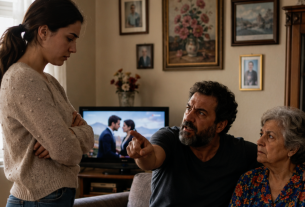
“You have an obligation to help your younger sister—she has children!” Klavdia Petrovna exclaimed indignantly, theatrically pressing her plump hands to her chest. “Have all those numbers made you completely heartless? We’re family! You’ll just have to make the sacrifice!”
Marina silently looked at her mother, feeling the familiar tight, cold spring of conditioned guilt beginning to coil inside her.
In her passionate tirade, Klavdia Petrovna had forgotten one small but extremely important detail from Marina’s childhood. The very detail that had long ago made the word “family” taste to Marina like cheap instant noodles and echoing loneliness.
When Marina turned nineteen, her grandmother died. She left behind a solid two-room apartment in a good neighborhood. After inheriting it, Klavdia Petrovna called a family meeting consisting of herself, Marina, and twelve-year-old Olenka.
Her mother spoke in a tone that allowed no argument.
“Marina, you’re already an adult. You’re studying and working part-time as a cashier. You can rent a room—you’ll manage. This apartment will be for Olenka. She needs stability in the future. She’s a delicate girl.”
The next day, Marina packed her belongings into two plaid bags and moved into a student dormitory that smelled of fried onions and hopelessness.
For the next twenty years, she literally clawed out a place for herself in the world. She worked nights, finished university, took endless side jobs, and moved from one company to another, slowly but steadily climbing the career ladder as an accountant.
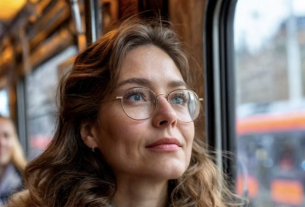
Marina was now forty-two. She had a small but cozy one-room apartment with a mortgage, purchased at the absolute limit of human endurance, a position as chief accountant at a logistics company, chronic sleep deprivation, and a left eye that twitched from stress.
Olenka was thirty-five.
She lived comfortably in that same apartment inherited from their grandmother. She had never officially worked a single day in her life, had given birth to two children with Vadik—a man of vague occupations and limitless ambitions—and sincerely believed that the entire world, especially her older sister, owed her everything.
“Mom,” Marina said quietly but firmly, pushing away her cup of cold tea. “Vadik owes the bank nine hundred thousand rubles. He wrecked a car bought on credit because he decided to save money by not getting comprehensive insurance and drove into oncoming traffic. Why should I take out a personal loan to pay for his stupidity?”
“Because they could lose their apartment!” Klavdia Petrovna shrieked. “Do you understand that the children could end up on the street? Vadik made a mistake—it happens to everyone! He was trying to do something for his family. He wanted to start a business and drive a premium-class taxi! You have an official salary and a good credit history. The bank will give you a reasonable interest rate. Nobody will lend Vadik anything anymore!”
“Of course they won’t. He hasn’t stayed at a single job for longer than three months in the past five years.”
“You sound just like someone from the film Moscow Does Not Believe in Tears,” Klavdia Petrovna said, pursing her lips and looking reproachfully at her older daughter. “You’ve become just like Lyudmila! Always looking for personal gain, always carrying a calculator around in your head! You should be more like Gosha—approach people with warmth and simplicity. Help your own family! Who is going to pay off their loan if not you?”
“Mom, Gosha was a highly skilled mechanic with golden hands. Vadik is a specialist in lying on the sofa with his phone,” Marina said, rubbing her temples wearily. “And I’m not looking for personal gain. I’m looking for a way to pay my mortgage, cover your utility bills, send you fifteen thousand rubles for medication every month, as I always do, and still have enough money left for food. I don’t have a spare million.”
“Oh, don’t pretend you’re poor!” her mother said irritably, waving a hand adorned with gold rings. “You live alone. No husband, no children. What do you need so much money for? Clothes? You’ve been wearing that same coat for three years. You could tighten your belt for your niece and nephew! Fine, I’m leaving. But think about it, Marina. You have until Saturday. Otherwise the debt collectors will make Olenka’s life a living hell!”
Klavdia Petrovna rose heavily, pulled on her expensive down jacket, and slammed the front door without even saying goodbye.
Marina remained sitting in the kitchen. A stack of unpaid bills lay on the table. A lonely pot of yesterday’s soup stood in the refrigerator.
She walked over to the window and stared at the gray autumn drizzle.
Her chest felt heavy.
Her mother had always been a virtuoso at playing on Marina’s sense of duty. Since childhood, Marina had been “the strong one,” the one who “would manage on her own,” while Olya had always been “the little one” who “needed help.”
The following day at work, Marina could not concentrate on the quarterly report. The numbers on the monitor blurred before her eyes.
Svetlana, the colleague who shared her office, was a perceptive woman with a sharp tongue. She immediately noticed Marina’s condition.
“Marinka, you’re as pale as a moth today. Has your family started acting up again?” Svetlana took a sip of coffee from a mug with the word BOSS printed on it. “What is it this time? Does your sister need money for the Maldives, or has her brilliant husband invested in another pyramid scheme?”
“Vadik wrecked a car bought on credit. The debt is almost a million. Mom wants me to take out a loan in my name and give them the money.”
Svetlana choked on her coffee.
“And naturally, you’re sitting there trying to calculate which bank has the lowest interest rate? Marina, have you lost your mind? They’re walking all over you! When was the last time you went on vacation? Five years ago, to that health resort near Ryazan? You wear boots that are about to open their mouths and beg for porridge, while your niece and nephew run around in designer jackets. I’ve seen the pictures you showed me!”
“But Sveta, they’re family,” Marina objected weakly, although her colleague’s words had struck the target. “If I don’t help, they’ll tear me apart with accusations. And I feel sorry for Mom. She worries, and then her blood pressure spikes.”
“Save your pity for the bees,” Svetlana snapped. “What you have is a classic savior complex. Fine, it’s your life. But if you take out that loan, I will personally stop speaking to you out of respect for common sense.”
That same evening, Klavdia Petrovna visited Marina again.
This time she was suspiciously affectionate. She brought cabbage pies and made tea.
“Marinochka, sweetheart,” she began in a syrupy voice. “You understand technology. Could you look at my phone, please? It seems to have frozen. The screen is dark, and WhatsApp won’t open. Olenka is supposed to send me pictures of the grandchildren. Fix it while I go to the bathroom.”
Klavdia Petrovna left her brand-new smartphone on the table—a gift Marina had given her for her previous birthday—and went into the bathroom.
Marina picked up the device. It had indeed simply frozen. She held down the restart button.
The phone flashed and turned on.
The lock screen lit up, and at that exact moment, a push notification appeared from the banking app:
“Your Reliable Interest deposit has been successfully renewed. Available balance: 1,850,000 rubles.”
Marina froze.
Her heart plunged into her stomach and then began beating so rapidly that her ears rang.
One million eight hundred and fifty thousand rubles.
How did her mother, who supposedly lived on her pension and Marina’s monthly financial support, have that kind of money?
Her fingers trembled.
Marina knew the phone’s PIN because she had set it herself. It was the year Olya had been born. She unlocked the screen and quickly opened the banking application. Logging in required only a short password, which her mother had once asked her to write on a piece of paper kept under the phone case.
Marina opened the transaction history.
The deposit had been opened three years earlier. The initial amount was one million six hundred thousand rubles.
Three years ago…
Marina frantically put the facts together.
Three years earlier, her mother had sold their grandfather’s old country house outside the city. At the time, Klavdia Petrovna had sworn through her tears that the property had been sold for next to nothing—only two hundred thousand rubles—which Olenka urgently needed to renovate the children’s room.
Marina had believed her.
She had even paid to repair the roof of her mother’s apartment by taking out a short-term high-interest loan.
But her mother had actually deposited the money in the bank and had been receiving compounded interest on it for all those years.
Marina’s hands turned ice-cold.
She left the banking application and automatically tapped the WhatsApp icon, where a new message had just arrived.
It was a conversation with Olya.
Olya: “Mom, how’s it going? Have you finally worn Marina down?”
Klavdia Petrovna, sent one hour earlier: “I’m working on her, Olenka. She’s resisting, but she has nowhere to go. She’s used to putting up with everything. She’ll whine for a while and then take out the loan. The important thing is to play on her sympathy and keep reminding her that we’re family.”
Olya: “Excellent! Because if you withdraw your deposit, we’ll lose all the interest for the year! It would be a shame to give the bank our hard-earned money. Better to let Marinka pay. She has no children and no responsibilities. What else does she have to spend money on? Another gray sweater? It won’t hurt her.”
Klavdia Petrovna: “Don’t worry, sweetheart. I’ll put a few drops of Corvalol on myself for the smell and say I had heart trouble. Vadik will have the money by the weekend.”
Marina stared at the screen, feeling as though all the air had suddenly disappeared from the kitchen.
She could not breathe.
Her vision darkened.
Her entire life flashed before her eyes.
The torn winter boots she had worn for two seasons so she could save money for her mother’s joint treatment. The dental appointments she had canceled in order to buy summer-camp trips for her niece and nephew. The endless things she had denied herself. The sleepless nights. The mortgage she was paying with her own flesh and blood.
They had not merely taken advantage of her kindness.
They had done it knowingly, cynically, with calculated cruelty.
To her own mother and sister, Marina was not a human being.
She was a free resource.
A convenient cash machine they could kick until banknotes came spilling out, while their own “hard-earned money” remained safely in a bank account.
Marina did not scream.
She did not throw the phone against the wall.
Instead, she suddenly felt a state of absolute, crystalline mental clarity—the kind that comes after a severe illness, when the fever finally breaks and the world regains its sharp outlines.
She quickly took screenshots of the conversation and the deposit statement, sent them to herself through Telegram, and immediately erased all traces of the transfer. Then she closed every application.
When Klavdia Petrovna returned to the kitchen, sighing heavily and clutching her left side, Marina was calmly drinking her tea.
“Here you go, Mom. I restarted it. Everything works now,” Marina said, handing her the phone.
“Oh, thank you, sweetheart.” Her mother took the device. “So, what about the loan? You understand there’s no one else who can help…”
“I understand, Mom,” Marina answered in a flat, lifeless voice. “All of you come here on Saturday. You, Olya, and Vadik. Six in the evening. I’ll set the table, and we’ll settle this financial matter once and for all.”
On Saturday, Marina prepared for the meeting methodically and calmly.
She baked a meat pie—the kind Vadik loved so much. She brewed good Indian tea and brought out her nicest cups.
She felt neither fear nor guilt.
Only cold, calculating anger.
A folder containing color printouts of the screenshots lay on the table. Beside it was a detailed Excel spreadsheet she had compiled the previous evening.
Her guests arrived at exactly six.
Olya looked exhausted and tragic, using her entire appearance to demonstrate the burdens of motherhood. Vadik behaved arrogantly, seating himself at the head of the table as though he owned the place and immediately reaching for a piece of pie.
Klavdia Petrovna fussed around, trying to create the illusion of a warm family dinner.
“Well, Marinka, good for you for agreeing,” Vadik mumbled through a mouthful of pie. “Here’s what I think: we relatives have to stick together. I’ll pay off this debt, then I’ll invest in crypto, and we’ll really start living! Just tell me when you’ll transfer the money. Can you do it by Monday? The penalties are adding up.”
Marina silently poured tea for everyone.
She sat across from her sister and clasped her hands together.
“There will be no money, Vadim. I’m not taking out a loan.”
A heavy silence descended over the table.
Vadik stopped chewing. Olya exhaled indignantly, while Klavdia Petrovna clutched her chest.
“What do you mean, there’ll be no money?” Olya shrieked. “You promised Mom! Do you understand that they could take away our apartment? Do you want my children to live under a bridge because of your greed?”
“They don’t seize a person’s only home over an unsecured personal loan, Olya. Learn the basics,” Marina replied coldly. “But since you need money so badly, I’ve found an excellent solution.”
She opened the folder, removed the first sheet, and placed it in the center of the table directly in front of her mother.
It was an enlarged screenshot from the banking application.
“Mom, you have one million eight hundred and fifty thousand rubles in your Reliable Interest deposit. You can withdraw the money any day. It’s more than enough to pay off Vadik’s debt and even buy him an annual public-transport pass.”
Klavdia Petrovna turned pale so quickly that it looked as though all the color had been washed from her face. Her mouth opened and closed soundlessly.
Olya craned her neck, looked at the printout, and froze as well.
Vadik swallowed nervously.
“Y-you… You went through my phone?” her mother finally managed to say, her voice rising into a hysterical falsetto. “What right did you have? That’s illegal! It’s an invasion of privacy!”
“An invasion of privacy?” Marina removed a second sheet—the printed conversation. “Then what is this, Mom? ‘Let Marinka pay. What else does she have to spend money on? It would be a shame to lose our own money.’ Is that your private life? Discussing the most convenient way to milk the last ruble out of me so you don’t lose a few pennies of interest?”
“That’s Mom’s money!” Olya shouted, jumping up from her chair. “She saved it for my children’s education! It came from Grandfather’s country house! You have no right to count it!”
“The country house Father built while he was alive, where I broke my back working every summer while you sunbathed by the river, Olenka,” Marina said, her voice cutting through the air like steel through butter. “And do you know what the funniest part is? I really did think of you as my family. I thought you were struggling.”
Marina removed a third sheet—the spreadsheet.
“I’m an accountant, Olya. I like numbers. This contains everything I’ve spent over the past five years. Fifteen thousand rubles a month for Mom’s ‘medicine.’ Mom’s utility bills. The winter tires I bought Vadik three years ago. Your washing machine, Olya, which I bought last year because ‘the poor children had nothing clean to wear.’ The roof repairs. Total: one million two hundred thousand rubles. I invested the price of a good car into your family, while you”—she stared directly at her mother—“had almost two million sitting in the bank.”
“You… You’re a monster! You’re settling accounts with your own mother!” Klavdia Petrovna theatrically rolled her eyes and began sliding down the back of the chair. “Water… I’m having a heart attack… Just like in the film Love and Pigeons… A myocardial infarction! A scar this big!”
“The blood-pressure monitor is on the shelf in the hallway, Mom. Your blood pressure this morning was one hundred twenty over eighty,” Marina said without moving a muscle. “And I’ll call an ambulance if the three of you don’t leave my apartment within the next three minutes.”
“Listen here, you bean counter,” Vadik said, rising menacingly and looming over the table. “Don’t you talk to your mother like that. Look at you, suddenly acting important! First you hold back the money, and now you’re showing off! We can manage perfectly well without you!”
“Then manage without me, Vadik. And if you take one more step toward me, I’ll call the police. I have a camera in the hallway. It records both video and sound.”
Marina picked up her phone.
There was no camera, but Vadik was a coward by nature and immediately stepped back.
“Get your things. All three of you.”
“You’ll regret this, Marina!” Olya hissed, grabbing her handbag. “You’ll end up alone! No one will even bring you a glass of water when you’re old! We want nothing more to do with you!”
“What a relief,” Marina said with a genuine smile. “Leave the apartment keys on the cabinet, Mom. And don’t come here again.”
They left, slamming doors, shouting curses, and hurling accusations of ingratitude and heartlessness.
When their footsteps faded on the stairs, a ringing, unfamiliar silence settled over the apartment.
Marina walked to the door, locked it with two turns of the key, and slid the bolt into place.
She returned to the kitchen.
The printouts were scattered across the table, surrounded by half-finished cups of tea. Marina took a piece of pie and bit into it.
The pie was magnificent—juicy, with a crisp crust.
For the first time in many years, food had a flavor that was not poisoned by anxiety over other people’s problems.
Marina walked over to the garbage bin and swept the printouts and the remnants of her guests’ dinner into it.
Then she opened the banking application on her phone and canceled the automatic payment for her mother’s utility bills.
Four months passed.
The winter that year was snowy and mild.
Marina stood on the waterfront in Kaliningrad, breathing in the salty, freezing air of the Baltic Sea. She was wearing a new, incredibly warm wine-colored down jacket and a pair of expensive, comfortable winter boots.
After that Saturday evening, her life had changed completely.
Marina began spending on herself the twenty thousand rubles a month that had previously gone toward the family “tribute.” She went to a good dental clinic, bought new clothes, and took a proper vacation for the first time in six years, flying to the seaside.
Without the constant stress, her twitching eye disappeared on its own.
At work, Svetlana could not have been happier for her friend. She remarked that Marina looked five years younger, as though she had removed an invisible sack of cement from her shoulders.
Her relatives, of course, did not surrender without a fight.
For the first few weeks, they maintained an offended silence, expecting Marina to come crawling back on her knees with apologies and a loan.
When that did not happen, they began trying to manipulate her through distant relatives.
Aunt Lyuba from Saratov called and scolded Marina for “abandoning her mother to her fate.” Marina calmly told her about the million-ruble bank deposit and blocked her number.
Then Vadik began messaging her.
He sent tearful voice messages saying that the debt collectors had taken their television and microwave and that the children were eating plain porridge.
Marina blacklisted his number.
Klavdia Petrovna made the final attempt.
She came to Marina’s workplace, intending to create a scene in the lobby. But after security informed Marina of her arrival, Marina simply refused to go downstairs. She sent word through the security officer that she would call the police if the woman did not leave the business center.
Her mother left and never appeared again.
As it turned out, old manipulations stop working at the exact moment their victim stops believing in them.
Marina’s guilt dissolved without a trace, leaving behind only common sense and self-respect.
She watched the waves crash against the dark stones of the breakwater.
The phone in her pocket vibrated.
It was Svetlana calling from work, simply wanting to chat and ask about the weather.
Marina smiled, answered the call, and began walking along the waterfront, feeling how easy and free it was to breathe in her new life—a life that finally belonged to her alone.