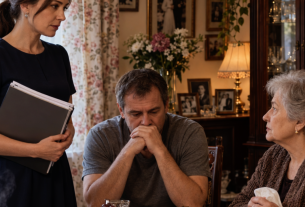
“Have You Decided to Turn Me into Your Obedient Maid? You Picked the Wrong Woman!” the Wife Snapped
Alina carried the box of books with her chin pressed against the lid to keep everything from spilling out. The first thing she noticed in the entrance hall of her new home was a floor cloth, neatly folded on the radiator.
It lay there as though someone had deliberately placed it in plain sight. As though it were a hint.
Naturally, Alina did not pay any attention to it then. A rag was just a rag. It was only months later that she would remember it and think: so that was how it all began. With a floor cloth on the radiator.
For the moment, she simply dragged the box into the room, set it on the floor, and straightened up, rubbing her lower back.
“Well, there we are,” Vladislav said somewhere behind her, breathing heavily. He was carrying the television. “See? It isn’t that frightening. We’ll settle in.”
“We’ll see,” Alina replied curtly.
She had not wanted to move in with her mother-in-law from the very beginning. Not at all.
She and Vladislav had their own rented two-room apartment on the other side of the city. It was small, with a permanently leaking faucet and neighbors who stayed awake half the night, but it was theirs. They could wear whatever they liked, argue and make up, eat dumplings straight from the pot at one in the morning, and nobody criticized them.
They had lived like that for six years—separately, independently, accustomed to making every decision together.
Then Vladislav brought up the subject.
At first, he approached it cautiously and indirectly.
“Mom is completely alone,” he said one evening over dinner, pushing pasta around his plate with his fork. “It’s difficult for her. The apartment is large, three rooms, and she sits there like she’s in a tomb. Alone in front of the television. I worry about her.”
“Then let’s visit her more often,” Alina said with a shrug. “We can go there on weekends.”
“That isn’t the same. She needs someone nearby. A living person.” Vladislav put down his fork. “Listen, maybe we should move in with her. There’s plenty of space. And we wouldn’t have to pay rent. We’d save eighteen thousand a month. Just imagine—more than two hundred thousand a year.”
That was when Alina became wary.
“Vlad, do you have any idea what it means to live with your mother-in-law? Under the same roof? It would be…”
“She’s my mother, not some strange mother-in-law,” he interrupted, sounding mildly offended. “Why are you immediately acting like that? Irina Pavlovna likes you.”
“She likes me when we come to visit for three hours. Living together every day, from morning until night, is completely different.”
“We’ll try it. If we don’t like it, we’ll move out again. What do we have to lose?”
They argued about it for two weeks. Alina presented reasons; Vladislav dismissed them. She talked about personal boundaries, while he talked about money and his lonely mother.
Eventually, she gave in.
Not because he had convinced her—he had not—but because she was tired of arguing, because she loved him, and because she did not want him to think she was heartless.
Fine, she thought. We’ll try it. If it becomes unbearable, we really will move out.
For the first few weeks, everything truly was quiet.
Irina Pavlovna was a short, thin woman with a tidy cropped hairstyle and a habit of pursing her lips. She behaved politely and even warmly. She offered them homemade pies, asked Alina about her work, and did not interfere in anything.
Alina worked as an accountant at a small logistics company. She usually came home around seven, and her mother-in-law would greet her with tea.
Alina even began to think she had worried for nothing. So an elderly woman lived beside them. What was wrong with that? Everything seemed perfectly normal.
The apartment really was lovely. It was a spacious three-room apartment in a brick building, with high ceilings and a large kitchen overlooking a courtyard filled with old linden trees.
In the mornings, sunlight flooded the kitchen so beautifully that Alina wanted to sit with her coffee a little longer.
Perhaps she had been afraid for no reason, she thought. Perhaps everything would work out after all.
The changes began quietly and gradually, so subtly that she did not notice them at first.
One morning, Irina Pavlovna casually remarked over breakfast:
“Alinochka, you’re finishing work earlier today, aren’t you? The floor in the living room could use a wipe. I’m not as good at bending down as I once was.”
Alina wiped it.
Of course she did. It was no great hardship. Her mother-in-law was sixty-four, her back hurt, and she was getting older. What was there to argue about?
A few days later, Irina Pavlovna said:
“Sweetheart, when you go to the store, pick up some bread, milk, and Vladik’s yogurts. He likes those. Here, I made you a little list.”
The list covered half a page.
Then washing the dishes somehow naturally became Alina’s responsibility as well.
So did all the laundry—not only hers and Vladislav’s, but her mother-in-law’s too.
Then there was ironing and dusting all three cabinets filled with the countless figurines Irina Pavlovna had collected throughout her life. Each one had to be wiped individually, piece by piece.
“Be careful,” her mother-in-law would say while sitting in her armchair and watching. “My late husband gave me that little ballerina. Pay special attention to her.”
Alina wiped the ballerina.
And the elephants.
And the dogs.
And the little vases.
Irina Pavlovna sat and watched, occasionally pointing out that there was still some dust left in a corner.
Somehow, without Alina noticing exactly when it happened, the entire household ended up on her shoulders.
Cleaning, cooking, grocery shopping, laundry—everything.
Her mother-in-law merely gave instructions and issued orders from her armchair, while Vladislav did not touch a thing. He came home from work—he was a supervisor at an auto repair shop and earned a decent salary of around ninety thousand—dropped onto the sofa, and scrolled through his phone until dinner.
Alina endured it.
At first, she kept silent, telling herself it was temporary. They simply needed time to adjust. There was no point starting arguments and ruining their relationship during the first few months.
But resentment continued to accumulate.
It rose slowly, like spring water in a basement: drop by drop, until suddenly you looked down and found yourself standing ankle-deep in it.
One evening, she could no longer remain silent.
She waited until they were in bed and Irina Pavlovna had begun snoring behind the wall. Then she spoke quietly into the darkness.
“Vlad, are you asleep?”
“Mmm. Almost.”
“I need to talk to you. I can’t keep living like this.”
“Can’t keep doing what?” he grumbled without opening his eyes.
“I come home from work and run around until bedtime. I cook for three people, clean the entire apartment by myself, do everyone’s laundry, and go grocery shopping alone. Your mother does nothing but order me around. And you don’t lift a finger either. I’m tired, Vlad. I’m a human being, not a housekeeper.”
Vladislav was silent for a moment and shifted beneath the blanket.
“You’re exaggerating,” he finally said. “Mom is old. Housework is difficult for her. You’re young, so it isn’t hard for you. What’s the big problem?”
“It is hard for me!” Alina whispered indignantly. “I work all day too! I spend the whole day keeping numbers in my head. I come home completely exhausted, and then my second shift begins!”
“Keep your voice down. You’ll wake Mom.” He rolled onto his other side. “Come on, don’t be so dramatic. You’re helping my mother. What’s wrong with that? Everyone lives like this. Can we go to sleep? I have an early shift tomorrow.”
And that was it.
The conversation was over.
Alina lay staring at the dark ceiling, where the headlights of passing cars cast moving reflections, and realized that her husband did not care about the problem at all.
From his perspective, there was no problem.
There was simply a convenient arrangement: his mother was happy, the apartment was clean, dinner was ready, and it did not matter who did all the work.
Alina continued to tolerate it.
She did not even know why. Perhaps she still hoped the problem would somehow resolve itself. Perhaps one day her mother-in-law would say, “Oh, Alinochka, you rest today. I’ll do it myself.”
She never said that.
Instead, her demands increased.
Now Irina Pavlovna also began finding fault with Alina’s work. The soup was too salty. Vladik’s shirt had not been ironed properly. The floors had not been washed thoroughly enough, and streaks remained.
“In my day, daughters-in-law obeyed their mothers-in-law,” she would say. “Young women today do nothing but turn up their noses. I used to empty my mother-in-law’s chamber pot without making a sound.”
Alina remained silent.
She pressed her lips together and said nothing because she knew that one word would start a scandal. Vladislav would take his mother’s side again, and everything would become even worse.
Everything finally broke apart on an ordinary Thursday.
Alina had endured a difficult day at work. They were preparing the quarterly report, her manager was on edge, and by evening her head was splitting.
Nevertheless, she came home, changed clothes, and stood at the stove because nobody else was going to cook.
She fried meat patties, made mashed potatoes, chopped a salad, set the table, and called everyone to dinner.
They sat down and ate.
The patties turned out well. Vladislav even asked for another helping, and Irina Pavlovna silently ate two portions.
When dinner was over, Alina sat there exhausted, her legs aching, and looked at the mountain of dirty dishes in the sink and the plates covering the table.
Then she spoke calmly, without the slightest trace of confrontation.
“Vlad, could you wash the dishes tonight? I cooked, and I’m about to collapse.”
It was the most ordinary request imaginable.
In any normal family, one person cooked and the other washed the dishes. Alina did not even doubt that he would agree. Perhaps he would grumble for appearances’ sake, but he would get up and do it.
Irina Pavlovna responded before Vladislav could.
Until that moment, she had been silently drinking tea. Suddenly, she placed her cup on its saucer with a sharp clatter.
“Why on earth should Vladik wash the dishes?” Her voice became sharp, like a strict schoolteacher’s. “A man washing dishes? He worked all day and came home tired, and now you want to put him in front of the sink?”
“I worked too,” Alina replied evenly. “I’m tired too. And I also cooked dinner for everyone.”
“That’s what a wife is for!” Irina Pavlovna almost rose from her chair. “A wife is supposed to take care of the house. A man should be allowed to rest. The men in our family have never washed dishes, and they never will. I didn’t raise my son for that.”
Alina turned her gaze toward Vladislav.
Now, she thought.
Now he would say, “Mom, that’s enough. I’ll wash them. What’s the big deal?”
Surely he would defend her.
Vladislav put down his phone, met her eyes for a second, and then looked away.
“Come on, Alina,” he muttered, picking at the tablecloth. “Why are you making such a fuss over some dishes? Mom is right. Just wash them. You’re used to doing it. I really am exhausted today.”
Then he lowered his eyes to his phone again.
At that moment, something inside Alina seemed to click into place.
She did not explode.
On the contrary, everything suddenly became very clear and very cold.
It was as though she had spent months looking through fogged glass, and someone had finally wiped it clean, revealing every tiny detail.
She understood.
She understood everything at once—the move, the claim that his mother was lonely, the floor cloth on the radiator that first day, the grocery lists, and the little ballerina figurines.
They had not brought her there to keep her mother-in-law company.
They had brought her there to work.
She was an unpaid servant attending to two masters.
And her husband knew it.
Perhaps he had known from the very beginning. Perhaps that was why he had persuaded her to move.
Alina slowly pushed back her chair and stood.
The dishes remained in the sink.
“So, this is how it is,” she said. Her voice was so calm that Vladislav looked up. “Apparently, I’m not a daughter-in-law or a wife here. I’m the hired help. I wasn’t invited here to live. I was brought here to scrub floors and fry meat patties.”
“Alinochka, what are you talking about?” her mother-in-law said hurriedly, immediately changing her tone to a sugary one. “Nobody has ever…”
“Have you decided to turn me into your obedient maid? You picked the wrong woman!” Alina snapped, turning toward her husband. For the first time that evening, there was steel in her voice. “We lived normally for six years, as equals. Then we moved here, and I became a servant. And you’re perfectly happy about it! It’s convenient for you! Your mother gives the orders, your wife works herself to death, and you lie on the sofa without a care in the world!”
“Don’t shout at me,” Vladislav said as he stood, his face breaking out in red blotches. “And don’t shout at my mother. You are living in her home, after all.”
“In her home,” Alina repeated with a bitter smile. “Thank you for reminding me. I had almost forgotten who everyone was around here.”
“Why are you so obsessed with these dishes?” he exploded. “You’ve turned nothing into a tragedy! You could have washed them already instead of putting on this performance!”
“This isn’t about the dishes, Vlad.” She shook her head. “It’s about the fact that, to you, I’m a function. A convenient object. I cook, wash, clean, and never object. Whether I feel anything, whether I’m tired—it makes no difference to you. All that matters is that you are comfortable.”
“I provide for you!”
“You provide for yourself. I earn my own money, in case you haven’t noticed. I contribute no less than you do to the household.” Alina looked around the kitchen—beautiful, bright, and belonging to someone else. “But what is the point of contributing to the communal pot when I’m the one being boiled alive inside it?”
Realizing that the situation was becoming serious, Irina Pavlovna attempted to take command.
“That’s enough. Both of you calm down. Alina, you’re wrong, and you’ve lost your temper. Go wash the dishes and cool off. And you, Vladik, don’t engage with her. Can’t you see the woman has worked herself into a state?”
“‘The woman has worked herself into a state,’” Alina repeated quietly. “You know, Irina Pavlovna, thank you. You’ve just said everything that needed to be said.”
She walked into the bedroom.
She took a suitcase from the wardrobe—the same one she had brought there six months earlier, full of hope and uncertainty.
She opened it on the bed and began packing her belongings.
Her hands moved automatically, quickly and precisely, without panic. The more methodically she packed, the calmer she became.
Vladislav rushed into the room after her.
“What do you think you’re doing?” His voice trembled. “Alina, what are you doing? Are you serious? Over something so trivial?”
“Over something trivial,” she agreed, folding a sweater. “Of course. Over something completely trivial.”
“Put those things down. Stop it. We had an argument. It happens to everyone. Mom lost her temper too. Let’s not do this.”
“We won’t,” Alina agreed. “More specifically, I won’t. I won’t do any of it anymore.”
Her mother-in-law arrived next and stood in the doorway, wringing her hands.
“Alinochka, where are you going so late at night? Forgive me if I said something wrong. I meant well. Stay. There’s no reason to leave.”
Alina closed the suitcase.
She straightened and looked around the room—the bed, the wardrobe, the window overlooking the courtyard and its linden trees.
Six months of her life.
Six months she had spent trying to be convenient for people who did not care about her.
“I warned you, Vlad,” she said quietly. “Before we moved. I told you this wouldn’t end well. You didn’t listen. And now here we are. It didn’t end well.”
“This is all your doing!” he shouted. “You’re the one making a huge issue out of it! Nobody turned you into a maid. You invented the whole thing!”
“Perhaps I did.” Alina took hold of the suitcase handle. “Then prove that I invented it. Wash the dishes tonight. Yourself. Without me.”
Vladislav opened his mouth.
Then he closed it.
He said nothing. He only glanced toward his mother as though waiting for her to tell him what to do.
That brief, helpless glance from a thirty-five-year-old man who still looked to his mother for guidance finally put Alina completely at ease.
She was doing the right thing.
There was no doubt about it.
She walked past them into the entrance hall.
Her mother-in-law lamented behind her. Vladislav was either trying to persuade her or becoming angry again. Alina did not listen.
She put on her shoes and pulled on her jacket.
At the door, she turned around.
“The dishes are in the sink,” she said. “Have a pleasant evening.”
Then she left.
The door clicked softly behind her, cutting off their complaints and excuses. The stairwell became quiet.
Alina stood there for a moment and caught her breath.
Then she walked downstairs and out into the courtyard.
It was a warm May evening. The air smelled of linden blossoms and damp earth after the afternoon rain. Music drifted from an open window somewhere nearby.
She called a taxi and went to her mother’s apartment.
Miroslava Sergeyevna opened the door wearing a dressing gown and curlers. When she saw her daughter standing there with a suitcase, she gasped.
“Alinka? What are you doing here at night with your things? Has something happened?”
“Something happened, Mom,” Alina exhaled. Suddenly, she felt as though she were holding herself together with the last of her strength. “Can I stay with you? For a while.”
“Good Lord, of course you can!” Her mother pulled her into the apartment and took the suitcase. “Come in, come in. Now tell me what happened.”
They sat in the kitchen until late into the night.
Alina told her everything—about the move, the floor cloth on the radiator, the grocery lists and the ballerina figurines, the dishes, and the way her husband had looked away.
Miroslava Sergeyevna listened, refilled her tea, shook her head, and finally said something very simple.
“You were right to leave. I would have told you to leave myself. Being someone’s servant is the lowest position a person can accept, sweetheart—whether it’s for a husband or a mother-in-law. When people don’t treat you like a human being, there is no reason to hold on to them.”
Those simple words gave Alina a sense of peace she had not experienced during the entire six months.
It felt as though someone had removed a heavy sack from her shoulders—a burden she had carried for so long that she had forgotten what it felt like to walk freely.
Vladislav called, of course.
He called the following day and again the day after that.
At first, he was angry.
“Come home. Stop behaving like a fool.”
Then his tone softened.
“Let’s talk. I was wrong.”
Eventually, he was almost crying into the phone.
“I’ll tell Mom not to interfere. Everything will be different. Just come back.”
Alina listened and understood that nothing would change.
Whether he spoke to his mother or not, the essence of the situation would remain the same.
A man who had watched his wife being turned into a servant for six months—and had enjoyed the convenience of it—could not transform himself after a single week of regret.
People did not abandon comfortable arrangements so easily.
Irina Pavlovna called once as well. This time, there was no sugary sweetness in her voice. She spoke coldly and reproachfully.
“So you abandoned your husband. Over a few plates. Well, well. You destroyed your family over nothing. Do you have any conscience at all?”
“I do, Irina Pavlovna,” Alina replied calmly. “That is precisely why I left. My conscience would not allow me to continue serving you. Goodbye.”
She ended the call and never answered her again.
A month later, Alina filed for divorce.
There was nothing to divide. They had not acquired any shared property. They had been living in his mother’s apartment, where the only possessions were Irina Pavlovna’s ballerina figurines and Vladislav’s tools in the garage.
The divorce was granted quickly, without courtroom scandals.
Vladislav arrived looking dejected and kept glancing toward her, but Alina looked straight through him, calmly and without anger.
He was simply a stranger.
Once, he had been the person closest to her.
Now he was a stranger.
Alina rented a small studio apartment near her workplace. It was on the seventh floor, with a balcony overlooking a park.
She could afford it. She earned sixty thousand, which left enough money for both rent and everyday expenses.
At first, the silence in the evenings felt unfamiliar.
There were no commands from her mother-in-law, no television blaring through the wall, and no grocery lists covering half a page.
There was only Alina and the silence.
But the silence did not feel empty.
It felt light, open, and breathable.
She developed a habit of drinking coffee on the balcony in the mornings.
She would simply stand there and look at the park, where the trees were turning green and people walked their dogs along the paths.
She did not have to rush anywhere.
She did not have to cook for anyone, report to anyone, or dust someone else’s little elephant figurines.
She was the mistress of her own life.
One day, while finally unpacking the suitcase that had remained untouched in the corner, Alina found her old planner.
She flipped through it.
On one of the pages, dated around six months earlier, she found something she had written before the move:
“Vlad is talking about his mother again. I don’t want to move. But I’ll probably agree. What other choice do I have?”
She reread the words “What other choice do I have?” and smiled.
It turned out she did have a choice.
More than she had ever realized.
Alina closed the planner and placed it on a shelf.
Then she walked over to the window.
Down in the park, someone was teaching a child to ride a bicycle. The little one swerved, fell, stood up, and began pedaling again with stubborn concentration.
Alina watched and thought that perhaps she was doing the same thing now.
She was learning to ride all over again.
Under her own power.
Without training wheels.
Without anyone holding the back of the seat and deciding which direction she should take.
Falling might be more frightening that way.
But at least you could go wherever you chose.