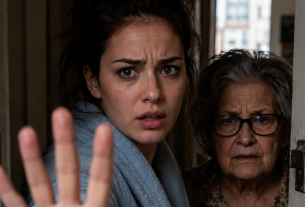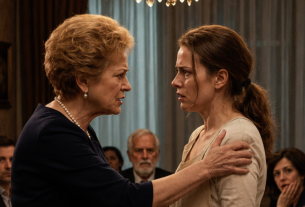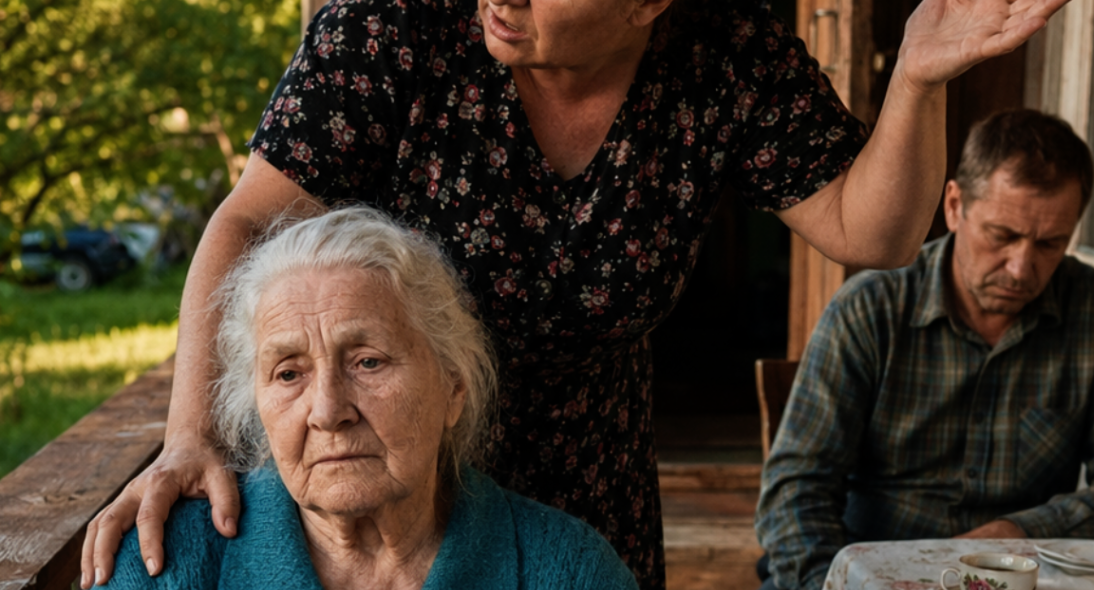
Valentina Petrovna brewed some tea and sat down by the window, watching the August twilight slowly settle over the dacha. The currant bushes sagged under the weight of berries she still had not managed to pick. She had never found the time—or perhaps she simply had not felt like it. The apartment was quieter without her, and that much she knew for certain.
Back in May, when her son Igor had delicately hinted that it might be a good idea for his mother to spend the summer at the dacha, Valentina Petrovna had not objected. She understood that the young couple needed space. Her daughter-in-law Lena was always polite, but her expression said everything: whenever her mother-in-law was nearby, the young woman seemed to tense up like a compressed spring.
“Mom, you love the dacha,” Igor had said, avoiding her eyes. “Fresh air, peace and quiet… And we need to renovate the bathroom.”
The renovation had already lasted three summers in a row. Valentina Petrovna said nothing. She understood that it was not really about the bathroom. The truth was that the two-bedroom apartment where she had lived for thirty years had suddenly become too cramped for three adults.
The first requests for money began in June. Igor arrived at the dacha looking embarrassed, turning his phone over and over in his hands, unsure how to begin.
“Mom, we’ve got a bit of a situation…” He sat down beside her on the bench. “Lena’s bonus has been delayed at work, and we need new furniture for the room. Could you help us out a little?”
Valentina Petrovna opened the old biscuit tin where she kept her savings. Her pension was small, but there was not much to spend money on at the dacha. She grew her own vegetables, electricity cost next to nothing, and she even drew water from the well. Over the summer, she really did manage to save a little.
“How much do you need?” she asked without looking at her son.
“Fifteen thousand should be enough.”
She counted out the money and handed it to him. Igor kissed her on both cheeks and promised to pay it back soon, but they both knew he would not. He worked two jobs, yet there was still never enough money. Lena liked living well.
The same thing happened again in July. This time, the reason was a trip to the seaside.
“Lena says she really needs a vacation,” Igor explained, sitting on the veranda and staring at his calloused hands. “Her job is so stressful, and her nerves are shot. I can’t refuse her, Mom. She’s my wife.”
“Of course you can’t,” Valentina Petrovna agreed quietly. “A young wife is sacred.”
Igor looked up, sensing something subtle in his mother’s voice, but he said nothing. He took the money and left.
August brought more requests. First they needed new curtains for the room, then Lena urgently needed an appointment with a cosmetologist. Valentina Petrovna silently reached into her savings each time, feeling the tin grow lighter and lighter. Igor always promised to repay her, but she saw how his shoulders sagged under the weight of endless expenses and how he rubbed the bridge of his nose with tired fingers in the evenings.
At the end of August, they came together.
Lena stepped out of the car wearing a new dress and high heels—hardly suitable clothes for the countryside. Her hair had been freshly dyed, and her nails were newly done. Igor followed behind her, carrying a bag of gifts.
“How are you, Valentina Petrovna?” Lena asked with a strained smile, as though performing an obligatory ritual. “You’ve got a lovely tan!”
“Everything’s fine,” her mother-in-law replied, studying the young woman carefully. Something about Lena’s behavior made her uneasy. She was too animated, too cheerful.
Over tea, Lena became unusually enthusiastic. She praised the cucumbers from the garden, admired the flowers, and asked about the neighbors. Igor remained silent, occasionally nodding, but his expression was guilty.
“Mom,” he finally began, “we have a favor to ask.”
“I’m listening.”
“You see, this is a very good time to buy a mink coat,” Lena said, not waiting for her husband to continue. “The season hasn’t started yet, but there are already some excellent offers. The discounts are good, and there’s plenty of time to check the quality. If we wait until winter, prices will double.”
Valentina Petrovna placed her cup on the table.
“And how much does this coat cost?”
“Well, a good, high-quality one is around eighty thousand. But it’s an investment! A coat like that lasts fifteen years, maybe longer. If you divide the cost by the number of years, it’s practically nothing.”
“Eighty thousand,” Valentina Petrovna repeated slowly. “Igor, don’t you have that kind of money?”
Her son lowered his eyes.
“No, Mom. I would buy it myself, but…”
“But you have the money!” Lena interrupted, a metallic edge appearing in her voice. “You’ve been at the dacha all summer, and everything here is free. You must have saved up plenty!”
She spoke with such confidence, as though it were the most obvious thing in the world.
Valentina Petrovna slowly rose from the table. Her heart was pounding, and a lump formed in her throat. Eighty thousand was her entire annual savings—every kopeck she had put aside over the years for an emergency.
“Sit here for a moment,” she said quietly. “I’ll be right back.”
The house felt stifling. Valentina Petrovna went into the bedroom, sat down on the bed, and folded her hands in her lap. Birds chirped outside, and the wind stirred the leaves of the apple tree. It was a peaceful August scene, yet everything inside her was burning.
“You must have saved up plenty.”
As though she had spent the summer lounging around on vacation. As though her pension simply fell from the sky. As though thirty years of hard work, saving every kopeck, mending and altering old clothes were not reasons to respect her, but reasons to make demands.
She remembered raising Igor alone after her husband died. She remembered working double shifts to give him an education. She had denied herself new clothes so that her son would never go without anything. And now her property was being treated like a family bank account from which money could be withdrawn whenever they demanded it.
Valentina Petrovna stood up and walked over to the mirror. Her face was serious, her lips tightly pressed together. There was a determination in her eyes that she had not felt in years.
When she returned to the veranda, Lena and Igor were whispering about something. The moment they saw her, they fell silent.
“I don’t have any money,” Valentina Petrovna said without preamble. “And soon I won’t have the dacha or the apartment either.”
Lena flinched.
“What do you mean, you won’t have them?”
“Exactly what I said. I’ve decided to transfer them to my sister. In return, she has invited me to live with her in her country house. It’s a large, two-story place, and she’s afraid to live there alone since her husband died. Besides, my nephews need the property more than you do. They have families and need homes. All you care about are fur coats and expensive trinkets.”
Silence fell. Igor went pale. Lena opened her mouth but said nothing.
“Mom, what are you talking about?” her son asked, his voice trembling. “You can’t be serious.”
“I’m completely serious. I’m going to the notary tomorrow. Zina has been inviting me for a long time, but I kept putting it off. I thought perhaps I would have grandchildren one day and there would be a place for them here. But now I see that isn’t what matters. You don’t need a family home. You need an ATM.”
“Valentina Petrovna, you don’t understand!” Lena exclaimed. “I didn’t mean any harm! I just thought…”
“You thought the old woman was sitting on a fortune, counting her money?” her mother-in-law interrupted. “You thought I had nothing else to spend it on except your needs?”
“Mom, let’s talk calmly,” Igor pleaded. “Don’t make a decision in the heat of the moment. Think about it some more.”
“I’ve already thought it through. I’ve been thinking for thirty years.” Valentina Petrovna sat down in the armchair and folded her hands. “Zina is right. We old people shouldn’t interfere with the young. She has a nice house and a large garden. It will be more enjoyable for us together.”
Lena jumped to her feet and began pacing across the veranda.
“But that’s unfair! You’re depriving your son of his inheritance because of some fur coat!”
“It isn’t because of the coat. It’s because you treat me like a cash cow. Igor is my son. I devoted my entire life to him. And what do I get in return? ‘Mom, give us money.’ ‘Mom, go live at the dacha.’ ‘Mom, stop getting in our way.’ That’s enough. You’re tired of having me around.”
Igor sat with his face buried in his hands. His shoulders were trembling.
“My dear son,” Valentina Petrovna said more gently, “I’m not doing this out of revenge. It’s simply time for me to live for myself. Life is good at Zina’s. It’s peaceful and quiet. She has a garden, but it isn’t too large. There’s a library nearby and a clinic. Most importantly, no one asks me for money to buy fur coats.”
“Fine!” Lena shouted. “Fine, I don’t need the coat! Forget about it!”
“It’s too late. This isn’t about the coat. The coat was simply the last straw.”
They left in silence. Lena sat rigidly in the car, and Igor did not lift his eyes. Valentina Petrovna waved as they drove away.
That evening, her sister called.
“Valya, what happened? Igor called me crying and begged me to talk to you.”
“Zina, is your offer still open?”
“Of course! When are you coming?”
“After the paperwork is completed. In about two weeks.”
The autumn was difficult. Igor came every weekend, begging his mother to reconsider. He promised to talk to Lena and change everything. But Valentina Petrovna refused to give in.
In October, Lena packed her belongings and left.
“I don’t see the point anymore,” she told her husband. “You have no money and no prospects. I’m only thirty. I still have time to build a decent life for myself.”
Igor drank for two weeks and stopped going to work. Valentina Petrovna had moved in with her sister, but she called her son every day, encouraged him, and urged him to pull himself together.
“My dear boy, she never loved you. If she had loved you, she wouldn’t have left because of money.”
“But I loved her, Mom.”
“I know. But love is not a reason to tolerate disrespect.”
By New Year’s, Igor had recovered. A new employee had joined his workplace—a modest young woman from the accounting department named Katya. She was quiet, hardworking, and undemanding. They began dating in the spring.
Valentina Petrovna liked Katya from the first moment they met. The young woman visited her at Zina’s dacha, helped with the housework, admired the flowers, and asked for recipes.
“Valentina Petrovna, how do you pickle cucumbers? And how do you make currant compote?” she asked sincerely, writing down the instructions in a notebook.
“Katya, why do you keep calling me Valentina Petrovna? Call me Mom.”
“May I really?” The young woman’s face lit up. “I wanted to, but I was afraid to ask.”
When Igor and Katya got married, Valentina Petrovna gave them a surprise.
“Zina, thank you for everything, but it’s time for me to go home,” she told her sister. “I’m going back to the children.”
“Valya, what are you talking about? What about your decision?”
“My decision was the right one. I removed the wrong people from my home, and now I’m inviting the right people in. Katya is a good girl. I won’t mind leaving the apartment to her. Let’s reverse the paperwork.”
The move took place in the spring. Katya welcomed her mother-in-law with flowers and a pie.
“Mom, I’m so happy you’ve come back! Igor has been so lost without you. And I want to learn everything you know.”
They lived together peacefully. Katya helped around the house, while Valentina Petrovna taught her to cook and told her family stories. Igor began to look healthier and started smiling again.
That summer, they all went to the dacha together.
“Mom, may I make the compote?” the young wife asked. “Using your recipe?”
“Of course, my dear. Just add a little less sugar. The berries are already sweet.”
Igor embraced his wife and his mother as he watched the sunset.
“Mom, thank you.”
“For what, my dear?”
“For teaching me how to tell real love from false love.”
Valentina Petrovna said nothing, but her heart was full. Sometimes, to find happiness, you must first find the strength to give it up. Then it returns on its own—in the right form and with the right people.
That evening, after the young couple had gone to bed, she sat on the veranda, listening to the sounds of the night and thinking about how life was fair to those who knew how to stand up for themselves, even when doing so meant risking what they valued most.
The old biscuit tin once again contained saved banknotes. But now they were intended for different purposes—for the grandchildren who would surely come one day, for family celebrations, and for the small joys the young family would create together.
And somewhere in the city, her former daughter-in-law was probably trying on a new fur coat bought with another man’s money, never realizing that what she had lost was not an apartment or an inheritance.
She had lost a family.