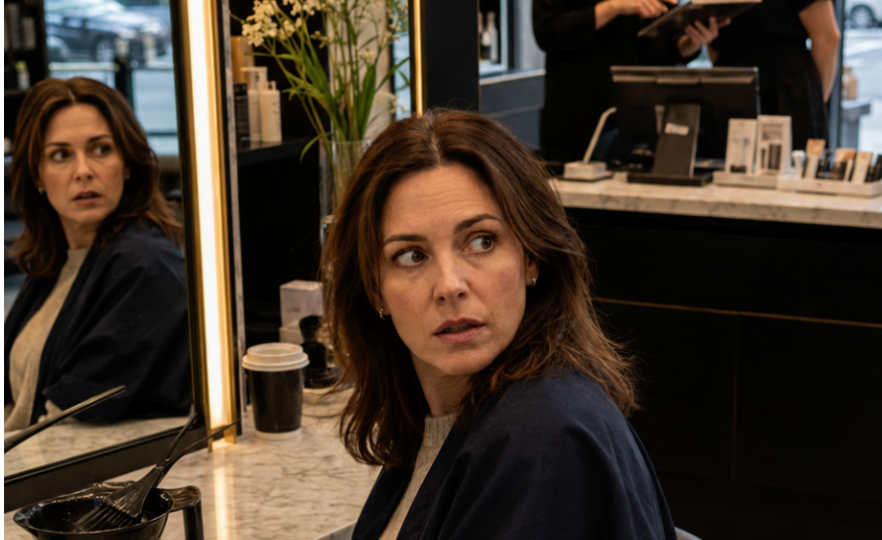
I ended up booking an appointment at that salon by chance. My regular stylist had gone on vacation, and my roots had grown out so badly that I couldn’t wait another two weeks. A friend sent me the number.
“Go see Zhanna. She’s inexpensive, and she’s good with her hands.”
Zhanna turned out to be a talkative woman of about forty-five, with quick fingers and a habit of commenting on everything. While she mixed the dye, I scrolled through my phone and listened with half an ear. It was the usual background chatter: who had dyed her hair, who had left the color on too long, who wanted to go blonde even though chestnut suited her better.
Then Zhanna said:
“One of my regular clients asked for this shade, actually. Astakhova. A beautiful, well-groomed woman. You can tell she takes good care of herself.”
Astakhova was my husband’s surname. And mine by marriage.
I didn’t even flinch. I don’t think my expression changed, either. I simply stopped scrolling and looked up at Zhanna in the mirror.
“Astakhova?” I repeated as calmly as I could.
“Yes. Kristina Astakhova. Do you know her?”
Kristina. Not Marina. So she wasn’t talking about me.
My name is Marina Astakhova. My husband’s name is Dmitry Astakhov. There was no Kristina in our family. No sister, no distant aunt, no colleague with the same surname. Astakhov wasn’t exactly the most common surname in our city.
“No,” I said. “The surname just sounded familiar. Has she been coming here long?”
As talkative stylists often do, Zhanna began remembering things aloud. She said Kristina had been coming to her for almost two years. Sometimes she came in before the weekend to have her hair styled. Once, in passing, she had mentioned Rechnaya Street and a spa membership her husband had given her.
Rechnaya Street.
Dmitry and I lived on Komsomolskaya Street.
I remained in the chair for another forty minutes. Zhanna dyed my roots while I stared into the mirror and thought about anything but my hair.
Two years.
If Kristina Astakhova had been coming here for two years, then she hadn’t started using my husband’s surname recently.
When Zhanna finished, I paid, left a tip, and went outside. It was October and chilly. I sat down on a bench near a pharmacy and called someone—but not my husband.
I called Sveta.
Sveta worked in accounting and always knew who to contact when something went wrong.
“Sveta, I need a lawyer. Not for a divorce. Not yet. I just need to talk to someone.”
Sveta didn’t ask any questions. She sent me a number three minutes later.
I didn’t go straight home. I stopped at a café, ordered tea, and opened my phone. I began thinking about what I could check without causing a scandal and without involving my husband.
The first thing I did was log in to the Gosuslugi state services portal.
Our apartment had been purchased during our marriage and was registered in Dmitry’s name. We had paid off the mortgage two years earlier, and I had also been a co-borrower. After paying it off, we hadn’t done anything else—no allocation of ownership shares, no additional agreements. According to the documents, the apartment belonged to him. Under the law, it was jointly owned by both of us. But I knew how easily something that was supposedly “ours” could become someone else’s if you weren’t careful.
The car was registered in Dmitry’s name. The country house belonged to his mother, Valentina Petrovna. I had my own salary card, and he had his. We didn’t have a joint account.
Every month, however, Dmitry transferred a fixed amount to my card for groceries and household expenses. I didn’t monitor the rest of his spending. I had never checked his bank statements.
I trusted him.
At that moment, the word “trusted” suddenly sounded as though it belonged to somebody else’s life.
The following day, I called the lawyer. Her name was Alla Igorevna. She listened without interrupting, then asked me three questions that I would never have thought to ask myself.
“Marina, do you have children?”
“A daughter. Polina. She’s eleven.”
“The apartment is jointly owned, the mortgage has been paid off, and no ownership shares have been allocated?”
“That’s right.”
“Do you know whether your husband has issued any powers of attorney, taken out loans, or acted as a guarantor for anyone during the past year? Have there been any large transfers?”
I didn’t know.
I knew almost nothing about his finances except the amount he transferred to me every month. That amount hadn’t changed once in four years.
Alla Igorevna told me to do three things.
First, order an extract from the Unified State Register of Real Estate for the apartment. It was simply to make sure the apartment was still there and that no restrictions or liens had been placed on it. I could request it through the MFC public services center or the Gosuslugi portal.
Second, check whether there were any loans or guarantor obligations in my name that I might not know about. I could do that through my credit history.
Third, do nothing rash.
Don’t shout. Don’t make accusations. Don’t leave.
As long as I had no facts, all I had was a surname mentioned by a hairdresser. It wasn’t evidence.
It was a warning signal.
I followed her advice.
I ordered the property extract that same day and requested my credit history through Gosuslugi. Both responses arrived within twenty-four hours.
The apartment was still there. There were no liens, gifts, sales, or mortgages registered against it.
I breathed a sigh of relief.
But not for long.
My credit history contained an inquiry. A bank had checked my details four months earlier.
I had never contacted that bank.
Alla Igorevna explained that an inquiry didn’t necessarily mean what it appeared to mean. It might have been a preliminary credit assessment, an application check, or even an error. But she recommended that I call the bank and ask.
I did.
The woman on the phone searched for the information for a long time, then politely informed me that an application for a consumer loan had been submitted four months earlier.
In my name.
The application had been rejected because there wasn’t enough proof of income. But the application had existed.
I had never applied for a loan.
My hands went cold.
Not because I was frightened by the amount. It wasn’t particularly large—two hundred thousand rubles.
What frightened me was that someone had used my personal information.
My passport was kept at home in a drawer in the bedroom dresser. Only two people had access to it: Dmitry and me.
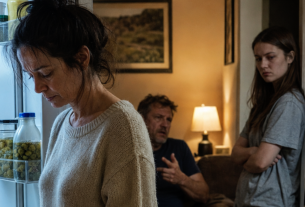
That evening, I returned home. Polina was doing her homework in her room. Dmitry was sitting in the kitchen, eating reheated buckwheat and a meat patty. The television murmured the evening news in the background.
“How was the haircut?” he asked without turning around.
“Fine. I had my hair dyed.”
He nodded.
I put the kettle on and looked at the back of his head.
Thirteen years of marriage. I knew the back of that head, those ears, and his habit of eating without taking his eyes off the television almost by heart.
I didn’t ask him anything.
Not yet.
The following day, I went to the bank in person with my passport. I asked them to retrieve the information about the application because my personal details had been used, and I told the employee that someone might have submitted it without my knowledge.
She was reluctant at first, but after I filed a report about the possible misuse of my personal data, she showed me the information associated with the application.
It had been submitted online.
The contact number listed on it wasn’t mine. I didn’t recognize it. But the home address, passport details, and place of employment were all mine.
Everything was correct.
Everything was exact.
That information wasn’t publicly available. My employer, job title, and length of service would only have been known to someone who had seen my proof-of-income certificate.
I had obtained such a certificate eight months earlier, when we had considered refinancing Dmitry’s car loan. The certificate had remained at home in the same dresser drawer.
That evening, after Polina had fallen asleep, I opened the drawer.
My passport was there.
The certificate was gone.
I didn’t panic.
It was something else—as though my familiar life had suddenly shifted slightly out of place, and I had finally felt it move.
I photographed the contents of the drawer. I wasn’t entirely sure why. Alla Igorevna had told me to document anything that seemed strange, so I followed her advice.
On the third day, I decided to investigate the telephone number from the loan application.
I didn’t call it.
I simply entered it into a search engine. Nothing came up.
Then I entered it into a messaging app.
The profile picture was a pink circle with no face. The profile name was short:
Kristi.
Kristina Astakhova, who visited Zhanna every three weeks.
Who lived on Rechnaya Street.
Whose husband gave her spa memberships.
And who had applied for a loan using my personal information.
Or, at the very least, she used the telephone number listed on the application.
That was enough to remove any remaining doubt.
I didn’t call Dmitry.
I called Alla Igorevna.
“Alla Igorevna, I have evidence now. What should I do?”
She listened and then said:
“Marina, the application was rejected. No money was issued, so technically, there was no financial loss. But attempting to obtain a loan using another person’s information constitutes fraud. You have the right to file a police report. The question is whether you want to do that now or speak to your husband first.”
I thought about it for an entire day.
Polina went to school. Dmitry went to work. I cooked dinner, checked homework, washed Polina’s school uniform, and called my mother.
It was an ordinary life, as though nothing had happened.
But inside me, everything had already changed.
I wasn’t thinking about Kristina.
I was thinking about the certificate.
About the fact that Dmitry had taken my proof-of-income certificate and given it to another woman.
A woman who had tried to take out a loan in my name.
It was no longer merely about an affair.
It was about the fact that he had allowed a stranger into my documents and into my life.
On the fourth day, I came home earlier than usual. Polina was still at school, and Dmitry was at work.
I had an hour.
I didn’t rummage through his belongings. I sat down at the shared laptop on the kitchen table. Whether out of carelessness or habit, Dmitry had left his email and banking notifications open.
I searched for the name “Kristina.”
There were no emails.
There were, however, notifications from the bank.
During the previous month, there had been three transfers to the number listed on the loan application.
Fifteen thousand rubles each.
Forty-five thousand in total.
Forty-five thousand rubles—the exact amount he transferred to me every month for groceries and household expenses.
I took screenshots, emailed them to myself, and closed the laptop.
I was surprised that my hands weren’t shaking.
I drank a glass of water and called Alla Igorevna for the third time.
“Alla Igorevna, I’m ready to speak to my husband. But first, I need to know what I could lose if he decides to act before I do.”
She listed everything clearly and without emotion.
The apartment was marital property regardless of whose name appeared on the ownership documents. In a divorce, it would ordinarily be divided equally, although the court might also consider the interests of the child.
If Dmitry decided to sell or give away the apartment, he would need my notarized consent. Without it, the transaction could be challenged. But it was better to take additional precautions.
“Submit a restriction on registration actions through the MFC or Rosreestr,” she said. “It’s free. You file a statement declaring that no registration may occur without the owner’s personal presence. It’s not a military operation—just an ordinary piece of paperwork.”
The car was registered in Dmitry’s name but had been purchased during the marriage, so it was also marital property. However, selling a car was easier. A spouse’s consent wasn’t required for such a transaction, although it could later be challenged.
I needed to document the model, year, mileage, and estimated value.
The country house belonged to Valentina Petrovna. It wouldn’t be divided.
It wasn’t my problem.
As for child support, if we divorced, the standard guideline for one child would usually be one-quarter of the paying parent’s official income unless the court or an agreement established a different arrangement.
Dmitry’s official salary was one hundred and twenty thousand rubles.
But the transfers to Kristina hadn’t come from his salary account. They had come from another account.
That meant he had savings—or some other source of money—that I knew nothing about.
I wrote everything down in my notes.
On the fifth day, I submitted an application at the MFC.
Until then, I had never imagined that I would stand in an ordinary queue with my passport in my hand while mentally dividing my life into “before” and “after.”
An ordinary queue. An ordinary service window.
The employee accepted my documents and explained that the restriction would be registered within five working days.
I signed the form and left.
On the sixth day, I spoke to Dmitry.
Polina was at a friend’s birthday party. Dmitry came home from work, changed his clothes, and sat down to dinner.
I placed a plate of stew in front of him and sat across the table.
“Dima, who is Kristina Astakhova?”
He stopped chewing.
Not immediately.
First, he finished chewing. Then he put down his fork.
“How do you know?”
Not “Who is that?”
Not “Which Kristina?”
But “How do you know?”
“I’m more interested in something else,” I said. “You gave her my proof-of-income certificate. She used my personal information to apply for a loan. That’s fraud. Do you understand that?”
He went pale.
Truly pale.
Not the way people do in films, but like a person who had suddenly realized that the conversation wasn’t going to be about feelings.
“Marina, it’s not what you think. She didn’t mean to—”
“I don’t care what she meant to do. I care about what you did. You took my documents. You gave them to a stranger. That person submitted a loan application in my name. You transfer money to her every month—the same amount you give me for our family. This isn’t just infidelity, Dima. Or rather, it isn’t only infidelity. It’s something worse.”
He remained silent. Then he said:
“The loan wasn’t approved. Nothing happened.”
“Something did happen. My information ended up in someone else’s hands. The inquiry remains in my credit history. And if the loan had been approved, the debt would have been mine. Do you understand that?”
He did.
I could see it in his eyes.
“I didn’t think it would turn out like this,” he said quietly. “She said she only needed it for a little while. She just needed some money to tide her over.”
I stood up from the table.
“Dima, I’m not going to shout. I’m not going to smash dishes. I’m going to tell you what happens next. Tomorrow, you are coming with me to see a lawyer. We will sit down and go through everything—the apartment, the car, the money, and Polina. If you refuse to come, I will file a police report regarding the attempted fraud. I have the bank’s documentation, the telephone number, and screenshots of the transfers. This isn’t hysteria, and it isn’t blackmail. I’m simply telling you what I intend to do.”
He didn’t argue.
The following day, we went to Alla Igorevna’s office together.
Dmitry sat on the edge of his chair and stared at the floor while the lawyer arranged the documents in front of him.
Alla Igorevna didn’t lecture him.
She asked questions.
“Dmitry Sergeyevich, which account were the transfers to this number made from?”
“A savings account.”
“Is the account in your name?”
“Yes.”
“Marina didn’t know about it?”
“No.”
“How much money is currently in the account?”
He hesitated.
“About one hundred and twenty thousand.”
“And how much was there originally?”
He remained silent even longer.
“About four hundred thousand.”
Four hundred thousand rubles.
A savings account I knew nothing about.
Money he had been saving—or perhaps money we had been saving—that was quietly flowing toward Rechnaya Street.
Alla Igorevna turned to me.
“Marina, do you want a divorce?”
I looked at Dmitry.
Thirteen years. Polina. Our home. Everything we had built.
“First, I want everything to become transparent. Every account. Every transfer. Every obligation. Then I’ll decide.”
Alla Igorevna nodded.
“Then we’ll begin with a notarized agreement. Dmitry Sergeyevich, are you prepared to provide complete statements for all your accounts for the past two years?”
He agreed.
Probably because he had already understood that there was no longer any point in evading the truth.
The following two weeks were the hardest of my life.
Not because we shouted.
On the contrary, Polina noticed almost nothing, and that made the silence in our home feel even heavier.
There were no scandals.
That only made it worse.
We lived in the same apartment, ate at the same table, and took turns walking Polina to school. But between us stood a wall made of printouts, screenshots, and numbers.
Dmitry brought the statements.
All of them.
His salary account, his savings account, and the card he used for online purchases.
I finally saw the complete picture.
Over eighteen months, he had transferred approximately six hundred thousand rubles to Kristina.
In addition, he had been paying the rent for her apartment on Rechnaya Street—twenty-five thousand rubles a month.
That was another three hundred thousand over eighteen months.
Altogether, it came to almost nine hundred thousand rubles.
I didn’t cry.
I simply stared at the figures and thought about our bathroom, which he had been promising to renovate “a little later” for three years.
Alla Igorevna prepared an agreement.
Dmitry committed to several conditions.
First, he would return three hundred thousand rubles to a separate account opened in my name within four months. It was approximately half of what he had spent.
It wasn’t compensation for the pain.
It was the return of family money that had been spent without my knowledge.
Second, he would give me access to information about all his accounts. Not passwords and not control over every receipt—just monthly statements that I could review.
Third, he would sign a notarized obligation to allocate ownership shares in the apartment to Polina and me within six months.
Fourth, he would end all contact with Kristina.
All contact, without exceptions.
Fifth, he would file a police report against Kristina for attempting to obtain a loan using my personal information.
After all, he was the person who had given her my documents.
He took the longest to sign the final condition.
He sat silently over the statement, as though only then had he finally understood that there was no way to turn back time.
He filed the report.
The police accepted and registered it. A local police officer called a week later and said that Kristina had been questioned and warned about the consequences if she ever tried to use someone else’s information again.
No criminal case was opened because there had been no financial loss and the loan had not been issued.
But the incident was officially documented.
Dmitry began returning the money.
Two weeks later, he transferred the first seventy-five thousand rubles into my account, as stipulated in the agreement.
I spoke to Polina separately.
I didn’t tell her about the affair or about Kristina.
Eleven was too young for those details.
“Polina, your father and I are going through a difficult time right now. We’re dealing with some adult problems. None of this is your fault. We both love you. If you ever feel worried or want to talk, you can always come to me.”
She nodded.
Then she asked:
“Are you going to get divorced?”
I didn’t lie to her.
“I don’t know yet. But no matter what happens, you will still have your home, your school, and both of your parents.”
She hugged me.
Tightly, silently, and for a long time.
Then she went back to her room and turned on some music.
Three months have passed.
Dmitry has returned two hundred and twenty-five thousand of the three hundred thousand rubles. The rest is being repaid according to schedule.
The documents allocating ownership shares in the apartment are being prepared by the notary.
Kristina has disappeared from his phone, his transfers, and his life.
I checked.
Not because I wanted to torment him.
I simply couldn’t do things any other way anymore.
We haven’t reconciled, but we haven’t divorced either.
We are living in a state for which there is no simple word.
Dmitry has become quieter. He comes home on time. He cooks dinner on Saturdays. He takes Polina to swimming practice.
He doesn’t buy me flowers or try to make up for what he did with gifts.
I wouldn’t accept them anyway.
Sometimes, after Polina has gone to sleep, we sit together in the kitchen.
We say nothing.
We drink tea, each of us lost in our own thoughts.
One evening, he said:
“I don’t know how to fix this.”
I answered:
“Not with words. With time.”
I still don’t know what to call our situation. We haven’t divorced, but we are no longer a family in the way we once were.
At least there is some order now.
The ownership shares are being registered. The money is being returned. The police report has been officially recorded. Polina goes to school without hearing shouting through the walls.
I know how much my husband earns and where every ruble goes.
I also learned one simple thing.
Income statements, passports, and documents like them shouldn’t be kept somewhere another person can access without asking.
Trust does not eliminate the need for caution.
When something seems wrong, it is better to investigate calmly first.
A property extract, a credit report, and a consultation with a lawyer are not acts of surveillance.
They are ways to avoid being left with someone else’s debts and your own tears.
I never went back to Zhanna.
She was a good stylist. Her hands truly were golden.
But whenever I think of her, I don’t remember the haircut.
I remember how one casually mentioned surname turned my entire life upside down.
And how important it was, at that moment, not to start screaming—but simply to sit down and think.