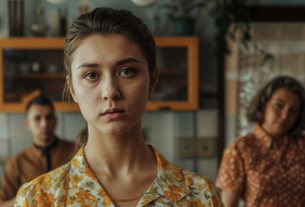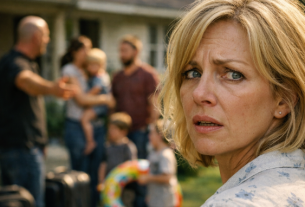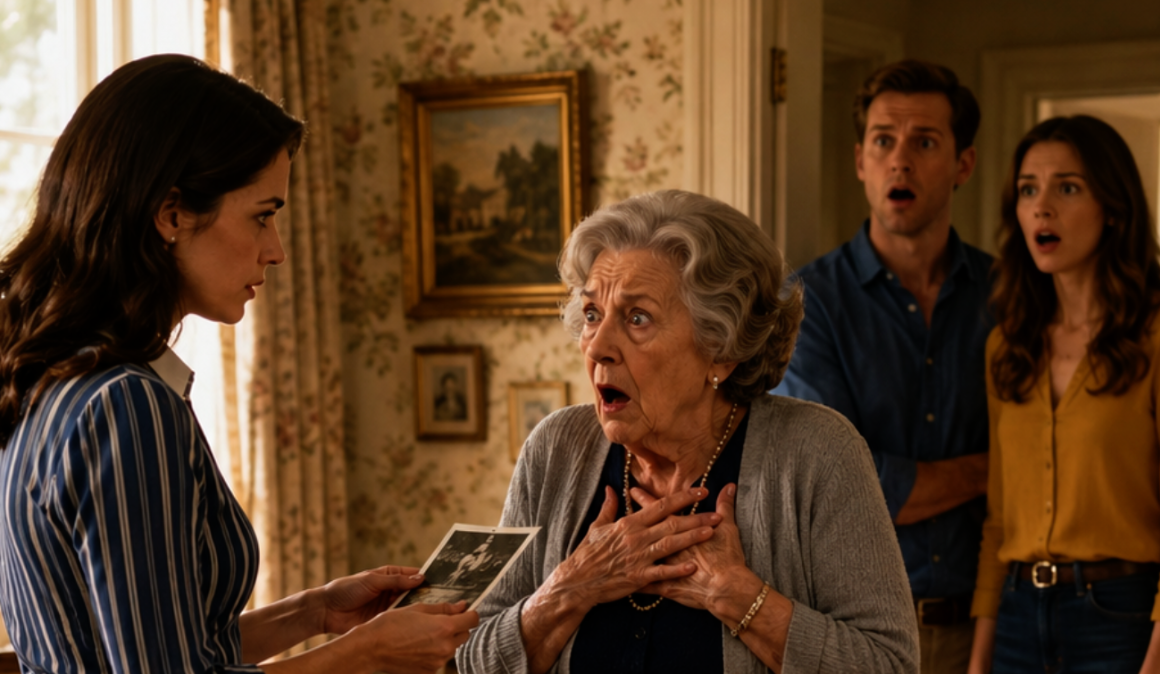
I stood on the porch and watched my mother-in-law’s red SUV disappear around the bend. The dust had not even settled over the gravel when a metallic taste appeared in my mouth—a warning that trouble was coming. The hot mug of coffee burned my palm, but I couldn’t feel the warmth. Two children stood in front of me: a skinny boy of about five with pale, almost washed-out eyes, and an older girl, angular, her lips pressed tightly together. She looked at me from under her brows like a stray cat ready to bare its claws at any moment.
My phone vibrated in my pocket. A voice message. Vera Stepanovna.
I pressed play and put it on speaker. Her cold, well-trained voice filled the veranda, drowning out even the birds.
“Anya, I know you’re furious right now. But they’re my grandchildren. Blood is thicker than water. I’ve had an emergency, and my flight to Milan leaves in three hours. I couldn’t exactly abandon the children at the train station. You’re the psychologist in the family, so find a way to deal with them. Don’t pressure them—they’re very sensitive. Kisses. And don’t even think about calling Dima. He’s in a meeting.”
The message ended. The silence struck my ears.
“You are unbelievable,” I whispered, staring at the dark screen.
The girl snorted. The boy clutched the strap of his backpack and stared at the ground. He was wearing new sneakers decorated with little cars, already covered in dust.
I looked at the house behind me. My grandmother’s country cottage. An old log house with a crooked porch and the scent of dried herbs that had soaked into the wood over the decades. My childhood had passed here—the little bit of it I had before the orphanage. Vera Stepanovna had never come here, considering the place “a backward village hole.” And now she had dumped her grandchildren here like unwanted luggage without even turning off her car engine.
I set my mug on the railing and inhaled slowly, very slowly. Somewhere inside my chest, a tight knot was forming—a mixture of fury and helplessness. I couldn’t throw the children out. It was a social taboo ingrained deeper than any law. Children were sacred. Even someone else’s children. Even if they had been brought here without permission and abandoned like a time bomb.
“What are your names?” I asked, trying to keep my voice even.
The boy said nothing. The girl shrugged.
“You already know. Grandma said you’re our aunt.”
“I know your names,” I corrected her. “I’m asking you to introduce yourselves. It’s basic politeness.”
The girl looked at me defiantly.
“I’m Milana. He’s five. His name is Timofey. He barely talks.”
“Why?”
“Because he doesn’t want to,” Milana snapped and deliberately turned away.
I inhaled again. Slowly. Counted to five. I remembered university, lectures on developmental psychology, my internship at a crisis center. I remembered my own experience—three years in an orphanage after my grandmother, the only person I had left, died. I knew what it meant to be abandoned. I knew the smell of institutional bedding and the sound of indifferent adults who were “just doing their jobs.”
“All right. Come inside. I’ll show you your room.”
I turned and walked into the house without looking back. Behind me came the shuffle of shoes over gravel. Milana whispered something to her brother. I couldn’t make out the words, only the tone.
Contemptuous.
Just like Vera Stepanovna.
The house smelled of dust and old books. I opened the door to the guest room, which I had aired out the day before because I’d planned to turn it into an office. Those plans were changing now.
“You’ll sleep here. There’s one double bed. Clean linen is in the wardrobe. The bathroom is at the end of the hall.”
Milana looked around the room, her gaze lingering on the faded floral wallpaper.
“Pathetic,” she muttered.
“Excuse me?”
“Nothing. I said thank you.”
A lie.
But I didn’t argue. I placed their backpacks on the floor—a pink one covered in glitter and a blue one with dinosaurs—and left, closing the door firmly behind me.
In the kitchen, I sat on a stool and stared at the wall. The wallpaper here was different—still from my grandmother’s time, tiny bell-shaped flowers faded to pale blue. Since childhood I had remembered every crack in the plaster, every water stain on the ceiling. This house had been my fortress, the only place where I had ever felt strong.
And now it was filled with strangers.
I took out my phone and called Dima.
Long rings.
Again.
Again.
He declined the call.
A minute later, a message appeared.
“I’m in a meeting. Is it urgent?”
I typed:
“Your mother brought the children to the cottage and left. No warning. I don’t know for how long. I’m not prepared for this.”
His answer came almost immediately.
“Mom, don’t start. It’s only for a week. What, is that too much to ask? They’re children. You always make a mountain out of a molehill. Take care of the house, distract yourself from your issues. And don’t you dare call Mom and ruin her vacation.”
I read the message three times.
Mom.
He had called me “Mom.”
Just as he always did whenever he asked me not to bother his precious mother. It was unconscious. She was the only authority figure in his life. To him, I wasn’t a wife. I was a function. A psychologist who was supposed to understand everything and forgive everything.
My phone vibrated again.
Another voice message from Vera Stepanovna.
“Oh, Anya, one more thing, I forgot to warn you. Timosha has a gluten intolerance, and Milana doesn’t eat red vegetables. Allergy. Feed them properly—I’ll check. And please, none of your psychological tricks. The children need peace, not interrogations.”
I laughed.
It came out dry and sharp.
Gluten intolerance.
Allergy to red vegetables.
She would check.
Of course she would.
I put the phone down and looked at my hands. They were trembling slightly. A familiar feeling grew inside my chest—the mixture of humiliation and powerless rage I felt every time I dealt with Vera Stepanovna. In five years of marriage, I had never learned how to manage it.
Even though I taught other people how.
Something crinkled in the pocket of my jeans. I reached inside and pulled out a small square of paper folded into quarters.
A pregnancy test.
Two lines.
I had stared at it that morning while sitting on the edge of the bathtub as Dima got ready for work. I had stared at it without knowing whether to laugh or cry.
I slipped the test back into my pocket.
I hadn’t told Dima yet.
And certainly not my mother-in-law.
Now, looking toward the door behind which two strange children were moving around, I understood that the house that was supposed to become our refuge had turned into a trap.
Something fell behind the door.
Then something else.
I got up and went to check.
Milana sat cross-legged on the bed. Timofey stood by the wardrobe staring at the floor. A book lay on the floor—an old photo album I kept on the top shelf.
“He climbed up there,” Milana said, nodding toward her brother. “I told him not to touch it.”
“You didn’t,” the boy whispered.
Those were the first words he had spoken since arriving.
I picked up the album. It had fallen open in the middle—black-and-white photographs of my grandmother as a young woman, my grandfather whom I barely remembered, and several strangers standing in front of this same house.
“It’s all right. But next time, ask permission before touching someone else’s things.”
“Are you going to punish us?” Timofey asked quietly.
I froze.
“Why would you think that?”
“Grandma says strangers always punish you if you don’t behave.”
I crouched in front of him.
He looked at me with those same pale, transparent eyes. There was no fear in them and no hope either.
Only emptiness.
That was how children looked when they had learned not to expect anything good from adults.
“I’m not a stranger,” I said, although everything inside me rebelled against the words. “I’m your aunt. And I don’t punish anyone without a reason. Understand?”
He nodded.
But nothing changed in his eyes.
I stood up and left the room, holding the album against my chest.
The evening had barely begun, and I already felt completely drained.
By nightfall, the wind had picked up. The old house creaked and sighed as though it were alive. I sat in the kitchen making mint tea—the only thing that had helped with my nausea over the past few days.
The doctor had said the first trimester was the hardest and that I needed more rest.
Rest.
Funny.
The children were already asleep. I had checked on them an hour earlier. Timofey was curled into a ball with his thumb in his mouth. Milana lay flat on her back with her arms spread like a starfish. In sleep, her face had softened, and I could finally see that she was still just a child—no more than ten years old despite the grown-up way she carried herself.
I took their dirty clothes from their backpacks so I could put them in the washing machine. I shook sand from the pockets of Milana’s jeans and checked everything that could damage the washer.
Then my fingers touched something hard.
Inside the side pocket of the blue backpack was a book.
Or rather, a notebook with a hard cover, worn and frayed at the corners.
A diary.
I was about to set it aside—reading someone else’s private writing was against my principles—but it slipped out of my hands and fell open in the middle.
The handwriting was childish and careful, slanting slightly to the right.
Milana’s.
“Grandma said that if we behave badly, she’ll send us to an orphanage like Aunt Anya. I asked what an orphanage was. She said it’s where children live when nobody loves them. Timosha cried. I didn’t cry. I don’t want to be like Aunt Anya.”
I turned the page.
“We found a box of photographs in the basement. Grandpa was in one of them with some other man. We showed Grandma and she got angry and tore one of the photos. I managed to hide another one. I don’t know why. It was just a nice picture. Grandpa was laughing and the other man had his arm around his shoulders. On the back it says July 1998. But Grandma says Grandpa died in 1997. So that means she lied.”
I closed the diary.
My hands had gone cold.
Grandpa.
Dima’s father.
Vera Stepanovna had always said he had died heroically when Dima was three years old.
A car accident.
She kept his portrait on the dresser, lit candles for him in church, and wore a black scarf on the anniversary of his death. Her entire life was built around the cult of her dead husband, “the only man worthy of respect.”
And now two children had found a photograph proving that he had been alive and well a year after his supposed death.
I stood and walked to the window.
My pale reflection stared back at me, dark circles under my eyes.
Pieces of a puzzle began fitting together in my mind—things that had once seemed random.
Vera Stepanovna never talked about the details of her husband’s death.
Dima did not remember his father.
All the documents had supposedly been “lost during a move.”
And six months earlier, when I had accidentally found an old photograph in her apartment and asked who was in it, she had ripped it from my hands and locked it in a safe.
At the time, I had dismissed it as the eccentric behavior of an aging woman.
Now I understood.
It had been a warning.
The door creaked.
I turned around.
Milana stood in the kitchen doorway wearing a long nightgown, barefoot.
She looked at me and then at the notebook in my hands.
“You read it,” she said.
It wasn’t a question.
“Yes.”
“That was wrong.”
“I know. I’m sorry.”
She came to the table and sat opposite me like an adult, folding her hands in front of her.
“Are you going to tell Grandma now?”
“No.”
“Why?”
“Because your grandmother shouldn’t have told you that. About the orphanage.”
Milana was silent for a moment.
“Is it true? Did you live in one?”
“Yes. But that doesn’t mean nobody loved me. Sometimes parents can’t take care of their children, and then other people help.”
“What people?”
“Caregivers. Teachers. People who are there.”
“Did they love you?”
I remembered a caregiver at the orphanage, a heavyset woman with tired eyes who secretly brought me sandwiches because I refused to eat in the cafeteria.
“Some of them did. Some didn’t. Just like everywhere else.”
Milana lowered her eyes.
“We found the photograph. I wanted to ask Grandma why Grandpa was alive in it if she says he’s dead. But she started screaming. Really scary screaming. Then she said we were going to your cottage because it was unhealthy for us to stay in the city.”
“When was this?”
“Three days ago. She packed everything in an hour. She said I imagined it all and that children shouldn’t say stupid things to adults.”
I stared at the girl as a cold clarity spread through me.
So that was it.
My mother-in-law had not simply decided to get rid of her grandchildren for a week.
She had panicked.
The children had found something they were never supposed to see.
And now they needed to be sent away before they told anyone.
“Where is the photograph?” I asked.
“Inside Timosha’s pillow. He sleeps with it.”
“Can I see it?”
Milana hesitated.
Then nodded and slipped out of the kitchen.
A minute later, she returned holding a worn rectangular photograph.
I took it carefully, as though it were a fragile relic.
A black-and-white picture.
Three men stood in front of this very house. I immediately recognized the porch, the railing, the old apple tree on the right.
One of the men was definitely Dima’s father. I had seen his photograph in my mother-in-law’s living room. He was laughing with his head thrown back.
Beside him stood another man—a young guy with long hair tied back—his arm around Dima’s father’s shoulders.
I turned the picture over.
Written in blue ink were the words:
“July 1998. The cottage. Kostik, Vitya, and Me.”
And underneath was a signature that made me stop breathing.
Handwriting I would recognize anywhere.
My own.
“And Me.”
I sat frozen.
Milana watched me anxiously.
“What is it?” she asked.
“Nothing. Everything’s fine. Go back to bed.”
“You’re lying.”
“Yes. But it doesn’t matter right now. Go. We’ll talk tomorrow.”
She left, glancing back at me.
I stayed alone.
My handwriting.
My signature.
On a photograph more than twenty years old.
I hadn’t even been born then.
Or had I?
I would have been two.
A year later, my grandmother had taken me from a children’s home—that was what she had told me.
I had been adopted.
She had never told me who my biological parents were.
They were dead, she had said.
No point digging up the past.
I pressed the photograph against my chest.
My temples throbbed.
I—a psychologist specializing in family crises—had somehow landed in the middle of a story so absurd even the writers of cheap soap operas wouldn’t invent it.
And somewhere thousands of kilometers away, Vera Stepanovna was drinking coffee in Milan—or wherever she was now—without realizing her plan was already falling apart.
I took out my phone.
I found an old email exchange with the regional civil registry archives. Years ago, I had tried to find information about my biological parents but had given up after hitting one dead end after another.
Now I had a lead.
Names.
Dates.
The house I was sitting in right now.
I wrote a short email:
“Urgent request. Please search the archives for July 1998. I am interested in records concerning three men who stayed at this house during that period. One is believed to be Viktor Andreyevich Sobolev, born in 1965. The others were named Kostik and… me.”
I sent it.
Then leaned back in my chair and closed my eyes.
Somewhere upstairs, the bed creaked.
Timofey murmured something in his sleep.
The wind outside grew stronger, and the old apple tree scraped a branch against the window.
I got up and made myself another cup of tea.
I had no desire to sleep.
The night dragged on endlessly.
I sat in the kitchen replaying fragments of old conversations, my mother-in-law’s sideways glances and strange slips of the tongue.
“She isn’t right for you,” she had once told Dima when she thought I couldn’t hear.
“She’s unreliable. Bad genetics.”
At the time, I assumed she was referring to my childhood in an orphanage.
Now I realized she might have meant something entirely different.
At six in the morning, the phone rang.
Dima.
“Why are you still awake?” His voice was sleepy and irritated. “I checked your stories and saw you were online at three in the morning.”
“Your mother dumped the children on us. Not us. Me.”
“I already told you, it’s not for long. Be patient. She’ll get some rest and come back.”
“And you? Are you coming?”
A pause.
“I have a report due Thursday. Maybe this weekend. We’ll see.”
“We’ll see,” I repeated. “Wonderful.”
“Anya, don’t pick apart every word. I really am busy. Stop turning nothing into a tragedy.”
I hung up.
Then called him back.
“Dima, answer one question. Honestly.”
“What?”
“Your father. What really happened to him?”
Silence.
So long that I thought the connection had dropped.
“Have you lost your mind?” he finally said. “What brought this on?”
“Just answer.”
“He died in a car accident. I’ve told you a hundred times.”
“Do you remember his funeral?”
“I was three. What could I possibly remember?”
“Are there photographs? Documents? A death certificate?”
“Listen, stop. This isn’t funny anymore.”
“I’m not laughing.”
He went quiet.
Then he said slowly, emphasizing every word:
“Mom said it was bad for you to be alone. You start imagining things. Get some rest. Work around the house. Don’t get involved in things you don’t understand.”
Then he hung up.
I looked at the photograph lying on the table.
Three men.
One signature.
My handwriting.
Even though that was impossible.
The children woke at eight.
I made porridge with water—I remembered the gluten intolerance—and cut up some fruit.
We ate breakfast in silence.
Milana studied me.
Timofey poked at his bowl with a spoon without looking up.
“Today is Saturday,” I said when they had finished eating. “Here’s the plan. We clean the house, then we walk to the river. In the evening, we make a fire. Any questions?”
“So you’re our nanny now?” Milana asked.
“I’m your aunt. And while you’re here, you live by my rules.”
“And what if we don’t?”
“You will. Because you don’t have anywhere else to go. Grandma is in Italy, your father is in the city, and here you have me. And believe me, I’m much kinder than your grandmother. But I’m also much stricter.”
Milana exchanged a glance with Timofey.
Some thought passed silently between them, quick as the shadow of a cloud.
“Fine,” she said. “But you can’t cook. The porridge was lumpy.”
“Next time you can make it yourself.”
She stared at me in surprise, opened her mouth, then closed it again.
I stood and began collecting the dishes.
“Cleaning starts in half an hour. You have time to get dressed and make your bed. That’s all.”
I left without looking back.
I could feel her astonished stare on my back.
I had made a decision.
No coddling.
I wasn’t going to try to make them like me.
I would be exactly what life had made me—tough, fair, but predictable.
Children who were used to manipulation and lies needed certainty.
Even when that certainty was unpleasant.
Half an hour later, they came out onto the porch.
Timofey carried a trash bucket.
Milana carried a dustpan and broom.
No reminders needed.
“What do we do?” she asked sullenly.
“Sweep the porch. Timofey can beat the rugs.”
I went into the vegetable garden and left them to work.
I stood over the beds that needed weeding.
Pregnancy was already making itself known. I felt dizzy and nauseated, but I couldn’t sit still. Physical work distracted me from the thoughts that had been swarming through my head all night.
An hour later, I looked back.
The porch was spotless.
The rugs hung over the fence, beaten clean in clouds of dust.
The children sat on the steps watching me, both out of breath and flushed, but pleased with themselves.
“Good job,” I said. “Now the river.”
The river was a twenty-minute walk away, narrow, with a gently sloping sandy bank.
We followed a path through the field, and I felt the tension slowly begin to leave me.
Timofey even started talking.
He pointed at butterflies and asked me the names of flowers.
Milana walked behind us, but there was no longer the same hostility in her.
At the riverbank, we spread out a blanket.
The children kicked off their sneakers and went into the water.
I sat on the grass watching the sunlight glitter on the surface and thought about how strange life could be.
I hadn’t wanted these children.
I hadn’t wanted to be a babysitter.
But for the first time in a long while, I felt that someone needed me for something other than satisfying my mother-in-law or my husband.
“Aunt Anya!” Timofey shouted, waving his arms. “Look, a fish!”
“I see it. Catch it.”
He laughed.
Milana snorted but smiled too.
For the first time since they had arrived.
By the time we returned to the cottage, evening was approaching.
I lit a fire in the old barbecue pit and threaded bread and vegetables onto skewers.
The children sat on tree stumps watching the flames.
“Tell us about the orphanage,” Milana suddenly asked.
I paused while turning the skewers.
“What is there to tell? It was an ordinary government institution. A bedroom for twenty people. Wake-up bell. Porridge for breakfast. Caregivers tired of life. Children dreaming that someone would take them into a family.”
“Nobody took you?”
“No. Nobody was waiting for me.”
“Why?”
“Because I was already older. Once you’re ten, your chances of adoption fall dramatically. Everyone wants babies.”
Milana wrapped her arms around her knees.
“What about Mom? Our mom?”
“I don’t know your mother. She’s Dima’s sister, right?”
“Yes. She left. A long time ago. Grandma says she abandoned us.”
“And your father?”
“He was never really there. I mean, he existed, but Grandma says he’s a bad person.”
The flames danced in the girl’s eyes.
She spoke calmly, but I could feel the pain hidden behind that calm, pain she probably didn’t even recognize herself.
“You know,” I said, “when I was in the orphanage, I thought I’d been abandoned too. I thought nobody needed me. That something was wrong with me. But eventually I realized adults sometimes make decisions not because children are bad, but because the adults themselves are lost.”
“And what difference does that make?”
“I don’t know,” I answered honestly. “But it helps you stop blaming yourself.”
Timofey moved closer and rested his head on my knees.
I flinched but didn’t pull away.
A minute later, his breathing became steady.
He had fallen asleep.
“He’s attached to you,” Milana said. “He normally doesn’t go to anyone.”
“I noticed.”
We sat by the fire until the coals had burned down to a red glow.
Then I carried Timofey into the house and put him to bed.
Milana went on her own, then stopped at the doorway.
“Aunt Anya.”
“Yes?”
“Grandma said you were mean. She said you destroyed their family.”
“Destroyed it?”
“She says when you married Uncle Dima, you stole him.”
“I didn’t steal him. He came willingly.”
“She says you did it on purpose. That you were after the apartment.”
I sighed.
“Milana, I bought our apartment with my own money. The mortgage is still in my name. And your grandmother… she simply doesn’t want to share her son with anyone. That’s her problem. Not mine.”
Milana nodded, but a question remained in her eyes.
She closed the door.
I stood in the hallway looking at the strip of light beneath it.
The next morning, rain began early.
Gray and steady, drumming against the roof.
I sat in the living room going through old documents stored in my grandmother’s dresser.
I was looking for anything that might provide an answer.
And I found something.
A yellowed envelope made from thick paper, tied with string.
Inside were letters.
I took one out and unfolded it.
“Dear Maria Ivanovna,
We hereby inform you that your application for temporary guardianship of the minor Anna, born in 1996, has been reviewed and approved. The child is being placed in your care for a period of one year, with the possibility of extension…”
Grandmother.
It had been my grandmother.
She had taken me under temporary guardianship.
Later, perhaps, she had made it permanent.
Or perhaps not.
I didn’t know.
I had never bothered looking at the documents.
I kept searching.
Another letter.
This one handwritten.
The handwriting was unfamiliar—nervous, uneven.
“Maria Ivanovna, I beg you, keep this secret. If Vera learns where the girl is, she’ll destroy her. I cannot explain everything, but please believe me—for my brother’s memory, hide Anya. Tell no one who her real parents are. I will pay for her care. Just don’t say a word to Vera.”
Signed:
“K. Sobolev.”
Kostik.
The brother of Dima’s father.
The third man in the photograph.
I put the letter down.
My hands were shaking.
A horrifying and impossible chain of events was taking shape in my mind.
Vera Stepanovna was not merely my mother-in-law.
She was the very person I had been hidden from for twenty-five years.
The rain grew heavier.
Somewhere upstairs, the floorboards creaked.
The children were waking.
I placed the letters back inside the envelope and hid it in the drawer.
Then I washed my face with cold water and looked in the mirror.
A pale woman with feverishly flushed cheeks looked back at me.
A woman who had just discovered that for the last five years, she had been living inside the family of the person from whom she had once been hidden as though from death itself.
My phone buzzed.
A message.
“Dear Anna Viktorovna,
In response to your inquiry, we confirm that during the period in question three men were indeed residing at the house owned by Maria Ivanovna Gorelova.
Viktor Andreyevich Sobolev had officially been listed as wanted since March 1997 on suspicion of large-scale theft of state property.
The case was closed in 1998 due to…”
I stopped reading.
I put the phone down and walked out onto the porch into the rain.
They had hidden me.
From Vera Stepanovna.
Which meant she had apparently reported her own husband to the authorities.
Or maybe she hadn’t.
Maybe the truth was different.
One thing I knew for certain.
She would be back in a few days.
And when she returned, she would have a lot of questions to answer.
The rain stopped by evening.
The air became clear and washed clean, filled with the smell of wet earth and pine.
I stood by the gate looking down the road.
In the distance came the sound of an engine.
A car.
I recognized the sound immediately.
The red SUV.
Vera Stepanovna had returned four days early.
She got out without turning off the engine.
She looked flawless—light-colored pantsuit, perfect hair, dark sunglasses pushed onto her forehead.
Nobody else got out of the vehicle.
She was alone.
“Are they packed?” she shouted instead of greeting me. “Where are my grandchildren?”
“They’re sleeping,” I replied calmly. “Quiet time.”
“At four in the afternoon?”
She checked her watch, then looked at me.
“What did you do to them that they’re sleeping during the day?”
“Fresh air and physical work.”
She came through the gate without asking permission and stopped two steps away from me.
“I changed my mind. I’m taking the children today. You were right. They have no reason to stay here. It’s a wilderness.”
“Did something happen?”
“Nothing. A grandmother’s heart simply can’t rest.”
She tried to smile, but it came out stiff and artificial.
“Where are they? I hope you haven’t completely ruined them with your methods.”
“Come in. They’re on the veranda.”
I let her walk ahead.
Her heels clicked against the floor as she looked around the house with disgust.
I remembered something.
She had never been here.
Not once in five years.
And suddenly she had needed to come personally.
Milana and Timofey were playing lotto on the veranda.
When they saw their grandmother, both froze.
Timofey instinctively moved closer to Milana.
“Pack your things,” Vera Stepanovna ordered. “We’re leaving.”
“Where?” Milana asked.
“Home. Back to the city. You’ve relaxed enough here.”
“We don’t want to go home,” the girl said quietly but firmly.
My mother-in-law froze.
Then slowly turned toward me.
“What have you taught them?”
“Nothing. They simply like it here.”
“Don’t lie.”
Her voice became lower and more dangerous.
“You’ve been turning them against me since the moment they arrived.”
“Vera Stepanovna, we need to talk privately.”
She hesitated.
Then nodded, telling the children:
“Stay here.”
We went into the living room.
I closed the door.
“I’m listening,” she said, folding her arms.
“Why did you bring the children here?”
“I told you. An emergency.”
“That isn’t true. You were frightened. They found the photograph.”
She went pale.
Only for a second.
But I noticed.
“What photograph?”
“The one showing your husband alive and perfectly healthy a year after his death.”
She said nothing.
I continued.
“And they found the diary. Milana wrote that you threatened to send them to an orphanage. That you told them if they talked, you would send them to the same place I went.”
“Children fantasize,” she said coldly. “You’re a psychologist. You should know that.”
“I do know. And I also know children don’t invent photographs they’ve never seen.”
I took the picture from my pocket.
“Here it is. July 1998. Your husband. Konstantin Sobolev, his brother. In front of this house.”
She stared at the picture but made no attempt to take it.
Her face had become a mask.
“Where did you get that?”
“Timofey slept with it. They found it in your basement.”
“They had no right to go down there.”
“They’re children. They get into everything. That’s their job.”
I put the photograph away.
“But that isn’t all. I found letters in my grandmother’s dresser.”
She flinched.
“Letters from Konstantin. He begged my grandmother to hide me. From you.”
Silence.
Somewhere in the house, water dripped from a faucet.
From the veranda came the faint whispers of the children.
They had gone quiet.
They were listening.
“You want to know the truth?” Vera Stepanovna asked in a hoarse voice.
“Yes.”
“Your father was Viktor Sobolev. My husband. You are his illegitimate daughter.”
I stood motionless.
My head was roaring.
“He had an affair with a woman from this village. I found out after you had already been born. He wanted to leave me for her. Leave me with Dima. I wouldn’t allow it.
“I arranged for him to be declared wanted.
“Then he disappeared for real.
“I don’t know where he is now. I don’t know whether he’s alive.
“But I found your mother.
“And I would have done anything to make you disappear too.
“Your grandmother hid you.
“Then she died, and you ended up in an orphanage.
“I thought that was it.
“The problem was solved.”
“But I grew up,” I said.
“And married your son.”
“Yes.”
She looked exhausted.
“You grew up and appeared in my life again.
Like a curse.”
There was no anger in her voice.
Only exhaustion.
Resignation.
Like a person who had carried an unbearable weight for thirty years and had finally dropped it.
“Is that why you hate me?”
“I don’t hate you. I was afraid.
“Afraid you would find out.
“Afraid Dima would find out.
“That you were his sister.”
“I’m not his sister. We have different mothers.”
“It doesn’t matter. It would destroy him. To learn that his father betrayed me. That he had another child. That his mother had hidden it…”
“That his mother turned his father over to the authorities,” I added.
She said nothing.
“Vera Stepanovna,” I said, “I feel sorry for you.”
“What?”
She stared at me in astonishment.
“You’ve spent thirty years living in fear. Lying to your son, manipulating your grandchildren, trying to control everyone and everything.
“And for what?
“To preserve the image of a perfect family that never existed.”
“You don’t understand…”
“I understand more than you think. I’m a psychologist. I can see trauma.
“Your trauma.
“You never forgave your husband.
“And you never forgave yourself.”
She sank into a chair.
For the first time, I didn’t see an enemy.
I didn’t see an abusive mother-in-law.
I saw an old, exhausted woman who had made a terrible mistake and spent her entire life trying to hide it.
“I won’t forgive you,” she said dully. “And you won’t forgive me. But I’m asking one thing.
“Don’t tell Dima.”
“I won’t.
“But you’re going to do one thing for me.”
“What?”
“You’ll leave the children here until the end of summer. They need peace, not your nerves.
“And you will not interfere.”
She stared at me for a long time.
Then nodded reluctantly.
“All right.”
I went out onto the veranda.
Milana and Timofey sat exactly where they had been, tense as strings.
“Grandma is leaving,” I said. “And you’re staying.”
Milana looked toward her grandmother, who stood in the doorway, defeated and somehow foreign.
“Really?” Timofey whispered.
“Really.”
He jumped from his chair and ran to me.
He wrapped his arms around my legs.
I stroked his hair.
Vera Stepanovna turned and walked toward her car.
A minute later, the red SUV disappeared around the bend.
Again, dust.
Again, silence.
But this time I knew it was only the beginning.
Somewhere beyond the horizon was the truth about the father I had never known.
Sooner or later, it would come to the surface.
But for now, I had these children.
This house.
And the new life beating beneath my heart.
I looked at the sunset and smiled for the first time in many days.
That evening, I called Dima.
I told him the children would remain at the cottage until the end of summer and that we needed to have a serious conversation.
He immediately started objecting—tired, irritated—but I interrupted him.
“Come on Saturday. Alone. It’s important.”
“What happened now?” There was panic in his voice, though he was trying to hide it behind his usual irritation. “Mom already called. She said you threw a tantrum and kicked her out of the house. What do you think you’re doing?”
“Nothing she told you. Come here and you’ll learn the truth.”
“What truth? Anya, stop playing games. I’m tired.”
“I’m tired too,” I said quietly. “Very tired. But you’re going to hear the truth.
“Saturday.”
Then I ended the call.
Saturday came faster than I expected.
During those days, we lived in a strange, fragile peace.
The children gradually thawed.
Timofey now talked nonstop.
Milana learned to make pancakes and even smiled at me a few times without any trace of her former hostility.
We picked raspberries, walked to the river, and read books before bed.
Inside me, I felt something new beginning to grow.
Tenderness mixed with anxiety.
A sense that a major change was approaching.
Dima arrived at noon.
I saw his car through the window and went out onto the porch.
He climbed out looking rumpled and unshaven, with dark circles beneath his eyes.
It was obvious he hadn’t slept.
“Well?” he asked instead of greeting me. “What’s so urgent?”
“Come inside. The children are in the garden. We shouldn’t talk in front of them.”
We sat on the veranda.
I placed a cup of tea in front of him.
He didn’t touch it.
“Anya, I honestly don’t understand what’s happening. Mom is crying on the phone, you’re speaking in riddles…”
“Your father is alive,” I said.
He froze.
The cup in his hand trembled.
Tea spilled onto the tablecloth.
“What?”
“Your father didn’t die in a car accident. He was declared wanted in 1997. For theft. The case was closed a year later.
“But he didn’t die.”
“That’s nonsense. Mom…”
“Your mother knows.
“More than that—she helped the authorities.
“She was afraid he would leave her for another woman.”
“What woman?”
“My mother,” I said calmly, although everything inside me was shaking.
“Dima, I am Viktor Sobolev’s daughter.”
He stared at me without blinking.
Disbelief.
Horror.
Denial.
One after another.
“You’re lying.”
“I found letters. A photograph. Documents. I sent a request to the archive. Their response came yesterday.
“I’m not lying.”
He stood so quickly that the chair toppled over.
He paced across the veranda, fists clenched.
“Do you understand what you’re saying?
“That you’re my sister?”
“Half-sister. We have different mothers.”
“That changes nothing!”
He was almost shouting.
“You’re my sister, and I… we’ve been married for five years… we…”
“We’re going to have a child,” I said.
He froze.
“What?”
“I’m pregnant.
“I found out last week.
“I wanted to tell you, but then your mother showed up with the children, and everything fell apart.”
Dima sank into a crouch and covered his face with his hands.
I saw his shoulders shaking.
He was crying.
For the first time in five years.
“This is some kind of monstrous joke,” he whispered.
“It isn’t a joke.
“It’s our life.”
“We can’t… this is…”
“We are not full biological brother and sister, Dima. We only share one parent. Genetically, the risks are relatively limited. Legally, we didn’t knowingly do anything wrong.
“But morally…
“That’s something you’ll have to decide for yourself.”
He raised his head.
His reddened eyes were filled with anguish.
“Do you want to keep the baby?”
“Yes.
“And I want a divorce.”
“Why?”
“Because our marriage was built on your mother’s lies.
“Because you were never on my side.
“Because I don’t want my child growing up in a family where its grandmother wishes its mother dead.”
“Anya…”
“It’s true.
“Vera Stepanovna kept me hidden for thirty years.
“She knew who I was.
“And when you brought me into her home, she decided it was her opportunity to control the situation.
“But I slipped out of her control.”
He said nothing.
I could see the battle inside him—the love he had for his mother fighting against the horror of what she had done.
“I don’t know what to do,” he finally said.
“Go to her.
“Talk to her.
“Then come back.
“Or don’t.
“That choice is yours.”
He left an hour later.
I stood on the porch watching his car disappear in a cloud of dust.
Inside, I felt empty and calm at the same time.
That evening, while putting the children to bed, I heard Milana whisper to Timofey.
“Is Aunt Anya going to stay with us forever now?”
“I don’t know,” he answered. “I hope so.”
“So do I,” she said.
I gently closed the door and cried.
For the first time in a long time, not from pain.
From relief.
Dima returned three days later.
During that time, I had managed to dig up the entire vegetable garden, wash every window, and reread my grandmother’s letters slowly and carefully, piecing together my family’s history bit by bit.
He arrived in the evening as the sun was setting.
He got out of the car and stopped by the gate.
“I talked to my mother,” he said.
“She admitted everything.”
“And now?”
“I don’t know if I’ll ever be able to forgive her.
“But I know one thing.
“I don’t want to lose you.
“Not you.
“Not the baby.
“If you’re willing to try again.”
I said nothing.
“I understand I failed you.
“I was a blind fool.
“I trusted my mother more than I trusted you.
“But I want to change.”
“You can’t change in three days,” I said.
“That takes a long time.
“With a therapist.”
“I’m ready.”
I opened the gate.
“Come in. The children are already asleep.
“Want some tea?”
He nodded and stepped inside.
We sat in the kitchen drinking mint tea without speaking.
Talking was difficult.
Silence was easier.
I looked at him and no longer saw a husband.
I saw a person fate had tied to me—cruelly, strangely, perhaps forever.
“I keep thinking about my father,” he said suddenly. “Where is he now? Is he alive?”
“There was an address in Kostik’s letter.
“It isn’t very far.
“A village about two hundred kilometers from here.”
“Do you want to find him?”
“Not now.
“Maybe later.
“Right now, I need to understand this life.
“The children.
“Myself.”
He nodded.
“Can I stay?
“For the weekend?”
“Stay.”
And he did.
We didn’t talk about the future.
Only the present.
We cooked, walked with the children, repaired the leaning fence.
Life continued—slow, simple, filled with small tasks that kept us from thinking too much about the larger pain.
A month passed.
August moved beyond its midpoint, and the nights grew colder.
One morning, I woke to someone knocking at the door.
An unfamiliar man stood on the porch.
He was elderly and slightly stooped, with gray at his temples and surprisingly young eyes.
He looked at me as though he couldn’t quite bring himself to speak.
“Hello,” he finally said.
“My name is Konstantin Sobolev.
“I am your father’s brother.
“May I come in?”
I stepped aside.
“I received your inquiry through the archive,” he said as he perched on the edge of a chair.
“And I realized the time had come.
“I know where your father is.
“And he wants to see you.”
Outside the window, a new day was beginning.
The children were still asleep.
Somewhere in the house, my grandmother’s old clock ticked steadily.
I poured my guest a cup of tea and prepared to listen.
Whatever came next waited beyond that threshold.
And I was ready to step through it.