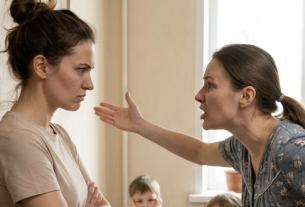
Galina happened to spot her husband at a café with a strange woman. Instead of confronting him, she made a choice that would turn their lives upside down. But the truth ended up being nothing like what she imagined.
She saw them through the window. He was sitting across from a woman in a dark green dress, laughing in a way he hadn’t at home in a long time.
Galina stopped right in the middle of the sidewalk. Someone brushed her shoulder, muttered something, and walked by. But she just stood there, watching Vadim lean over the table to say something to the woman, who threw her head back and laughed.
Her fingers squeezed the handle of the shopping bag so tight that the plastic dug into her palm.
Inside the bag were two kilos of apples, a pack of buckwheat, and sour cream. She was on her way back from the grocery store because Vadim had asked her that morning, ‘Can you cook something real? I’m sick of frozen meals.’ So she went, even though her legs ached after her shift, and even though it was three blocks out of her way, because the sour cream at the closer store was twenty rubles more expensive.
And there he was, sitting in the ‘Veranda’ café on Komsomolskaya Street. Laughing.
Galina turned around and headed home. She didn’t run or cry. She just walked steadily, counting the cracks in the pavement. There were a lot. She counted seventeen before she reached the turn into their courtyard.
It was quiet at home. Her son Lyosha was in his room, headphones on, staring at his laptop. Fourteen years old, one meter seventy-two tall, skinny wrists, and a lock of hair that always stuck up. He didn’t hear her come in.
Galina left the shopping bag on the hallway floor. She took off her shoes, went to the kitchen, turned on the kettle, and sat at the table with her hands in front of her. The handle had left her right palm red. She looked at that mark and thought it looked like a scar.
The kettle started to hum. Then it clicked off. She didn’t get up.
Vadim came home an hour and a half later. He was cheerful, smelling of coffee and something sweet, a scent she hadn’t noticed before. Maybe she’d never bothered to notice.
‘Hi. Why are you sitting in the dark?’ he asked.
She hadn’t turned on the light. Only now did she realize it.
‘Just thinking,’ she replied.
‘Is there dinner?’ he asked.
‘There are apples in the bag. By the door.’
He grunted and walked past her to the fridge, took out some sausage and bread. He made sandwiches. Then he handed one to her.
‘Here you go.’
‘Thank you.’
She took the sandwich and placed it on the table. She didn’t feel like eating. Her mouth had a metallic taste, as if she had bitten her cheek.
Vadim chewed and scrolled through his phone. The screen reflected in his glasses, and Galina could see chats flickering by, but she couldn’t make out any names. He was sitting just half a meter away from her—and yet felt so far.
‘How was work?’ she asked.
‘It was fine. The meeting ran long.’
A meeting. She nodded. The lie sat between them on the table, like a third sandwich no one would take.
That night, Galina couldn’t sleep. She lay on her side, facing the wall, listening to Vadim breathe—steady, deep. Asleep. No guilt, no anxiety, not a single hint that his wife might have seen him.
Or maybe she was mistaken. Maybe it was just a colleague. Maybe it was a work meeting. People laugh at business meetings. It happens.
But the scent. Sweet, floral, and not hers. Galina had run out of perfume in March, and hadn’t bought more because the price of laundry detergent went up and she had to choose. She chose detergent.
At three in the morning, she got up, walked to the kitchen, and took his jacket off the hook. She checked all the pockets. Nothing. Absolutely clean. Not even a receipt.
That was worse than if she had found something. Someone with nothing to hide doesn’t bother to empty their pockets.
She hung the jacket back up. Straightened her shoulders—the way she always did in the office mirror before her boss scolded her for someone else’s mistake. Habit made her keep her back straight, even when all she wanted was to curl up.
In the morning, she made porridge. Oatmeal, just how Lesha likes it, with banana and cinnamon. For Vadim, she prepared cheese sandwiches. Everything as usual. Not a single muscle twitched.
Vadim kissed the top of her head before leaving. His lips were dry and quick.
“I’ll be late tonight, got a project on fire.”
“Alright.”
The door closed. Galina stood in the hallway, staring at his shoes by the door. The left one was crooked, toe pointed at the wall. She bent down and straightened it.
Then she stood tall again and wondered: why?
At work, she sat at her accounting desk, staring at the monitor. The numbers swam before her eyes. Next to her was Zoya Pavlovna, fifty-six, big, with short hair and a habit of tapping her nail on the desk while thinking, preparing the quarterly report.
“Galya, your line thirty-two doesn’t add up. Check the counterparty.”
“Yeah.”
Zoya Pavlovna looked at her over her glasses.
“Why do you look so green?”
“Didn’t get enough sleep.”
“Ah. It happens.”
Galina fixed line thirty-two. Her hands worked on their own. Her mind was someplace else: in a cafe on Komsomolskaya, at a table by the window, where Vadim leaned close to a woman in a green dress.
She opened her browser. Searched for the cafe’s name. The website showed interior photos: wooden tables, candles in glass jars, menus on kraft paper. Average bill: eight hundred rubles. Vadim never took her anywhere with a bill like that. They always went to the Blinnaya by the metro, where pancakes cost a hundred twenty.
On her lunch break she called her friend. Rita picked up after the fourth ring.
“Hello, Gal, I’m out running, make it quick.”
Rita ran every day. Forty-one, not an ounce overweight, short black hair, a mole under her left eye. She got divorced five years ago and since said men were only good for moving furniture.
“Rita, I saw Vadim with a woman yesterday.”
“Where?”
“At a cafe. On Komsomolskaya.”
“Okay. And?”
“Nothing. I left.”
Pause. She could hear Rita breathing heavily, slowing her pace.
“Did you talk to him?”
“No.”
“Gal.”
“What?”
“Talk to him.”
“And what am I supposed to say? ‘Hi, I saw you with another woman, explain yourself’? He’ll say ‘colleague’ or ‘an acquaintance’ and I’ll just stand there like an idiot.”
“So you’ll just stay silent and wonder. That’s worse.”
Galina ran her finger along the edge of the table. The polish on her index finger was peeling.
“I won’t stay silent. I’ve thought of something.”
“Oh? What?”
“I’ll tell you later.”
She hung up. Rita called back a minute later. Galina didn’t answer.
The plan was simple. Not even a plan—more like a decision she made at night, lying with her face to the wall, counting her husband’s breaths.
She won’t make a scene. She won’t check his phone. She won’t cry, blame, or beg. She’s seen all of that from Tamara’s sister, when she found out about her husband Oleg. Tamara yelled, broke down in hysterics, while Oleg just sat on a stool, waiting for her to tire herself out. A week later, they made up. A month later, it happened again.
Galina is going to do things differently.
She’ll start living for herself. Quietly, without announcements or declarations. She’ll simply stop being convenient.
On Wednesday, she didn’t make dinner. Vadim came home at eight and peeked into the kitchen.
“What about dinner?”
“There are sausages in the fridge.”
“Anything normal?”
“I’m tired.”
He looked at her for a long moment. She held his gaze. He went off to boil the sausages. The jangling of a pot and his muttering could be heard from the kitchen. She sat in the living room with a book, not flipping a single page.
On Thursday, she signed up for sewing classes. When she was a child, her grandmother taught her to sew on a Podolsk machine, and those memories were the only ones that warmed her soul. The scent of machine oil, the clatter of the needle, her grandmother’s fingers with a thimble.
The classes cost three thousand a month. She paid from the stash she’d been saving for new curtains.
“Where do you go in the evenings?” Vadim asked on Friday.
“To classes.”
“What kind of classes?”
“Sewing.”
He snorted.
“Sewing. Seriously?”
“Seriously.”
“What about dinner?”
“Lyosha knows how to heat things up.”
Vadim opened his mouth, then closed it. Something flashed in his eyes—not anger, no. Confusion. Like someone who’s used to a chair being in its usual spot, and suddenly the chair’s moved.
There were six women and one man at the classes. The man’s name was Boris, he was over sixty, and he’d been sewing dresses for his wife for every holiday for thirty years. His hands were big, with short fingers, but his stitches were perfectly straight, as if drawn by a ruler.
Galina sat at the last sewing machine. The fabric under her hands was cotton, cool, with a tiny blue pattern. She placed her palms on the table and felt something start to let go inside. Not all at once. Slowly, like water draining from a tub.
The instructor, Inna, forty-five, with a long red braid and a habit of starting every explanation with «look,» showed them how to make a dart.
“Look, the fabric should lay like this. Don’t pull. Let it do it itself.”
Galina didn’t pull. For the first time in a long while, she wasn’t straining—not herself, not anyone else.
She got home at ten. The kitchen light was on. Vadim was sitting at the table, eating pasta with ketchup.
“Hi.”
“Hi. How were the classes?”
“Good.”
He nodded. She walked past him into the bathroom, turned on the shower and stood under the water until the hot ran out. Her skin was red, her shoulders aching. But inside, it was quiet.
On Saturday, she woke up early. Vadim was still asleep, one arm thrown over his head, just like always. She looked at his face: the wrinkles by his eyes had grown deeper in the past year. Or maybe she just hadn’t noticed before. The cheekbones she once loved looked just like plain cheekbones now. Just a face.
She drank her coffee standing by the window. Outside, the groundskeeper was scraping up the last leaves with a shovel. October was coming to an end. The air smelled of dampness and wet bark.
Lyosha walked out of his room in just underwear and a t-shirt.
“Mom, is there anything to eat?”
“Bread, butter, eggs. Help yourself.”
He looked at her closely. At fourteen, kids notice much more than adults think.
«Are you okay?»
«I’m fine.»
«Then why are you like this?»
«Like what?»
«I don’t know. Different.»
She smiled. For the first time in a week.
«Is being different a bad thing?»
He shrugged and went to make some eggs. The pan sizzled. The smell of oil filled the kitchen. Galina stood by the window and thought: maybe this is how it starts. Not with shouting, not with a suitcase by the door. With eggs her son cooks himself.
A week passed. And then another. Galina went to classes, came home late, and only cooked every other night. Vadim didn’t complain, but something new crept into his silence. Tension. Like a string pulled tight but not plucked.
He started coming home earlier. No more staying late «on the project.» In the evenings, he’d sit in the kitchen and watch her iron sewing patterns.
«Do you even realize those dishes have been in the sink for three days?» he said on Tuesday.
«I do.»
«And?»
«And nothing. Wash them.»
Silence. Long, like a winter evening.
«Galya, what’s going on?»
«Nothing’s going on.»
«You’ve changed.»
«People change.»
He stood up, went to the sink, turned on the water, and started washing the dishes. She watched his back. Broad, familiar, a little slouched. His shirt had come untucked. Before, she would’ve walked over and fixed it. Now, she didn’t.
Water ran, plates clattered. He washed every last cup, dried his hands on a towel, and turned around.
«Did I do something?»
«What do you think?»
His expression changed. He didn’t go pale or red. It was just that something shifted in his eyes, like an image in a kaleidoscope.
«Galya…»
«What?»
«You know?»
And that’s when she felt the ground slip out from under her feet. Not because of his words. Because he didn’t ask «what do you know.» He just said, «you know.» Which meant there was something worth knowing.
She sat down on the stool. The same one where Tamara’s sister’s husband sat when Tamara was shouting. Galina didn’t shout. She just sat.
«Start talking.»
Vadim sat down across from her. He laid his hands on the table. His fingers were damp from the dishes, and he kept rubbing them against each other, as if he couldn’t stop.
«It’s not what you think.»
«I haven’t said anything yet.»
«I can see it.»
«Then tell me what actually happened.»
He was silent. Behind the wall, Lesha turned on some music, the deep bass leaking through the partition. The clock on the wall showed quarter to nine.
«Her name is Natasha. We worked together. Last year, on that ‘Stroygarant’ project.»
«I didn’t ask her name.»
«I know. But I need to say it.»
Galina clasped her hands under the table. Her nails dug into the backs of her hands.
«Go on.»
«We were seeing each other. For three months. From July to September.»
Since July. She remembered July. The heat, Lesha at camp, just the two of them at home. She painted the bedroom walls while Vadim was ‘working late.’ Every night. She even thought: well, it’s just a project, it happens. She painted and listened to podcasts about healthy eating.
«I ended it in September.»
«Why?»
«Because I realized it was a dead end.»
«A dead end.»
«Yes.»
She got up, went to the window and opened the vent. Cold air flooded in, bringing the smell of wet leaves and exhaust fumes. The noise of the street. Someone’s car alarm was going off.
«And the cafe? On Komsomolskaya?»
He flinched.
«You saw us?»
— Two weeks ago.
— It happened… She called me. Said we needed to talk. I came over, just to end things.
— You laughed.
He looked down.
— She told a joke. I did it out of habit.
— Out of habit.
— Galya.
— Don’t call me ‘Galya’. You lied to my face for three months, came home, ate my soup, slept next to me, kissed me on the head—and the whole time you had another woman. And now you expect me to just say, ‘well, it happens’?
Her voice didn’t break. She spoke calmly, quietly. It was scarier than shouting, and Vadim sensed that—he was the first to look away.
She didn’t kick him out. Not that night, not the next day. She did something else instead.
On Monday, Galina got to work, opened her laptop, and started counting things up. Not the quarterly report—her life. Salary: thirty-eight thousand. Rent for a one-bedroom in their area: twenty-five. Utilities: five. Food for two with Lesha: fifteen. Total: negative seven.
Zoya Pavlovna peeked at her over the monitor.
— You look green again.
— I’m counting.
— Counting what? You don’t look well.
— Counting my life, Zoya Pavlovna.
She was silent for a moment, tapping her nail on the desk.
— Is he dumping you?
— No. I’m dumping him.
Zoya Pavlovna took off her glasses and set them on the table.
— Well then. Tell me everything, from the top.
And Galina told her. Not everything. No names, no details. Just this: caught him with someone else. He confessed. Three months. Says it’s over.
— And you?
— I can’t. I can’t look at him and not see that café. I can’t eat his sandwiches and pretend everything is fine. I just can’t.
Zoya Pavlovna nodded.
— The accountant on the fourth floor just quit. Salary’s forty-five. Want me to put in a word?
— That’s another company.
— It’s just one floor up. Same cafeteria.
Galina looked at her. There was no pity in Zoya Pavlovna’s eyes. It was something else: a businesslike spirit. The practicality of a woman who’s been through things and knows you need a plan after the tears are over.
— Please, talk to them.
That evening she came home and took a big sports bag out of the closet. Blue, with a white stripe. They’d bought it on sale three years ago for a seaside trip—but they never went.
Vadim walked into the bedroom and saw the bag on the bed.
— What’s this?
— A bag.
— I can see that. What for?
— I’m packing my things.
He leaned against the doorframe, arms crossed over his chest. Lifted his chin—like he always did when trying to look calm.
— Yours or mine?
— Mine.
His arms dropped.
— Wait. Galya, wait. We haven’t even talked things through.
— We talked. On Tuesday. You told me. I heard you.
— But I said it was over. I made a mistake. I want to be here.
She folded a sweater. Carefully, seam to seam, just like her grandmother taught her. Edge to edge, sleeve to sleeve.
— You want to be here because it’s comfortable. There’s soup, clean shirts, and a woman who straightens your shoes at the door. But I want to be somewhere I won’t be betrayed.
— This is too much.
— No, Vadim. Three months of lies is too much. Packing a bag is normal.
He sat on the bed next to the bag. She kept packing. Jeans, two T-shirts, underwear, phone charger, makeup bag. Every move was precise. Nothing extra.
— What about Lesha?
— Lesha is coming with me. We’ll stay at my mom’s until I find an apartment.
«You’ve already made up your mind.»
«Yes.»
«Without me.»
«You made your decisions without me for three months. Now it’s my turn.»
Lyosha stood in the doorway of his room, headphones resting on his neck.
«Mom.»
«Yes.»
«Are you leaving Dad?»
She zipped up her bag. The sound cut through the silence like a sharp line.
«Dad and I are going to live apart. For a while.»
«Why?»
She looked at her son. Tall and lanky, with his father’s cheekbones and her eyes. He deserved the truth. But not all of it.
«Because sometimes people make choices that change everything. And then you can’t pretend nothing happened.»
He nodded and went to his room. A minute later, he came out with his backpack.
«I’m ready.»
Galina felt her nose sting. She turned to the closet and stood there for a few seconds, waiting for it to pass.
«Thank you.»
«Mom.»
«What?»
«He’s an idiot.»
She almost smiled.
Her mother lived on the other side of town. A two-room apartment on the fifth floor, the elevator always broken, the staircase filled with the smell of cats and boiled cabbage. Nina Petrovna, sixty-three years old, short, with cropped gray hair and a habit of talking to the TV.
She opened the door and saw the bag and her grandson with his backpack.
«Well.»
«Mom, we need to stay for a while.»
«I can see that. Come in. There’s soup on the stove.»
Not a single question. Not a single reproachful look. She simply stepped aside, let them into the hallway, took Lyosha’s backpack and carried it to the room.
Galina stood in the hallway looking at the wallpaper. The same as in her childhood. Greenish, covered in tiny flowers. Some spots had yellowed, but the pattern remained the same. And the smell. Her mother’s apartment smelled clean and a little herbal, maybe mint, the kind Nina Petrovna dried on the balcony.
«Mom.»
«Later. Eat first.»
It was pea soup. With croutons, just the way she liked. Lyosha ate for two, his spoon clinking against the bottom of the bowl. Nina Petrovna sat across from him, looking at her grandson with that kind of expression you have for people you’re happy to see in any condition.
After dinner, Lyosha went to the room, leaving Galina in the kitchen. Her mother washed the dishes, wiped her hands on her apron, and sat down next to her.
«Tell me everything.»
And Galina told her everything. The café, the green dress, pockets free of receipts, sausages, sewing classes, the confession in the kitchen, the bag on the bed.
Nina Petrovna listened without a word. She didn’t interrupt, didn’t gasp, didn’t shake her head. She listened the way people do when they know words aren’t for advice, but just to let things out.
When Galina finished, her mother was silent for a moment. Then she got up, took a jar of jam from the cupboard. Cherry, from last year.
«Eat.»
«Mom, I don’t want any.»
«Eat. Jam helps.»
Galina took a spoonful. The jam was tart and thick, full of whole berries. She found the pits and put them on the edge of the saucer. One, two, five, seven. Such a simple thing, but her mind began to quiet.
«You did the right thing,» her mother said.
«You think so?»
«I know. Your father strayed, too. I tolerated it. And what came of it?»
Galina looked at her. Her mother had never said this before. Not once. In all these years.
«Dad?»
«Dad. Three years. Then he stopped. But I was already different. Like a cup that’s been glued back together: it can still hold water, but the crack always shows.»
Galina lowered her eyes. The cherry pits on the saucer made a small pile.
«I don’t want to be a glued cup.»
«Then don’t be.»
Vadim called every day. During the first week, she didn’t answer his calls. In the second week, she finally picked up, only because he texted, «Lyosha needs his schoolbooks from home—do you know which ones exactly?»
Their conversations were only about Lyosha. Textbooks, swim practice, arranging a dentist appointment. The talks were short and strictly businesslike, as if they were two former colleagues just handing over tasks.
At her sewing class, Galina finished her skirt. It was blue, with a white trim along the hem. Inna complimented her stitching. Boris—the one known for his flawless seams—looked it over and nodded.
«You have a steady hand. That’s the most important thing.»
Her hand really was steady. It was strange—everything around her seemed to tremble, but her hand held firm.
She wore the skirt to work. Zoya Pavlovna looked her up and down.
«You made it yourself?»
«Yes, myself.»
«It’s beautiful. And the color suits you.»
Galina smiled. Then she remembered that yesterday her transfer to the fourth floor had been approved. Forty-five thousand. Starting in November. Minus seven equaled zero, but if she saved money by not taking taxis, she could even end up with a small surplus.
Numbers. Right now, her whole life revolved around numbers: her salary, rent, sewing classes, the distance from her mom’s place to Lyosha’s school (four bus stops, then a five-minute walk through the park). Numbers didn’t lie. Numbers didn’t go to cafes on Komsomolskaya.
A month later, Vadim asked to meet. Not over the phone—in person.
She agreed. They met in the same park Lyosha walked through to get to school. On a bench by the fountain. The fountain wasn’t working, yellow leaves and small coins rested at the bottom.
Vadim looked different. He’d lost weight, had dark circles under his eyes. Same jacket, but wrinkled, as if he just tossed it onto a chair instead of hanging it up.
«Hi.»
«Hi.»
«How are you both doing?»
«We’re okay. Lyosha’s gotten used to it.»
«And you?»
«Me too.»
He rubbed the bridge of his nose.
«Galya, I started seeing a psychologist.»
«A psychologist?»
«Yeah. Someone at work suggested it. I’m… trying to sort things out.»
«Sort what out?»
«Myself. Why I did what I did.»
She stared at the fountain. The coins at the bottom caught the light whenever the wind moved the water.
«And? Have you figured it out?»
«Not yet. But I understand what I broke. And I’m not asking for forgiveness. Because forgiveness won’t fix anything.»
She turned to him. For the first time, he wasn’t saying, «I made a mistake, let’s go back.» It was something else. Something that didn’t ask her for anything in return.
«I want you to know: I won’t ask you to come back. If your mind’s made up, I accept it. But if one day you ever want to try again, I’ll be ready. Not now. Someday.»
She said nothing. Stood up, adjusted her scarf, and walked down the path toward the park exit. Leaves crackled under her shoes. The sky was gray and low, but a thin band of sunlight broke through between the clouds.
She didn’t look back.
At her mom’s place, in the kitchen, stood her kettle—the one she’d brought from her old apartment. White, with a chipped spout. Nina Petrovna wanted to throw it out, but Galina wouldn’t let her.
She switched on the kettle. Took out her favorite mug—the one with the blue design she bought at the handmade market during her sewing class. The first thing she’d picked out just for herself, not for anyone else.
Lyosha was sitting at the table doing his homework.
«Mom, are we going to spend New Year’s with Dad?»
«Do you want to?»
«I’m not sure. Maybe.»
«We’ll think about it, okay?»
He nodded and went back to his notebook. She poured herself some tea, wrapped her hands around the cup, and stood there warming her fingers.
November was just beginning outside. It was the first November in fifteen years when she had no idea what came next. But somehow, not knowing felt less scary and more real, like a piece of fabric that hasn’t been sewn yet—you could make anything from it.
The kettle was cooling. Galina stood by the window, sipping tea from a blue mug.
For the first time in a long while, she didn’t need to fix anything.
The next day, she woke up early. It was still dark outside, but somewhere under the roof, pigeons cooed, and just like that, sleep was gone. Galina lay on the old sofa in her mother’s living room, wrapped in a blanket she remembered from university, and listened to the silence.
The silence in her mother’s apartment was different. Not the heavy silence that hung in her and Vadim’s bedroom, when both stayed quiet, knowing any talk would go where no one wanted. Here, the silence felt soft. Little sounds lived in it: the ticking clock in the hallway, a floorboard creaking under the rug, the distant hum of the first bus.
She got up, threw on her mom’s robe, and headed to the kitchen. The cold linoleum chilled her bare feet. The window had fogged up overnight, and she traced her finger across the glass, leaving a long, clear line. Through it, she could see the courtyard—still dark, a streetlight glowing near the entrance, and someone’s car covered in frost.
The first frost of the year.
Galina put on the kettle and sat to wait. She wasn’t in a rush, wasn’t headed anywhere, wasn’t making sandwiches for someone who didn’t deserve them. She simply waited for the water to boil.
Her mother came out around five. She looked at Galina, didn’t say anything, and sat down beside her. They drank tea in silence. Outside, dawn broke.
«Mom.»
«Hm?»
«Thank you for not saying, ‘I told you so.’»
Nina Petrovna set her cup down.
«Why would I? You know already.»
Yes. She knew. And knowing didn’t hurt. Instead, it brought a kind of clarity—like morning after rain, when the air is so clean you can see every leaf on the tree.
Rita called at lunchtime.
«Well, are you going to tell me now?»
«I left.»
«You left Vadim?»
«Yes.»
Silence. Then an inhale.
«How are you?»
«Weird. But okay.»
«‘Weird but okay’ isn’t really an answer.»
«It’s the only honest answer I have right now.»
Rita was quiet for a bit longer.
«I think you’re amazing.»
«I’m not amazing. I’m just tired of being convenient.»
«That’s exactly what makes you amazing.»
After the call, Galina sat at her desk and looked at her hands. Her nails were clipped short, and a callus showed on her right index finger—scissors, from her classes. The wedding ring was gone. She’d taken it off that night, packing her bag, and left it on the hallway shelf, beside the old apartment keys.
Vadim probably found it. Or maybe not. She didn’t care anymore.
No, it wasn’t that she didn’t care. It just didn’t hurt now. That difference was something she was only beginning to understand.
In November, Galina started a new job. Her office was on the fourth floor, with a window looking out over the park. She could see the tree tops, already bare, and the gray sky—and sometimes, if she opened the window, she could hear children playing on the playground.
Her new boss turned out to be decent. She didn’t yell, didn’t look for someon
e to blame, just let her work. Galina dived into spreadsheets and reports, and the numbers made sense again—not in that desperate way when she worried if rent would be covered, but in a calm, work-focused way.
In the evenings, she would sew. First came a skirt, then a blouse, and later a dress for her mother. Nina Petrovna tried it on, spun a little in front of the mirror, and said:
«The shoulders are a bit crooked.»
«I know. I’ll fix it.»
«But the color is nice.»
Lesha visited his father on weekends. He came back quiet, ate his grandmother’s soup, and went to his room. An hour later, he’d come out acting normal. She never asked questions. He would talk when he wanted to.
«Dad bought a new couch. Green.»
«Is it good?»
«Not really. It’s slippery and uncomfortable.»
She smiled. Green again. Like that dress. Coincidence. Or maybe not.
Just before New Year’s, Vadim brought Lesha a gift: headphones—the good ones—the pair his son had mentioned for six months. He called first to ask if it was okay.
«It’s okay.»
He climbed up to his mother’s place on the fifth floor, out of breath. He had a gift bag in his hand and a cautious look, like someone unsure if he’d be allowed in.
Nina Petrovna opened the door. She looked at him for a long moment.
«Would you like some tea?»
«If I may.»
«Come in.»
He sat at the table, sipping tea, staring down. Galina stood at the stove, warming up pastries. She could feel his presence like you feel a draft—can’t see it, but you know the window is open.
«Would you like a pastry?»
«I would.»
She placed a pastry on a plate and set it before him. Their fingers didn’t touch.
Lesha opened his new headphones in his room. They heard him say «Wow,» and he immediately turned on some music. The bass thumped through the wall.
«Thank you for letting me come,» Vadim said quietly.
«You’re his father. It’s not about permission.»
He nodded, finished his tea, stood up, and put on his jacket—the same one, this time with empty pockets.
«Happy New Year, Galya.»
«Happy New Year.»
The door closed. She stood in the hallway, listening as his footsteps echoed down the stairs. Fifth floor, fourth, third. Then the entrance door slammed. Then silence.
Nina Petrovna came out of the kitchen, dish towel in hand.
«He’s lost weight.»
«Yes.»
«Eyes look guilty.»
«Mom.»
«Alright, I’m quiet.»
But she didn’t really stop. As she walked away, she added:
«He ate the pastries, though.»
Galina tidied up his cup. Washed it, dried it, and put it back on the shelf. Not separately, not off to the side. Just like a regular cup. Just in its place.
On December thirty-first, the three of them sat together: Galina, Lesha, and Nina Petrovna. The table was small, but it held everything—Olivier salad, herring under a fur coat, mom’s cabbage pastries, and a bowl of tangerines.
The TV murmured in the living room. Lesha ate enough for two. Nina Petrovna kept putting more salad on his plate, her face full of the kind of happiness that can’t be put into words.
Just before midnight, Galina stepped out onto the balcony. The cold hit her face, and she hugged herself. Firecrackers were going off below, someone was laughing, and the air was full of the smell of gunpowder and snow.
The year was ending. The very same year when she had seen her husband with another woman and didn’t shout, didn’t cry, didn’t collapse. Instead, she packed a bag, put on the skirt she’d sewn herself, and left.
The clock began to chime. She counted: one, two, three…
On the fifth chime, Lesha stepped onto the balcony.
«Mom, you’ll freeze out here.»
«I’m coming.»
On the ninth chime, she went back inside, finding her mother already pouring champagne into glasses. Not crystal ones, just regular glass, with a small crack on the stem of one.
«What should we toast to?» Lesha asked.
«To new beginnings,» Galina said.
She raised her glass—the very one with the little crack. She chose it on purpose.
They clinked their glasses together. The champagne was cold and tart, with bubbles that tickled their noses.
Across the street, lights turned on in the window. Someone’s Christmas tree flashed red and yellow. The tangerine in Lyosha’s hand smelled just like tangerines do in childhood or on New Year’s Eve. Nina Petrovna watched her grandson and smiled.
Galina set her glass down on the table. The crack in the stem sparkled under the string lights.
She had no idea what would happen next. But she held onto the glass.