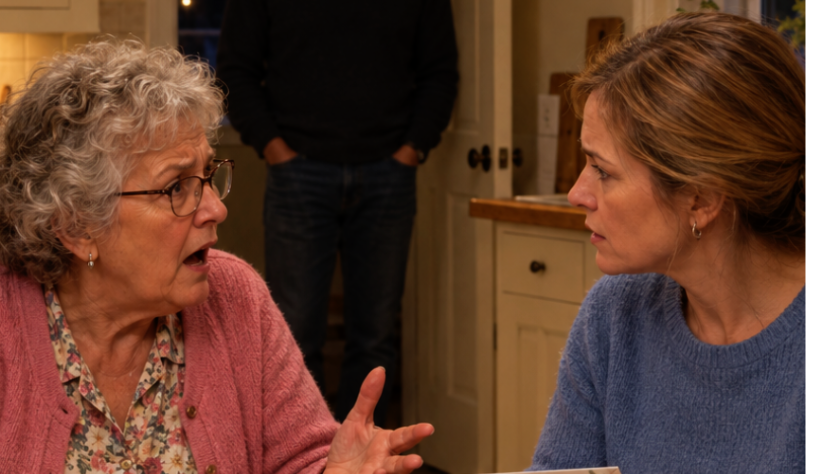
My mother-in-law grabbed a piece of notebook paper, wrote the word «million,» underlined it twice, and slid it across the plastic tablecloth to me, right past the sugar bowl.
«That’s for the apartment,» she told me. «You’ll pay it back by November fourteenth.»
I was just unpacking apples from a bag, and the last one—a shiny red with a soft dent on one side—was still in my hand.
«Which apartment, Serafima Ilyinichna?» I asked.
«Yours, on Stroiteley. I gave you the down payment back in ’16. Or did you already forget?»
«I haven’t forgotten. You gave us three hundred thousand. At the housewarming, in an envelope.»
«That was three hundred,» she tapped her pen on the paper. «But now it’s a completely different amount, Elia.»
Lyonya sat on the stool by the fridge, peeling a tangerine in one long spiral, just like his mother taught him as a child. He didn’t lift his head.
There’s an aloe plant on the windowsill that’s been sitting in a mayonnaise jar for three years, and in all that time it hasn’t grown a single new leaf. All morning, a drill buzzed behind the wall, on and off, as if the neighbors couldn’t decide where to hang a shelf.
«I did the math,» my mother-in-law opened a checkered notebook, but kept the page turned toward herself. «Your apartment cost two million back then. Now, those go for six—saw it in the newspaper. Tripled in value. That means my money in it has tripled as well. Nine hundred thousand. And I rounded it up for ten years.»
Have you ever seen someone add up another person’s apartment on paper, column by column? I have. Her numbers were perfectly aligned, one under the other, like in the savings bank where she worked at the window for forty years.
«Serafima Ilyinichna,» I said, setting an apple on the table. «Bring the receipt. If it was a loan, there should be a paper. Bring it, and then we’ll talk.»
My mother-in-law took off her glasses and polished them for a long time with the edge of her apron, even though the lenses were spotless.
«Family doesn’t write receipts for each other,» she replied.
«But you wrote one for our neighbor Tonya, and stuck it on her fridge.»
«Tonya isn’t my family.»
«So we’re family, but we’re the ones who owe a million.»
«Mom…» Lyoñya finally lifted his head. «Can we just not do this today?»
«When then, Lyoñechka?» she asked, but spoke to the sugar bowl, staring it down. «When?»
Lyoñya set a peeled tangerine on his saucer and didn’t touch it again. My mother-in-law brushed imaginary crumbs from the tablecloth with her palm, folded a paper into quarters, and set it on my bag.
«By the due date,» she said. «I’m not in a rush.»
We walked down from the fifth floor in silence. I stuffed the million-ruble slip into my coat pocket and didn’t find it again until a week later.
My mother-in-law always loaned money with a receipt—whether it was for neighbor Tonya on her fridge, or her own niece for a holiday trip. Once, over tea, she explained it to me: «Without a piece of paper, Elia, it isn’t a loan. It’s a gift. And I’m not rich enough to hand out gifts.» I laughed, thinking she learned that at the savings bank.
But in 2016, she actually gave us a gift. We’d sold grandma’s room in the dorm for six hundred thousand, but it still wasn’t enough for a down payment. My mother-in-law arrived at our housewarming with a blue envelope with two swans on it. She put it on the table for everyone to see. Three hundred thousand—the money from Arkaidy Petrovich’s garage, my late father-in-law, who’d been gone for two years. I burst into tears and hugged her, and for the only time I can remember, she didn’t pull away.
No one mentioned that money for ten years—not even during fights. On the way home, my mind kept repeating the same questions. Why now? Why a million, not nine hundred thousand, since she’s always so exact? And where did she get this date, the fourteenth? Lyoñya drove and answered every question the same: «I’ll take care of it.»
Now, I don’t blame my mother-in-law for that night—I blame myself. I’ve worked at the post office for twenty-two years, and I can spot a pile of old notices in someone’s mailbox a mile away. But right in my own home, I missed all the signs.
At home, Lyoñya, as usual, emptied the contents of his jacket pockets onto the shoe rack: keys, coins, and some receipt folded into quarters. I brushed the papers into the old biscuit tin on top of the fridge.
Anything paper goes in there: bills, warranty cards, Dasha’s postcards. Other people’s papers, I don’t read—first thing you learn at the post office.
«Did you know?» I asked once we sat down for dinner.
Lyoñya took the fork, set it down, picked it up again.
«Mom called this morning. Said she wanted to talk. I thought it was about the dacha.»
«A million, Lyoñya!»
«But she gave it to us then—she really did.»
«She gave it. In front of everyone. You opened the envelope yourself.»
«El, it’s Mom. She’s seventy-four.»
«Let her bring the paperwork and I won’t say another word.»
«She doesn’t have any paperwork, you know she doesn’t!»
I got up to pour him more tea, even though he hadn’t asked. In the small room, the radiator barely warmed the air again; the plumber from the building promised he would come by Monday.
«Then where did that number come from?»
«I don’t know anything! I’m tired, El. Let’s talk tomorrow.»
«Tomorrow I have pension payments. A hundred and forty addresses.»
«Then the day after tomorrow.»
His phone buzzed on the table, face down. Lyoñya picked it up, checked it, and stood up right away, pushing aside his plate of half-eaten potatoes.
«It’s work,» he said.
He stepped out onto the balcony and closed the door behind him. Through the glass, I could see his back: he talked for a while, then listened for a long time, nodding into the dark. Lyoñya quit smoking six years ago.
Nine Guests and a Toast to Mom
For the next two weeks, my mother-in-law called Lyoñya every evening at exactly nine. I counted: eleven times, not once for me. Lyoñya would go out to the balcony with his phone and come back with his ears red from the cold. She never brought up the million to me again. She was waiting.
Meanwhile, I figured everything out for myself. All summer, my mother-in-law talked about the new apartment by the park, with an elevator and windows overlooking the courtyard, and even brought home a glossy brochure from the sales office. Climbing to the fifth floor was really tough for her: she’d stop on every landing and pretend to look for her keys in her purse. That’s when I decided where the million was going. The apartment by the park — and by her math, we were the debtors.
There was something else, too, but I chalked that up to a different reason. Since August, Lyoñya started sending twenty-three thousand less to our joint account: he said they’d cut bonuses at the factory. The whole city was talking about layoffs, so I didn’t ask questions. I just decided to put off getting new windows until spring.
Now I realize I should have asked. At least once.
On October seventeenth, it was Artur’s forty-fourth birthday, and my mother-in-law hosted everyone at her place. Nine guests, not counting the hostess, squeezed into a room made for six: me and Lyoñya, his aunt from Kameshkovo and her husband, his cousin with his wife and their seven-year-old son, neighbor Tonya, and the birthday boy himself. The room smelled like herring under a fur coat and someone’s sweet perfume.
Artur was the last to arrive, by taxi, with a bouquet of yellow chrysanthemums for his mother. On his own birthday. He’s ten years younger than Lyoñya, and every time he comes home, it’s like he’s returned from a long voyage.
After the second toast, my mother-in-law stood up with her glass. You know that feeling when someone rises at the party table and looks straight at you? The sound of forks just stops.
«I want to toast my eldest son,» she said. «The one who’s going to pay his mother back. Right, El?»
Everyone turned to me. The little boy stopped swinging his legs under the table, and I could suddenly hear the neighbor’s dog barking upstairs.
«What debt are you talking about, Sima?» the aunt asked.
«That one. I gave them a million for the apartment, and now Elvira doesn’t want to give it back. She wants a written receipt, can you imagine?»
«Oh Sima, it’s a party!»
I stood up, the stool screeching on the floor. The only other time I’d had to speak standing up was at department meetings when we discussed missing postal stamps.
«Serafima Ilyinichna gave us three hundred thousand as a housewarming gift,» I said. «Thank you for that, honestly. But a million isn’t a gift. Show me a signed receipt, and I’ll pay it back the same day.»
«There she goes about the paper again!»
«If there’s no paper, it’s a gift. That’s what you always say.»
Our neighbor Tonya, who once borrowed from my mother-in-law for a fridge (with a promissory note!), suddenly got very absorbed in her salad.
«Mom,» Arthur said quietly. «Maybe not today?»
«Today, son.»
My mother-in-law just stood there, still holding her glass up, forgetting to lower it.
«Alright,» I said. «Let’s try something else. If you don’t have enough for the apartment near the park, let Lyońa go with you to the bank on Monday. We’ll figure out how much is needed and help as much as we can. Fair and square.»
My mother-in-law set her glass down on the tablecloth without looking, and the wine spilled onto the napkin, leaving a red stain.
«You’re not dragging me to banks! I want what belongs to me, not your help.»
That’s when I said too much. I heard it myself, just as I finished, but it was already too late.
«You should really ask Arthur. He has the car wash, the business—he gets cash coming in every day.»
Arthur set his fork down on the edge of his plate, prongs facing down. My mother-in-law dropped the serving spoon straight into the salad. Nobody said a word, and I decided it was because of me—like I’d been rude to the hostess at her own holiday table.
«The car wash works, it works,» my mother-in-law said a little too quickly. «Eat, Arthur, eat.»
That’s when Lyońa stood up. He wasn’t looking at me or his mother, just somewhere toward the middle of the table, at the chicken dish.
«We’ll pay, Mom,» he said. «By the fourteenth, it’ll all be paid.»
An aunt nodded approvingly, someone reached out for a toast, and the holiday rolled on like a train after a short stop. I didn’t open my mouth again until tea.
An hour later, I went out to the hallway for my bag and saw my mother-in-law. She was sitting on a pouf surrounded by someone else’s jackets, holding Arthur’s scarf—gray and checked—on her lap. Her lips were moving, like she was counting something. She didn’t notice me right away.
«Go back to the table, Ella,» she said, not looking up. «The tea will get cold.»
I left without waiting for cake. Lyońa stayed to help his mom with the dishes, and I went down one flight and stood by the window. Someone had painted the windowsill blue right over the old layer. I stood there until I noticed I was squeezing my keys in my fist the whole time, tines pressing into my palm.
Down below under the streetlight, a boy was teaching his dog to jump over a skipping rope. The dog would sit and wait, and every time, the boy laughed so loudly you could hear it through the glass.
When I got home, for some reason I opened my banking app. Six hundred and forty thousand—the money we’d set aside over three years for new windows and Dasha’s wedding.
Our deposit matured on November fourteenth.
The Cookie Tin
Lyońa later confirmed he’d told his mother about our deposit himself. It all checked out. Not pretty, but understandable—or so it seemed to me back then.
On November fourth, the holiday, my mother-in-law came over on her own. Lyońa had gone out early to change the tires, and I was mopping the floor, so I opened the door with the mop still in my hand.
She took off her shoes, walked into the kitchen, and put a jar of lecho on the table. She placed her bag up on the fridge next to my cookie tin.
She sat down, still in her coat, and pulled an old key on a string from her pocket, the head all chipped.
«It’s from Arkasha’s garage,» she said. «They changed the lock long ago, but I still carry it. I sold that garage for you, Ella.»
«I remember, Serafima Ilyinichna.»
– You remember. And yet you’re asking for a piece of paper.
I wrung out the rag over the bucket. The smell of bleach drifted in from the hallway, and a wet pigeon was shuffling on the window ledge.
«Arkady would have died of shame,» my mother-in-law said. «A son asking his wife for permission to help his own mother.»
«Your son isn’t asking at all. He already promised you, in front of everyone.»
«And he did the right thing!»
«Then just tell me straight. Why do you need the money by the deadline? For that apartment by the park?»
My mother-in-law looked at the key, then down at her hands.
«For the apartment,» she said. «What else?»
«I want to know where the money we saved for three years is going.»
She buttoned her coat all the way up, bottom to top, even though she was still sitting down.
«I welcomed you into our family when all you had was your grandma’s tiny room,» she said. «And now you want receipts from me.»
She took the key, but left the jar behind. I stood for a long time over the not-quite-clean floor, watching her wet footprints fade from the edges to the center.
***
On the tenth, as always, I sat down to pay the rent. I took the old cookie tin off the fridge and dumped everything onto the table.
At the very bottom lay a blue envelope with two swans on it, empty and crumpled at the edge. I keep everything handwritten. In my mother-in-law’s neat round script on the back it said: «For Lyonya and Ella. For your new home. Live well!» I slid the envelope beneath the sugar bowl.
And then from between the receipts, that one check fell out, folded into quarters. It unfolded perfectly along the crease, and the first word I saw was «loan.» Our loan had been paid off a year and a half ago, so I kept reading.
Deposit receipt, October second. Depositor: Leonid Arkadyevich. Purpose: Repayment of the loan contract, borrower Artur Arkadyevich. Amount: twenty-three thousand four hundred rubles.
I sat staring at that piece of paper until my tea went cold. That’s exactly how much less Lyonya had been transferring to our card since August.
Lyonya came home around seven-thirty, spotted the check from the hallway, and just stood in the kitchen doorway—still in his jacket, keys in hand.
«What is this, Lyonya?»
«So now you go through my stuff?»
«You put everything on that shelf yourself. The day your mom wrote her million. What is this?»
He sat down without taking off his jacket and placed his keys next to the check.
«Artur took out a loan,» he said. «Two years ago, for a car wash business. One and a half million. Mom was his guarantor, signed for him at the bank.»
«Mom—who wouldn’t lend her neighbor eight thousand without a receipt.»
«It’s Artur, El.»
He spoke in short bursts, like he was answering test questions. The car wash at the highway closed back in the spring. Artur stopped making payments in June, and in July the bank started calling Mom. Since August, Lyonya paid his brother’s installments in cash at the bank each month, using the very bonus he told us was cut. Then in October, the bank demanded the rest in one payment: nine hundred sixty-eight thousand.
«So that’s when you came up with the apartment.»
«Mom came up with it. I agreed.»
«Why didn’t you tell me?»
For the first time all month, Lyonya looked me straight in the eye.
«Because you wouldn’t have given Artur a single ruble. But Mom—you would have.»
«You spent three months paying your brother’s debt from our money.»
«From mine.»
«From ours, Lyonya! Seventy thousand two hundred.»
He was silent, rolling his keys around the table.
«You’ll take it out on the fourteenth,» he said, «and then it will all be over.»
«No.»
He left without even taking off his jacket. A minute later, the car alarm chirped outside.
So that’s how it is. The million wasn’t for our two-bedroom place or for the apartment by the park—it was for the bank, for Arthur’s car wash. The savings book with the elevator photo lay on my mother-in-law’s dresser, just for show. Maybe to impress the neighbors, or maybe herself.
Arthur was born when Lyonya was ten, and ever since, Lyonya had been the eldest in the house. A neighbor’s window broken by a ball, a dented car, endless debts—Lyonya stepped up for his brother so often, he stopped noticing. It was just easier than telling their mother, ‘enough,’ even once.
For forty years, my mother-in-law asked for a receipt from anyone who borrowed even a thousand from her, but she signed that bank paper for Arthur without even reading it. No one reads the fine print for their favorite son. She couldn’t tell her daughter-in-law that Arthur had lost everything. It was easier just to call me the debtor.
Late at night, I sat in the dark kitchen and dialed my mother-in-law: ‘Fine. I’ll take it out.’ My finger hovered over the call button.
What was I about to lose? Six hundred forty thousand, three years, some windows, a piece of Dasha’s wedding. And her? She’s over seventy, her pension is less than my salary, and she lives on the fifth floor with no elevator. Which of us is poorer?
But I’ve been delivering pensions to other people’s apartments for fifteen years—I know how these things go. If I pressed that button, Lyonya would be paying for his brother for years, Arthur would find something else to invest in, and my mother-in-law, at the next crisis, would pull out her notebook again to tally up what we owed her.
I deleted the message. Then I tore a sheet from Dasha’s old notebook and wrote ‘Receipt’ at the top in my postal handwriting, the same I use for notices all shift. I left blank lines underneath. I put the sheet, along with the check and an envelope, in my work bag.
At half past one, my phone beeped. Dasha had sent a photo of dress fabric—creamy white with a tiny pattern—and a message: ‘Mom, what do you think?’ I replied that it was beautiful. That was the truth.
In the morning before my shift, for the first time ever, I called Arthur myself. I just said, ‘On the thirteenth, seven p.m. at our place—conversation about Mom.’ And I hung up before he could ask anything.
The thirteenth. Evening. Four cups.
On the thirteenth, I got home from my shift at twenty to seven. My mother-in-law’s boots were on the mat, toes pointed at the door, and her coat hung on my hook. I hung my jacket right on top of it.
The kitchen light was on. My mother-in-law sat in my usual seat, Lyonya was by the window. In front of her lay the bank deposit agreement I kept in the document drawer. It had been taken out without me.
‘Tomorrow at nine we’re going to the bank,’ my mother-in-law said instead of ‘hello.’ ‘I made an appointment, they’re open until two on Saturdays.’
‘Did you make an appointment for me too?’
‘You don’t need one. You’ll just sign where they tell you.’
I set my bag on the stool and looked at Lyonya. He was staring at the radiator.
‘Ella, let’s not make a scene,’ he said. ‘We’ll take the money out, pay it back, and life goes on.’
‘What kind of life, Lyonya?’
‘Same as before.’
My mother-in-law placed her hand on the agreement, as if shielding it from a draft.
«You better not forget your place, Ella,» she said. «You’re the outsider in this family. I’ve paid for these walls, so I’m not a guest here. But who are you? If I want to, I’ll go to court—half the table heard Leon promise.»
I didn’t reply. I washed my hands, filled the kettle, and took out four blue cups with white polka dots: Dasha had left them behind when she went off to study in Nizhny.
«There’s three of us,» my mother-in-law said.
«There’ll be four soon.»
Right at seven, the doorbell rang. Leon opened the door and came back with Arthur. He was wearing his work jacket and holding a cake in a box, and he looked at his mother as if surprised to see her there.
«Why are you here?» his mom asked.
«Ella invited me. She said we needed to talk about you.»
Leon lingered in the kitchen doorway. I poured tea, sat across from my mother-in-law, and pulled a swan-printed envelope from my bag. I put it on the table between us with the writing facing up.
«You asked for a receipt, Serafima Ilyinichna. I found it. Written in your own hand.»
My mother-in-law stared at the envelope for a long time. Then she put on her glasses, even though there wasn’t much to read.
«That means nothing,» she said.
«It means you gave us a gift. You always said without paperwork it’s just a present, and now there is even paperwork.»
Then I set a receipt next to it. I unfolded it and pushed it over to Arthur.
«And here’s a receipt for something else. Leon paid for your car wash for three months, Arthur. With our money. And your mom is asking me for a million, not for the apartment, but to cover your loan.»
Arthur looked at the receipt, then at his brother. Leon stared out the window where our kitchen with its lit lamp was reflected in the dark glass.
«And one more thing,» I said, placing a sheet from Dasha’s notebook and a pen in front of Arthur. «Write down that you took the money from your brother and when you’ll pay it back. In your own handwriting. Your mom makes everyone do this—even the neighbor.»
«What, are you crazy? You want a receipt from your own brother?»
«So from a neighbor it’s okay, but not from a brother?»
«Mom,» Arthur turned to his mother. «Will you please tell her something!»
His mother was silent. Her hand rested on the sugar bowl lid and didn’t move.
Arthur looked down at the word «Receipt» and the blank lines underneath. He stood up, yanked his jacket off the chair, and left without saying goodbye. On the stairs, his footsteps echoed as he skipped every other step. The cake sat on the table in its box.
My mother-in-law stared at the door. Upstairs, the neighbor’s washing machine started up with a long hum as it filled. She took off her glasses, folded them, and laid them on the envelope.
«He didn’t tie his laces,» she said.
Leon moved away from the door. He picked up the deposit agreement, took it to the room, and I heard him slide a drawer shut with a click. He returned and stood behind his mother.
«Mom,» he said. «I’m not paying for him anymore. That’s it.»
«Serafima Ilyinichna, you never ask for gifts back,» I said. «But debts should be repaid by the one who borrowed.»
Then I told her what I knew from work. That the bank will seek payment from her since she’s the guarantor—there’s nothing to be done. That anything she pays for Arthur, she has the right to ask back from him. And no one will touch her apartment; it’s her only one.
She listened, eyes on the cake. Then she went to the hallway and slowly did up her coat from bottom to top, just like last time.
«Teaching you about paperwork came back to bite me,» she said as soon as she walked in.
Lyonya drove her home. I washed four cups. No one ever touched three of them.
A month went by.
My mother-in-law pays the bank herself, little by little, from her pension. Artur, as Lyonya says, drives the bread truck and brings his mother ten thousand whenever he remembers. He still hasn’t signed the receipt—the paper sits in our old cookie tin.
My mother-in-law doesn’t call me. On Saturdays, Lyonya visits her alone and doesn’t say anything about her, and I don’t ask. He’s very polite with me now: thank you, you’re welcome, would you like some bread? It’s the way he talks with the guys at the autoshop. My aunt in Kameshkovo tells the family that the daughter-in-law left the mother-in-law penniless. The mechanic never showed up.
Today was pension day and the first snow. On Zavodskaya, Pyotr Semyonovich, who will be ninety this spring, signed the register, carefully writing each letter, and slipped a blue-wrapped caramel into my pocket. Every month it’s the same. I still haven’t told him I don’t like caramel.
I didn’t do this out of spite. The deposit could have been withdrawn that Saturday, and it would have settled things. Only then Lyonya would’ve had to pay for his brother for a long time, and Artur would never have found out how much his car wash really cost. I paid to end it, in my own way: with Lyonya’s politeness and the empty spot at my mother-in-law’s table.
Even now I’d help anyone from Lyonya’s family. But first, I’d ask who’s actually going to take the money.
The envelope with the swans sits in the cookie tin, on top of the electricity bills. Ten years ago, my mother-in-law summed everything up in one word: “Live.”
We live.
What would you have done? Would you have withdrawn the deposit so your mother-in-law didn’t have to pay off her younger son’s debt from her pension? Or would you have said the person who borrows should pay?
All written materials on this page are copyrighted. Copying, distribution (including uploading to other websites or resources), or any use of the materials without prior approval from the copyright owner is prohibited. Commercial use is not allowed.
At the request of a reader, all place names are omitted and names have been changed.