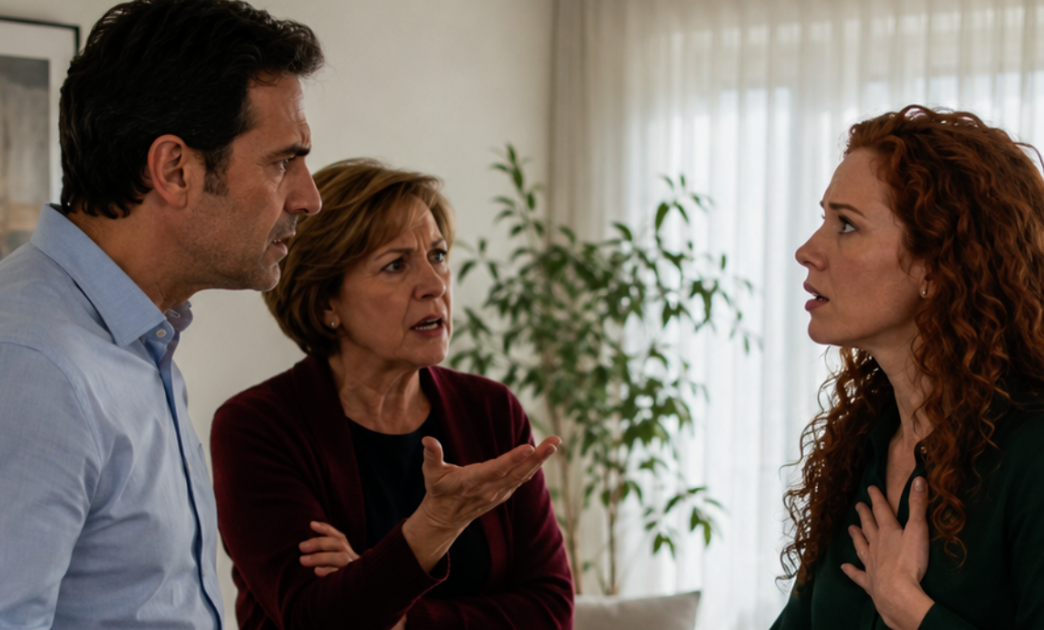
Egor entered the room first, followed by Raisa Pavlovna, her lips pressed tightly together. From the way they stood side by side, shoulder to shoulder, Yaroslava immediately understood: they had rehearsed this.
“Just look at this,” Egor said loudly, as though the room were packed with spectators. “I showed her that catalog for a whole month. A month! I pointed right at it: look, this one, the gray one with the sheen. And she says, ‘Nice, it would suit you.’ And that’s it. That’s all, you understand? Not a single ruble.”
“It is nice,” Yaroslava replied calmly, setting her book down on the armrest. “I didn’t lie about a single thing. It really would suit you.”
“It would suit me! Sure, it would suit me, but who’s supposed to buy it? The Holy Spirit?”
Raisa Pavlovna lowered herself carefully onto the edge of the sofa, as though it belonged to someone else rather than having been bought with money she herself had never bothered to count.
“Yaroslavochka, don’t take offense, but sometimes things are clearer from the outside,” she began in the tone one might use to announce an incurable diagnosis. “I see everything. Everything. Those shoes of yours. The skirt. The pressure cooker. And that refrigerator, by the way, isn’t exactly small.”
“It’s enormous,” Yaroslava agreed. “You could even fit a conscience in there. If there were one.”
“Stop clowning around!” Egor snapped. “Mother has a point! You’ve got a new jacket, a new sweater, that pantsuit—I saw it hanging there, the price tag was still on it. I’m not blind!”
“No, you’re not,” she nodded. “You’re observant. I’ve always admired that quality in you. You read price tags much better than you read bills.”
“And the bed linen?!” Egor stepped closer, his voice cracking and rising. “The silk robe! The cosmetics—a whole set! I saw the price. You could buy a laptop for that kind of money! And you bought a laptop too, by the way! Your hairdresser every month! The swimming pool! You pay to go swimming, Yaroslava! You pay money just to swim in water!”
“Terrible,” she said. “Imagine that. Water costs money. Cruel world.”
“That’s enough!” Raisa Pavlovna pressed a hand to her chest. “Just look at how she talks to you. What does my son wear? Old clothes. And she’s always dressed to perfection. Is that decent? Is that what a wife does?”
Yaroslava remained silent. She looked from one to the other, and her silence had the patience of someone counting all the way to the end before answering.
“Are you finished?” she finally asked. “Or are there more items on the list? I’d like to answer in order, otherwise I might lose track, and clearly we’re conducting a very serious audit here.”
“We’re finished,” Egor said through clenched teeth.
“Excellent. Then sit down. This won’t be a short conversation.” She stood up, and somehow the room seemed smaller because of her height. “Let’s start with geography. Right now, you’re standing in an apartment whose down payment was made by me. With money from my grandfather’s house. Remember how I told you I had to fight for that house?”
“What does the house have to do with anything?” he muttered.
“It has everything to do with the fact that for twenty years people kept explaining to me that I was second-class. My sister had twins, then another child, and people sighed right in my face: ‘Slava, you’re strong, you don’t need anything. Everything will go to Milana.’ That was when I understood the most important thing: if I wanted a wall behind my back, I had to be that wall myself.”
“Here we go again with your honors-degree story,” Egor scoffed.
“Again,” she agreed. “I earned it through a nervous breakdown, through a year when my hands shook so badly that I dropped spoons. Nobody gave me anything. Not a ruble, not even a kind word. Grandpa was the only one who kept his promise. He divided the house between his granddaughters, and afterward my relatives spent six months trying to persuade me to sign my share over to my sister because ‘she has children and you have nothing.’ And I said no. The first real ‘no’ of my life.”
Raisa Pavlovna pursed her lips.
“You really are greedy.”
“Thrifty,” Yaroslava corrected her. “Greedy is when you count someone else’s shoes. Thrifty is when you pay for the apartment where those shoes are sitting in the hallway.”
“Moving on.” She bent one finger down as she counted. “The mortgage. It’s in my name. I pay it. The interest—me. The principal—me. The insurance—also me, believe it or not. Utilities—me. The food in that refrigerator you so touchingly mentioned—me.”
“I contribute too!” Egor shouted.
“To what?” She tilted her head. “Seriously, to what? Tell me. I’ll write it down. Six months ago, you came to me and announced that ‘our family’s financial strategy needed to change.’ Such a beautiful word—strategy. I agreed. Remember how quickly I agreed? You were surprised.”
“I remember,” he said gloomily.
“I agreed because I wanted to see what you would do with that freedom.” Yaroslava smiled without warmth. “And this is what you did: you stopped contributing to the household and started living like a king, except none of the kingdom belonged to you.”
“How dare you!” Raisa Pavlovna gasped.
“I dare. I bought him the sneakers he had been sighing over for a month and a half. I bought him a tracksuit. It’s still sitting on the shelf, by the way, never worn once, like a museum exhibit. I took him to the movies. I paid at cafés. I paid for trips, tickets, and presents for his relatives on every holiday.”
“I don’t need your presents!” Raisa Pavlovna bristled.
“You do,” Yaroslava said gently. “And that’s perfectly normal. What isn’t normal is accepting a gift and then, the very next day, calculating how much my own shampoo cost me.”
“You’re humiliating me!” Egor tugged at his shirt collar. “You’re humiliating me in front of my mother!”
“No, darling. Humiliation is when a grown man stands in the middle of someone else’s apartment demanding that she buy him a suit instead of saving up for it himself. I’m simply calling things by their proper names. This isn’t humiliation. It’s inventory.”
“You earn more than I do! That means you’re obligated!”
“Stop right there.” Her voice became level and very firm. “I decide where my earnings go. Neither you nor your mother has any right to tell me how to live. I don’t have to account for my spending. Not for my shoes, not for the swimming pool, not for cosmetics, not for the hairdresser.”
“You’re a wife!”
“I’m a wife, not a self-service cash register.”
“Do you hear what she’s saying?” Raisa Pavlovna turned to her son. “Do you hear her? She doesn’t even consider us human beings!”
“I do,” Yaroslava said. “That’s precisely why I’m speaking honestly instead of smiling sweetly and nodding for the third year in a row. And believe me, I nodded for a long time. Far too long.”
“Do you know what people at work used to say about you?” Egor suddenly blurted, his face twisting. “That you slept your way to the top! That you didn’t advance because of your brains, but because of something else! I shut those rumors down. I defended you!”
Yaroslava looked at him for a long moment. Then she nodded, as if she had finally received the missing piece of a diagram.
“Thank you. Now everything makes sense.”
“What makes sense?!”
“You kept that filth tucked away like emergency cash. For a rainy day. So that one day you could pull it out and throw it at me. Do you know the difference between a husband and a man who simply lives beside you? A husband who hears something like that shuts the gossip down immediately. You kept it. In reserve.”
“That’s not what I meant!”
“That is exactly what you meant. And I’ll answer you once. I clawed my way upward with my teeth and elbows, starting in a three-person department where people tore me apart for every step I took. I was twenty-four, and I used to cry in the stairwell so nobody at home would see. And now I’m being told I ‘slept my way up’ by the same man who is demanding that I buy him a suit. The universe has a sense of humor.”
“Pack your things,” she said simply.
The room fell silent. Raisa Pavlovna started to rise, then sat down again.
“What did you say?” Egor asked.
“I said pack your things and leave my apartment. I don’t need a kept man. I dreamed of having a husband—a person who made me feel warm and secure. Instead, I got someone who envies my salary and has the audacity to demand it for himself.”
“You… you’re going to regret this.”
“The only thing I regret is the three years I spent paying for an illusion,” Yaroslava said. “An expensive subscription, I have to admit.”
“Egorchik, don’t get worked up,” Raisa Pavlovna fussed. “She’s just saying it in the heat of the moment. Women always say things in the heat of the moment…”
“I’m not saying it in the heat of the moment,” Yaroslava cut her off. “I made my decision back when you mentioned the pressure cooker.”
Egor went into the bedroom and began slamming the wardrobe doors, loudly and theatrically, making sure everyone could hear. Raisa Pavlovna went in to him twice, whispering, tugging at his sleeve, while he brushed her away and threw shirts haphazardly into a bag.
Yaroslava sat down in the armchair, stretched out her legs, and opened her book to the bookmarked page. Not a single tear. Not one step toward the bedroom.
“You should talk to him,” Raisa Pavlovna finally said, unable to restrain herself. “He’s really going to leave.”
“He’s a grown man,” Yaroslava replied without looking up. “He has legs, free will, and a mother. Three supports. He’ll stay upright.”
The phone rang. The name “Inga” appeared on the screen. Yaroslava rejected the call—quickly, discreetly—and raised the phone to her ear.
“Yes, hi,” she said warmly, in the same tone Egor had not heard from her in about eight months. “No, no, I’m almost finished with things at home. Just a little longer, and I’ll be completely free. Yes. Entirely at your disposal.”
Egor froze in the bedroom doorway, bag in hand. Raisa Pavlovna slowly rose from the sofa, her face lengthening in shock.
“Of course I’m expecting you,” Yaroslava continued. “I missed you too. All right, kisses.”
She placed the phone on the armrest and returned to her book.
“Who was that?” Egor asked hoarsely.
“That,” she said, turning a page, “is no longer your territory. You’re in the process of moving out of it.”
“Egor, let’s go!” Raisa Pavlovna grabbed her son’s bag. “Come on! Did you see that? Did you see? She isn’t even divorced yet, and she’s already calling someone! Maybe this has been going on for a long time!”
Egor walked past his wife deliberately slowly, expecting her to stand up. She didn’t. She simply followed him with her eyes, watching him carefully all the way to the door.
The lock clicked.
Silence.
Outside, a fine, biting rain was falling, soaking straight through his jacket.
“What have I done?” Egor said aloud. “What have I just done?”
“What have you done?” Raisa Pavlovna adjusted her hood. “You told her the truth. Now you see what kind of wife you have, son. Now you see.”
“Be quiet. Please. Just be quiet for one minute.”
“Oh, so that’s how it is.” She took a step backward. “So now I’m to blame. Fine. Stand here, then. Just stand here.”
She turned and walked toward the bus stop, her head held high in offended dignity. Egor remained alone, holding his bag with a shirt sleeve sticking out of it, feeling as though the ground beneath him had suddenly become slippery.
Fifteen minutes later, the entrance door opened. Yaroslava came outside in a light raincoat, carrying an umbrella, calm as though she were coming downstairs after an ordinary evening rather than the collapse of her marriage.
“Still here?” she asked. “Do you want me to call you a taxi? I already have the app open. A car can be here in four minutes.”
“Slava…” He stepped toward her. “Listen, I…”
“Don’t give me ‘listen.’ We’ve said everything there was to say. In fact, the two of you said considerably more than enough.”
“I didn’t want it to happen like this.”
“This is exactly how you wanted it to happen,” she replied without anger, almost matter-of-factly. “You wanted me to get scared. You wanted me to chase after you, grab you by the sleeve, and promise to buy you the suit. Well, fear is a bad currency, Egor. They don’t accept it where I come from.”
A car pulled up to the curb and flashed its headlights. Yaroslava folded her umbrella and opened the rear door.
“You’re really leaving?” he asked dully. “Right now? Just like that?”
“Yes. And do you know what the worst part is for you?” She was already getting into the car. “I’m not going to ask where you’re going. Not today, not tomorrow. I’m not interested anymore.”
The door closed. The car pulled away, its headlights sweeping across the wet asphalt before it disappeared around the corner.
Egor stood there with the bag in his hand and understood one very simple thing: she had not thrown him out in a fit of anger.
She had crossed him out.
Calmly, neatly, with a single line.
And that line had been drawn a long time ago—back when they mentioned the pressure cooker.