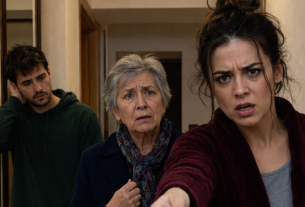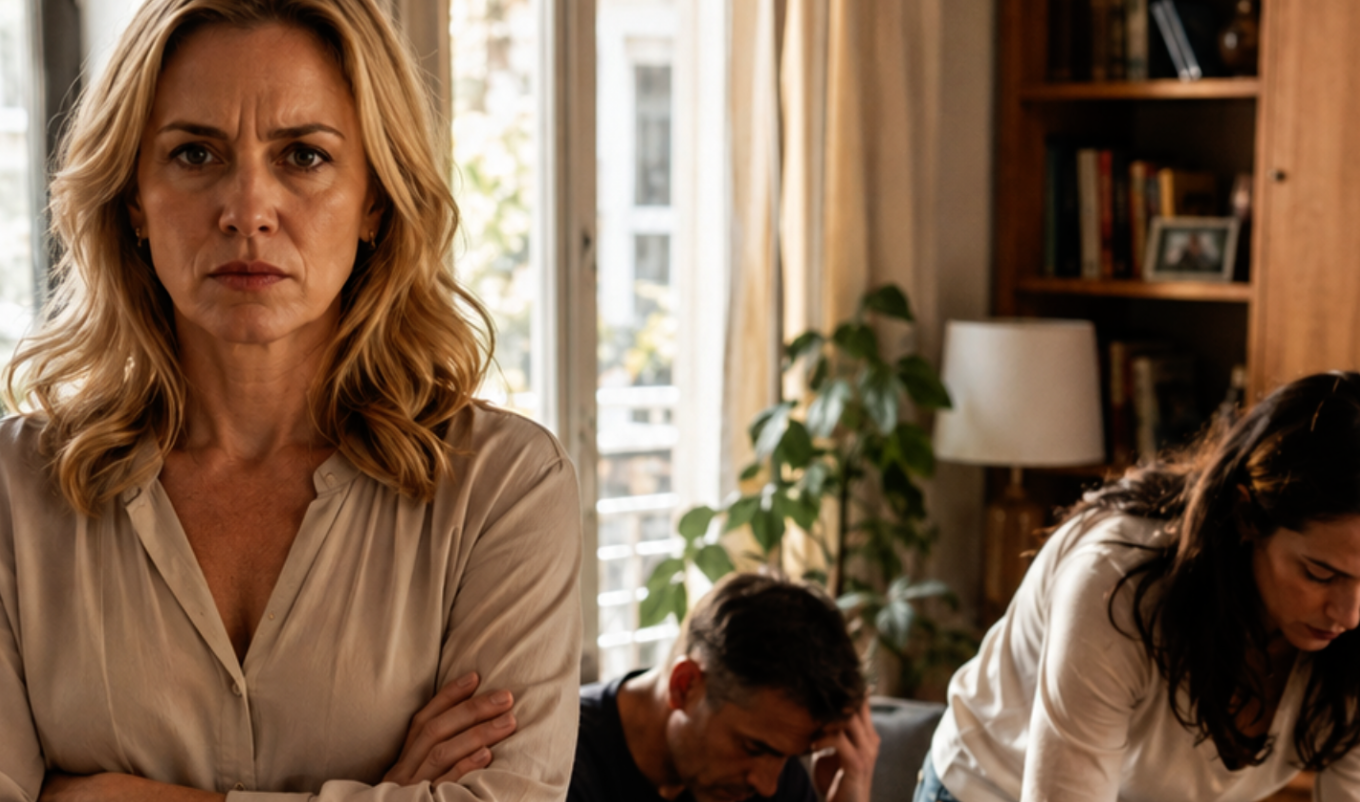
Galina returned from her business trip a day early. The door was unlocked, and a pair of unfamiliar sandals stood in the entryway. She didn’t make a scene. She did something else instead.
The sandals were red, with thin straps and a worn buckle on the left one. Size thirty-seven. Galina wore a thirty-nine.
She set her suitcase down by the door and simply stared at the shoes for a while. The lights were on in the apartment, and the sound of the television came from the living room. An ordinary Thursday evening, except for the unfamiliar sandals.
The train had arrived four hours earlier than expected. Her business trip to Tula had been wrapped up in two days instead of three: the client signed the acceptance certificate without any objections, and Galina decided there was no point spending another night in a hotel with a sagging mattress. She bought a ticket for the next train.
She didn’t warn anyone.
Now she stood in her own entryway and smelled perfume.
Not hers.
Something floral, cloyingly sweet, with a hint of vanilla.
“Alyosha,” she called quietly.
The television went silent.
Then came a frantic rustling, hurried, like rats inside the walls.
He stepped into the hallway barefoot, wearing sweatpants and a T-shirt. His face looked as though someone had thrown a bucket of cold water over him. His mouth hung slightly open, his eyes darting around.
“Gal… You weren’t supposed to be back until tomorrow…”
“They let us leave early.”
She didn’t raise her voice. She simply took off her jacket, hung it on the hook, and walked into the kitchen.
The kettle on the stove was still warm.
Two cups stood on the table.
One contained the remains of tea with milk.
Galina drank her tea without milk.
So did Alyosha.
Her hands automatically reached for the faucet. She turned on the water, rinsed her own mug—the blue one with “Tula” written on it that she had brought home from a previous business trip—and filled it with water.
She drank standing up.
A young woman came out of the living room.
Galina saw her out of the corner of her eye without turning her head.
Short, dark-haired, around twenty-five. Narrow shoulders, a long neck, a thin bracelet around her wrist.
She was wearing Alyosha’s T-shirt, the gray one from the festival.
It hung down to her knees.
The woman stopped in the kitchen doorway, barefoot on the cold linoleum.
“Hello,” she said.
Galina placed her mug in the sink.
“Hello.”
Alyosha stood behind the young woman looking as though he wished he could sink straight through all three floors into the basement.
His Adam’s apple bobbed up and down.
His fingers twisted the hem of his T-shirt.
“Gal, I can explain everything…”
“Don’t.”
She took a third cup from the cupboard. A white one with a crack in the handle, the one they used for guests.
She placed it beside the other two and poured water from the kettle into it.
The water was barely warm by then.
“Sit down,” Galina said, pointing to a stool.
The young woman didn’t move.
She looked at Alyosha.
He remained silent.
“I’m serious. Sit down. Your tea is getting cold.”
Her name was Vika.
Galina learned that after four minutes of silence, while all three of them sat around the kitchen table listening to the clock above the refrigerator tick.
“Vika, do you work or study?”
“I work. At a beauty salon. I’m a nail technician.”
Her voice was quiet and slightly hoarse.
Her fingers wrapped around the cup. Her nails were perfect—pale pink with white tips.
An occupational habit.
Alyosha sat as though he were being interrogated. His back was straight, his hands on his knees.
He was waiting for a scandal.
Galina could tell by the way he pursed his lips.
After twelve years, she knew every expression he made.
But there was no scandal.
“And how old are you, if you don’t mind me asking?”
“Twenty-six.”
Twelve years younger.
Galina was thirty-eight.
She calculated it automatically, the way one calculates change in a shop.
“How long have you known Alexei?”
Vika glanced quickly at him.
He didn’t move.
“Two months.”
“I see.”
Galina took a sip from her mug.
There wasn’t even any tea in it—just warm water. She hadn’t bothered putting in a tea bag.
Yet she drank calmly, as though it were the finest tea of her life.
Alyosha finally couldn’t take it anymore.
“Gal, what are you doing?”
“Drinking tea.”
“You understand…”
“I understand everything, Alyosha. Sit down.”
He sat back down.
Vika stared at Galina with an expression Galina recognized.
It wasn’t fear.
It wasn’t shame.
It was confusion.
The young woman had expected shouting, tears, broken dishes.
Instead, she had been given tea and questions about her job.
It threw her off balance.
Galina knew it would.
At nine that evening, she went to the bathroom.
She took her toothbrush, towel, and pajamas out of her suitcase.
She washed her face.
Applied cream to her face, neck, and hands.
Every movement was familiar, practiced over years.
Whispering came from the kitchen.
Alyosha was saying something to Vika quickly and nervously. Vika answered in short phrases.
Galina wasn’t listening.
More accurately, she heard every word because the walls in their Khrushchyovka apartment were thinner than cardboard.
But she pretended not to hear.
“She’s crazy,” Vika said.
“She’s not crazy. She’s…”
“What?”
“I don’t know.”
Galina looked at herself in the mirror.
Light-brown hair tied back with an elastic band.
Dark circles beneath her eyes from the train.
A wrinkle between her eyebrows that had appeared two years ago and never disappeared.
She was one meter seventy-four tall—two centimeters taller than Alyosha whenever she wore heels.
That was why she had stopped wearing heels long ago.
She dried her face with a towel and walked out.
“I’m going to bed. The spare bedding is in the cupboard, on the top shelf. There’s an extra pillow there too.”
Alyosha stared at her.
“You’re… serious?”
“I have to be at work by eight tomorrow. I’m tired from the trip.”
And she went into the bedroom.
Closed the door.
Lay down.
The mattress was familiar and soft, with a hollow on her side.
The pillow smelled of her shampoo.
The sheet was cool, slightly stiff from washing.
She lay on her side, pulled her knees toward herself, and closed her eyes.
Everything inside her was burning.
But nothing on the outside moved.
She didn’t sleep.
Of course she didn’t.
She lay in the darkness listening to the apartment.
The creak of the sofa in the living room.
Footsteps in the hallway.
The click of the bathroom light switch.
Running water.
Then silence.
Vika stayed.
Galina could tell from the sounds: the sofa was unfolded, a blanket rustled, something soft fell onto the floor.
Alyosha didn’t come into the bedroom.
He didn’t knock.
He didn’t try to explain.
He slept on the narrow couch in the kitchen, the one they had bought for occasions when one of them stayed up too late.
Three people in a two-room apartment on Kirovogradskaya Street.
Each in their own corner.
Galina rolled onto her back and stared at the ceiling.
There was a crack above the chandelier that Alyosha had promised to repair since March.
It was October now.
The crack had grown longer.
She thought about how that morning she had brushed her teeth in the hotel room in Tula and felt happy because she was going home that day.
She had imagined opening the door, putting down her suitcase, and Alyosha coming out to meet her.
She would say, “I brought you a gingerbread.”
He would say, “Gingerbread again?”
Then they would drink tea in the kitchen while she told him about the client who always used the wrong verb when saying “put it here.”
The gingerbread was still in her suitcase.
Tula gingerbread with white icing, packed in a cardboard box.
She never took it out.
The clock showed twelve forty.
Then one.
Then two.
Someone in the living room was crying quietly.
Not Alyosha.
Vika.
Galina pulled the blanket up to her chin and squeezed her eyes shut.
At five in the morning, she got up.
Not because she had slept enough, but because lying there had become unbearable.
The kitchen smelled of stale tea and something unfamiliar.
The couch was empty.
Alyosha had gone somewhere else.
Or perhaps he hadn’t slept at all.
His jacket was gone from the coat rack.
Galina put the kettle on.
She took eggs, butter, and bread from the refrigerator.
Turned on the burner.
Cracked two eggs into a frying pan.
The click of the gas.
The hiss of butter.
The smell of hot bread from the toaster.
She prepared breakfast as though it were an ordinary morning.
And in some sense, it was.
The same walls.
The same stove with the stain from milk that had once boiled over.
The same view from the window of the poplar tree in the courtyard that no one ever seemed able to cut down.
The difference was the pair of sandals by the door.
And the girl sleeping on the sofa in the living room.
Vika appeared in the kitchen doorway at seven minutes past six.
She was already dressed.
Jeans, sweater, hair tied back.
Her face was pale and her eyes were red.
She stood looking at Galina, who was spreading butter on toast.
“Good morning,” Galina said.
Vika said nothing.
Then she sat down on the same stool as the night before.
“Would you like some fried eggs?”
“No… Thank you.”
“Tea?”
“Could I have some water?”
Galina poured her filtered water and placed the glass on the table.
Vika wrapped both hands around it, just as she had held the cup the night before.
“Are you really not going to yell?” Vika asked.
“No.”
“Why?”
Galina took a bite of toast.
Chewed.
Washed it down with tea.
“What would be the point?”
Vika looked at her as though she were seeing a human being for the first time.
They sat alone together in the kitchen for twenty minutes.
Alyosha wasn’t there.
He had left early.
Galina found a note on the refrigerator:
“I’m at Dimka’s.”
Dimka was his friend from work and lived two courtyards away.
He had run away.
Galina folded the note and dropped it into the trash.
“Did he tell you anything about me?” she asked without turning around.
“He said you were divorced.”
Galina made a short, muffled sound, almost like a cough.
“Divorced.”
“Yes. He said you lived separately. That the apartment belonged to him.”
She leaned against the counter.
The ring on her ring finger glinted beneath the kitchen light.
Her wedding ring.
She never took it off, not even when washing dishes.
“Do you see this ring?”
Vika looked.
Nodded.
“Twelve years. We have a son, Timofey. He’s nine. He’s staying with my mother in Kaluga for the autumn school holidays right now. The apartment was bought with my money, maternity capital, and a mortgage that I pay by myself because Alyosha earns thirty thousand and thinks that’s enough.”
She spoke evenly and without emphasis, as though reading out a shopping list.
“He isn’t divorced. We don’t live separately. And the apartment isn’t his.”
Vika put the glass down.
The water trembled inside it but didn’t spill.
“Why are you telling me this?”
“Because you have the right to know what you’ve gotten yourself into.”
Vika lowered her eyes.
The bracelet around her wrist trembled slightly, almost imperceptibly.
But Galina noticed.
“I didn’t know.”
“I believe you.”
And she really did.
There was no arrogance in Vika’s voice.
Only exhaustion and something resembling nausea.
That particular kind of nausea that comes when you realize someone has fooled you—and not some distant stranger, but someone you trusted.
Galina knew that feeling.
From the inside.
At quarter past seven, Vika went into the living room and began packing her belongings.
Galina could hear from the kitchen: the click of a bag clasp, fabric rustling, the floor creaking.
She washed the dishes.
Three cups.
Two plates.
The frying pan.
Hot water, a sponge, a little lemon-scented dishwashing liquid.
Foam in the sink.
She scrubbed the frying pan and thought about Alyosha.
Not about Vika.
Vika wasn’t the main issue.
Vika was the consequence.
The cause was sitting at his friend Dimka’s apartment, probably inventing a version of events that would explain everything.
Galina scrubbed the pan and remembered how, three years earlier, she had found messages on his phone with some woman named Nastya.
There had been a scandal then.
Shouting.
Tears.
A broken plate.
Promises.
A bouquet of roses the following day.
The roses lasted a week.
The petals dried out.
She threw them away.
And a month later, everything was forgotten.
Or perhaps not forgotten.
Perhaps it had simply settled to the bottom like sand in a jar of water—invisible until someone shook it.
Now someone had shaken it.
The sand rose again.
And Galina no longer intended to wait for it to settle.
She placed the clean frying pan on the drying rack and wiped her hands.
Vika stood in the hallway with a bag over her shoulder.
The sandals were already on her feet.
Red, with thin straps.
“I’m leaving,” she said.
“All right.”
“I’m… sorry. Really.”
Galina leaned against the doorframe.
She looked at this twenty-six-year-old woman with red eyes and perfect nails, standing in someone else’s entryway without knowing what to do with her hands.
“You have nothing to apologize for. He lied to you. He lied to me too.”
Vika nodded.
Then she turned, opened the door, and left.
The lock clicked.
Galina remained in the entryway for another minute.
She looked at the place where the red sandals had stood.
They had left a faint indentation in the rug.
She straightened the rug with her foot.
Alyosha returned at nine.
Galina was already getting ready for work: handbag, coat, keys.
He entered quietly, as though hoping to sneak inside.
But there was nowhere to hide in the cramped entryway.
“Gal.”
“I’m going to work.”
“Wait. We need to talk.”
“We do.”
She buttoned her coat.
One button after another, from top to bottom.
Four buttons.
“But not now.”
“When?”
“When I’m ready.”
He stood in front of her looking pathetic.
Two days of stubble.
Bags beneath his eyes.
Wrinkled undershirt.
One meter seventy-two tall.
Once, she had thought he was handsome.
He had nice hands and a gentle voice, and he knew how to listen when he wanted to.
The problem was that he wanted to less and less often.
“Did she leave?” he asked.
“She left.”
“What did you tell her?”
“The truth.”
He flinched as though burned.
“What truth?”
“That we aren’t divorced. That the apartment is mine. That we have a child.”
Alyosha leaned against the wall.
Exhaled.
“Why did you do that?”
“What should I have done?”
He didn’t answer.
Galina picked up her bag.
“I’ll be back at seven. I’m picking Timka up from Kaluga on Saturday. By Saturday, decide where you’re going to live.”
She said it casually, the way someone might say, “Buy some milk,” or “Turn off the light.”
But every word had been weighed carefully.
She had rehearsed them in her head since three in the morning.
“You’re throwing me out?”
“I’m asking you to make a decision. You’re an adult.”
She opened the door and left.
The stairwell smelled of dampness and someone’s cabbage soup.
The light bulb on the landing had burned out again, and she descended the stairs in semi-darkness, counting the floors.
Fifth.
Fourth.
Third.
On the second floor, she stopped.
Pressed her forehead against the cold railing.
Stayed like that for about thirty seconds.
Then she straightened up and kept going.
At work, they asked her how Tula had been.
She said the gingerbread was good.
Everyone laughed.
She laughed too.
Then she opened her work email and drowned herself in messages.
For two hours, it was salvation.
At lunchtime, she went outside.
October.
Cold.
The wind chased leaves across the pavement.
She bought coffee from a vending machine near the metro station—bitter coffee in a cardboard cup—and stood beside a trash bin to drink it because the bench was wet.
Her mother called.
“Galinka, Tima wants to stay until Sunday. He and Kostya are making some project out of chestnuts and he doesn’t want to leave it unfinished.”
“Let him stay.”
“You sound tired.”
“The train came early.”
“And how’s Alyosha?”
“Fine.”
Her mother was silent.
She had a particular talent for silence with intonation.
Galina could feel her gaze through the phone—narrowed eyes, attentive, maternal.
“Mom, everything’s fine. Really.”
“All right.”
Galina put the phone away.
The coffee had gone cold.
She threw the cup away and returned to the office.
At her computer, she caught herself staring at the screen without seeing the letters.
The cursor blinked in the middle of a spreadsheet, and she couldn’t remember which number she had intended to enter.
She remembered the unfamiliar sandals.
Red, with a worn buckle.
She remembered Vika sitting on the stool in Alyosha’s T-shirt, holding the cup in both hands.
Young.
Confused.
The bracelet around her wrist.
And Galina felt sorry.
Not for herself.
For Vika.
Because Vika was twelve years younger and was already sitting in another woman’s kitchen with another woman’s husband—a man who had lied to both of them.
The only difference between them was that Galina had already been through it.
Vika was going through it for the first time.
Galina entered the number into the spreadsheet and continued working.
That evening, the apartment greeted her with silence.
Alyosha wasn’t there.
There was another note on the kitchen table, the second one that day:
“I’ll stay with Dimka for now. I’ll call.”
His handwriting was rushed, the letters crooked.
He had always had terrible handwriting.
Galina took off her coat and hung it on the hook.
Removed her shoes.
Then she walked slowly through the apartment as though seeing it for the first time.
The living room.
The sofa was folded back up.
The blanket was neatly folded.
Vika had cleaned up after herself.
A glass of water stood untouched on the coffee table.
The bedroom.
The bed was still unmade from that morning.
On the bedside table were the alarm clock, a book, hand cream.
All hers.
The bathroom.
His razor on the shelf.
His toothbrush in the cup.
The shampoo Galina always bought because he never remembered to buy it himself.
She opened the wardrobe in the hallway.
Half of his clothes were still there.
Winter jacket.
Boots.
Shirts.
He had only taken a few things.
Galina closed the wardrobe and went into the kitchen.
She put the kettle on.
Then she took the Tula gingerbread out of her suitcase.
It was still in its cardboard box.
She opened it and broke off a piece.
The gingerbread was hard and slightly stale.
The filling had become sticky.
She chewed it, washing it down with tea, while looking through the window at the poplar tree that no one ever managed to cut down.
Then she took out her phone.
There were no messages.
Not from Alyosha.
Not from anyone.
She opened her contacts and scrolled down to the letter M.
Mom.
Her finger hovered over the call button.
She didn’t press it.
Instead, she opened her notes app and began writing.
Not a letter.
Not a social media post.
A list.
An ordinary list, the kind people write before going to the supermarket.
Only the items on this list were different.
Call a lawyer.
Ask about division of the apartment.
Take the documents from the drawer in Alyosha’s desk.
Change the automatic mortgage payment.
Pick up Tima on Saturday.
Buy him new sneakers; the old ones are too tight.
She wrote steadily, letter by letter, item by item.
Her fingers didn’t tremble.
The screen glowed in the dim kitchen.
When the list was finished, she read it again.
Twelve items.
Not one of them contained the word “Alyosha.”
He called three days later.
“Gal, we need to talk.”
“Come over Saturday after two. Tima will be at Kostya’s birthday party.”
“All right.”
A pause.
She could hear him breathing.
Heavily, through his nose.
“How are you?”
“Fine.”
“Gal…”
“Saturday, Alyosha.”
She ended the call and realized she had felt nothing.
No anger.
No hurt.
No relief.
Zero on the scale.
As though a colleague had called to confirm the time of a meeting.
That frightened her more than anything.
On Friday evening, she picked Tima up from Kaluga.
He burst into the car carrying a backpack stuffed with chestnuts, and his chestnut project spilled onto the back seat along with glue, little sticks, and scraps of paper.
“Mom, Kostya and I built a fortress! Look, here’s the tower, here’s the moat, and here’s the bridge!”
“It’s beautiful.”
“Is Dad home?”
“Dad’s staying with Uncle Dima.”
“Again?”
Galina looked into the rearview mirror.
Tima sat holding the chestnut fortress against his chest.
Dark eyes.
Freckles on his nose.
His front tooth had only just begun growing back, so his smile was crooked, with a gap in it.
“Tim, Dad is going to live separately for a while.”
“Why?”
“We need to sort something out. Something between adults.”
“Did you have a fight?”
She drove while feeling her fingers tighten around the steering wheel.
Her knuckles turned white.
She loosened her grip.
“Not exactly. But we’ll work it out.”
“Okay.”
He said “okay” and returned his attention to the fortress.
A child’s ability to adapt.
Instantaneous and frightening.
They drove along the highway.
Outside the windows stretched yellow and brown fields, broken occasionally by small patches of woodland.
The sky was gray, low, unmistakably October.
The windshield wipers smeared fine rain across the glass.
“Mom.”
“What?”
“Did you bring gingerbread?”
“I did.”
“Tula gingerbread?”
“Tula gingerbread.”
“With filling?”
“With filling. It’s gone a little stale.”
“That’s okay. I’ll soften it in milk.”
She smiled.
For the first time in four days.
Saturday.
Two o’clock.
Tima had gone to Kostya’s.
Galina sat in the kitchen wearing a clean blouse, her hair neatly tied back, a cup of tea in front of her.
Alyosha arrived exactly at two.
He rang the doorbell even though he still had his keys.
That bothered her.
A tiny thing, but it bothered her.
She opened the door.
He stood on the threshold holding a bag.
There were roses inside.
She could see green stems sticking out of the paper.
“Come in.”
He entered and placed the bag in the hallway.
He didn’t take the roses out.
He removed his shoes and walked into the kitchen.
They sat opposite each other.
Like the negotiations that morning with Vika, except this time Alyosha himself sat in Vika’s place.
“Gal, I screwed up.”
She remained silent.
“I don’t know what got into me. With Vika… it was stupid. I understand that.”
“You understand.”
“Yes.”
“And with Nastya three years ago, did you understand then too?”
He flinched.
He hadn’t expected that.
“That was different.”
“How?”
“That was only messaging.”
“And what was this? A book club?”
He lowered his eyes.
Ran his palm across the table as though wiping away something invisible.
“I want to come home.”
“I know.”
“And?”
“And I don’t want you to come back.”
He raised his head.
His eyes were wet.
His chin trembled.
Galina saw it and felt something twist painfully and tightly inside her.
But her hands remained calmly on the table.
She controlled them.
“You’re serious?”
“Yes.”
“Because of one time?”
“Because of two. And because of everything else.”
“What else?”
She stood up and walked to the window.
The poplar tree in the courtyard swayed in the wind.
Its branches scraped against the edge of a neighbor’s balcony.
“Alyosha, for the last five years you’ve come home, sat on the sofa, and turned on the television. I cook. I clean. I take Tima to the doctor, to his activities, to his tutor. I pay the mortgage. I fix the faucet when it leaks because you say ‘tomorrow,’ and tomorrow never comes.”
She didn’t raise her voice.
She spoke in the same calm tone she had used that morning when listing facts for Vika.
“I’m not complaining. I’m listing things. So that you’ll hear me.”
“I hear you.”
“Don’t interrupt. Three years ago there were those messages with Nastya. I made a scene, you brought me roses, and we ‘made up.’ Do you know what changed afterward?”
“What?”
“Nothing. Not one thing.”
He remained silent.
Outside, the poplar tree creaked especially loudly.
“You went back to sitting on the sofa. I went back to paying the mortgage. You went back to saying ‘tomorrow.’ And I went back to pretending everything was fine because pretending was easier than admitting it.”
“Admitting what?”
“That I’m alone. I have been for a long time. I’m alone in this marriage.”
He left at four.
The roses remained in the bag in the entryway.
Galina carried them to the trash without even unwrapping them.
That evening, she sat on the floor in the hallway sorting through the wardrobe.
His things on one side.
Hers on the other.
Shirts.
Sweaters.
Socks.
Every item had its own smell.
Cologne.
Laundry detergent.
His sweat.
She folded everything carefully into neat stacks, like clothes in a store.
She didn’t throw or crumple a single thing.
At the bottom of the wardrobe, she found a shoebox.
She opened it.
Photographs.
Their wedding.
Tima as a baby.
A vacation in Anapa.
New Year’s at her mother’s house.
She went through them one by one.
In one photograph they were standing on the waterfront, both tanned.
Galina wore a white sundress.
Alyosha had his arm around her shoulders.
Tima was one year old, sitting in his stroller chewing on his sunhat.
Galina stared at the photograph for a long time.
Then she put it back into the box.
She placed the box on the top shelf behind the towels.
The photographs were for Tima.
Not for her.
Not for Alyosha.
For the boy who would grow up one day and ask what his parents had been like when they loved each other.
The weeks passed one after another.
November.
Then December.
Alyosha picked Tima up on weekends and brought him home again on Sunday evenings.
They communicated briefly and practically.
Schedule.
Homework.
Jacket.
Indoor school shoes.
Galina called a lawyer.
Had a meeting.
Learned what she needed to know.
The mortgage arrangements were changed.
It took a month and a stack of paperwork.
Her mother came for the weekend and helped with Tima.
She didn’t ask any questions.
She cooked borscht, ironed shirts, and sat in the kitchen drinking tea before bed.
Galina sat beside her.
“Mom.”
“What?”
“Thank you.”
“For what?”
“For not asking.”
Her mother looked at her.
Dark eyes with fine wrinkles around them.
Sixty-one years old.
One meter sixty-three tall.
Strong hands, worn by years of work.
“I’ll ask when you’re ready. Not before.”
Galina nodded and turned toward the window.
The poplar tree outside had already lost all its leaves.
Its bare branches drew dark lines across the gray sky.
In January, Galina received a promotion.
She hadn’t expected it.
Hadn’t asked for it.
Her manager called her into his office and said:
“You’re doing excellent work. We’re expanding the department. I want you to take over the project.”
Galina nodded and left.
In the corridor, she leaned against the wall.
Stood there for half a minute.
Then she returned to her desk, opened her laptop, and started working.
That evening, she and Tima cooked dinner together.
He peeled potatoes—badly, leaving thick strips of potato attached to the peel—but he did it himself.
She chopped onions.
And she didn’t cry.
Not because of the onions.
Not at all.
“Mom, is Dad coming for New Year’s?”
“No, Tim. But you’ll see him during the holidays.”
“Okay.”
That word again.
“Okay.”
His universal response to everything.
Galina caught herself thinking that Tima resembled her in that way.
Don’t show it.
Hold it in.
Process everything inside.
The potatoes sizzled in the frying pan.
The same frying pan she had washed that morning while Vika packed her belongings.
Oil hissed.
The kitchen smelled warm and familiar.
Tima sat at the table doing his homework, sucking on the end of his pencil.
The chestnut fortress stood on a shelf in his room, already covered with dust.
Galina turned the potatoes over and looked at her hand.
Her ring finger.
The mark left by her wedding ring was still visible, slightly paler than the rest of her skin.
The ring lay in a jewelry box on a shelf.
She had taken it off in November, quietly and matter-of-factly, the way someone takes off a watch before getting into the shower.
The mark would fade by spring.
Or by summer.
It didn’t matter.
She divided the potatoes between their plates, placed them on the table, and sat opposite her son.
“Eat while they’re hot.”
“Mom, can I have ketchup?”
“You can.”
He poured ketchup generously over his potatoes, some of it running down the edges of his plate.
She didn’t correct him.
Outside the window, snow was falling.
The first snow of the year.
Soft, large flakes.
The poplar tree in the courtyard stood covered in white, strangely unfamiliar, as though someone had replaced it with another tree.
Galina ate her potatoes and watched the snow.
They were hot and crispy, with ketchup that Tima had accidentally dripped onto her plate too.
Good potatoes.
A good evening.
Small.
Ordinary.
Her own.