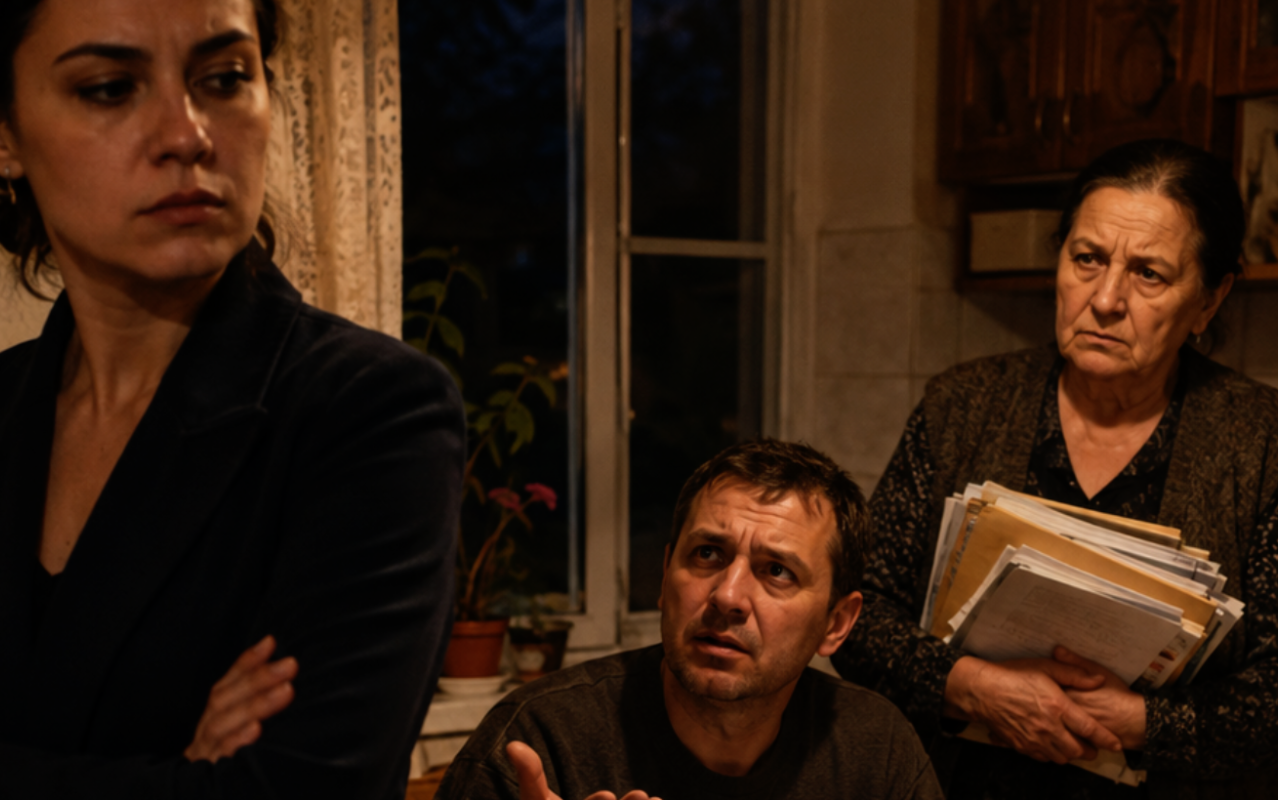
Larisa sat in the conference room, scrolling through the presentation for tomorrow’s meeting with clients. Numbers, charts, forecasts—the multimillion-ruble contract demanded her full concentration. Her phone vibrated at the worst possible moment.
“Hi, sunshine! Mom needs help again. Call me when you’re free,” Igor wrote.
Larisa exhaled and placed the phone face down. The third time this month. Galina Petrovna was in debt again, needed money again, and once again it would be the daughter-in-law—not her son—who would have to deal with it.
That evening, her husband greeted her with a guilty smile, hugged her, and kissed her on the cheek.
“Larochka, you earn good money,” he began cautiously. “Mom needs ten thousand. Her pension is small, and the utility bills have gone up.”
“How many times has your mother already asked for help this month?” Larisa kicked off her shoes and went into the kitchen.
“Well, twice. But those were small amounts.”
She opened the refrigerator, took out vegetables for dinner, and said nothing about the fact that their entire household budget rested on her ninety-thousand-ruble salary, while Igor’s thirty thousand barely covered gasoline and his personal expenses. She didn’t feel like arguing.
“All right,” she said as she sliced tomatoes. “I’ll transfer it tomorrow.”
Igor hugged her from behind.
“You’re the best.”
Larisa remained silent, thinking about the figure she had long since stopped saying aloud: over the past year, she had given her mother-in-law about two hundred thousand rubles. And not once had she heard a simple “thank you.”
The Coffee Maker, Multicooker, and Robot Vacuum
The requests came one after another, almost on schedule. First it was a loan from an old debt, then dental treatment, then repairs. After that came a new smartphone for thirty thousand because the old one was “too slow.” Then three purchases at once: a premium coffee maker, a multicooker with functions no one ever used, and a robot vacuum cleaner. The total bill was thirty-five thousand.
“Mom says the old appliances completely broke down,” Igor explained, laying the receipts on the table.
“Igor, these aren’t necessities,” Larisa said wearily. “They’re luxuries. Your mother lives on a pension of twenty-two thousand and buys appliances for thirty-five thousand. Does that seem normal to you?”
“Well, it’s not her fault the appliances broke. She chose something better. She wanted to treat herself.”
“Treat herself with my money?”
As usual, the conversation reached a dead end. Larisa reminded him that she had offered to help him improve his résumé and find a better-paying job. He had refused.
“I’m happy with my job. Not everyone can be a boss.”
She transferred the money. The loan was paid off. Until next time.
A month later, Larisa was closing the quarterly report and working overtime. In her mind, the bonus was already sitting in the savings account labeled “Vacation, sea, finally get some rest.” But Igor came home with new bills: his mother had taken out a loan for bedroom furniture—a bed, wardrobe, and chest of drawers. Forty-five thousand.
“Igor, this is too much!” Larisa threw the papers onto the table. “Your mother already has furniture.”
“It’s old. It squeaks terribly.”
“For forty-five thousand, you could buy two ordinary beds!”
“You’re cruel,” Igor said, turning away. “She’s my mother. I can’t abandon her.”
“No one is asking you to abandon her. I’m asking you to stop financing her whims. Medicine? Fine. Groceries? No problem. But not furniture when we have plans of our own.”
Igor went into the other room and slammed the door. Larisa remained alone in the kitchen. She stared at the bills and wondered how long this would continue. A year? Ten years? She gritted her teeth but paid off the debt, saying goodbye to her dreams of a seaside vacation.
“Thank Igor for Remembering”
The next day, Larisa went to the pharmacy herself—her mother-in-law had asked for blood-pressure medication. She bought everything on the list and delivered it. Galina Petrovna opened the door without a smile.
“Oh, it’s you. Did you bring the medicine?” She looked inside the bag and nodded approvingly. “Good. Thank Igor for remembering.”
Thank Igor. Not Larisa, who had bought everything with her own money and driven through traffic to deliver it. Igor, who had merely passed along the request.
“Galina Petrovna, don’t you want to thank me?” Larisa asked quietly.
“What?”
“I asked whether I deserve a thank-you. For the medicines I buy. For the loans I pay off every month. For the furniture, appliances, and phones.”
Her mother-in-law straightened up, and her voice turned icy.
“Larisa, you’re getting something confused. Helping your husband’s parents is your direct responsibility. You’re Igor’s wife, which means you have to take care of his family. And instead of demanding gratitude, you should be happy that you’re able to serve the family.”
Larisa stood there, unable to believe her ears. Serve the family. Responsibility. She should be happy. Two hundred thousand in a year, overtime work, giving up her vacation—and all of it was supposedly her duty, something that did not even deserve gratitude.
“I understand,” she said, turning toward the exit.
“Good, I’m glad you understand,” her mother-in-law called after her. “And about the furniture—tell Igor I still need a bedside table. I forgot to include it on the list.”
The door slammed shut. Larisa stood on the landing. A bedside table too. Of course. After all, it was the daughter-in-law’s duty.
That evening, she told her husband about the conversation. Igor listened with half an ear, without looking away from the television.
“Well, that’s what Mom thinks. She has her own opinion,” he said with a shrug.
“And you agree with her?”
“Larisa, you know Mom. She has conservative views. Just ignore it.”
“Ignore it?” Larisa laughed bitterly. “Igor, I’ve spent two hundred thousand on your mother! And instead of gratitude, I heard that it was my sacred duty.”
“Well, in a way, she’s right. We’re family.”
Larisa stared at her husband for a long time. In his understanding, “family” meant a mother who had to be supported and a wife who worked as an endlessly available source of money. Without another word, she went into the bedroom.
A New Television on Credit
A month passed in tense silence. On Sunday evening, Igor entered the room where Larisa was preparing a presentation and placed another set of papers in front of her.
“Mom needs help again. Fifty thousand. She bought a new television and a food processor. On credit.”
“A television and a food processor,” Larisa repeated slowly. “For fifty thousand. And who is going to pay for them?”
“Well… we are.”
Larisa leaned back in her chair, looked carefully at her husband, and suddenly smirked.
“No more free handouts, darling!” She stood up and closed her laptop. “Your mother can deal with her own problems from now on. If she wants a television, she can save money from her pension. Or you can pay for it out of your thirty thousand.”
“Darling, are you joking? She’s my mother. She needs help!”
“Needs help? Someone who keeps buying appliances on credit while living on a twenty-two-thousand-ruble pension? That isn’t need. That’s sheer entitlement.”
“Larisa, you’re greedy!” Igor shouted. “You earn ninety thousand. What does it cost you to help?”
“In one year, I’ve given your mother two hundred thousand. That’s more than you earn in six months! And I’m the greedy one?”
Igor couldn’t think of an answer, so he reached for his final trump card.
“If you don’t help my mother, I’ll divorce you!”
“Fine,” Larisa replied calmly. “No one is stopping you. Shall we file right now through the government services portal?”
Igor was genuinely stunned. He was accustomed to his wife eventually giving in and compromising. But now she was talking about divorce without tears or pleading.
“You can’t just… We’re family.”
“A family where I’m an ATM and you’re your mother’s errand boy. Wonderful family. I just don’t need one like that.”
“Go to Your Mother and Live With Her”
The next few days were a cold war. Igor alternated between begging, threatening, and accusing his wife of being heartless. Galina Petrovna joined in as well—calling and messaging Larisa, calling her selfish and disrespectful toward her elders. Larisa simply blocked her number.
Two weeks later, Igor came home furious.
“Mom is crying! The bank is demanding money and threatening to sue her. This is all because of you!”
“It’s because your mother took out loans,” Larisa corrected him without looking up from her book. “And because you’re incapable of telling her no.”
“If you don’t help, I’ll go live with Mom!”
“Go,” she said simply.
“What?”
“Go to your mother. Live with her. Pay off her loans out of your thirty thousand. Let’s see how long you last.”
Igor looked bewildered and stepped back.
“You can’t throw me out.”
“I can, and I will if you don’t leave voluntarily. The apartment is mine. I bought it before we were married.”
“You’re threatening me?”
“You certainly have no problem threatening me. You blackmail me with divorce and pressure me through guilt. That, by the way, is also a form of emotional abuse.”
Igor stood in the middle of the living room, pale. His entire life, his mother had made decisions for him, then his wife had made them, while he simply drifted with the current. Now, for the first time, he found himself face-to-face with reality.
“I’m giving you a week to think,” Larisa said. “Either you stop funneling money to your mother, or you leave. There is no third option.”
A Conversation in the Supermarket One Year Later
The week passed in silence. On the eighth day, Igor came home looking worn out and exhausted.
“Let’s try again. I’ll talk to Mom. I’ll tell her not to take out any more loans.”
“And a month from now, you’ll come back with another pile of bills.” Larisa shook her head. “I don’t believe your promises. Her opinion will always matter more to you than mine.”
“That’s not true.”
“It is. And we both know it.”
The divorce was finalized quickly. Galina Petrovna blamed her former daughter-in-law for every imaginable sin when talking to acquaintances, but Larisa no longer cared.
A year later, Larisa received a promotion and was now earning one hundred and twenty thousand. She bought a new car, traveled to Italy, and started building up her savings. One day, she ran into Igor at the supermarket. He was choosing discounted pasta. He looked older and thinner, with a dull, exhausted expression.
“How are you?” Larisa asked.
“Fine. I live with Mom.” He hesitated. “You know… you were right. About Mom. About everything.”
“And what has changed?”
“Nothing. She keeps taking out loans, and I pay them from my salary. I don’t even have enough left for decent food.”
“Maybe you should tell her no?”
“I can’t.” Igor shook his head hopelessly. “She’s my mother.”
Larisa looked at him and understood that he would never change. Galina Petrovna would drain her son of everything he had, and he would endure it because that was how he had been raised.
“Larisa, wait,” he called when she was already heading toward the checkout. “Maybe we could try starting over? I’ll change. I’ll find a better-paying job. I’ll stop helping Mom…”
“You just said you can’t refuse her.”
“Well, I’ll try! I just need a strong person beside me.”
“No, Igor.” She smiled gently. “I have a different life now. No more of your mother’s loans and no more constant stress. I’m happy. And I’m not going back.”
He lowered his head. Larisa paid for her groceries and stepped outside. The sun was shining, and people hurried about their business. She got into her car and turned on her favorite music. She had an entire free evening ahead of her—she could try a new restaurant, go to the movies, or simply go home with an interesting book. The choice belonged entirely to her.
And that turned out to be the best feeling in the world.
What do you think—could this family have been saved if Igor had stood up for his wife even once? Or can men like him really never be changed?