Part One. The Housewarming
A tire swing hung from a rope beneath the old apple tree, and Polina squealed with delight as she soared almost as high as the lowest branches. Larisa stood on the porch and counted: a year and a half’s worth of weekends, more than seventy trips, three buckets of filler, and one broken handsaw.
The house had been worth it.
It stood straight and solid, breathing the scent of fresh paint, its new windows looking out over their quarter-acre plot.
“Hold on with both hands, pilot!” she called to her daughter. “If you fall, we’ll rescue you, of course, but the swing will laugh at you for a very long time.”
“I won’t fall!” came the reply from beneath the apple tree. “Dad, push harder!”
Kirill gave the tire another shove. It shot toward the sky, and Polina shrieked so loudly that the neighbor’s goat raised its head behind the fence.
The gate creaked.
The guests had arrived. 🌿
Zhanna came in first, looked around the veranda, and whistled.
“Wow. You really went all out. I thought this place was a wreck, but now it looks like something out of a magazine.”
“It was a wreck,” Larisa agreed. “It took us a long time to persuade it otherwise.”
Artur squeezed through behind her carrying bags, followed by Diana with Timur and Sonya. The children immediately raced toward the swing, pushing Polina aside. She quietly gave way. They were guests, after all.
“You’ve done all right for yourselves,” Artur drawled, tapping one of the veranda posts. “Solid. How much did you sink into this place?”
“Exactly as much as we didn’t spend on vacations, movies, and new jackets,” Larisa said with a smile. “A house likes it when people suffer for its sake.”
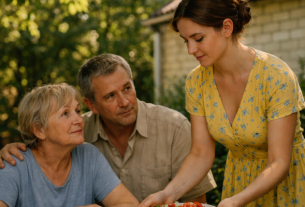
Dinner was noisy and cheerful. Kirill grilled meat, Diana chopped vegetables, and Zhanna photographed the veranda from every possible angle.
And somewhere between the second and third toast, the atmosphere changed ever so slightly.
“You’re lucky, of course,” Zhanna said, spooning salad onto her plate. “Stable jobs, no debts. Naturally you managed to save up. Some people are simply lucky in life.”
“Exactly,” Artur nodded. “Some people get lucky. Others work themselves to the bone.”
Larisa put down her fork and looked at him calmly, the way one looks at a cat that has just sat down on a freshly washed floor.
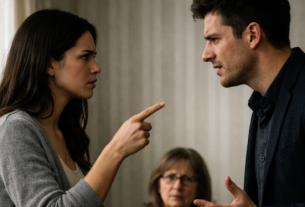
“Artur, in the year and a half we were working on this house, you came here once. You arrived, sat on the steps for forty minutes, and left. If that’s what you call ‘luck,’ then I must have been exceptionally lucky. I even painted the ceiling myself.”
“Oh, here we go,” he snorted. “Can’t even say anything anymore.”
“Say whatever you like,” she replied. “Just make sure your words have at least a passing acquaintance with the facts.”
Kirill defused the tension with more grilled meat. Everyone laughed, and the conversation moved on.
But Larisa remembered.
During all those months of renovation, not one of them had ever asked whether help was needed. Yet once the table was set, everyone was eager to decide who had been given more in life.
Part Two. The November Call
The summer passed quietly and happily. Polina learned how to tell blackcurrants from gooseberries. Kirill installed a clap-activated light on the veranda, and in the evenings all three of them would stand there clapping like lunatics.
In September they closed the house for the winter: drained the water, shut off the gas, and closed the shutters.
They returned to the city with light hearts and plans to come back in May.
Artur called in November.
His voice had the tone of someone announcing a week of terrible weather.
“Kirill, we’ve got a problem. My back. I can’t work after the surgery, and Diana can’t carry everything alone. The landlord’s throwing us out. We’re two months behind on rent.”
Kirill listened standing up, and Larisa could tell from his shoulders what was coming before he even said a word.
“Let us stay at the country house. Until spring. We’ll be quiet as mice.”
Kirill put down the phone and turned to his wife with the expression of a man who had already made up his mind and was now looking for an ally.
“Lar, he’s my brother. He has kids. And his back…”
“He used to have a conscience somewhere too,” Larisa said. “Though I haven’t seen that in a very long time.”
“What are we supposed to do? Put them out on the street?”
“Not on the street.”
She sat opposite him and spoke evenly.
“Two months. December and January. On February first, they move out. That isn’t a suggestion. It’s a schedule.”
“Lar, do you have to make it sound like an accounting deadline?”
“Kirill, kindness without a deadline is called a life sentence,” she cut him off. “And one person always ends up paying for it. Usually the one who painted the ceiling.”
“All right. Two months. I’ll tell him.”
“Tell him clearly. Not, ‘Well, see how it goes,’ but ‘February first.’ And explain the boiler, the heating settings, and the fact that the house is not a testing ground.”
Artur came for the keys two days later. He hugged his brother and nodded at Larisa with enough condescension for three people.
“Thanks, bro. I owe you for life.”
“Let’s skip the lifetime debt,” Larisa said. “Keeping the house tidy and the walls intact will be enough. Modest requirements, but at least they’re measurable.”
“What could possibly happen to the house?”
“That,” Larisa said, “is exactly what I’m wondering.”
Part Three. December
In mid-December Larisa insisted that they go check on the house.
Kirill resisted. It would be awkward, he said. They would look like inspectors dropping in unannounced.
She reminded him about the boiler and the pipes.
He gave in.
The gate opened with a creak.
A large red-haired dog on a long chain bounded toward them through the snow. Near the porch were empty bottles and a pile of boards.
Among them, Larisa recognized the top rails of their own fence.
“Kirill,” she said quietly. “Look carefully. Those are our boards. They used to stand upright and were known as a fence.”
Diana opened the door. She was disheveled and wearing someone else’s jacket over her bathrobe.
“Oh… you’re here. We weren’t expecting you. The place is a mess. The kids were sick, and we haven’t had time to clean.”
Inside, toys were scattered across the floor. A blanket covered the sofa, with stuffing sticking out from underneath it. The sink contained a three-story tower of dirty dishes.
“Hello,” Larisa said. “Diana, I’m not here to inspect anything. I just have one question. Does the dog have a kennel, or does it live in the living room?”
“She’s very gentle…”
“I don’t doubt the dog. I doubt the sofa.”
Artur came out of another room, walking briskly with long, confident strides and no sign of stiffness whatsoever.
“Oh, visitors! Kirill, hey! Lar, why are you starting on us the second you walk through the door?”
“Artur, you just walked ten meters like a champion race walker,” Larisa observed. “Am I right in assuming your bad back recovered and went on vacation?”
“I’m on painkillers!”
“Then I suppose you dismantled the fence while on painkillers too. Excellent medication. I should remember the name.”
“Those were old boards! They were rotten anyway!”
“Kirill and I replaced the rotten boards ourselves in June. With our own hands. I practically remember them by face.”
Kirill shifted uneasily by the door before finally managing:
“Artur, seriously, just be more careful. The house is new.”
“Everything’s fine!” Artur snapped. “There are kids, a dog, it’s winter. What do you expect, a museum? By spring I’ll be back on my feet and I’ll fix everything.”
They drove home in silence.
Larisa stared at the road and counted to fifty so she wouldn’t begin the conversation in a tone from which there would be no turning back.
“You were too hard on him,” Kirill finally said. “He really is going through a difficult time.”
“Kirill, a difficult time is when a man eats nothing but bread and repairs our gate out of gratitude. Not when he burns our fence in the stove and gets himself a dog the size of a calf.”
“We’ll put up with it until February.”
“I’m not good at putting up with things,” she said. “I’m good at counting days. There are forty-two left.”
Part Four. The Truth Comes Out
On January fifteenth, Vera Stepanovna, the neighbor two houses down, called.
Her voice was energetic and very specific.
“Larisochka, I’m not calling to gossip. This is business. You’ve got guests there every evening, music until half past one in the morning, and that dog howls constantly. I went over there once, but your relative just waved me away and shut the gate.”
“Vera Stepanovna, thank you. What kind of guests?”
“All sorts! Last weekend complete strangers arrived with bags in two cars. They knocked on my door asking where they were supposed to collect the key and what time check-in was. I said, ‘What check-in, dears? People live there.’ They looked embarrassed and went over to your place.”
Larisa slowly sat down on the arm of the sofa.
“Check-in, you say.”
“And there were people like that before New Year’s too. Young people with a big speaker. I thought you’d started renting the house out. Honestly, I was surprised. You raised that house like a child.”
“We aren’t renting it out,” Larisa said evenly. “Thank you. Really. Thank you very much.”
That Saturday, she and Kirill arrived without warning.
The gates were wide open. The red-haired dog greeted them without its chain, and an unfamiliar car was parked in the yard.
The inside of the house looked like a disaster zone.
The sofa they had saved six months to buy had been clawed open all the way down to the springs. The countertop had two burn marks. A cabinet door hung from a single hinge.
On the windowsill lay the shattered pieces of Grandma’s china set, carefully pushed together into a little pile, as though that somehow made them less dead.
“Kirill,” Larisa said quietly. “Come here. Look at the pile.”
He looked.
His face went pale.
His grandmother had brought that china set home from the first major trip she had ever taken and had treasured it for forty years.
Just then Artur came barging into the house with Slava. Both were carrying bags that clinked loudly.
“Oh, what are you doing here without calling?” Artur began cheerfully. “You know, that’s really not how things are done.”
“That’s not how things are done,” Larisa agreed. “I completely agree with that statement. I just happen to be applying it to you.”
She took out her phone and opened the notes where she had written down what the neighbor had told her.
Not that she needed them.
She remembered every word.
“Artur, I have three questions for you. First: why did six strangers spend the night in our house on December twenty-ninth and ask our neighbor about check-in time?”
Slava began backing toward the door.
Artur put the bags down.
“What people? That’s nonsense!”
“Second question,” she continued calmly. “There’s a notebook lying on the table in the bedroom. It contains dates and amounts. The thirty-first. The second. The seventh. And numbers with three zeroes after them. Is that how you’re planning your post-surgery rehabilitation?”
“You’ve been going through my things?!”
“It was lying open on our table in our house. I didn’t even turn the page. One page was enough.”
“Fine, I rented it out!” Artur shouted, his voice rising. “I rented it out over the holidays! What was I supposed to do?! I have children to feed! What do you care?! The house would’ve been sitting empty anyway!”
“The house would have been empty and intact,” Larisa said sharply. “Now it’s occupied and wrecked. There is a noticeable difference. It can be measured in sofas and money.”
“You’re throwing a sofa in my face?! A piece of fabric stretched over some springs?!”
“I’m throwing your lies in your face. The sofa is the result. The lies are the cause. And right now, the cause is walking around on perfectly healthy legs carrying shopping bags.”
Kirill stepped forward.
His face was white, but his voice was firm.
“Artur. You rented out our house. You lived here for free and charged strangers money to stay here.”
“I would’ve paid you back!”
“You’re going to pay back Grandma’s china set?” Kirill asked. “How? Which store sells forty years of memories?”
“The kids broke it! The kids! Are you going to scream at children now?!”
“I’m not screaming at children,” Larisa said. “I’m speaking to an adult who is hiding behind his children like a shield. Artur, children don’t dismantle fences for firewood, and they don’t take advance payments for January weekends.”
“You’re both greedy!” Artur shouted, stepping toward her.
Kirill moved between them.
“You have a house, a car, everything! What are we supposed to be, second-class people?”
“Second-class people are the ones who are treated like fools,” Larisa replied without moving an inch. “And that is exactly what you’ve been doing to us for two months. To the very people who gave you a roof over your head.”
“Move out today,” she finally snapped. “After this, you have no place in our home.” 🚪
“Kirill!” Artur spun toward his brother, almost choking with rage. “Are you listening to what she’s saying?! Are you even a man, or does your wife run everything around here?!”
“She isn’t giving orders,” Kirill said. “She’s saying it out loud. And I’m signing my name underneath it. You destroyed our house, Artur. You didn’t borrow it. You didn’t simply live here. You destroyed it. Pack your things.”
Artur stared at them for about three seconds, his face twitching.
“Henpecked fool,” he spat. “That woman pulls your strings, and you’re happy to let her.”
“The only thing we pull by a string in this family is the swing,” Larisa said. “And you know what? It’s more honest than you. When it creaks, at least it has a reason.”
The door slammed so hard that snow fell from the top of the frame.
Part Five. Spring
Zhanna called the next morning at exactly nine and started talking without even saying hello.
“Larisa, have you lost your mind? Throwing people with children out in the middle of winter! You help family. You don’t throw them onto the street!”
“Good morning to you too,” Larisa said. “For the record, nobody was thrown onto the street. Diana went to stay with her sister yesterday. I personally helped her pack, and I personally called the car. We paid for it too, by the way.”
“That doesn’t matter! You could have put up with them until spring!”
“We could have. And by spring we would’ve had no fence, no furniture, and none of Grandma’s memories left. But we would have preserved our reputation as very patient people. A valuable thing, certainly, though you can’t put it in a house.”
“You’re cruel,” Zhanna said sharply. “You don’t understand what family means.”
“I understand perfectly,” Larisa replied. “Family means the people who help you. Not the people who use you, lie to you, and break your things. Artur was renting our house to strangers for money while telling his brother about his bad back. Tell me, Zhanna, which article of the family code does that fall under in your dictionary?”
Silence on the other end.
“He didn’t tell you?” Larisa asked. “Strange. People usually like to share achievements like that.”
Zhanna hung up without another word.
Artur finally moved out completely a week later.
He left the keys under the doormat and a note containing a single word:
“Thank you.”
No period. No signature.
After that there were no calls and no apologies.
In spring, they began again.
Kirill reupholstered the sofa, replaced the countertop, and restored the fence rails—new ones this time, pale and smelling of fresh wood.
Larisa painted the veranda, humming to herself, while Polina sat beside her on the steps and handed her brushes.
“Mom, is Uncle Artur never coming back?”
“I don’t know, Polina.”
“Are you angry?”
“A little,” Larisa admitted. “But anger is a terrible tenant. It eats a lot and pays no rent. So I evicted that too.”
On June first, they hung a new rope on the swing—thick, strong, and blue.
Polina soared toward the lowest branches while Kirill rested his hands lightly on his wife’s shoulders.
“You know, I was angry with you back then. For the first few days,” he admitted. “But then I realized that if it hadn’t been for you, I would’ve dragged the whole thing out until autumn. And then until the next autumn.”
“I don’t ‘put up with things,’ Kirill. I never have—not for a year, not for two. Patience is when someone silently lets the bill pile up so that one day they can present the whole thing at once. I prefer paying in installments and out loud.”
“You’re tough.”
“Respectful,” she corrected him. “I treat everyone with respect.”
Meanwhile, Artur was sitting in a cramped rented room in the city, cursing Larisa out loud.
It had all been her idea.
She had talked Kirill into it.
His brother would never have done it on his own. His brother was softhearted. He would have given them another couple of months, and then maybe they could have stretched it until autumn.
Artur had new debts now—to the very people who had arrived for “check-in” and received neither their January weekends nor their money back.
One of them called every evening and spoke to him in a very unpleasant manner.
They had to return the dog to Denis, and Timur refused to speak to his father for four days because of it.
Diana stopped shouting and began counting.
Out loud.
Right in front of him.
Every single thousand.
Zhanna called every other day and recited the list: the house, his brother, Grandma’s china, the humiliation in front of the entire family.
“You’ve dragged all of us into this,” she told him. “Do you understand that you don’t have a family anymore?”
“My back…” Artur would begin automatically.
“It’s not your back,” Zhanna would cut him off. “It’s your nerve. At least a bad back eventually gets better.”
And on their quarter-acre plot, beneath the old apple tree, the new swing creaked gently.
Larisa looked at her daughter and her husband and thought something simple and certain:
All along, her real family had been only the two people sitting beside her on those warm porch steps. 🌿