The lamp above the worktable cast a steady white light, and beneath it a tiny sunflower slowly bloomed on Rita’s fingernail—three brushstrokes, a fine line, a dot. Darya worked with a brush as thin as a single hair, barely breathing, and smiled. In the next room, five-year-old Sonya was putting her stuffed fox, Tosha, to bed and explaining the rules of life to him in a loud whisper.
“Dash, are you even human?” Rita examined her finger at arm’s length. “This is a painting. Now I’m afraid to wash my hands.”
“You can wash them. You just can’t sell them,” Darya replied without looking up. “I retain the copyright.”
“Hey, did that bride of yours come by? Polina, right?”
“She did. The wedding’s in two weeks. She wants little lavender branches and pearl dust. I’ve already drawn the design and redone it three times.”
Rita laughed and blew on her fingers. Darya put her brushes back into their case, each one in its own slot like a surgeon’s instruments. A year and a half ago, she had owned one bag, had a child, and rented a tiny corner of someone else’s place. Now she had a packed schedule and clients who booked appointments a month in advance.
“When’s Yegor coming back?”
“Tomorrow night. Or the day after. He’s out on a run—you know how it is, the schedule has a life of its own.”
“You’re lucky,” Rita sighed. “He courted you so beautifully back then. I remember Alisa telling me about it.”
“He did,” Darya agreed. “Flowers for no reason, ten-minute voice messages, dinners. And that line: ‘Sonya will be like my own daughter.’”
After seeing Rita out, Darya came back, sat on the floor beside her daughter, and built a four-story tower out of blocks. Sonya ceremoniously knocked it down and announced that it had been a catastrophe of global proportions.
The phone vibrated on the table.
“Dash,” Yegor’s voice was businesslike, with no introduction. “Mark has a fever. Thirty-eight point six.”
“Oh. What does he say?”
“Nothing. He’s just lying there. Can you stay with him? I won’t be back until Monday.”
“Yegor, I’m fully booked Thursday, Friday, and Saturday. Saturday is the bridal design.”
“Well, you’re home anyway,” he said calmly, as if discussing the weather. “Reschedule them.”
She rescheduled them.
More precisely, she canceled three appointments, apologized twice by voice message and once by text, and received a short reply from Polina:
“Sorry. I found another nail artist.”
A regular client, a wedding, recommendations, an entire chain of brides-to-be she knew—it all disappeared in a single minute.
Darya put down the phone and went to take the temperature of someone else’s child.
The next five days were all the same: pharmacy, broth, raspberry drink, laundry, floors, airing out the rooms, checking his temperature every four hours.
Mark lay there with his tablet, answering in monosyllables and never once looking her in the eye. In all five days, he said “thank you” exactly once—without looking away from the screen when she placed a plate on his bedside table.
“Mark, you need to eat the soup while it’s hot.”
“Uh-huh.”
“The tablet isn’t going anywhere.”
“Uh-huh.”
Lidia Petrovna called regularly. Not to ask how the boy had slept. Not to ask whether Darya herself had slept.
To conduct an inspection.
“What did you make the broth with?” she would begin, without even saying hello.
“Chicken.”
“Did you remove the skin? You have to remove the skin. And the carrot should go in whole, not diced. You’re poisoning him.”
“Lidia Petrovna, he’s getting better. His temperature is thirty-six point eight.”
“Mark told me there are dishes sitting in your sink. Yegorushka… Yegorushka works himself to death, barely sees daylight, and you can’t even keep the house in order.”
“I manage to keep the house in order. The only things I don’t manage are working, sleeping, and being happy—but apparently those weren’t included in the package.”
“You’ve gotten mouthy.”
“I was always like this. You just used to listen to your own thoughts instead of listening to me.”
On Thursday, Yegor came home for half a day.
Darya was foolishly happy. She thought he would stay with his son so she could at least see two clients.
He took off his jacket, glanced at the thermometer, asked, “So, he’s okay now?” and forty minutes later left to replace a leaking faucet at his sister’s apartment.
“Alisa asked me. Hers is dripping,” he tossed over his shoulder from the doorway. “I’ll be gone two hours.”
“We have a child here recovering from a fever.”
“But you’re here.”
He returned at eleven.
From Alisa’s place, he had gone to see Vlad “for half an hour to discuss some things.”
Darya finished washing the dishes, finished cooking porridge for the morning, and went to bed without waiting for him.
On Sunday, Zhenya came over—Darya’s friend since school, carrying a box of éclairs and her usual whirlwind of energy.
She sat on the floor beside Sonya, built a tent out of a blanket, and only after that became a functioning adult.
“So, tell me. How are you?” Zhenya broke an éclair in half. “You look like you’ve spent a week unloading freight cars.”
“Mark was sick. Five days.”
“And Yegor?”
“Yegor was away working.”
“I see.” Zhenya nodded. “You know what my Deniska did yesterday? Grisha woke up in the middle of the night. I didn’t even open my eyes—Denis got up, rocked him back to sleep, even sang him that song about the crocodile. And in the morning he carried him home from kindergarten on his shoulders. Can you imagine? He offered to do it himself.”
“Really? All by himself?”
“Yep. Sometimes I wonder where I even found a man like that. He’s not perfect. He leaves his stuff all over the apartment. But he’s there. He’s rowing in the same boat with me instead of sitting on the shore judging my rowing technique.”
Darya looked at her hands—dry and chapped from endless cleaning and washing.
She had been told so many times that she “wanted too much” that she had almost started believing it.
Apparently, there was another way to live.
And that other way was living just a few neighborhoods away.
“Does Yegor help you?” Zhenya asked.
“He does,” Darya lied in an even voice. “Of course he does.”
Zhenya looked at her a little longer than necessary but said nothing.
By Wednesday, Darya couldn’t take it anymore and called Irina Lvovna.
Her mother arrived the next morning carrying two bags of groceries and another bag with a package of pasta sticking out of it.
“All right,” Irina Lvovna said, setting the bags down. “Sonya, come give Grandma a hug. Darya, come here. Are you living in this house, or are you servicing it?”
“Mom, don’t start.”
“I haven’t even started yet. I see my daughter, who has lost weight in a month, and I see a house where she isn’t the lady of the house—she’s a function. Do you even hear yourself? You just said, ‘They let me go out for two hours.’”
“I misspoke.”
“You misspeak once. The second time, it’s a diagnosis.”
Yegor came home that evening and, when he found out who had visited, went white with anger.
“Why did you call her?” he demanded the moment he walked in. “What, I can’t handle things myself? You’re making me look bad in front of your family!”
“I called for help. Help arrived with potatoes and a pair of working hands. You arrived with complaints and nothing else.”
“You’re making a huge drama out of nothing!”
“You created the drama. I just read out the bill.”
Two days later, he came home late, unsteady on his feet and loud.
Darya understood everything from the sound of the key in the lock and managed to take Sonya into her room.
Yegor stood swaying in the hallway, talking to no one in particular.
“It’s never enough for you, is it?” he raised his voice. “Oksana started exactly the same way! First it was ‘help me,’ then ‘you’re not the man I thought you were,’ then came the suitcase!”
“You’re comparing me to the woman who left you. Is that supposed to be an argument or a prediction?”
“You came into my house!”
“I came into a house where I was promised there would be a family. So far, all I’ve found is a free household-service subscription.”
Sonya came out of her room barefoot, clutching her stuffed fox to her chest. When she saw her stepfather, she darted back inside and shut the door.
Darya heard the handle click.
Yegor waved a hand dismissively and went to sleep in Mark’s room.
The next morning, he was polite. He poured her some water and said he had “had too much” and that “work was hard.”
Darya nodded, washed her hands, and sat down to work.
By lunchtime, one client arrived, then another, and everything almost felt normal again—until Darya went to get a blanket and heard Mark’s voice through his half-open door.
“No, Grandma,” the boy was saying to someone on the phone. “She’s not my mom. She’s Dad’s wife. She just lives here.”
Darya stopped, took the blanket, and went back without saying anything.
She wasn’t angry with the child. Children repeat what adults teach them, and someone had clearly taught him this long before yesterday.
But one phrase lodged inside her like a nail:
She just lives here.
That evening, Yegor came home angry and wound up after a conversation with his mother and some kind of trouble on his route.
He threw his bag into the corner, sat down, and stared at her.
“I got fined. Twenty thousand. So I’m out there busting my ass, and you’re sitting here waving little brushes around.”
“I earn money with those little brushes. Or did you think nails magically turn themselves into works of art?”
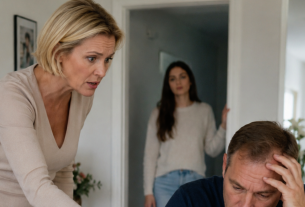
“You’ve got everything handed to you!” He jumped to his feet. “The apartment is mine, the refrigerator is mine, the electricity is mine! You showed up here with one bag and a kid hanging around your neck!”
Darya slowly placed the bottle on the table so she wouldn’t spill it, then turned toward him.
“I’m glad you’ve decided to start keeping accounts,” she said calmly. “Let’s calculate together. I spent five days nursing your son back to health. I canceled three appointments, lost a bridal booking, and lost a client along with all her friends. That wasn’t me ‘sitting at home.’ That was more than thirty thousand rubles that I quietly gave up for you.”
“Why don’t you send me an invoice while you’re at it!”
“I will, if you want. I buy the groceries every other time. I bought Mark’s medicine. I bought the laundry detergent. I chose and paid for his autumn jacket, too. In a year and a half, you haven’t taken Sonya to kindergarten once. Not once, Yegor. Even when you were home.”
“She’s not my daughter!”
“There. Thank you. You said it yourself—I didn’t even have to prompt you.” Darya nodded. “And yet you promised she would be like your own. Your promises are beautiful. They just come with a warranty that expires the moment they become inconvenient.”
“Don’t you dare!” His voice rose to a shout. “I feed you!”
“You don’t feed us. You use us and present it as charity. Your mother calls not to ask how the child is doing but to inspect the sink. Your sister calls you to fix her faucet while your own son is at home with a fever. And your friend is more important than both your son and your wife. I’m not complaining. I’m listing facts.”
“Everybody lives like this!”
“No. They don’t. It took me a year and a half to figure that out, but apparently I’m not completely hopeless.”
He began breathing rapidly, pacing back and forth across the room.
Then he stopped and jabbed a finger toward the hallway.
“You’re ungrateful! I got you out of that rented little dump!”
“I walked out of that dump myself, on my own two feet, carrying a suitcase and a child. All you did was open a door and decide you’d bought me wholesale at a discount.”
“You’ve got nowhere to go!”
“There’s always somewhere to go once you stop being afraid. Fear is a terrible landlord, Yegor. The rent is far too high.”
“You’ll be sor— You’ll come running back!”
“The only running I do is in the mornings, and without witnesses.” Darya opened the wardrobe. “I’ll leave with what I came with. Want to inspect everything?”
She packed calmly and quickly, like someone who had already sorted everything out in her mind a long time ago.
Two stacks of her own clothes. Sonya’s dresses and tights. Tosha the stuffed fox. Two toothbrushes. Documents. Her box of brushes. The lamp.
Yegor stood in the doorway of the room, watching the zipper travel all the way across the bag.
“You’re leaving?” he asked nervously. “Seriously? After everything?!”
He grabbed her by the elbow.
“Take your hand off me. That’s my working hand. I don’t get issued a spare.”
“Dasha, wait! I lost my temper, okay? That fine, my mother driving me crazy… Come on, let’s talk calmly!”
“Calm was the last year and a half. Calm is over.”
“What about Mark? He’s gotten attached to you!”
“Mark explained to his grandmother over the phone that I’m his dad’s wife and that I just live here. The boy isn’t to blame. Adults taught him that. I’m not angry with him. I’m simply going to stop occupying a place that no one ever really gave me.”
She helped Sonya into her jacket, zipped it all the way up to her chin, and took her daughter by the hand.
Then she removed her keys from the key ring and placed them on the table gently, so they wouldn’t make a sound.
“I’ll come back Tuesday for the lamp and sterilizer. I’ll call first.”
“Are you serious?!” His voice rose again as they reached the stairwell. “You’re leaving me because of some dishes?!”
“Because of respect, Yegor. Dishes are nothing. You wash them clean. Contempt doesn’t wash off.”
The door closed.
He called fourteen times. He wrote long messages, first accusing her, then explaining himself, then begging.
Darya put her phone on silent.
All the way to Irina Lvovna’s home, she talked to her daughter about how tomorrow they would go and choose a new hair tie with daisies on it.
One night at her mother’s.
Then came a one-room apartment on the fourth floor. It was old but bright, with a large table against the wall—exactly what she needed for her lamp and brushes.
Her appointments returned within two weeks.
First Rita.
Then Zhenya.
Then Zhenya’s friends.
Then three girls who came through recommendations.
Soon her schedule was packed again.
The evenings were simple: drawing with felt-tip pens, reading a story about a little mouse that wasn’t afraid of the dark, and falling asleep hugging Tosha the fox.
“Mom,” Sonya asked one day, turning a pencil between her fingers. “Are we going back to Uncle Yegor?”
“No, sweetheart. We’re not.”
“Okay,” Sonya said, and went off to build another tower.
Darya sat for a long time looking at the lavender design that had never been used.
Then she finished it for herself.
Her family was right here: this little girl with her stuffed fox, and the box of brushes on the table.
Everything else would either find its rightful place beside them—or honestly remain outside the door. 🚪
A month later, Yegor sat alone in the empty apartment and did the calculations again.
Mark had gone to live with Lidia Petrovna because there was no one left to cook or do the laundry.
Alisa called once—to ask whether he could help transport a wardrobe.
Vlad invited him over, but Vlad had a wife and child at home, and the conversations there only made Yegor feel worse.
“Mom, are you happy now?” he said into the phone. “You were always saying, ‘She cooked it wrong, she washed it wrong.’ Are you happy now?”
“Don’t you dare shout at me! You’ll find another woman.”
“The others left after a day. Two days. This one carried me and my son for a year and a half, and I threw that in her face like it meant nothing.”
“Yegorushka… Yegorushka, what’s gotten into you?”
“Nothing. That’s it,” he said, and ended the call.
That night, he wrote to Darya one more time—a long, confused message about how he had been wrong, how he had burned out, how maybe they could try again.
Her reply came in the morning.
It was short and polite:
“Yegor, I wish you well. But no.”
He never wrote again.
He understood from the tone that the door wasn’t merely locked.
It was closed for good.