The string lights blinked as though they were celebrating a holiday of their own. Balloons swayed beneath the ceiling—gold ones, pink ones, and a single blue one that Mila had chosen herself and declared “the most important.” The large room smelled of frosting and oranges, and a mountain of presents wrapped in shiny paper covered the sofa.
Kira adjusted the foil crown on her daughter’s head and stepped back to admire her.
“Well, that’s it. You are officially the oldest five-year-old woman in this house,” she said.
“Mom, I’m not old!” Mila protested.
“Of course you’re not. You’re aged. Like a fine cheese, only louder.”
Artyom emerged from the hallway with a camera in his hands and immediately caught them in the frame. He was smiling broadly, almost proprietorially, as though he were photographing not his family but one of his own accomplishments. The door slammed behind him—Vlada had arrived with her son.
“Happy birthday, princess!” Vlada sang, handing Mila a box. “Auntie didn’t come empty-handed!”
“Thank you!” Mila was already tearing off the wrapping paper.
“Come in, Vlad.” Kira nodded toward the table. “Timofey, hang your jacket on the lower hook. That one is yours personally.”
“I have my own hook?” the boy exclaimed happily.
“A personalized one. We’ll put a nameplate on it soon.”
The last to arrive was Nikita, Kira’s brother, carrying an enormous stuffed fox under one arm. The fox was about a head taller than the birthday girl.
“I misjudged the scale,” he admitted from the doorway.
“You always misjudge the scale,” Kira laughed. “Remember when you gave me a bicycle to grow into for my eighteenth birthday?”
“Well, you did grow.”
“I grew in a different direction, Nikit. Outward and inward.”
Everyone sat down at the table. Artyom rose with a glass in his hand and gestured around at the walls, the fresh renovation, and the wide window overlooking the park. There was something in the gesture of a general surveying his territory from the top of a hill.
“To our home,” he said. “We moved in a year ago. And you know what? I’m proud. Not everyone can manage something like this.”
“Not everyone,” Kira agreed. “Especially if they don’t have a grandmother’s apartment on Rechnaya Street.”
There was a brief burst of laughter around the table. Artyom laughed too, but for a second his eyes went blank, like a screen that had been switched off.
“Oh, here we go again.” Vlada waved a hand. “Kira, you bring up that apartment on Rechnaya every single time.”
“Not every time. Only on holidays. Like the national anthem.”
The children ran off to the kids’ room, and shrieks and the crash of toy blocks immediately came from inside. The adults remained around the table, their conversation flowing slowly, lazily, comfortably.
Vlada wandered around the apartment with her phone, recording stories, until she suddenly stopped beside the window in the far room.
“Artyom, does this window face south?” she called.
“Southeast,” Artyom replied.
“Perfect. You could put a wall-to-wall wardrobe here.”
Kira raised her eyebrows and looked at her husband. He was intently slicing an apple, even though nobody had asked for apples.
“Vlad, are you our interior designer now?” Kira asked.
“I’m just giving advice,” her sister-in-law shrugged. “What, I’m not even allowed to give advice anymore?”
“You are. Give it louder. I’m taking notes.”
Timofey came tumbling out of the children’s room, red-faced and happy, and climbed onto his mother’s lap.
“Mom, will my room be this one with the window?” he blurted out.
The room became very quiet. The string lights continued blinking, and suddenly their little clicks seemed loud enough to hear throughout the apartment.
“Tim, be quiet,” Vlada said quickly.
“But you said so yourself! You said we’d move in here once all the paperwork was finished!”
“Timofey.”
“And you said I’d get the room with the window and Mila would move away!”
Kira slowly lowered her fork. She looked at Artyom. He was still slicing and slicing the unfortunate apple, cutting it into almost transparent slivers.
“Artyom,” she said evenly. “Are you the director of this little play, or just a spectator in the front row?”
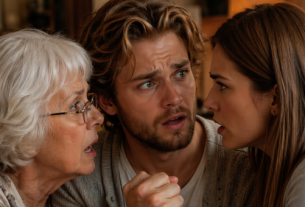
“Kira, don’t start this in front of the child,” he said through clenched teeth.
“The child started it. Children are honest. It’s an age-related condition. They grow out of it eventually.”
Nikita pushed back his chair and stood up. He said nothing. He simply walked into the hallway and returned with his phone in his hand.
The guests left quickly, as though someone had let all the air out of the apartment. Vlada dragged Timofey away by the hand, hissing something into his ear. Mila fell asleep hugging the stuffed fox, still wearing her foil crown.
Kira stood in the middle of the room, surrounded by wrapping paper and balloons, staring at her husband.
“Start talking,” she said.
“About what? Tim said something stupid. He’s six.”
“Artyom, honesty wasn’t exactly what made me fall in love with you, but don’t take me for an idiot either. Vlada is already arranging wardrobes along my walls.”
“Your walls?” he snapped. “Interesting choice of word.”
“Very interesting. Let’s discuss it.”
He said nothing.
Kira walked into the room where his desk stood and pulled a flat gray folder out of a drawer. It had not even been hidden. It lay between appliance manuals, calm and brazen, like someone utterly convinced no one would dare touch them.
“You went through my things?” Artyom appeared in the doorway.
“I was looking for a charger. I found my life instead.” Kira opened the folder. “Owner: Artyom. Second owner: Vlada. Do you know what’s strange? I’m missing from this fairy tale. I could swear I was there. I even remember selling my grandmother’s apartment and bringing you the money. Apparently, I was just passing by at the time.”
“It’s a temporary arrangement,” he said quickly. “It had to be done this way. Vlada had a clean situation, no risks, everything could be registered in her name without any problems…”
“Without problems for whom?”
“For us!”
“Artyom.” Kira snapped the folder shut. “‘For us’ means something that benefits both people. When it benefits one person and the other finds out from a six-year-old, there’s a different word for it. I know the word, too, but I’m not going to say it in front of a sleeping child.”
He exploded. Kira had noticed long ago that people who were caught never defended themselves quietly. They shouted, because shouting made it easier to drown out other people’s questions.
“Do you even understand that you’re nobody in this apartment?!” Artyom stepped toward her. “Have you ever dealt with the documents? The registration? You just sat there waiting for me to do everything!”
“I waited for you to do it. I just didn’t think this was what you were going to do.”
“Your grandmother’s dump was worth pennies! Pennies, do you hear me?! I paid for half this apartment myself!”
“Wonderful.” Kira nodded. “Then take your half and live in it. Just decide which half you want—the right side, the left side, or the part where Vlada has already hung her curtains.”
“That’s not funny!”
“I’m not joking. I’m making an observation with irony. Those are different genres, Artyom. You’re confusing them.”
He slammed his palm against the table. The folder jumped.
“You should be grateful! You lived completely protected! You have no idea what would have happened to you without me!”
“I do,” Kira replied calmly. “Everything would have been exactly the same, except the apartment would have been mine. Terrible fate. Horrifying to imagine.”
“Kira, you’re going to drive me insane!”
“Where? To the truth? That’s exactly where I’m taking you. By the hand, carefully, so you don’t trip.”
He turned toward the window and spoke more quietly, but with even greater anger.
“I wanted what was best. I wanted to protect the family.”
“From whom? Your wife?” Kira stepped closer. “Artyom, look me in the eyes and say it again. You protected your family from me.”
“You’re twisting my words.”
“I’m quoting you. Word for word, actually. Want me to turn the volume up? There was also a very touching part about my grandmother.”
Kira did not sleep that night. She did not cry. She simply sat on the floor beside her daughter’s bed and thought. In the morning, she made three phone calls. One of them was to Nikita.
Her brother arrived an hour later. Without a word, he placed his phone on the table in front of his sister, screen facing upward.
“I didn’t want to tell you yesterday. It was a birthday, after all,” he said.
“Tell me.”
“Your husband has been renting an apartment on Olkhovaya Street for two months. He’s not living there alone.”
Kira stared at the screen for a long time. Something inside her broke loose and fell—quietly, without a crash, like a book slipping from a shelf.
“Is she pretty?” she finally asked.
“Kira.”
“I’m not asking out of jealousy. I’m curious. I want to understand what all this was worth.”
“Kira, it gets worse,” Nikita said. “He was planning to transfer your share—or rather, what should have been your share—entirely to Vlada. She was already looking for somewhere to move you and Mila ‘temporarily.’ She talked about it openly in front of people. She wanted the keys and official residence registration.”
“So the plan was this,” Kira said slowly. “My daughter and I move out ‘temporarily.’ His sister moves in ‘forever.’ And he still gets to be the good guy because ‘nobody threw anyone out.’”
“More or less.”
“Elegant. Almost beautiful. Shame it’s so despicable.”
That evening, Kira called everyone over. Vlada arrived first, confident, carrying a handbag in which keys jingled. Artyom came in after her, tense, wearing the expression of a man who could smell smoke but was still hoping it was only the neighbors having a barbecue.
Kira sat Mila down in the children’s room with cartoons, closed the door, and returned to the living room.
“Let’s begin,” she said. “Vlada, there are keys to this apartment in your bag. Where did you get them?”
“Artyom gave them to me!” she snorted. “I happen to be an owner. Legally, I’m entitled to them.”
“Wonderful. Now the second question. Artyom, how much did my grandmother’s apartment on Rechnaya Street sell for?”
“Kira, don’t turn this into a circus.”
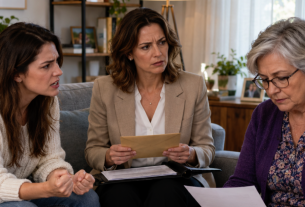
“I’m not. I’m conducting an inventory.” Kira laid printouts across the table. “Here’s the amount from the sale. Here’s the date. Here’s the transfer—to you, that same day. Here’s the purchase price of this apartment. Let’s calculate: almost two-thirds of this place was paid for with my money. And there isn’t a single letter of my name anywhere in the documents. Artyom, you’re not a financial genius. You’re just a man who decided I couldn’t read.”
Vlada flushed.
“Oh, enough with your stupid papers! Who even are you? You came into our family with one bag!”
“With a bag, Vlad. And an apartment. I kept the bag and gave you the apartment. I admit I handled that badly.”
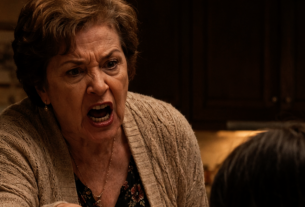
“You’re ungrateful!” her sister-in-law shrieked. “We accepted you! We put up with you!”
“Put up with me?” Kira turned fully toward her. “Vlada, darling, you put up with a toothache. Nobody needed to put up with me. I wasn’t an illness. I cooked, cleaned, raised a child, and kept quiet while all of you tried my walls on for size.”
“Artyom, say something to her!”
“Kira, enough,” Artyom said dully.
“No, it isn’t enough.” She took out her phone. “Olkhovaya Street, number seven. Should I continue, or would you like to tell the story yourself? You love making speeches. You’re good at them.”
Artyom went pale.
“It’s not what…”
“Artyom, it is exactly what I think it is. For two months, you were living between two apartments while simultaneously deciding where to move me ‘temporarily.’ You weren’t confused. You were making a schedule.”
“I wasn’t going to throw you out!”
“You were going to arrange things so that we left on our own and apologized for the inconvenience on the way out.”
Then something happened that Artyom had not expected. Vlada suddenly calmed down—as abruptly as if someone had flipped a switch. She adjusted her hair and looked at her brother with a new, cold interest.
“Artyom,” she said. “Since everything’s out in the open now, let’s be honest. The apartment was registered to both of us, but your share… do you remember what you signed?”
“What do you mean?” Artyom turned toward her.
“Exactly what I said. You asked me yourself to transfer everything into my name so it would all be ‘clean.’ I did. You said, ‘Vlad, I trust you.’”
“What the hell are you talking about?”
“I’m talking about the fact that my surname is the one on the documents now,” Vlada said calmly. “And I’m not throwing anyone out. Timofey and I simply need an apartment. And as I understand it, you’ve already settled in on Olkhovaya Street.”
Artyom opened his mouth, but no sound came out. Kira watched him.
“Artyom,” she said gently. “You won’t believe this, but it’s called the law of conservation of treachery. It never disappears. It simply passes to whoever is closest.”
“She’s lying! Vlada, you’re lying!”
“I’m not lying about anything,” his sister shrugged. “You came up with the whole thing yourself. I merely agreed.”
“You swore to me!”
“You swore to your wife,” Kira cut in. “As you can see, oaths are disposable items in your family.”
Artyom paced frantically around the room, grabbing papers, dropping them, then grabbing them again. He called someone, but they did not answer. He shouted at Vlada while Vlada stared at her phone.
Kira walked past them into the children’s room and crouched beside her daughter.
“Mila, let’s go stay with Uncle Nikita. Remember his balcony with the pigeons?”
“Can we take the fox?”
“Absolutely. The fox is traveling first class.”
She zipped up her daughter’s jacket, pulled on her hat, and tucked a loose strand of hair back into place. Mila held out her little hand to her—warm and trusting—and there was more of a home in that tiny hand than in all forty-eight square meters surrounding them.
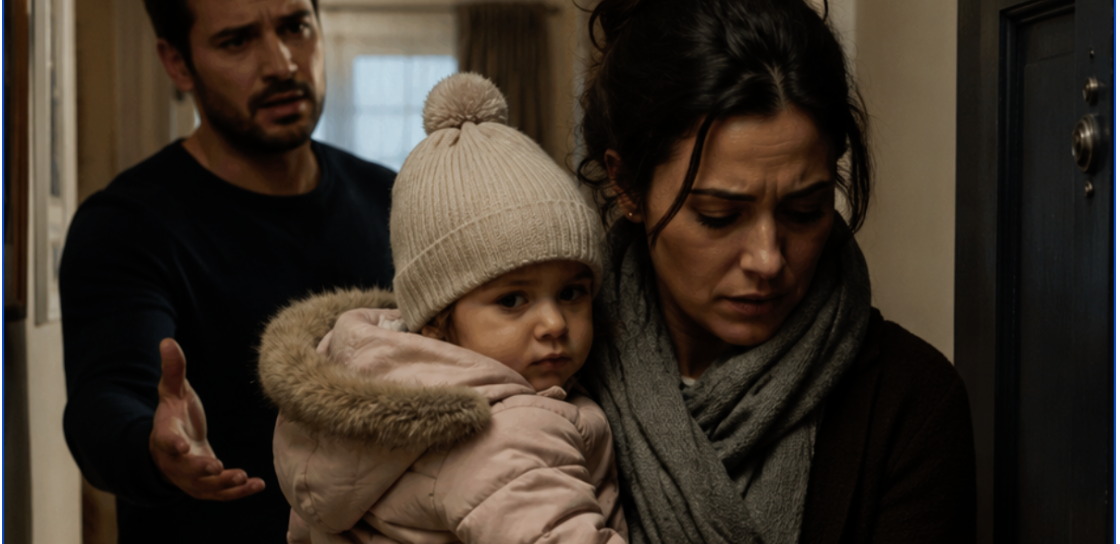
Artyom blocked their way in the hallway. His face was wet and his lips were trembling.
“Kira. Kira, wait. We’ll work this out. I’ll fix everything. I’ll talk to Vlada, I’ll get it back…”
“Get what back?” she asked quietly. “My grandmother? The three years I spent believing you? Or that moment when my child heard that she was supposed to move out of her own room? I’ll get what belongs to me back through the courts. You should know that—and prepare yourself for criminal liability.”
“I wasn’t myself!”
“You were completely yourself. In fact, you were very much yourself, Artyom. For the entire two months, every day, right on schedule.”
“You’re really leaving? After everything we’ve been through?!”
Kira looked at him.
“Exactly because of everything we’ve been through. If there had been nothing between us, maybe I would have stayed.”
Without another word, she took her daughter by the hand and picked up her bag and the stuffed fox. The door closed softly, almost soundlessly. Kira had never liked dramatic effects.
A week later, Nikita told her that Artyom was calling every day.
“He isn’t living on Olkhovaya anymore,” her brother added. “Apparently, things got complicated there.”
“Things are very simple there,” Kira replied. “She was interested in him when he was a man with an apartment. Now there is no apartment.”
“And Vlada?”
“Vlada moved in. With her wall-to-wall wardrobe, just like she dreamed. And with her brother standing on the doorstep asking if he can stay there ‘temporarily.’”
“Are you enjoying this?”
“No, Nikit. I’m just watching greed chew itself to pieces. It isn’t a pretty sight, but it’s educational. And I’ve already filed the court papers.”
Mila ran into the room, dragging the fox by one ear, and launched herself onto her mother’s lap.
“Mom, are we going to live here?”
“For now. And later we’ll have a place of our own. Completely our own, where your name will be written in big block letters right on the door.”
“And on the paper too?”
Kira laughed.
“On the paper too, sunshine. Especially on the paper. Turns out that’s the most important place of all.”
She hugged her daughter and looked out the window at the warm lights glowing in other people’s homes.
She wasn’t afraid.
She felt light—the kind of lightness you feel when you finally take off a backpack you’ve been carrying for years, all the while believing the weight was simply part of your own back.