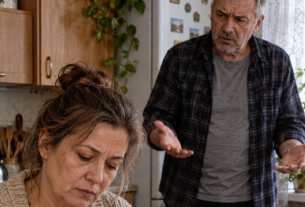
“Say those words again, and I’ll pack my things. No amount of money could ever replace having you healthy and here beside me.”
Eva emptied her piggy bank straight onto the floor and sat down right in the middle of the pile of coins, like a sparrow splashing in a puddle. She stacked the five-ruble coins into towers and lined the ten-ruble ones up into a neat little train. Veronika sat beside her on the rug with her legs tucked under her, handing her daughter the coins one at a time. The sewing machine in the corner had long since fallen silent, and the apartment was filled with that pleasant, cozy kind of quiet that only exists at home.
“Mom, there are a hundred million here,” Eva announced solemnly.
“A hundred million what, sunshine? Smiles?”
“Money! We’ll buy a house. And a swing. And new scissors for you, because you’re always complaining about the old ones.”
“Scissors are sacred,” Veronika agreed. “I’ll buy the scissors first. The house can wait.”
Gleb stood in the doorway, one hand resting against the frame. These days, he always stood like that, as though the floor beneath him might suddenly sway. He watched his daughter and smiled, and this time the smile was genuine, effortless. Veronika caught sight of it and tucked it away somewhere inside herself, the way you place something precious in a jewelry box. Over the past six months, there hadn’t been many smiles like that.
“Keep counting, you rich people,” he said. “Fifteen rubles and forty kopecks.”
“Forty-eight,” Veronika corrected him. “Don’t undervalue our capital. We’re people of considerable means.”
“I’m a realist.”
“You’re a bore, but that’s why I chose you.”
Eva poured the coins back into the piggy bank, making enough noise for a tiny orchestra, then went off to put her teddy bear to bed. Gleb lowered himself onto the sofa slowly, in two stages, supporting his lower back with one hand. Veronika pretended not to notice. He couldn’t stand it when she fussed over him, and arguing with him in the evenings was hopeless anyway.
She picked scraps of thread off the rug and folded up the half-finished costume—an order for a children’s theater production, eight thousand rubles, due the day after tomorrow.
“Are you going to be working much longer tonight?” he asked.
“Until one. Sewing buttonholes is practically meditation. Buddhists would be jealous.”
“Nika.”
“What do you mean, ‘Nika’? You’re about to tell me I’m working myself to death. I’ve heard that sentence nine times this week. I’m immune to it now.”
“Tonight will make ten.”
“Then I’ll turn the sewing machine up louder.”
The next morning at the grocery store, Eva clung to the refrigerator case and pointed at a yogurt with a little bear printed on the package. Veronika looked at the price, then mentally ran through her list: bread, milk, pasta, eggs. Two thousand rubles until payday, four days to go, and kindergarten still needed to be paid.
“Not this time, bunny. We’ll get it on Friday, I promise.”
“Why?”
“Because the little bear has the day off today,” Veronika said, scooping her daughter into her arms. “He’ll come back on Friday, and he’ll taste even better.”
Tamara Vitalyevna came over on Saturday carrying bags and wearing that particular expression that meant: rescue has arrived.
She placed bags of grain, chicken thighs, and a can of sweetened condensed milk on the table. Then she pulled out a sheet of paper folded in half and a bundle of money held together with a rubber band.
Twenty-five thousand rubles.
On the sheet was a list:
“Kindergarten — 4.”
“Groceries — 9.”
“Shoes for Eva — 6.”
“Put aside — 6.”
“Count it,” her mother ordered. “And read what each amount is for. I wrote everything down so you don’t spend it all somewhere else.”
“Why don’t you start a school diary for me too?” Veronika said. “You can give me grades for good behavior.”
“You’d be getting C’s. And for your information, I’m taking this money away from myself to give it to you.”
“Thank you. But I’m not five years old. There’s only one five-year-old in this house, and she’s asleep right now.”
Her mother sighed loudly enough for someone in the next apartment building to hear.
Gleb walked through the room, nodded in greeting, and went back into the bedroom. He closed the door quietly behind him, but Tamara Vitalyevna turned toward it anyway.
“He’s walking around,” she said. “Six months now, just walking around.”
“Don’t start.”
“What? Am I lying? Your father worked on a crane with his blood pressure at two hundred and never complained. Real men don’t sit around like this.”
“My father died at fifty-three,” Veronika replied evenly. “Is that your idea of a successful strategy?”
“Don’t you dare!”
“Don’t you dare come into my home and compare my husband to dead men. He isn’t sitting around. He’s recovering. The doctor said any physical strain could put him right back on the operating table. Do you want me to read his medical report aloud to you? I’m very good at dramatic reading.”
Her mother pursed her lips and adjusted one of the grocery bags. Then she changed her tone, making it as sweet as the condensed milk she had brought.
She took out her phone, scrolled through it, and dictated a number. Her voice became businesslike and confidential, as though she were handing Veronika a ticket to another life.
“Write this down. Eduard, Larisa Petrovna’s son. He needs costumes made at home for some kind of celebration. His daughter is performing in a play. He pays without even looking at the price.”
“All right. Costumes are my thing.”
“And one more thing. He owns three auto repair shops. There are jobs there where you can work sitting down. Answering phones, dealing with paperwork. Just right for yours.”
Veronika wrote the number on a scrap of paper. Something warm and dangerous stirred inside her chest—hope.
She walked her mother to the door, came back, looked at the scrap of paper, and slipped it into her pocket.
“Who was that?” Gleb called from the bedroom.
“Possibly a client. And possibly a job for you. A seated one.”
“Possibly is a good word.”
“A wonderful word. Every great achievement and half of all stupid ideas started with it…”
Continuation is just below in the first comment.