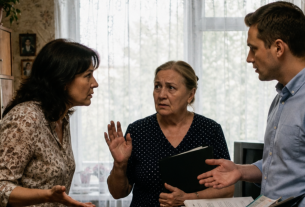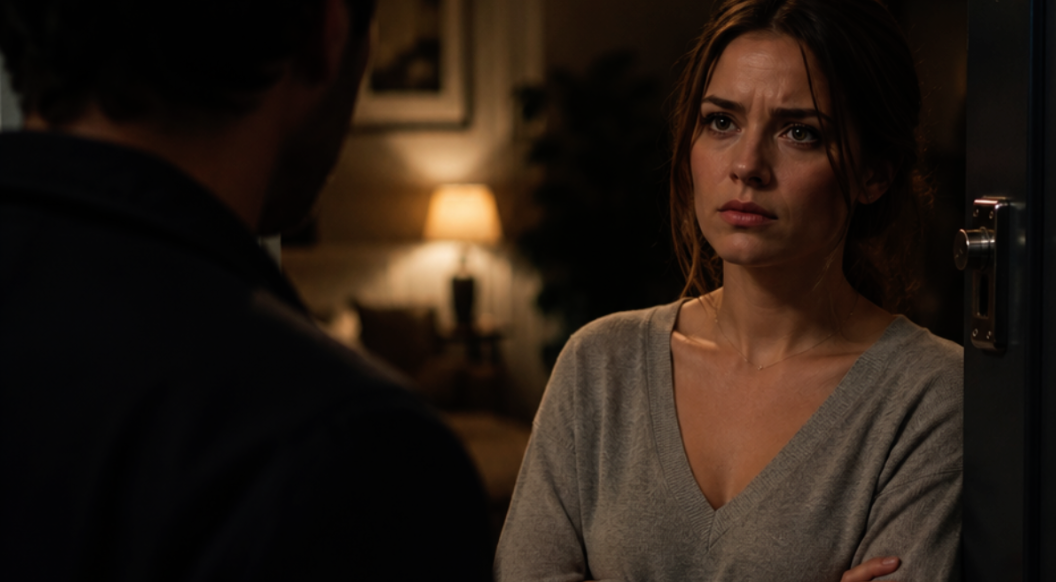
— You can call me whatever you want outside the door. But you will never set foot in this apartment again, — Elena said coldly to her ex-husband.
Andrey even opened his mouth for a second. Until then, he had been speaking nonstop for almost ten minutes, as if he had not come to a woman who was already a stranger to him, but to a guilty subordinate who needed to be put in her place. He stood on the landing in an unbuttoned jacket, his face red with anger, a phone in his hand and keys clutched between his fingers. He looked as though he still considered ringing this doorbell a mere formality.
Elena stood barefoot in the hallway, wearing home clothes, holding the door with one hand. Behind her, the corridor light was on; the apartment smelled of freshly washed floors and apples from the shopping bag she had not yet had time to unpack. A few minutes earlier, she had just bent down toward the bags when the doorbell rang. Sharp, long, impatient. Not once, not twice. The person behind the door pressed the button as if he had every right to demand an immediate answer.
Elena understood at once who had come.
After the divorce, Andrey appeared exactly like this: without calling, without warning, without asking whether it was convenient for her. He could text at night with a short “open up,” wait for her by the entrance in the morning, or come on a weekend and announce that he needed to “talk normally.” Each time, that “normal conversation” ended the same way: reproaches, memories, accusations, and an attempt to make Elena feel guilty for daring not to live by his rules anymore.
The apartment was hers. Not theirs together, not disputed, not “almost shared,” as Andrey liked to say. Elena had bought it long before the marriage, back when she worked as a production technologist and took every extra shift she could just to settle the housing issue faster. Andrey appeared later — handsome, confident, able to speak in such a way that the first months beside him felt like a holiday. He moved in with her a year after they met. At first he brought one bag, then a box of tools, then fishing gear, then his habits, demands, and favorite phrase about how “the man of the house should decide.”
Back then Elena still did not understand how quickly a person could turn someone else’s space into his own if he was allowed to do it little by little.
At first Andrey simply disliked it when she stayed late after work. Then he began getting annoyed if Elena bought something for the apartment without his approval. Then he started saying her friends “knew too much.” And after several years, she caught herself explaining every trip to her sister, every visit to the store, every new thing in the house. Not because she had to. Because that way, things were quieter.
The worst part began when Andrey became convinced that the apartment had at least become half his by the fact that he lived there. He said it lightly, as though joking, but his eyes remained serious.
— I’ve lived here for so many years. I’m not a stranger, am I?
— Living somewhere and owning it are two different things, — Elena replied.
— There you go again. With you, everything is about paperwork. What about being human?
For Andrey, “being human” somehow always meant doing what was convenient for him.
When they divorced, there was almost nothing to argue about. They had no children, and no large jointly acquired property either. At first Andrey tried to start a conversation about compensation for his “years of investment,” but it quickly turned out that those investments consisted of a couple of shelves he had bought, replacing a faucet, and a set of tools that he later took back himself. They finalized the divorce through the registry office because formally, both agreed. Back then Andrey spoke calmly, even pretended to be magnanimous. He promised he would leave with dignity and would not “make a circus.”
The circus began a month later.
At first he sent messages. Dry, short, with a claim to authority: “Where are my documents?” “You had no right to throw away my box.” “Open up, I’ll take my things.” Elena answered only to the point. He collected the documents. The box too. Then it turned out he needed an old extension cord. Then a winter jacket, though Elena clearly remembered him taking it away in the trunk himself. Then some flash drive she had never seen. Each new excuse was more ridiculous than the last, but behind each one was the same thing: Andrey was checking whether he could still enter.
Once, she opened the door. He walked in quickly, without even asking permission, went into the kitchen, looked around, and smirked.
— You’ve settled in nicely. Cleaned everything up right away without me?
Elena did not answer then. She stood at the kitchen entrance and watched as her ex-husband opened a cabinet with the air of an owner, as if looking for a cup.
— Andrey, take what you came for and leave.
— I’m in no hurry.
That day, he left only after Elena dialed her sister’s number and said loudly that her ex-husband was in her apartment and was refusing to leave. Andrey’s face changed immediately. He threw an old flash drive onto the small cabinet — one that had somehow been found in his own pocket — and hissed:
— You’ll regret turning me into an enemy.
She did not regret it. But she became more careful.
A week later, Elena called a locksmith and changed the lock. Without announcements, without theatrics, simply because she had the right. Andrey, of course, had once returned the old key. But trusting that would have been foolish. He was perfectly capable of making a copy in advance. When the locksmith finished the work, Elena stood in the hallway for a long time, looking at the new lock cylinder. There was nothing ceremonial about it. Just a small metal circle in the door. But that evening, for the first time in a long time, she went to bed calmly.
Andrey found out about the lock quickly. Apparently, one day he tried to open the door with his key and could not. After that, twenty-one missed messages appeared on her phone. Then calls. Then a voice message:
— Are you completely insane? Changing the locks! I lived there! My things were there!
Elena listened only to the first ten seconds and deleted it. Andrey’s things were no longer in the apartment. He had collected everything against a signed inventory, which he himself had irritably signed at their last meeting. Elena had insisted then: a list, a date, a signature. Andrey had laughed, called her petty, but signed it. Now that sheet lay in a folder together with the apartment documents, the divorce certificate, and copies of their correspondence.
She was not planning to fight. She simply no longer wanted to be a convenient target.
That evening, when Andrey appeared at the door again, Elena first decided not to open. She looked through the peephole and saw his face too close. He stood leaning toward the door, as if he could push through it with his gaze. There was no one else on the landing. The elevator had already gone down. The usual evening silence hung in the building: somewhere a door slammed, a television sounded from the floor above, water rushed through the pipes.
The doorbell rang again.
Then Andrey knocked with his fist.
— Lena, open up. I know you’re home.
Elena stepped away from the door, slowly exhaled, and looked at her phone. She could call the police immediately. But for some reason, she wanted to say everything herself one last time. Not justify herself, not argue, not prove anything. Just mark the boundary so clearly that even Andrey would understand: there was nowhere further to go.
She opened the door on the chain.
— What do you need?
Andrey smirked when he saw the chain.
— Seriously? So now I’m a criminal?
— What do you need? — Elena repeated.
— To talk.
— Write a message.
— I’m not going to discuss personal matters over the phone.
— We no longer have any personal matters.
His face twitched. Not much, but Elena noticed. Andrey had always handled simple phrases badly when they left no room for his maneuvers.
— You learned to become a stranger very quickly, — he said.
— We are divorced. That means we are no longer family.
He smiled crookedly.
— Look how smart you’ve become. You weren’t like this before. Before, at least you knew how to listen.
— I’m listening now too. I’m just not obligated to agree.
Andrey shoved his hand into his jacket pocket, took out a pack of cigarettes, then remembered smoking was not allowed in the building and clenched it in his palm. The skin on his fingers turned white.
— I need to take my things.
Elena looked at him calmly.
— You took all your things two months ago. I have a list with your signature.
— Not all of them.
— Which ones exactly?
He hesitated, but quickly found an answer:
— My cordless screwdriver.
— You took it with the toolbox.
— Then the bits are still there.
— No.
— You don’t even want to check?
— I don’t. Because I already checked three times after your messages.
Andrey abruptly stepped closer. The chain tightened, and the door shook. Elena did not step back. She only gripped the handle more firmly.
— Open properly, — he said in a lower voice.
— No.
— Elena, don’t push me.
— You’re standing outside my apartment and demanding to be let in for no reason. You are the one pushing yourself.
Across the hall, a lock clicked cautiously. The neighbor, Vera Sergeyevna, an observant woman who never missed any stairwell incident, opened her door a hand’s width. Andrey noticed the movement and immediately turned his head.
— What are you looking at? Free movie?
The door opposite closed slightly, but not all the way.
Elena realized the evening could become loud. Before, she would have felt embarrassed, started speaking more quietly, asked Andrey not to make a scene. Before, she would have felt awkward in front of the neighbors, uncomfortable under other people’s gazes, ashamed that her personal life was spilling out onto the stairwell landing. But now the shame had disappeared somewhere. She was not the one who had come to make a scandal at someone else’s door. She was not the one pressing the bell. She was not the one demanding entry into a place where she was no longer welcome.
— Andrey, leave.
He laughed shortly.
— Leave? Are you giving me orders now?
— Yes.
— So that’s how it is. Lived alone for a while and put on a crown?
Elena said nothing. He waited for a reaction. An offended breath, a sharp reply, an attempt to explain that she was not like that. When he got nothing, he began speaking faster.
— Do you think anyone will need you with that character? Do you think there’s a line of men waiting? You’re cold, empty. Impossible to live with. I tolerated you for a long time, by the way. Another man would have run away much earlier.
Elena looked at him and suddenly saw clearly not the man she had once married, but a person who had simply lost access to a familiar button. Before, he pressed it — she justified herself. Pressed harder — she cried or proved that she was trying. Pressed again — she gave in just to end the conversation. Now the button did not work.
And that infuriated him most of all.
— Are you finished? — she asked.
Andrey blinked.
— What?
— Are you finished?
— You…
He said a word that clearly seized Vera Sergeyevna’s curiosity behind the neighboring door: the crack widened. From above, someone came out onto the landing between floors. Out of the corner of her eye, Elena noticed slippers and the edge of a housecoat. People had begun peeking out.
Andrey saw it too, but he could no longer stop. He was carried away.
He called Elena ungrateful. Then hard-hearted. Then he remembered that she had “ruined his life.” He declared that after so many years, she had no right to throw him out as if he were some random tenant. He said she had deliberately turned their mutual acquaintances against him, although Elena had hardly discussed their breakup with anyone after the divorce. Then he moved on to her appearance, her age, her habits, her work, and the fact that she had “always counted everything.”
At that last part, Elena smiled almost imperceptibly.
Yes, she had counted. Money, strength, and time. Too late, but she had learned.
She remembered how, during the marriage, Andrey could calmly take her bank card “to go to the store,” then come back with purchases for his fishing and a bottle of expensive sauce that only he liked. How he suggested paying for repairs in the building entrance “fifty-fifty,” even though the apartment was hers and she had already made the payment herself. How once his sister, Svetlana, came to stay with them for a week and lived there for almost a month because Andrey did not want to offend her by refusing. Elena worked, cooked, cleaned, and in the evenings listened to complaints about how there was “some kind of heavy atmosphere” in the house.
Svetlana was even offended later when Elena asked her to name the exact date she would be leaving.
— You complicate everything too much, — Andrey said. — A person is in a difficult situation.
Svetlana’s difficult situation consisted of an argument with the friend she had originally planned to stay with.
Then her father-in-law, Viktor Pavlovich, came. He needed to have a medical examination in the city. Elena did not object to helping, but for some reason Andrey decided that helping meant full service: make the appointment, take him there, pick him up, feed him, listen to his complaints about lines, and then thank him for the trust. Andrey himself was busy on those days. As always, when care stopped being words and became actions.
And all of this happened in her apartment. In her home. In the place where she had once wanted to return with joy.
After the divorce, Elena gradually reclaimed her space. She threw away Andrey’s cracked mug, which for some reason he had forbidden anyone to touch. She took down from the upper storage space the boxes of his old magazines, which he had never collected, and sent them to him by courier. She cleared a shelf in the bathroom. She cleaned up the balcony. She washed the sticky marks from the kitchen cabinet doors, the ones that had irritated her every morning. She bought herself a new reading lamp and a small rug for the hallway. Not for renovation, not to demonstrate change. Simply because she could choose for herself.
Andrey, it seemed, could not bear that. It was not that Elena was suffering that irritated him. In fact, he did not see any suffering. What drove him mad was something else: she was living without him and not falling apart.
— Do you even understand how you look from the outside? — he continued. — A woman who kicked out her husband and now pretends to be untouchable. Ridiculous.
— I did not kick you out, — Elena said calmly. — You collected your things yourself and signed the divorce papers.
— Because you drove me to it!
— You went to the registry office on your own.
Someone above quietly snorted. Andrey raised his head.
— Is everyone having fun? — he barked. — Go away!
— Don’t give orders in the stairwell, — Vera Sergeyevna said dryly from behind her door. — The whole floor can already hear you.
— Nobody asked you.
— But you informed all of us anyway, — the neighbor replied, and she pulled the door closer, though the lock did not click again.
Elena looked at her ex-husband. Andrey’s face had turned blotchy. He hated looking ridiculous in front of witnesses. At home, without other people’s eyes, he could say whatever he wanted. But here, his words suddenly stopped being a “man-to-woman conversation” and became an ordinary scandal on the landing.
— Andrey, I am telling you for the last time: leave.
— And what if I don’t?
Elena lifted her phone so he could see the screen.
— I will call the police and say that my ex-husband is trying to force his way into my apartment, insulting me, and refusing to leave the building.
He narrowed his eyes.
— Trying to scare me?
— Warning you.
— You were always a coward. You can only act through other people.
Elena tapped the screen. She did not dial the number, but she opened the keypad. Andrey noticed the movement, and the first crack appeared in his confidence. He shifted his gaze from the phone to her face, as if searching for doubt there. He did not find it.
— You’ve become completely alien, — he said more quietly now, but with more anger.
— Yes.
The simple answer hit harder than a long speech. Andrey looked at her for several seconds, then suddenly changed his tone. This was familiar too: when pressure did not work, he tried to come in through pity.
— Lena, what are you doing? We lived together for so long. I’m not a stranger to you. I only wanted to talk. Normally. And you go straight to the chain, the police, the neighbors.
— Normally means asking in advance whether you can come.
— If I had written, you would not have answered.
— Then the answer would have been clear.
He noisily inhaled through his nose and turned the keys in his hand. On the keychain, Elena noticed the old charm shaped like a metal fish. She had given it to Andrey about seven years earlier, when he had come back from fishing angry over a broken reel. Back then, it had seemed sweet to her to support him with such a small thing. Now that charm looked ridiculous and foreign.
— I still have photographs there, — Andrey said suddenly.
— What photographs?
— Ours. On the old laptop.
— You took the laptop.
— Not that one. Another one.
— I don’t have another laptop.
— You do. You just don’t want to give it back.
Elena looked at him almost tiredly.
— Andrey, do you even realize you are making this up as you go?
— Don’t you dare talk to me like I’m an idiot!
— Then don’t behave like one.
He jerked toward the door. The chain tightened again. Elena sharply closed the door completely. A wooden surface and a new lock remained between them.
A palm immediately struck the door from outside.
— Open up!
Elena stood in the hallway and looked at the door. Her heart was beating fast, but her hands obeyed her. She switched on video recording on her phone and aimed the camera at the door.
— Andrey, I am recording. Leave.
— Record! I don’t care!
— Fine.
Behind the door came a laugh, then an indistinct curse. He pressed the bell once more. Then knocked. Then, apparently, leaned closer to the door, because his voice became muffled:
— You think you hid and won? I’ll get in anyway. If not today, then tomorrow.
Elena opened the door again, but this time not on the chain — only as far as the door limiter allowed. She needed him to see her face.
And that was when she said the very phrase:
— You can call me whatever you want outside the door. But you will never set foot in this apartment again.
Andrey fell silent abruptly.
Not because he understood. Not because he repented. Simply because for the first time, Elena did not argue with the content of his insults. She did not prove that she was not cold, not ungrateful, not a bad wife, not to blame for all his failures. She did not touch those words at all. She set a prohibition.
Final.
And because of that, Andrey seemed to lose his footing. His usual tactics required the other side’s participation. He needed an Elena who justified herself, got angry, cried, tried to soften the conversation. But standing before him was a woman who had already decided everything.
— You have no right… — he began, but his voice sounded less confident.
— I do. This is my apartment. You are not registered here, you do not live here, you have no keys, there is no shared property here. You have taken all your things. The documents are signed. If you appear again with threats, I will go to the police. If you wait for me by the entrance, I will do the same.
— Oh, so that’s how you talk now.
— Yes. Exactly like that.
He looked over her shoulder, as if hoping to see at least something of his there. An old jacket on a hook, a box, a tool, some trace of his former presence. But in the hallway there were only Elena’s things: her coat, her bag, her neatly folded scarf on the shelf. Even the smell in the apartment was different. Not street tobacco, not men’s cologne, not fried fish on Sundays, after which the apartment had to be aired out for a long time. The home no longer revealed Andrey in a single detail.
This, it seemed, hurt him more than the refusal.
— You cleaned everything up quickly, — he threw out.
— Two months is not quickly.
— So you were preparing.
— Yes, — Elena said. — For a peaceful life.
Footsteps sounded on the stairs again. From above came Pavel, a young father from the apartment above. He was holding a garbage bag and clearly did not intend to interfere, but stopped on the landing after assessing the situation.
— Is everything all right? — he asked Elena.
Andrey spun around sharply.
— Go where you were going.
Pavel did not leave. He looked at Elena.
— Do you need help?
Elena nodded briefly, without theatrics.
— Please stand here for a minute. My ex-husband does not want to leave.
Pavel came down to the landing and stood by the railing. Not too close, not threateningly, but clearly enough. Andrey looked him over and smirked.
— Already called defenders?
— No, — Elena replied. — You gathered the audience yourself.
Pavel took out his phone.
— Sir, it’s better if you leave. There are cameras at the entrance, if anything. And the neighbor across the hall heard everything.
Andrey turned to Elena. Anger mixed with confusion flashed in his eyes. He had clearly been counting on a different evening: to enter, apply pressure, force her to talk, perhaps go into the kitchen, take his usual place, restore the feeling of control. Instead, he found himself on the landing, under the neighbors’ eyes, in front of a closed door, in the role of a man being asked to leave.
— You’ll regret this, — he said quietly.
Elena tilted her head slightly, looked at him carefully, and answered:
— I already regretted things. I regretted letting you come back after every scandal. I regretted opening the door when I didn’t want to. I regretted thinking that obvious things could be explained to an adult. That is what I regretted. Not this evening.
Andrey clenched his jaw. Then he abruptly turned toward the elevator and pressed the button. The button did not light up: the elevator was occupied. He pressed it again, harder, as though even the elevator was obligated to obey. Pavel was still standing by the railing. Vera Sergeyevna’s door remained slightly open.
— Is the show over? — Andrey muttered.
— Yes, — Elena said. — Leave.
The elevator finally arrived. The doors opened. Andrey stepped in, but at the last moment stuck out his foot so the doors would not close.
— I’m asking one last time. Are we going to talk normally?
Elena shook her head.
— No.
— Then you chose this yourself.
— I chose silence in my own home.
He wanted to add something, but Pavel took a step closer to the elevator. Without words. That was enough. Andrey pulled his foot back. The doors closed, and a second later the cabin went down.
The landing became quiet.
Pavel was the first to break the silence.
— Are you sure you’re okay?
Elena turned to him. Only now did she notice that all this time she had been holding the door handle so tightly that a red mark had remained on her palm. She unclenched her fingers.
— Yes. Thank you.
— If he comes again, call. Or knock on the radiator; I’ll hear.
Vera Sergeyevna looked out from behind the opposite door.
— I heard it too. If necessary, I’ll confirm it. He behaved disgracefully.
Elena unexpectedly smiled. Not cheerfully, not broadly, but with genuine relief.
— Thank you.
— And close the door, — the neighbor said sternly. — There is no need to talk long with people like that.
— I’m closing it.
Elena entered the apartment and turned the lock. Then again. Then she put the chain on, although Andrey had already gone. For several seconds she stood in the hallway, listening. Downstairs, the building entrance door slammed. A car in the courtyard chirped its alarm briefly. Somewhere behind the wall, a child laughed. The ordinary sounds of home, which before had been lost behind the constant expectation of someone else’s intrusion.
She put the phone on the cabinet, stopped the recording, and saved the file in a separate folder. Then she opened her chat with Andrey and took screenshots of the latest messages. Not because she wanted things to continue. Because now she knew: peace also had to be protected carefully, with documentation, and without unnecessary trust.
After that, Elena took the folder out of the drawer. She checked the documents: the ownership certificate, the extract, the copy of the divorce application, the list of transferred belongings with Andrey’s signature. Everything was in place. She added a sheet on which she briefly wrote the date, time, and essence of that evening’s incident. Before, this would have seemed excessive to her. Now it seemed reasonable.
Then she returned to the grocery bags. She rolled the apples into a deep bowl. Put the grains in the cupboard. Placed the packet of coffee on the shelf. The cutlery left in the drying rack after dinner she neatly put into the drawer. Simple movements gradually returned the evening to its place. The scandal was not the main thing. The main thing was that after it, she did not rush around the apartment, did not write long messages, did not try to explain to Andrey why he was wrong.
She was no longer going to educate her ex-husband.
Half an hour later, the phone vibrated. A message from Andrey.
“You humiliated me in front of the neighbors.”
Elena looked at the screen and, for the first time, did not feel the urge to reply immediately. She opened the chat, read it, closed it. Then she blocked his number in the messenger, leaving only regular SMS in case of genuinely important information. Although there could hardly be any important information between them anymore.
The next message came exactly as an SMS:
“I’ll still take what’s mine.”
Elena typed briefly:
“All your things were handed over to you according to a signed list. You are not entering the apartment. If there are repeated threats, I will contact the police.”
She reread the text. Not one unnecessary word. She sent it.
There was no answer for about ten minutes. Then came:
“Bitch.”
Elena looked at that word and suddenly felt nothing except tired indifference. Before, something like that could have ruined her whole day. She would have replayed the conversation in her head, argued in her mind, proved to some invisible judge that she did not deserve it. Now the word looked like nothing more than a set of letters from a person who had not received what he wanted.
She took a screenshot and put the phone away.
That evening, Elena called her sister. Not to complain, but to warn her. Irina listened silently, only sharply inhaling into the phone a couple of times.
— He has completely lost his sense of fear, — she finally said.
— More like control, — Elena replied.
— Are you going to file a statement?
— If he comes again, yes. For now, I saved the recording and messages. The neighbors saw it.
— Good. And don’t open the door anymore.
— I won’t.
— Lena, I’m serious. He’s pressing on habit. He knows that before, you tried to smooth everything over.
Elena walked into the room, sat in the armchair by the window, and looked at the dark courtyard. Two teenagers were sitting on the bench by the entrance, a phone screen flashing beside them. A delivery car stopped near the trash bins. Life continued without dramatic music and loud signs. Just an evening in an ordinary building.
— He doesn’t know anymore, — Elena said. — He used to. Not now.
Irina was silent for a moment, then said softly:
— I’m proud of you.
Elena did not answer right away. Those words turned out to be unexpectedly important. She ran her palm over the armrest of the chair, gathering her voice.
— I’m a little proud of myself today too.
After the call, she did not go to bed for a long time. Not out of fear, but because of a strange alertness. As if space had been freed inside her, space that for many years had been occupied by other people’s claims. Elena walked through the apartment and, for the first time that evening, looked around carefully.
Here was the hallway where Andrey liked to leave his shoes right in the middle. Now it was clear. Here was the kitchen where he could spend hours proving that she was “making a problem out of nothing.” Now there were only apples and a closed book on the table. Here was the room where he had once said that without him she was “nobody.” Now her lamp was on in that room, her books stood on the shelf, and in the corner lay a blanket bought without anyone’s permission.
The apartment had not become bigger. It had not become more luxurious. But it was possible to breathe calmly in it again.
The next day, Andrey did not come. But his sister Svetlana called. Elena saw the name on the screen and spent several seconds deciding whether to answer or not. Then she decided to answer — not out of politeness, but to immediately close off a possible new line of pressure.
— Yes.
— Elena, this is Sveta. What happened between you two yesterday? Andrey came back beside himself. He says you humiliated him in front of the neighbors.
— Andrey came to me without invitation, insulted me, and refused to leave.
— Well, he was emotional. You know his character.
— I do. That’s why I’m no longer opening the door.
Svetlana sighed.
— Listen, you’re both adults. There must be some softer way. He did live with you for so many years, after all.
— Exactly why I was softer for far too long.
— He says he still has things there.
— He took all his things. There is a list with his signature.
The other end of the line went quiet. Documents and signatures always sobered Andrey’s relatives faster than any emotion.
— Maybe some small thing…
— If he remembers a specific item, let him send an SMS. If that item is really found at my place, I will send it by courier or leave it with the concierge in the neighboring building. He will not enter the apartment.
— How harsh you’ve become.
— Safe.
Svetlana exhaled irritably.
— You’ve changed.
Elena looked at her hands. Her nails were filed short, and there was a small scratch on her index finger from the cardboard box she had unpacked the day before. Ordinary hands of an ordinary woman who had finally stopped giving her peace to people who had no intention of protecting it.
— Yes, — she said. — And that is good news.
She ended the call first.
After that, Elena did one more important thing: she wrote a short statement to the district police officer through the official service, describing the situation and attaching screenshots of the threats. Not because she expected immediate action. It was important for her to put it on record: her ex-husband came, insulted her, threatened to “get in,” and did not react to being forbidden. She no longer hoped everything would “blow over on its own.” Too often women around her said exactly that: don’t get involved, don’t escalate, he’ll calm down. And then they were surprised when a person who got away with everything came again.
Elena did not want to test how far Andrey was willing to go.
That evening, the district officer himself called her. His voice was businesslike, a little tired. He clarified the details, asked whether the ex-husband was registered in the apartment, whether they had minor children together, whether any of his property was being stored at Elena’s place. She answered every question calmly: no, no, no. The officer said he would have a preventive conversation with him, and that if Andrey appeared again with threats, she should call the police immediately.
After the conversation, Elena felt not triumph, but clarity. This was what adult self-protection should look like: without hysterics, without revenge, without a desire to prove to her ex how strong she was. Just consistent actions.
Andrey appeared again three days later.
This time he did not ring the doorbell. He was sitting on the bench by the entrance when Elena was returning from work. She noticed him from afar and managed to stop near the archway. Andrey saw her too, stood up, and walked toward her. He was wearing the same jacket, but he no longer looked so confident. His face was drawn, shadows lay under his eyes. Perhaps he had slept badly. Perhaps he was angry. Perhaps, for the first time, he had encountered consequences.
— We need to talk, — he said, blocking her path to the entrance.
Elena did not come closer.
— Move aside.
— I’m calm.
— Move away from the entrance.
— Lena, enough. I went too far, I admit it. But you weren’t exactly innocent either. You immediately involved the neighbors, the district officer. Why?
— Because you threatened me.
— I didn’t threaten you. I said it in the heat of the moment.
— I don’t care what temperature you said it at.
He ran his palm over his face in irritation.
— Are you going to use every word against me now?
— Only the words you bring to my door.
Andrey looked around. There were people in the courtyard: a woman with a stroller, a man near a trunk, two schoolchildren by the entrance. Here it was inconvenient for him to raise his voice.
— I wanted to do this like a human being.
— Like a human being, you could have written and asked whether I was ready to talk. I am not ready.
— So that’s it? Just like that?
— Yes.
He smirked, but tiredly.
— It’s like you erased me.
— I divorced you.
— That’s not the same thing.
— For me, now it is.
He was silent. For the first time in a long while, Andrey did not look dangerous, but lost. But Elena already knew that pity for his lostness had cost her too much. Out of that pity, she had once tolerated harshness. Then control. Then his relatives in her apartment. Then humiliations disguised as “that’s just my character.” She no longer confused pity with the duty to let someone back in.
— I loved you, — Andrey said.
Elena looked at him carefully.
— Maybe. But too often you treated me as if love gave you the right not to respect me.
He looked away.
— I really don’t have the bits for the cordless screwdriver, — he suddenly said almost casually.
Elena almost laughed, but held back. There it was, the real reason. Not love, not conversation, not remorse. Drill bits.
— Buy new ones.
— You’ve become principled.
— Practical.
He looked at her again, but without the former pressure.
— I didn’t think you could be like this.
— I didn’t think so before either.
Vera Sergeyevna walked past with a bag from the pharmacy. She slowed down, gave Andrey a stern look, and said loudly:
— Elena, is everything all right?
Andrey twisted his face.
— Guard duty again.
— Everything is all right, — Elena replied. — Andrey is already leaving.
She said it so calmly and confidently that arguing would have been foolish. Andrey stood there for a couple more seconds, then stepped aside.
— Fine. Live.
— I will.
— Without me.
— Exactly.
He wanted to answer with a barb; it was visible on his face. But Vera Sergeyevna was standing nearby, children were playing by the entrance, and Elena held herself as though any phrase of his would simply become another point in the folder that had already been started. Andrey turned around and walked toward the parking lot.
Elena waited until he had moved away and only then entered the building. Vera Sergeyevna came in after her.
— You handled him correctly, — the neighbor said. — People like that first say they want to “talk,” and then they start giving orders right in the hallway.
— He will not enter again, — Elena replied.
— Good. A home should be a home, not a passageway for exes.
For some reason, that phrase stayed with Elena the entire evening.
A home should be a home.
Not a place where you listen for footsteps behind the door. Not a territory where people can burst in with complaints. Not a continuation of a marriage that has already ended. Home is when the keys belong to those you trust. When the door opens by your choice. When silence does not feel like a pause before a scandal.
A week later, Andrey sent his final message:
“I won’t come again. I found the bits.”
Elena read it and smirked. So that was the whole grand reason for the siege. A little box of metal pieces, found somewhere in a car trunk or on a friend’s shelf. And so much noise, threats, and humiliation had been raised around a nonexistent excuse.
She did not answer.
Spring slowly entered the city. The days grew longer, light lingered in the courtyard in the evenings, and neighbors appeared on the benches again. Elena began to get used to her new life not as forced loneliness, but as a normal state. She bought groceries only for herself. Planned weekends without looking back. Invited Irina over when she wanted to, and canceled meetings when she was tired. On Saturdays she went to the market for vegetables, choosing greens, apples, cottage cheese, fresh bread. At home she cooked simple dinners and ate them at a clean table, without listening to remarks that “it used to taste better.”
One day, she caught herself thinking a strange thought: the apartment sounded different. Not literally. It was simply that someone else’s dissatisfaction no longer hummed in the background. Cabinet doors were no longer slammed irritably. The television no longer came on at full volume. From the room, she no longer heard: “Lena, where are you?” in that tone that made her absence from a distance of two meters sound like a violation of order.
Now the apartment held her steps, her music, her silence.
And still, the main moment returned to her not in the evening, not at night, not in conversations with her sister. It returned every time Elena approached the front door. Her hand touched the new lock, and Andrey’s face on the landing surfaced in her memory: confused, angry, unprepared for the fact that he was no longer being let in.
She did not rejoice in his humiliation. She did not need him to suffer. She needed him to understand one simple thing: divorce is not a pause, not an educational measure, not an invitation to come and check boundaries. Divorce is the end of access.
One day Irina asked:
— Have you forgiven him?
Elena thought about it. The question was not simple. Forgiveness was often presented as a beautiful full stop after which everything became easy. It was not like that for her. She did not wake up one day renewed, did not forget the harsh words, did not turn the past into a wise parable. It was simply that the memories stopped controlling her actions.
— I don’t know, — she said honestly. — But I have definitely stopped waiting for him to understand.
— And is that better than forgiveness?
— For me, it’s more useful.
Irina laughed.
— That’s my sister. Sorted everything onto the shelves.
— At least it works.
They sat in the kitchen, eating baked vegetables and salad, discussing plans for the summer. Irina suggested going for a couple of days to a nearby city, walking along the embankment, and spending the night in a small hotel. Elena agreed almost immediately. Before, she would have thought about how Andrey would react, whether he would call the trip stupid, whether he would start calculating why she needed to spend money. Now there was only one question: did she herself want to?
She did.
Later, while seeing her sister out, Elena lingered in the hallway. Irina had already stepped onto the landing and waved.
— Lock up.
— In a second.
Elena smiled and closed the door. The lock clicked. The sound was short, ordinary, but for some reason it carried finality.
She placed her palm against the door. Not from weakness. Simply to feel the smooth surface of the wood — firm, reliable, hers. Behind that door remained the stairwell, other people’s footsteps, former claims, voices that no longer had the right to command her life. On this side were her apartment, her order, her air.
And exactly then, Elena finally felt it: her home belonged only to her again.