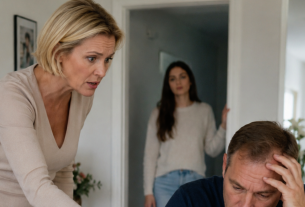
“I don’t want a divorce. It’s too much hassle. But I’m not going to keep living with you either,” the husband told his wife.
At first, Inna did not even answer.
She was sitting across from Vadim at the kitchen table, looking not at him, but at his hand. Her husband was lazily spinning his phone between his fingers, as if he had just announced not the end of their marriage, but that he would not be able to stop by the store tomorrow.
“Repeat that,” she said quietly.
Vadim raised his eyes. Not a single muscle moved in his face. Over the past few months, Inna had already grown used to that expression: distant, bored, almost irritated. As if she were not the wife he had lived with for fourteen years, but someone in a queue who had been asking the same question for too long.
“What is there to repeat?” He leaned back in his chair. “I said it like it is. Divorce means courts, papers, explanations to relatives. I don’t need any of that. But I don’t want to pretend we’re a family anymore either.”
Inna slowly removed her hands from the table and folded them in her lap. Her fingers had become disobedient. She squeezed the fabric of her house pants several times to keep herself from screaming.
“So what exactly are you suggesting?”
“That we live normally,” Vadim shrugged. “Each of us living our own life. I’ll come by when I need to. My things will stay here. My documents too. We won’t tell our parents anything for now.”
Inna looked at him more carefully.
“Come by when you need to?”
“Yes.”
“To my apartment?”
Vadim grimaced, as if she had deliberately chosen an unpleasant word.
“Here we go again. Inna, we’ve been married for so many years. Stop throwing this apartment in my face.”
“It’s mine, Vadim. It was mine before the marriage, and it remained mine.”
“I’m not arguing.”
“You are. Every time you speak as if you have the right to come here on your own schedule.”
He put the phone down and rubbed the bridge of his nose.
“God, you’re so difficult. I’m not trying to take anything from you.”
“Then what are you trying to do?”
Vadim did not answer right away. He looked away toward the window, behind which the courtyard was growing dark. Downstairs, the entrance door slammed, someone laughed loudly, and then the sound dissolved into the night.
“I need time,” he finally said. “To live separately. To figure things out.”
Inna smirked, but the smile came out short and dry.
“You’ve already figured everything out. You just want me to pretend I don’t understand.”
For the last few months, their marriage had been held together not by feelings, but by habit. By the same routes through the apartment, by shared utility bills, by questions like, “Did you buy bread?” and “Did you lock the door?” Vadim had begun staying late more and more often, coming home with the scent of someone else’s perfume on him, though every time he explained it away as a meeting, a client appointment, or saying he had given a female colleague a ride in his car.
Inna did not make scenes. Not because she did not notice. She noticed too much.
How Vadim had started taking his phone even into the bathroom. How he had stopped leaving his jacket in the hallway and immediately hung it in the closet, as if afraid some extra scrap of paper might fall out of his pocket. How on weekends he found errands that had never existed before. How once, absentmindedly, he called her not Inna, but Inessa, and then spent a long time proving that he had simply misspoken.
Inna had said nothing then. She had only placed a plate of dinner in front of him and sat across from him. Vadim ate quickly, without looking at her, and for the first time in many years she understood: the person at home with her had already mentally packed his suitcase long ago.
But still she waited for a conversation. An honest one. An adult one. Without humiliation and cheap tricks.
That evening, she started it herself.
“Vadim, are you going to make some kind of decision?” she asked when they were left in the kitchen after a heavy argument.
The quarrel had flared up over nothing. He had come home later than usual, without warning her, thrown his keys onto the cabinet, walked past her to the refrigerator, and irritably asked why there was “again silence in the house like in an archive.” Inna replied that silence appears where two people stop talking. Vadim sharply slammed the refrigerator door. Then came the usual words: she was nitpicking, she complicated everything, it was her own fault that it was impossible to live peacefully with her.
And then silence came.
Vadim sat with his phone, moving his thumb across the screen and pretending not to hear the question. Inna looked at him and waited. One minute. A second. A third.
“Are you going to answer at all?” she asked.
“To what?”
“To a direct question.”
“I’m tired.”
“So am I.”
He exhaled heavily, put his phone face down, and said that very phrase:
“I don’t want a divorce. It’s too much hassle. But I’m not going to keep living with you either.”
After those words, the silence became different. Not the kind that happens between tired people. The kind after which the air in the house seems to change.
Inna slowly rose from the table. The chair slid softly across the floor. She went to the sink, rinsed her hands even though they were clean, dried each finger separately with a towel, and only then turned back to her husband.
“Where are you planning to live?”
Vadim brightened almost imperceptibly. Apparently, that was exactly the question he had been waiting for.
“For now, at Seryoga’s place. He has a two-room apartment sitting empty. He moved out to the region.”
Inna nodded.
“I see.”
“But I’ll leave some of my things here.”
“No.”
He blinked.
“What do you mean, no?”
“I mean exactly that. If you’re leaving to live separately, you take your things with you.”
“Inna, don’t start.”
“I’m not starting. I’m finishing.”
Vadim gave a crooked smile.
“Nicely put. Just like in a TV series.”
Inna went to the cabinet, took out a notebook and a pen, and placed them in front of her. Vadim watched her with lazy confusion.
“What are you doing?”
“A list.”
“What list?”
“Your things. So tomorrow you won’t forget anything.”
Vadim’s jaw tightened.
“I’m not taking anything tomorrow.”
“You are.”
“Inna, you’re acting on emotion right now.”
She raised her eyes to him. Her voice was even, without trembling.
“No. I was acting on emotion for the last six months, when I was trying to understand why my husband was coming home like a stranger. Right now, I’m very calm.”
“So what, are you going to throw me out?”
“Out of my apartment, yes, if you’ve decided there is no family anymore.”
Vadim shoved his chair back sharply.
“Have you lost your mind? I’m registered here.”
“Temporarily registered. Until the end of the month. You insisted on it yourself when you were changing documents for work. Your permanent registration is at your father’s house.”
He fell silent.
That was something he had not expected. Inna saw it in the way he quickly looked away and reached for his phone.
“Don’t write to anyone,” she said. “Tomorrow you’ll take your things. The day after tomorrow I’ll file for divorce in court, since you don’t want to go to the registry office with me.”
“Are you crazy? What court? We don’t have minor children, there’s nothing to divide.”
“Then come with me to the registry office.”
“I said I don’t want the hassle!”
“Then there will be court. That’s your choice now.”
Vadim stood up. His face reddened in uneven patches.
“You think you’re so smart?”
“No. I think I was convenient for too long.”
He left the kitchen, slamming the door so hard that a glass jar of grains rattled on the shelf. Inna was left alone. She did not cry. She only stood by the table and looked at the notebook, where she had managed to write the first word: “clothes.”
A few minutes later, she added: “documents, tools, box with fishing gear, winter jacket, books, suitcase.”
At first, her handwriting was sharp and angular, then it became steadier.
That night, Vadim lay down on the sofa in the living room. Inna locked herself in the bedroom. Not to hide, but to prevent him from continuing the conversation in his usual manner: first irritation, then mockery, then the phrase after which she used to begin doubting herself.
She barely slept. But she did not toss and turn, did not jump up, did not check his phone. She simply lay with her eyes open and counted not the minutes until morning, but the steps she needed to take.
In the morning, Vadim came into the kitchen in a wrinkled T-shirt, as if nothing special had happened.
“Is there coffee?” he asked.
“In the cabinet.”
He froze.
Usually, Inna would turn on the coffee machine herself, take out a mug, ask whether he wanted breakfast. Today she was already sitting at the table, dressed, with a neat folder in front of her.
“Where are you going?”
“To a lawyer.”
“Already?” He laughed briefly. “That was fast.”
“Yes.”
“Inna, seriously, don’t embarrass yourself. Cool down for at least a couple of days.”
She lifted her eyes from the folder.
“I’m not obligated to wait until it becomes convenient for you.”
Vadim poured coffee for himself. He took a mug from the upper cabinet and set the spoon down beside it with irritation, too sharply, but Inna did not even turn her head.
“You do realize I can refuse to move out?” he said.
“You can try.”
“Is that a threat?”
“That is a warning that I will no longer agree to your rules.”
He sat opposite her, took a sip of coffee, and grimaced.
“No sugar.”
“The sugar is where it always is.”
Vadim looked at her as if she had violated some unspoken agreement. For many years, Inna had known where his shirt was, what pills he took for headaches, when his favorite toothpaste ran out, what documents he needed before a trip. She had not even noticed how she had become for him not a wife, but a domestic service with a human face.
Now that service was closed.
After the consultation with the lawyer, Inna returned home calmer. They had explained simple things to her: if her husband did not want to go to the registry office together, she could file a claim for dissolution of marriage through court. The apartment belonged to her; she had inherited it from her aunt before the marriage, and Vadim had no right to a share. His temporary registration would soon expire, and she was not obligated to extend it. If he refused to remove his belongings, it was better to notify him in writing and document the condition of the property.
Inna left the law office with the feeling that a floor had appeared beneath her feet again. Not happiness. Not relief. Simply a solid surface instead of sticky uncertainty.
Vadim was not home.
On the cabinet in the hallway lay a note written in a hurry:
“Left on business. Don’t touch my things for now.”
Inna read it twice. Then she took out her phone and photographed the note. Not for drama. Simply because from now on she had decided to document every important little thing.
By evening, she had packed his things into large bags and boxes. She did not throw anything away, did not damage anything, did not take revenge. She folded his shirts neatly. She placed the documents in a separate folder. The tools went into a plastic box. On every box, she stuck a piece of paper: “clothes,” “shoes,” “personal documents,” “miscellaneous.”
When Vadim returned around ten, he found the hallway lined with his belongings.
“What are you doing?” he asked, stopping on the threshold.
Inna came out of the room.
“I’m helping you not drag this out.”
“I told you not to touch anything!”
“You said you weren’t going to keep living with me.”
“But I didn’t say you could rummage through my things!”
“I didn’t rummage. I packed them. Take them.”
Vadim stepped into the hallway and kicked one of the boxes with the toe of his boot.
“And where am I supposed to take all this right now?”
“To the place where you’re planning to live.”
“There’s no room at Seryoga’s.”
“There was yesterday.”
He stopped short. Quickly, almost imperceptibly, but Inna caught it.
“So not Seryoga’s?” she asked.
“It doesn’t matter.”
“It already doesn’t matter to me. To you, apparently, it matters that I not ask questions.”
Vadim threw his jacket onto a box.
“You ruined everything with your personality.”
Inna laughed softly.
“Of course. Your leaving the family was also arranged by my personality?”
“You think you’re easy to live with? Always controlling everything. Always so correct.”
“And you need someone incorrect?”
He did not answer.
At that moment, his phone rang. The screen lit up on the box. Inna had not intended to look, but the name was large, across the entire screen: “Kira Salon.”
Vadim quickly grabbed the phone and rejected the call.
Inna remembered not the name. She remembered his movement. Sharp, guilty, almost boyish.
“So that’s why divorce is too much hassle,” she said.
“Don’t start.”
“Does she know you’re not planning to get divorced?”
“Inna.”
“Does she know?”
“That’s none of your business.”
“As long as I’m your wife, it is my business. But not for long.”
Vadim clenched the phone in his hand.
“You’ll regret this.”
For the first time that evening, Inna stepped close to him. She did not raise her voice, did not wave her hands. She simply stood opposite him, forcing him to look her in the face.
“I already regret it. I regret not listening to myself sooner.”
The next day, Vadim removed only part of his things. He deliberately spent a long time walking through the rooms, opening closets, looking on shelves, pretending to search for something very important. Inna did not follow him around. She sat in the kitchen with her notebook and marked down what he had taken.
“Have you seen my watch?” he shouted from the bedroom.
“In the top drawer of the dresser.”
“And the gray belt?”
“In the box with shoes.”
“And the car documents?”
“In the folder you refused to take yesterday.”
He appeared in the kitchen with an unpleasant smirk.
“You prepared well.”
“Yes.”
“You were just waiting for a reason to throw me out.”
Inna put down the pen.
“No, Vadim. I was waiting for the day you would sit across from me and honestly say, ‘I fell in love with someone else, let’s separate like decent people.’ But you chose to leave me as a backup landing strip.”
His face hardened.
“Don’t flatter yourself.”
“I’m not. I’m simply calling things by their names.”
He took two more bags and left.
He did not leave the keys.
Inna noticed immediately. Before, she might have postponed the conversation, decided she would ask him later. Now she called him five minutes later.
“Return the keys.”
“I’ll come by again.”
“When you come, you’ll ring the doorbell.”
“Inna, don’t make me laugh.”
“The keys, Vadim.”
“This was my home too.”
“It was. Until you yourself said you weren’t going to live with me.”
He ended the call.
Inna looked at the phone, then opened her address book and found the number of a locksmith. No declarations, no complicated actions. An ordinary service. The locksmith came the next afternoon, replaced the lock cylinder, checked the keys, and handed her a set. Inna paid for the work and put the old keys into a bag together with the receipt.
That evening, Vadim tried to open the door.
First once. Then a second time. Then the key scraped in the lock more insistently.
Inna approached the door but did not open it.
“Inna!” came from outside. “Are you completely insane?”
She looked through the peephole. Vadim was standing there with a bag in his hand, angry, red from the stuffy stairwell. Nearby on the landing, the neighbor, Zoya Pavlovna, had stopped with a garbage bag, but upon seeing the scene, slowed down.
“The key doesn’t fit,” Vadim said more quietly, having noticed the neighbor.
“Because the lock has been changed,” Inna answered through the door.
“Open up.”
“Why did you come?”
“I have things here.”
“Call in advance. I’ll hand them over.”
“You have no right!”
Inna opened the door on the chain. Her face was calm, her hair was tied back, and she had a phone in her hand.
“Vadim, I’m going to start recording now. Please repeat what you need.”
He stepped back half a pace.
“Don’t put on a circus.”
“I’m not. I’m documenting the conversation because you refused to return the keys and tried to open the door after moving out.”
Zoya Pavlovna was no longer pretending that she was merely passing by.
“Is everything all right?” she asked Inna.
“Yes, thank you. My almost-ex-husband is picking up his things.”
“I’m not your ex yet!” Vadim snapped.
Inna looked at him through the gap.
“That’s why I said almost.”
He squeezed the bag so hard that the handles stretched.
“You’ll regret this when you have to carry everything yourself. The faucets, the appliances, the shelves — everything depended on me.”
“You promised to hang the shelf in the bathroom three years ago. It’s still lying in the pantry.”
Zoya Pavlovna coughed, hiding a smile.
Vadim glanced at the neighbor.
“Don’t you have anything better to do?”
“I do,” she replied calmly. “But everyone can hear shouting in the stairwell.”
Inna closed the door, removed the chain, then opened it fully again, but remained standing on the threshold.
“What are you taking?”
“My jacket and documents.”
“Wait here.”
“I’ll come in myself.”
“No.”
He took a step forward, but Inna did not move back. She did not look frightened. She only straightened her shoulders, as if some part inside her, bent for years by other people’s convenience, had finally stood upright.
“Don’t force your way into my apartment, Vadim.”
“Why do you keep repeating that?”
“Because it matters. My apartment. My lock. My rules.”
He ground his teeth, but remained outside the threshold.
Inna brought him the jacket and folder. He grabbed the things, turned around, and went toward the stairs.
“Go ahead and sue as much as you want!” he threw over his shoulder.
“I already started,” she replied.
And closed the door.
The next day, she filed the claim. Without loud announcements, without theatrical gestures. She simply gathered the documents: marriage certificate, passport details, apartment ownership extract, confirmation of Vadim’s temporary registration, receipt for payment of the state fee. The clerk at the court office accepted the papers, checked them, and stamped them.
Inna walked out into the street and, for the first time in a long while, bought herself coffee not because she needed to wake up, but because she wanted to take a walk.
Then the calls began.
First, her mother-in-law, Tamara Yegorovna.
“Inna, what is going on with you two? Vadim came to us with bags, walking around black as a cloud!”
“He decided to live separately.”
“What do you mean, he decided? Are you a wife or what? A man must be held onto, not thrown out.”
Inna stopped at the crosswalk.
“Tamara Yegorovna, I didn’t throw him out. He said himself that he wasn’t going to live with me.”
“He said it in anger!”
“He said it very calmly.”
“And why divorce? People make peace.”
“It takes two people to reconcile.”
Dissatisfied snorting sounded on the other end of the line.
“You were always proud.”
“No. I was patient for a long time. You simply confused the two.”
Her mother-in-law fell silent, then spoke in a different tone.
“And the apartment is still family property. He lived there for so many years.”
“The apartment came to me as an inheritance from my aunt before the marriage. It is not subject to division.”
“Oh, here we go with the legal talk.”
“Yes. Because the domestic part is already over.”
Inna ended the conversation first.
Then Vadim’s younger brother, Pavel, called.
“Inna, hi. Listen, maybe there’s no need to be so harsh? He’s sleeping on a folding bed at our parents’ place.”
“Pavel, he’s an adult.”
“Yes, but you were together for so many years…”
“Exactly. That’s why he could have acted honestly.”
Pavel was silent for a moment.
“Does he have someone?”
Inna looked at the pedestrians by the crosswalk, at a woman with a dog, at a man with a bouquet, at a teenager with a backpack. The world around her continued moving, and for some reason that helped her speak calmly.
“Ask him.”
“I see,” Pavel sighed. “I’m sorry. I didn’t know.”
“No one knew. Even I pretended for a long time that I didn’t know.”
A week later, Vadim appeared again. This time, not alone.
With him was a woman of about thirty-five, in a light-colored coat, with perfectly styled hair and the face of a person who had decided in advance to behave confidently. Inna saw them through the peephole and did not open the door right away. First, she turned on the recording on her phone.
“What do you need?”
Vadim stood slightly ahead.
“We need to talk.”
“Talk.”
The woman stepped closer.
“Hello. I’m Kira.”
“I guessed.”
Kira lifted her chin slightly.
“I think we all need to behave in a civilized way.”
Inna looked at her without anger. Even with curiosity.
“You came to someone else’s door together with a married man to teach me civility?”
Kira blinked. Vadim exhaled with irritation.
“Inna, don’t attack.”
“I’m standing in my own home. You are the ones who came.”
Kira clasped her fingers in front of her.
“Vadim said you haven’t been living as a family for a long time.”
“Vadim says a lot of things.”
“He doesn’t want conflict.”
“That’s why he came with you?”
Vadim interrupted:
“We need to take the rest of the things.”
“Fine. I’ll bring them out.”
“There’s a lot.”
“Then you’ll wait.”
“What kind of childish nonsense is this?”
Inna calmly closed the door.
She brought the boxes out one by one. Vadim tried to enter, but each time he ran into her direct gaze and the camera of her phone. At first, Kira stood proudly, then began noticeably to grow nervous. On the third box, she quietly asked:
“Vadim, why didn’t you take everything at once?”
“Because I wasn’t allowed to,” he muttered.
Inna put the box on the floor.
“That’s not true. I packed his things on the very first day. He only took what he wanted.”
Kira turned to him.
“You said she wasn’t giving them back.”
Vadim flared up.
“You believe her?”
“I’m listening.”
For the first time, Inna looked carefully at Kira. Not as a rival, not as a homewrecker, but as a woman whom Vadim, it seemed, had also been feeding convenient versions of the truth.
“Kira,” Inna said calmly, “he didn’t want a divorce not because of feelings. It was convenient for him to keep everything unclear. So with you he could be almost free, with me almost a husband, and with his parents almost the victim.”
Kira turned pale. Not dramatically, not theatrically. The confidence simply drained from her face.
“That’s not true,” Vadim said sharply.
Inna brought out the last folder.
“Here are the receipts for your things, warranty papers, and copies of the documents you left behind. Check them.”
He grabbed the folder.
“You’re deliberately ruining everything.”
“No. For the first time, I’m making everything clear.”
Kira suddenly asked:
“Did you really file in court?”
“Yes.”
“But he said you agreed to wait.”
Inna smiled with only her eyes.
“Now you understand how he makes agreements.”
Vadim turned to Kira.
“Let’s go.”
She did not move right away. She looked from him to Inna, as if fitting together details in her head that had not matched before.
They left in silence.
After that, Vadim did not call for several days. Instead, he sent a long message. It had everything: accusations, self-pity, reproaches, memories of good years, hints that Inna was ruining not only his life but her own too. At the end, he wrote: “Maybe it’s not too late to stop all this.”
Inna read the message in the morning, sitting in the kitchen. On the table lay the court documents, next to them a cup of coffee and a to-do list. She did not answer right away. She finished reading, locked the screen, and put the phone away.
She replied only in the evening:
“It could have been stopped at the moment when you decided not to lie. You chose otherwise. I am going to court.”
The court hearing was ordinary.
Vadim came in a dark jacket, with a tired face and the look of a person who had been unfairly dragged into an unpleasant procedure. He tried to say the decision was hasty, that his wife was acting under the influence of resentment, that he “did not rule out reconciliation.” Inna listened and looked at his hands. The same hands that had spun the phone that evening in the kitchen.
When the judge asked for her position, Inna stood up.
“I insist on dissolution of the marriage. Our life together has ended. Reconciliation is impossible.”
Vadim turned his head.
“Inna…”
She did not look at him.
“Everything that needed to be said, you said at home.”
They were given a period for reconciliation. Vadim left the courthouse almost pleased.
“See? Even the court understands you’re rushing.”
Inna buttoned her coat.
“The court is following procedure.”
“During this time, you’ll change your mind.”
She looked at him calmly.
“No.”
“You don’t know that.”
“I do.”
He wanted to say something in reply, but at that moment his phone rang. He glanced at the screen and rejected the call. Inna noticed Kira’s name and barely shook her head.
“Promising different things to everyone again?”
Vadim put the phone away.
“That no longer concerns you.”
“Exactly.”
She left first.
During the month they were given for reconciliation, Inna did what she had long been postponing. She sorted out documents. Closed shared household issues. Re-registered service contracts in her own name where Vadim had once been listed as the second contact. She called a handyman and finally had the shelf in the bathroom hung. Not symbolically, not out of spite, but because she was tired of waiting for a person who had promised for years to do it “on the weekend.”
Pavel stopped by one evening to pick up his brother’s remaining fishing gear. Alone. Without lectures.
“May I?” he asked at the door.
“Come in,” Inna said. “The box is in the hallway.”
Pavel picked up the box but did not leave immediately.
“Inna, I wanted to apologize. Mom was pressuring you.”
“She was defending her son.”
“She doesn’t know everything.”
“She already knows enough.”
Pavel nodded.
“Kira left him.”
Inna was not surprised. She only raised her eyebrows slightly.
“Fast.”
“She found out he had been telling her one thing, us another, and you a third. It also turned out that he wanted to live at her place temporarily too, but without a divorce. He said he needed to ‘softly exit his old life.’”
Inna laughed quietly.
“Softly. How convenient.”
“He’s angry at everyone now.”
“That’s his business.”
Pavel looked at her carefully.
“Are you holding up?”
Inna ran her palm along the edge of the cabinet, wiping away an invisible speck of dust.
“I’m not holding up. I’m living.”
Pavel said nothing. He only wished her luck and left.
At the second hearing, Vadim looked different. Without his former self-confidence. He had lost weight, looked drawn, and spoke more quietly.
“I agree to the divorce,” he said when the judge clarified his position.
For the first time in a long while, Inna heard something honest and brief from him.
After the hearing, they walked outside together. For a few seconds, they stood by the steps like strangers after a chance meeting.
“Well, that’s it,” Vadim said.
“Yes.”
“You really never regretted it?”
Inna looked at him. Before her stood the man she had once loved. The man with whom she had chosen dishes for their first kitchen, gone to the sea, laughed at stupid movies, welcomed guests, made plans. But beside those memories stood another Vadim — the one who had wanted to leave her suspended, without respect, without clarity, without the right to her own decision.
“I regretted it,” she said. “But not the divorce.”
He understood. His face twitched, but he said nothing.
“Inna, maybe someday…”
“No.”
She said it without anger. She simply closed the door where he was still looking for a crack.
A few weeks later, the decision came into force. Inna received the documents and put them in a folder. She did not throw a party, did not invite friends, did not post meaningful phrases on social media. She simply came home, took off her shoes, walked through the apartment, and stopped in the kitchen.
The same kitchen where Vadim had once said he did not want a divorce, but he was not going to live with her either.
Now it was quiet here. But it was no longer the old silence, stuffed with things unsaid and waiting for someone else’s step. This was her silence. Free, even, honest.
Inna opened the window. Cool air entered the room. On the table lay the notebook, the same one in which, on the first night, she had started a list with one word: “clothes.” She turned the pages and saw how much had been written after that: documents, court, lock, things, receipts, dates.
At the end, one empty line remained.
Inna took the pen and wrote:
“Stop waiting for someone else to decide for me.”
She closed the notebook and put it in the drawer.
That evening, Tamara Yegorovna called. Inna looked at the screen for a while, then answered.
“Yes?”
Her mother-in-law spoke unusually quietly.
“Inna, I won’t take long. I wanted to say… Vadim is to blame himself. I understand that now.”
Inna was silent.
“He lived with us, and I saw how he knows how to shift everything onto others. I used to think you were exaggerating. Now I see.”
“Thank you for saying that.”
“Don’t hold a grudge.”
Inna looked at the window, in which the bright kitchen was reflected.
“I don’t. I simply no longer need to take part in it.”
Her mother-in-law sighed.
“Take care of yourself.”
“You too.”
Inna ended the call and placed the phone face down.
Once, she had feared such conversations. She had feared seeming cruel, ungrateful, wrong. Now she understood: sometimes people call an ordinary boundary cruelty because before, they had been allowed to go too far.
Later, Vadim tried to appear several more times. Sometimes he asked her to find an old flash drive, sometimes he remembered a book, sometimes he wrote that they “needed to talk normally, without courts and other people’s advice.” Each time, Inna answered briefly and only to the point. She had not seen the flash drive. She passed the book through Pavel. There was nothing to talk about.
One day, he finally wrote:
“What I said in the kitchen back then was stupid.”
Inna looked at that phrase for a long time. Not because she was wavering. It was simply strange to see a person trying to call stupidity something that had become the point of no return for her.
She replied:
“No, Vadim. You told the truth. You just didn’t expect me to hear it.”
And that was the end of it.
Inna did not become a different person in one day. She still sometimes forgot to buy bread. She could still get tired after work. She still, out of habit, turned her head toward the door when she heard footsteps in the stairwell. But now there was no longer a person in her life who came and went, leaving her in the role of convenient waiting.
The most surprising thing was not that she had coped with the divorce, the court, the locks, and other people’s conversations. It was how quickly the apartment became her home again.
Not a place where she had to guess her husband’s mood by the sound of his keys.
Not rooms where she walked carefully so as not to provoke another burst of irritation.
Not a kitchen where betrayal could be spoken casually, almost lazily.
But a home where every thing lay where she had decided it should. Where no one threw someone else’s exhaustion onto the table and called her character the reason for his own indifference. Where the door opened only to those she herself wanted to let in.
And if before Inna had thought that the most important thing in a family was to preserve at least something until the very end, now she understood something else: sometimes preserving yourself is more important than holding onto a marriage in which one person has already left, while the other is still setting the table for two.
Vadim did not want to divorce her and did not want to live with her.
He wanted to leave her in between.
But Inna did not choose in between.
She chose a full stop.
And she put it there herself.