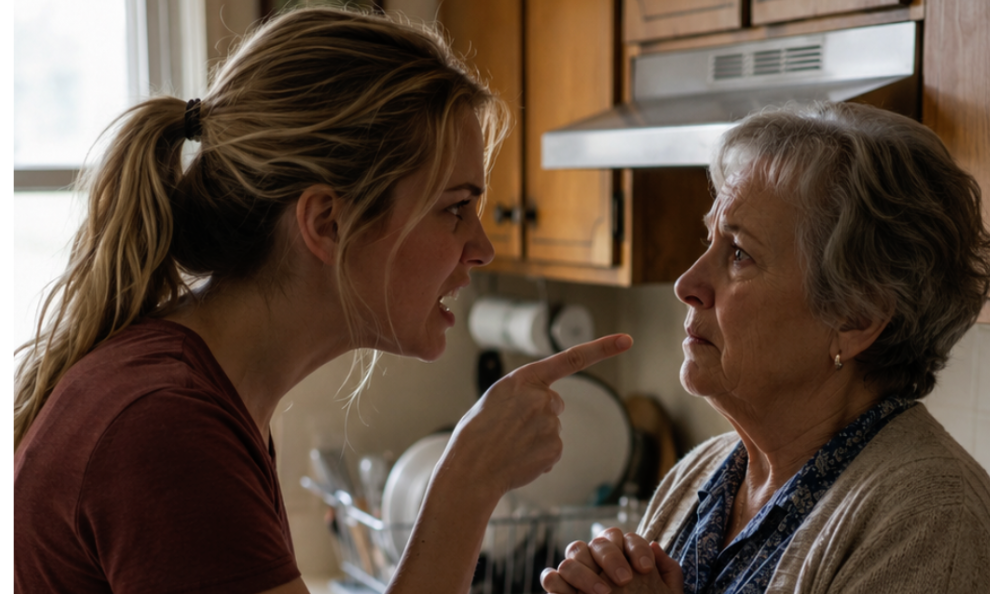
“Valentina Petrovna, I asked you not to give Kirill candy before dinner. He won’t eat anything afterward.”
Zhenya set the frying pan on the stove and turned around. Her mother-in-law was sitting at the kitchen table, calmly unwrapping another Korovka candy and holding it out to her grandson.
“One little candy won’t change anything, Zhenechka. Don’t invent problems. Igor ate sweets whenever he wanted as a child, and nothing happened. He grew up into a healthy man.”
Kiryusha, four years old, his cheeks smeared with chocolate, was already stuffing the candy into his mouth. Zhenya sighed and wiped her hands on the towel with an embroidered rooster that had been hanging on the oven handle since last year. She had no strength to argue. Her shift at the clinic had been hard: from eight in the morning until four in the afternoon — appointments, medical cards, patients’ complaints, a broken printer at reception. Then kindergarten to pick up Kiryusha, the store, the bus, then another bus.
“All right,” Zhenya said quietly. “Kiryush, go wash your hands. We’re about to have dinner.”
The boy ran into the hallway, his slippers slapping against the linoleum. Valentina Petrovna watched him go, then turned to her daughter-in-law.
“Are you frying cutlets?”
“Yes.”
“What oil are you using?”
“Sunflower oil, Valentina Petrovna. As always.”
“That’s a mistake. Olive oil is healthier. I always cooked for Igor with olive oil.”
Zhenya said nothing. She flipped a cutlet. The oil hissed and splattered onto her wrist. She jerked her hand back but did not even wince. She was used to it.
Valentina Petrovna had come over for the third time in the past two weeks. Officially, she was there to help, to sit with her grandson while Zhenya was at work. In reality, every time Zhenya came home, she found that the things in the closet had been rearranged, the spices in the kitchen had been moved, and Kiryusha had been fed so many sweets that he turned away from his porridge.
The first time, Zhenya stayed silent. The second time, she gently asked her not to move things around. Valentina Petrovna got offended, called Igor, and said that her daughter-in-law was “kicking her out of the house.” That evening Igor came home gloomy and muttered, “Mom is upset. Couldn’t you be a little softer?” Zhenya swallowed that too.
Today was the third time.
“Zhenya, where do you keep the floor rags?” Valentina Petrovna had already stood up and opened the cabinet under the sink. “I’ll wipe the floor while I’m here. You apparently don’t have time.”
“I washed it this morning.”
“Well, you washed it in the morning, but now it’s already evening. The child crawls and plays on the floor. It should be washed at least twice a day.”
Zhenya pressed her lips together. She placed the cutlets onto a plate lined with paper towels. Her hands trembled slightly — not even from anger, but from exhaustion.
“Valentina Petrovna, don’t. I’ll wash it myself after dinner.”
“Oh, there you go again — myself, myself. I’m trying to help. Or am I not even allowed to help anymore?”
The front door slammed in the hallway. Igor. Zhenya heard him kick off his shoes and hang his jacket on the hook that had barely been holding in the wall for three months — he still had not gotten around to fixing it.
“Oh, Mom, hi!” Igor’s voice from the hallway was immediately different. Warm, boyish. “You came?”
“Of course, son. Who else will help you if not me?”
Igor entered the kitchen, kissed his mother on the cheek, then nodded to Zhenya.
“Hi. What’s for dinner?”
“Cutlets. I’ll finish the mashed potatoes now.”
“Great.”
He sat at the table and took out his phone. Kiryusha ran in from the bathroom with wet hands and climbed onto his father’s lap.
“Dad! Grandma gave me candy!”
“Good job, Grandma,” Igor said, ruffling his son’s hair.
Zhenya turned back to the stove. Silently. She mashed the potatoes, added milk and butter, and served the plates. Then she placed them on the table.
“Thanks,” Igor said without taking his eyes off his phone.
Valentina Petrovna tasted the mashed potatoes and chewed thoughtfully.
“Zhen, do you even add salt? It’s a bit bland.”
“I do. Just a little. Too much salt is bad for Kiryusha.”
“Well, you can make a separate portion for the child. Adults need a normal amount of salt. Igor, it’s bland for you too, isn’t it?”
Igor raised his head.
“It’s fine, Mom.”
“See? Even he says ‘fine,’ which means it isn’t very good. He just doesn’t want to hurt your feelings.”
Igor grimaced.
“Mom, I said it’s fine. I mean, everything is good.”
Valentina Petrovna waved her hand.
“All right, all right. I’m not criticizing. I’m just saying how it would be better.”
Dinner passed in silence. Kiryusha picked at his cutlet with a fork, Zhenya ate quietly, Igor scrolled through something on his phone. Valentina Petrovna told them about a neighbor in her building who “also can’t stand her daughter-in-law, but at least that one knows how to cook proper borscht.”
Zhenya stood up, collected the plates, and turned on the water. There was no hot water — cut off again according to schedule. The cold water burned her hands in its own way, with a dull icy sting.
“Mom, are you staying the night?” Igor asked.
“Well, what else can I do? The last bus to Shchyolkovo leaves at nine. I won’t make it now. Besides, I’m tired.”
“Of course, stay. Zhenya will make the bed for you in the living room.”
Zhenya turned off the tap.
“Igor, the laundry is drying in the living room. I can’t hang it on the balcony because it’s raining.”
“Then move it somewhere else.”
“Where? Into our ten-square-meter bedroom?”
“Zhen, just figure it out, please. Mom is tired.”
Valentina Petrovna raised her hand in a peacemaker’s gesture.
“If I’m in the way, I can sleep in the kitchen. I’m used to it. I raised my son alone and slept on a folding cot for fifteen years while I gave him the room.”
There it was. Zhenya knew that tactic. Every time the conversation reached a dead end, Valentina Petrovna pulled out the story about the folding cot — how she had raised Igor alone after divorcing his father, how she had worked two jobs and night shifts. And there was no way to argue against it, because all of it was true. She really had carried everything alone. She really had sacrificed. She really did love her son.
But that did not give her the right to rearrange other people’s things in someone else’s home.
“I’ll make the bed in the living room,” Zhenya said. “I’ll move the laundry.”
She dragged the drying rack into the bedroom, where there was already barely room to turn around — the bed, the wardrobe, Kiryusha’s little bed, which they still had not removed because he sometimes woke up at night and came to his parents. She unfolded the sofa in the living room and took clean bedding from the dresser. The sheets smelled of detergent — Zhenya had washed them the day before yesterday.
Valentina Petrovna came into the living room and examined the bed.
“Zhenechka, do you have another blanket? This one is scratchy.”
“This is the only spare one. I can give you a throw.”
“Give me the throw. And a lower pillow, if you have one. My neck hurts.”
Zhenya brought the throw and another pillow. Valentina Petrovna sat on the sofa and pressed her hand against the mattress.
“It’s sagging. You should buy a new one.”
“We know, Valentina Petrovna. We can’t right now.”
“Well, if Igor had gone to work at Sberbank when I advised him to, instead of that company of yours, maybe you could.”
Igor worked as a manager at a construction firm. The salary was decent but unstable — sometimes delayed, sometimes cut. Zhenya worked part-time as a paramedic; she could not do more because of Kiryusha and the kindergarten schedule. Together they managed the mortgage on their one-room apartment in a panel five-story building on the outskirts. They were not living luxuriously, but they were not starving either.
“Good night,” Zhenya said and closed the door.
In the bedroom, Igor was already lying down, buried in his phone. Zhenya lay beside him and stared at the ceiling. The smell of leftover fried food drifted from the kitchen. Behind the wall, the clock ticked — the clock Valentina Petrovna had given them as a housewarming gift: loud, with a pendulum, and completely wrong for the apartment.
“Igor.”
“Hm?”
“Could you at least tell her about the candy?”
“Zhen, don’t start. One candy isn’t a catastrophe.”
“I’m not talking about one candy. I’m talking about the fact that she does things her own way every time. I ask, and she doesn’t listen. And you stay silent.”
“She’s my mother, Zhen. She helps us. For free, by the way. We can’t afford a nanny.”
“I know we can’t afford one. But help means helping the way you’re asked. Not coming over and redoing everything.”
Igor put down his phone and turned toward her.
“What do you want me to say to her? ‘Mom, don’t come over’? She’ll be offended.”
“No. I want you to say, ‘Mom, Zhenya is the mistress of this house. Respect her rules.’”
“She already respects them.”
“She just told me my cutlets were bland and my floor was dirty.”
“She doesn’t mean it badly. That’s how she shows care.”
Zhenya turned onto her side, her back to her husband. She closed her eyes. There was no point in arguing further — they had been going in circles like this for half a year, ever since Valentina Petrovna retired and suddenly had “free time.”
In the morning, Zhenya got up at six. Quietly, so she would not wake Kiryusha. She went into the kitchen — and Valentina Petrovna was already there. The kettle had boiled, and a plate of sliced bread stood on the table.
“Good morning, Zhenechka. I started making breakfast. I’ll cook semolina porridge for Kiryusha. You’re in a hurry for work, aren’t you?”
“Thank you, Valentina Petrovna. But he doesn’t eat semolina. I usually make oatmeal.”
“He doesn’t eat semolina? Nonsense. All children eat semolina.”
“Ours doesn’t. The lumps make him throw up.”
“Then you have to cook it without lumps. I’ll show you how to do it properly.”
Zhenya poured herself some coffee. Instant, cheap — the one with the yellow lid, for one hundred twenty rubles. She took a sip. Bitter, like everything lately.
“I’ll leave the oatmeal on the table. Pour boiling water over it when Kiryusha wakes up.”
“I’ll manage. I’m not a child,” Valentina Petrovna said, stirring the semolina on the stove. “Go on, or you’ll be late.”
At work, Zhenya told Natasha everything. Natasha was a nurse from the next office. They drank tea together during a break between appointments in the tiny utility room, where it smelled of antiseptic and dry biscuits.
“And Igor does nothing at all?” Natasha dipped a biscuit into her tea.
“Nothing. He says she’s helping and I shouldn’t argue.”
“Classic. It was the same with my first husband. His mother would come over and explain how to cook borscht to me. I’d been cooking it for fifteen years, and she was explaining it to me.”
“What did you do?”
“I divorced him,” Natasha snorted. “But not because of the mother-in-law. There were other things. Listen, have you tried talking to her? Not to Igor — to her directly? Like a normal human being?”
“I tried. She immediately says, ‘I’m the mother, I know better.’ And then she starts about the folding cot.”
“What folding cot?”
“How she slept on a folding cot for fifteen years for Igor’s sake.”
“Ah,” Natasha said knowingly. “The trump card. Every mother-in-law has one. Mine always said, ‘I raised my son in poverty, and you can’t even cook him proper borscht.’”
“So what should I do?”
“Set boundaries. Clearly and calmly. Don’t be rude, don’t make a scandal — just say, this is my home, these are my rules. If you’re a guest, respect the hostess.”
“She doesn’t consider herself a guest. She thinks it’s her son’s home.”
Natasha put down her tea.
“That’s exactly the problem, Zhen. As long as you allow it, she’ll keep thinking that.”
Zhenya came home at five. She opened the door and immediately knew something was wrong. The apartment smelled of bleach. Strongly, like a swimming pool.
“Valentina Petrovna?”
“I’m in the bathroom!” her mother-in-law’s voice came from behind the closed door. “Cleaning the tiles. You haven’t looked after them in ages. They’re covered in residue.”
Zhenya went into the bathroom. Valentina Petrovna, wearing rubber gloves — her own, brought from home — was scrubbing the tiles with a brush. The floor was wet, and the smell of bleach hit Zhenya’s nose so sharply that her eyes watered.
“Valentina Petrovna, Kiryusha is allergic to bleach. I told you that. I clean with a special product, without chlorine.”
“What allergy? We all grew up with bleach and we’re alive.”
“He’ll get a rash. Where is he?”
“In the living room watching cartoons. I put on Smeshariki for him.”
Zhenya rushed into the living room. Kiryusha was sitting on the sofa, wrapped in a throw, watching TV. He seemed fine. She touched his forehead and checked his hands — clear for now.
“Kiryush, did you go into the bathroom?”
“No. Grandma told me not to.”
At least that much.
Zhenya returned to the kitchen. And then she saw it. The refrigerator had been sorted through. Food had been moved around. Everything Zhenya had frozen for the week — chicken breasts, ground meat, broth in containers — was sitting on the table, thawed.
“Valentina Petrovna,” Zhenya’s voice trembled. “Why is the meat on the table?”
Her mother-in-law came out of the bathroom and pulled off the gloves.
“I defrosted the refrigerator. It hums like a tractor. There was ice on the walls as thick as a finger. It could break like that.”
“I prepared all this for the week on purpose. I don’t have time to cook every day. I work.”
“Well, that’s not good. Frozen food isn’t food. A child needs fresh meals. I always cooked fresh food for Igor. Every day.”
“You weren’t working at that time, Valentina Petrovna.”
“That’s not true. I was working. I simply managed.”
Zhenya stood in the middle of the kitchen and looked at the thawed ground meat, at the containers of broth she had boiled on Sunday until eleven at night while Kiryusha slept and Igor watched football. She stood there and felt something inside her stretch tight, like a string.
But it did not snap. Not yet.
“All right,” she said. “I’ll cook this now so it doesn’t go to waste.”
“That’s right. Fresh is always better.”
Zhenya cooked until eight. The ground meat became cutlets, the chicken breasts went into the oven, the broth became soup. Kiryusha wandered around nearby, asking for food and whining. Valentina Petrovna sat in the living room watching television — tired after cleaning.
Igor came home at half past eight. Cheerful, smelling of beer — he had stopped somewhere with colleagues after work.
“Oh, you cooked so much! Good job, Zhen.”
“That’s because your mother thawed everything I had prepared for the week.”
Igor looked at her, then toward the living room, where his mother was watching some talk show.
“Well, she meant well. The refrigerator really was humming.”
“Igor, I spent five hours on Sunday. Five hours.”
“So what? Now everything is fresh. Mom, come have dinner!”
Valentina Petrovna came into the kitchen, sat down, and looked over the table.
“Oh, beautiful. See, Zhenechka, you can do it when you want to. This is completely different — fresh and hot. Not all those containers and frozen things. Like a cafeteria.”
Zhenya silently served the food onto plates. Kiryusha climbed into his chair and tapped his spoon on the table.
“Mom, Grandma said you cook wrong.”
Silence.
Valentina Petrovna looked away.
“I didn’t say that. I said it could be better.”
Zhenya placed the plate in front of her son. Her hands were not trembling. Her voice was even — more even than she herself had expected.
“Kiryush, Mama cooks well. Eat.”
Dinner passed in silence. Afterward, Valentina Petrovna washed her own plate — demonstratively, thoroughly, wiping it dry with a towel — and went into the living room.
“Igor,” Zhenya caught her husband in the hallway. “We need to talk.”
“Zhen, I’m tired. Let’s do it tomorrow.”
“You’re tired every day. And I’m not? I work too. I cook, wash, clean. And then your mother comes and redoes everything after me, as if I can’t handle anything.”
“She helps.”
“She does not help! She controls! She thawed my prepared food, cleaned the bathroom with bleach even though our child is allergic, sorted through the refrigerator, moved my things around. That’s not help, Igor. That’s occupation.”
“Now you’re exaggerating,” Igor grimaced. “Occupation. She’s a normal mother. She cares.”
“About whom? About you? Or about me too? Because her care makes me want to climb the walls.”
“You’re overreacting.”
“Mom! Dad!” Kiryusha’s voice came from the bedroom. “Why are you shouting?”
Zhenya closed her eyes and exhaled.
“We’re not shouting, sweetheart. Lie down. Everything’s fine.”
“It’s not fine! You’re talking loudly!”
Igor went to put his son to bed. Zhenya stayed in the hallway. From the living room came the sound of the television — Valentina Petrovna had turned up the volume so she would not hear their conversation. Or to show that she did not care.
The next day Zhenya called her mother. Her mother lived far away in Saratov. They spoke once a week; more often than that never worked out.
“Mom, I don’t know what to do.”
“Zhenka, have you talked to her? Directly, without hints?”
“She doesn’t hear me. She thinks she knows better.”
“Well, maybe she does think that. But the apartment is yours. You’re the hostess. Speak like the hostess.”
“Igor doesn’t support me.”
“Then deal with your man separately. Tell him: either we’re a family and you’re on my side, or I don’t understand why we’re together.”
“Mom, that’s an ultimatum.”
“And what do you want — to endure forever? You’re not a doormat, daughter. You’re a person. You work, you raise a child, you carry the household. You have the right to respect in your own kitchen.”
Zhenya hung up and sat for a long time in the utility room, pressing the phone to her chest. Natasha looked in, saw her face, and silently placed a cup of tea in front of her.
“Mother-in-law?”
“Mother-in-law.”
“Hold on, Zhen. You’re stronger than you think.”
On Friday, everything collapsed.
Zhenya came home earlier than usual. At work they had let her go because the doctor she worked with had a sick child, and the appointments had been canceled. She opened the door quietly. The apartment smelled of fresh paint.
Paint.
Zhenya walked into the living room and froze. The wall above the sofa — the one she and Igor had painted warm gray themselves in the fall — was now beige. Fresh paint, a roller on newspaper, a can of Tex paint on the floor. Valentina Petrovna stood by the wall in Igor’s old shirt, splattered with beige.
“Valentina Petrovna,” Zhenya said slowly, as if every word took effort. “You repainted the wall.”
“Oh, Zhenechka, you’re early! I wanted to surprise you. That gray was so gloomy. Like a hospital. Beige is cozier, warmer. Isn’t it?”
“Igor and I chose that color together. We liked the gray.”
“Well, you thought you liked it. But objectively, gray is oppressive. I read it in a magazine.”
“You. Repainted. The wall. In my apartment.”
“In my son’s apartment,” Valentina Petrovna said calmly, even softly. As if stating an obvious fact. As obvious as two plus two.
And that was when it snapped.
Zhenya felt it physically — as if something thin and stretched inside her had finally broken. Not with a crash, not with a scream. It simply clicked and let go. And everything became quiet. Very quiet.
“I cook, do the laundry, clean the house, and you’re still telling me what to do?” Zhenya said. She did not shout. Her voice was steady, low. For the first time, she used the informal “you” with her mother-in-law. “I work, I pay half of this mortgage, I cook the food, wash the floors, do the laundry, take the child to kindergarten, to the clinic, schedule his vaccinations, stand in lines at government offices, fix everything that breaks because Igor ‘has no time.’ I am the mistress of this home.”
Valentina Petrovna lowered the roller. Her eyes widened — she had clearly not expected this. In three years, Zhenya had never raised her voice, never truly objected.
“Zhenya, what are you saying? I did it for you…”
“No. Not for us. For yourself. You come here, move my things, criticize my food, wash the bathroom with bleach even though your grandson is allergic to it, thaw my prepared meals, and paint the walls in my apartment. That isn’t help. You simply can’t accept that your son has grown up and lives with another woman.”
“I…” Valentina Petrovna grabbed the back of a chair. “How can you? I gave my whole life for Igor. Fifteen years on a folding cot!”
“I know about the folding cot, Valentina Petrovna. You’ve told us. Many times. And I respect you for it, truly. But that does not give you the right to interfere in my family and redo everything your own way.”
“Mom?” Kiryusha stood in the doorway to the living room, wearing dinosaur pajamas and rubbing his eyes. “Why is Grandma crying?”
Valentina Petrovna really was crying. Quietly, soundlessly, tears rolling down her cheeks and leaving streaks on her face, which was spattered with beige paint. She sat down on a chair and covered her face with her hands.
“Kiryush, go to your room, please. Mama will come in a moment.”
“But Grandma…”
“Kiryush. Go.”
The boy left. Zhenya stood in the middle of the living room with the repainted wall, looking at her crying mother-in-law, and felt both relief and heaviness at once. Like after a long illness — the fever is gone, but weakness remains.
She poured some water and placed the glass in front of Valentina Petrovna.
“Drink.”
“You hate me,” her mother-in-law said dully.
“No. I don’t hate you. I’m tired. I’m just very tired, Valentina Petrovna.”
“I wanted to help. I truly did. Things here are… well, not perfect, and I thought I’d advise you, help you, make it easier. I have more experience. I’ve been through all of this.”
“I know you have more experience. But this is my experience. My mistakes. My home. Do you understand?”
Valentina Petrovna did not answer. She drank the water in small sips. The clock on the wall ticked.
Igor called at seven — he was delayed, a corporate event. Zhenya did not tell him anything over the phone.
The evening passed strangely quietly. Valentina Petrovna sat in the living room without turning on the television. Zhenya fed Kiryusha, bathed him, and put him to bed. Then she returned to the kitchen and sat at the table. Her mother-in-law followed her in.
“Zhenya.”
“Yes.”
“Am I really not allowed to come over?”
“You are allowed to come over. You’re his grandmother. Kiryusha loves you. But when you come over, you are a guest. Not at home. A guest. And here, my rules apply.”
“What rules?”
“Do not give Kiryusha sweets before meals. Do not clean anything with bleach. Do not touch my things. Do not redo what I have already done. If you want to help, ask what you can help with. I’ll tell you.”
“That’s…” Valentina Petrovna paused. “A lot of rules.”
“Those are normal rules, Valentina Petrovna. Any hostess would tell you the same.”
“Lera’s mother — you know, Andrey’s wife’s mother — doesn’t let her mother-in-law cross the threshold at all. At least I come over.”
“I’m not Lera. And I do let you come over. But with respect — for you and for me.”
Silence. The refrigerator began to hum — loudly indeed. Maybe Valentina Petrovna had been right about it. But now that did not matter.
“All right,” her mother-in-law finally said. “I’ll… try.”
“Thank you.”
Igor came home at eleven. Quiet, sober — perhaps he had sensed something. Or perhaps his mother had called him on the way.
“Zhen, Mom told me… that you were rude to her.”
“I wasn’t rude. I told the truth.”
“She cried.”
“I know. It was hard for me to watch. But I couldn’t stay silent anymore, Igor. She repainted the wall.”
“What wall?”
“Go into the living room.”
Igor went in. Then came back out.
“That’s… beige?”
“Yes.”
“But we painted it gray.”
“Exactly.”
He sat down on the stool in the hallway and rubbed his face with his hands.
“Okay. That’s… yes, that’s too much.”
“Igor, this is not just ‘too much.’ It crossed the line a long time ago. And every time, you say ‘she’s helping.’ She isn’t helping me. She’s helping herself feel needed. And I understand her, honestly. She’s lonely, she’s retired, she has nothing to occupy herself with. But I am not obligated to pay for that with my home.”
“What do you want?”
“I want you to be on my side. Not against your mother. On my side. Because I am your wife. We are a family. And if you can’t choose, then I don’t know why we are together.”
Igor was silent for a long time. From the living room, no sound came — either Valentina Petrovna had fallen asleep, or she was lying there quietly and listening.
“I’ll talk to her,” he finally said.
“I already talked to her. Now it’s your turn. Not ‘sort it out yourselves’ — you, personally, need to tell her that this is our home and my rules apply here.”
“Your rules?”
“Our rules. But I run the household, I cook, I do the laundry and cleaning. That means the kitchen is my territory. And the bathroom. And the refrigerator. And the walls.”
He nodded.
In the morning, Zhenya heard Igor talking to his mother in the kitchen. Quietly, without shouting. She was not eavesdropping — she was getting Kiryusha ready for kindergarten. She only heard fragments: “Mom, please understand…” “That doesn’t mean we don’t love you…” “Just ask first, all right?”
Valentina Petrovna left at ten in the morning. At the door, wearing her gray coat and holding a bag with her house slippers, rubber gloves, and an issue of Domashny Ochag magazine, she looked at Zhenya.
“Does the wall need to be painted back?” she asked. There was no offense in her voice, no poison. Just a question.
“Yes,” Zhenya said. “Gray. Igor and I will do it on the weekend.”
Valentina Petrovna nodded. Then she bent down to Kiryusha and kissed the top of his head.
“Bye, little bunny. Grandma will come… when Mama allows it.”
“Grandma, come on Saturday!” Kiryusha hugged her leg. “We’ll draw!”
“We’ll see,” Valentina Petrovna said with a smile. A crooked, sad smile — but a smile. And she left.
Zhenya closed the door and leaned back against it. The apartment still smelled of beige paint — sweetish, cloying, foreign. By the weekend, it would air out. And they would repaint the wall.
Kiryusha tugged at her hand.
“Mom, why is Grandma sad?”
“Because adults sometimes say important things to each other, and that can be sad, Kiryush. But afterward, things can get better.”
“Really?”
Zhenya crouched down and looked her son in the eyes.
“Not definitely. But I hope so.”
She got Kiryusha ready, took him to kindergarten, then got on the bus to the clinic. Outside the window, the familiar five-story buildings drifted past, the Pyaterochka on the corner, the bus stop with the torn schedule. An ordinary city, an ordinary day, an ordinary life.
But something had shifted. Something small, almost invisible — like a clock hand that had finally moved from its place. Zhenya did not know whether Valentina Petrovna would come on Saturday. She did not know whether Igor would keep his promise. She did not know whether things would become easier.
But she knew one thing: she would no longer stay silent. Not because she wanted war. But because silence was also an answer. Just the wrong one.
At work, Natasha met her in the corridor.
“Well? Alive?”
“Alive.”
“And the mother-in-law?”
“She left. I told her everything.”
“And how did it go?”
“She cried. But she heard me. I think.”
Natasha silently hugged her. Briefly, tightly — the way people hug when they have been through the same thing.
“Well done, Zhenka. You should have done it long ago.”
“I know,” Zhenya said, tucking her hair behind her ear, and went into the office. A stack of medical cards lay on the desk, and patients were already sitting in the corridor. The workday was beginning. An ordinary day. Like any other.
Only a little lighter.