“Mom, just for an hour. Well, an hour and a half at most. I need to go somewhere, and I can’t take the kids.”
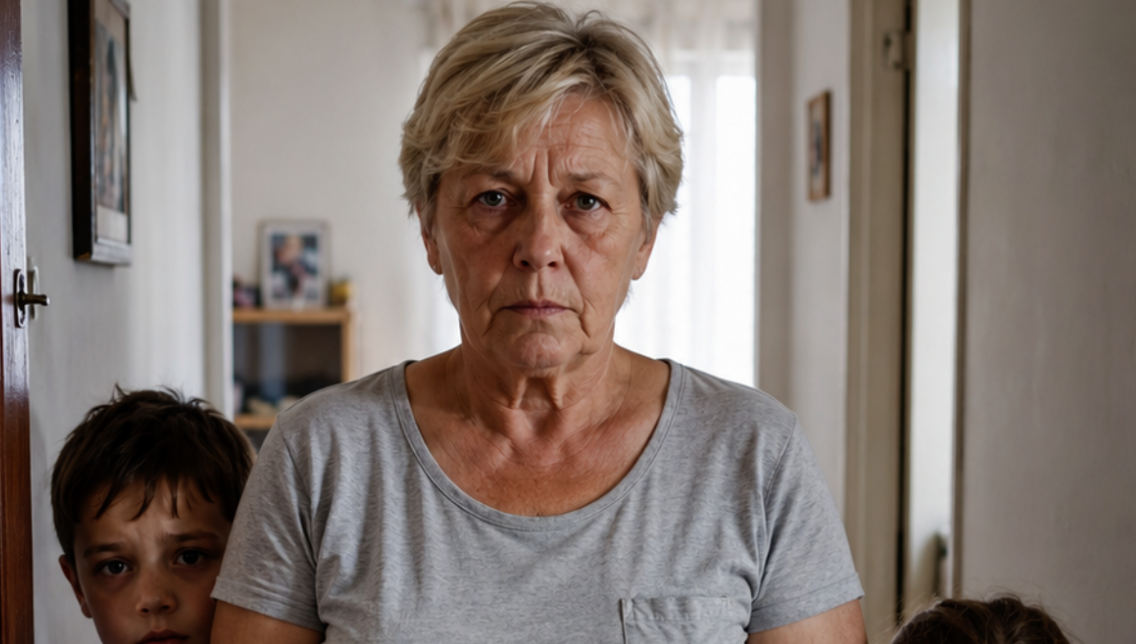
Alisa was standing in my hallway, shifting from one foot to the other, and she smelled of those same perfumes I had not given her — the kind that cost as much as my pension. Behind her stood Miron and Sonya. Miron silently held his little backpack with toy cars, while Sonya clung to the hem of my robe as if someone was about to take her away.
“Alisa, I was about to go to the store.”
“Well, I’ll pick them up after the store. Two hours, maybe three. Mom, I’m begging you.”
I looked at the children. Miron was six, Sonya was three. My grandchildren. My own flesh and blood. What kind of grandmother would I be if I couldn’t watch my grandchildren for a couple of hours?
“Fine. Go.”
She kissed me on the cheek, turned around, and flew out the door so quickly that I didn’t even have time to ask what time to expect her back. The lock clicked. Sonya immediately burst into tears. Miron silently sat down on the little stool in the hallway and stared at the floor.
Back then, I didn’t know that those three hours would stretch into one hundred and eighty-three days.
The first day went as it should have. I boiled pasta with sausages, because there was nothing else in my fridge for children. I barely managed to put Sonya to sleep — she kept asking where her mother was. Miron ate silently and stared down at his plate.
At nine in the evening, I called Alisa. Ringing.
At ten — ringing.
At eleven — “the subscriber is unavailable.”
I sat in the kitchen, drinking cold tea and telling myself that my daughter’s phone had probably died. It happens. She would show up tomorrow.
Only something unpleasant was gnawing inside my chest. I knew Alisa. She was my daughter. I had known her for thirty-two years. And I knew that when she said “for an hour,” it could mean three hours, or five. But not a whole day. Never a whole day.
And suddenly — a whole day.
In the morning, I dialed her number again. Unavailable again. I took Miron by the hand and brought him outside to the courtyard, because my own yard had neither a slide nor a sandbox — the building was old. I carried Sonya in my arms, and she cried again. She was heavy for me, about fifteen kilograms, and by the end of the walk my back was aching so badly that I wanted to lie down right there on the bench. My neighbor Lida saw us from the window and came downstairs.
“Tamara, who are these children with you?”
“My grandchildren. Alisa left them.”
“For long?”
“For a couple of hours.”
Lida looked at me over her glasses. Lida is a blunt woman. She doesn’t like lying, and she doesn’t like it when others lie to her either.
“Tamara. People don’t bring grandchildren for a couple of hours with a backpack and a pillow.”
I said nothing. I had already seen it myself. In Sonya’s bag lay her favorite bunny pillow. And two pairs of pajamas. And spare tights. And a bottle. Alisa had packed all of it in advance. In advance.
On the third day, I went to my daughter’s place. I had spare keys to her apartment — she had once given them to me herself, just in case. I left the children with Lida and went.
The apartment was a mess. Not the kind of mess you see in the home of a young mother with two children, but a different kind — as if someone had been packing in a hurry. The wardrobe was half-empty. On the table stood an empty wine bottle and two glasses. Two. I stood there, looking at those two glasses, and something cold rolled through me from my chest down into my stomach.
I dialed Alisa’s number. One ring. Another. And suddenly — her voice.
“Mom, what is it?”
“Alisa. Where are you?”
“Mom, well… listen, this isn’t a good time. I’ll call you back.”
“Alisa, I am standing in your apartment. Where. Are. You.”
A pause. A long one. On the other end, someone laughed — a man’s voice, quietly — and then immediately fell silent.
“Mom, just don’t get angry. I left. Not for long. I need to sort something out. The kids can stay with you for now, okay? A couple of weeks.”
“Alisa, are you…”
“Mom, that’s it, I really don’t have time. I’ll send you money. Love you.”
And she hung up.
I stood in the middle of her apartment, holding the phone in one hand and the keys in the other. And for the first time in my life, I wanted to smash something.
She did not send any money that evening. Nor the next day. Nor a week later. A month passed. One full month.
I counted my savings twice. I had my pension, and I had an envelope. In that envelope were one hundred and twenty thousand rubles — I had been saving little by little for three years. For Karelia. All my life, I had wanted to see Kizhi. With my own eyes, not on television. The ticket had been bought for June, through an acquaintance at a travel agency, with a discount.
And there I sat, counting. Diapers for Sonya — every day. Milk, cottage cheese, fruit. Miron would be going to school in September; he needed clothes. Sonya needed a jacket for autumn; she had outgrown her old one over the summer. Medicine — Sonya had been coughing for the third week, and I had taken her to a private pediatrician because at our clinic the next appointment was a month and a half away.
In the first month, I spent thirty-two thousand from the envelope. Thirty-two.
Alisa called once. Once in the entire month.
“Mom, how are you all doing?”
“Alisa. When are you going to pick them up?”
“Mom, there you go again. Just a little longer. I have such a situation here… I’ll explain everything later. Just hang in there, okay? I love you.”
“Alisa. Money.”
“Oh, Mom, right! I’ll send it now. Right now. Okay, kisses.”
She didn’t send the money.
That evening, I sat in the kitchen. The children were already asleep in my bedroom — both of them, in my bed, because there was nowhere else for them to sleep in my apartment. I sat there and cried. Quietly, so they wouldn’t hear.
Then I called her again.
“Alisa, listen to me carefully. If you don’t come for the children by the fifteenth, I am calling child services.”
“MOM! Have you lost your mind?! They’re my children! What are you, their grandmother or what?!”
“I am their grandmother. Not their mother. Their mother is you. And I’m giving you until the fifteenth.”
“Mom. You don’t understand. I have… I have Igor now. Do you understand? A man. And he… he is good, but he doesn’t like other people’s children. He said so himself. If I bring the kids now, he’ll leave. And I don’t want him to leave, Mom. For the first time in five years, I’ve met a normal person. Give me just a little more time. Please.”
I was silent. Everything inside me was boiling.
“So,” I said slowly, “you chose between a man and your own children. And you chose the man.”
“Mom, don’t say it like that.”
“How should I say it, Alisa? How?”
She hung up.
I sat in the kitchen and looked at the envelope. There were eighty-eight thousand left in it.
That night, I decided that I would not hand the children over to child services. I would not throw them out onto the street. But I decided something else too. Only at that point, I had not fully admitted it to myself.
In December, Sonya really got sick. Not just a cough, but a fever. Thirty-nine point two. I checked her temperature every hour, and every hour the thermometer showed the same thing. I called an ambulance. It arrived two hours later. A very young woman in uniform looked at her throat, listened to her lungs, and said:
“Bronchitis. Maybe pneumonia. She needs to go to the hospital.”
“Can’t we treat her at home?”
“You can. If you sign a refusal. But if anything happens, it’s your responsibility.”
I signed the refusal. Going to the hospital with a three-year-old meant staying there with her, and I had Miron at home. Where would I put him? With Lida? Lida was sixty, with her own health problems.
I called Alisa. Twenty-three times. No answer. I wrote to her in a messenger: “Alisa. Sonya is sick. I need your help. Urgently.”
She read it. I saw the check marks. She did not answer.
Then I wrote again: “Alisa. If you don’t answer by morning, I am going to the police to file a report that the mother abandoned her children.”
Two minutes later — a call.
“Mom, have you lost your mind?! What police?!”
“Alisa. Sonya has a temperature of thirty-nine. I need money for medicine. The antibiotic the doctor prescribed costs two thousand two hundred. The syrup is another seven hundred. Suppositories — four hundred. I have eight hundred rubles in my wallet, and my pension comes in a week.”
“Mom, well, I… I don’t have any right now.”
“Alisa. You do. I can hear music behind you. You are in a café or a bar. Find two thousand for your daughter’s medicine.”
Silence. Long silence.
“I’ll send a thousand.”
“Alisa, I need three.”
“Mom, I really don’t have more! Igor is out of work, I’m supporting him myself…”
“So you are feeding him too?! You, who can’t give money for your child’s antibiotic, are feeding a grown healthy man?!”
She hung up. Ten minutes later, a notification came: one thousand rubles. One. Thousand. For a sick child.
I got dressed, left Miron watching cartoons, and ran to the pharmacy. I paid the rest myself. I came home, gave Sonya the syrup, gave her the suppository. Then I sat beside her little bed and stayed there until morning. I held her hot little hand and thought only one thing: “If you die now, my little girl, I will strangle your mother with my own hands. With my own hands.”
Sonya did not die. In the morning, her temperature dropped to thirty-eight, and by evening, to thirty-seven point five. A week later, she was running around the apartment as if nothing had happened.
And I aged five years in that week.
Two more months passed. It was February.
Sonya grew stronger and stopped asking about her mother every morning — she had already gotten used to things and was calling me “Mom.” I did not correct her. I didn’t have the strength to correct her. Miron started attending a preparatory group at school — I enrolled him myself, arranged some documents, ran from office to office. They told me that a power of attorney from the mother was needed for registration. I called Alisa. She sent a photo of a signed paper in the messenger. No greeting. No question about the children.
By February, there were forty thousand left in the envelope.
I did three things I had sworn to myself I would never do.
First, I went to Lida and borrowed ten thousand. Until my pension. Lida gave it to me without asking anything, only looking at me for a long time.
“Tamara. Have you looked at yourself in the mirror lately?”
“I don’t have time for that.”
“That’s exactly the problem. Your eyes have sunk in. You probably weigh fifty kilos.”
“Lida, don’t start.”
“I will start. These are not your children. They are her children.”
I said nothing.
The second thing — I canceled my trip to Karelia. The travel agent sighed and fussed, but returned about half the money. I put that money in the envelope and closed it. And after that, I did not look inside the envelope again. I couldn’t.
And the third thing — for the first time in my life, I shouted at a child. At Sonya. She spilled kefir on the carpet, and I shouted. I don’t remember what I said. I remember how she froze, looked at me with her big gray eyes — exactly like Miron’s, like Alisa’s when she was three, like my own — and began to cry silently. Without a sound. Just tears running down her face.
I sat down on the floor and began to cry too. Then I hugged her.
“Sonyechka. Sonyechka, forgive Grandma. Grandma is tired. Grandma is very, very tired, little one.”
She pressed herself against me and whispered:
“When will Mommy come?”
I didn’t answer. I didn’t know.
That evening, I called Alisa. Some unfamiliar woman answered.
“Hello?”
“Hello, may I speak to Alisa?”
“Who is this?”
“I’m her mother.”
“Oh, you’re the mother. Alisa is in the shower. She’ll call you back.”
And she hung up.
I sat with the phone in my hand and thought: what woman? A friend? A neighbor? And why was she answering my daughter’s phone at all?
Alisa called back two hours later.
“Mom, why did you call?”
“Alisa. Who was that woman?”
“What woman?”
“The one who answered your phone.”
“Oh, that’s… Igor’s sister. We’re visiting her. Mom, is this about something or are you just calling?”
“Alisa. I am running out of money. I borrowed from Lida.”
“Mom, I told you I’d send some. I’ll send it. Soon.”
“When?”
“Soon, Mom. Things are difficult with work right now. Igor is looking, I’m looking. Do you know how hard things are now?”
“Alisa. I know how hard things are now. I’ve been feeding your children alone for five months.”
Silence.
“Mom, you sound like you’re accusing me.”
“I am accusing you.”
“You know what, Mom? If it was so hard for you, you shouldn’t have taken them. I would have figured something out.”
That was when I understood that my daughter — the daughter I had given birth to, raised, paid for through university — my daughter had become a stranger.
I hung up. Silently.
That night, I opened the wardrobe, pulled out two large plaid bags — the kind I had kept since the nineties, the ones I used to take to the market — and began packing Miron and Sonya’s things into them. Carefully. Tights with tights, sweaters with sweaters. The bunny pillow on top, so it wouldn’t get crushed. I had not made this decision suddenly. It had been ripening inside me for six months. But it finally took shape that night, when Igor’s sister answered my daughter’s phone.
Two more weeks passed.
I prepared. Slowly. I did everything the way I believed was right.
First, I went to child services. Not to hand over the children, but to ask whether I had the right to return my grandchildren to their mother. The girl in the office looked at me wearily and said:
“Tamara Stepanovna, you are not their guardian. The mother has not been deprived of parental rights. Legally, you owe them nothing. This is her responsibility.”
“And if I just bring them and leave them at the door?”
“They are her children. If you leave them at the door and the door is opened, that is her responsibility. If no one opens, that is a different matter.”
“They’ll open,” I said. “I’ll find a way to make sure they open.”
The girl looked at me closely and then, unexpectedly, nodded.
“I understand you. Good luck.”
Then I called Masha — a girl from the neighboring entrance, a student who sometimes worked as a nanny. I arranged for her to come with me. For a thousand rubles. Just to sit with the children for twenty minutes on the stair landing by one door. Masha did not ask questions.
Then I called Lida.
“Lida. Will you come with me tomorrow to one place?”
“Where?”
“To Alisa’s. The children are going back to their mother.”
Lida was silent for about ten seconds.
“Tamara. Are you sure?”
“I’m sure.”
“And if she brings them back to you?”
“She won’t. I’m changing the locks.”
Lida was silent again.
“I’m with you.”
And one more thing. That same morning, I called a locksmith and arranged for him to come at six in the evening to install a new cylinder in my door. And a second lock — on the upper latch. I paid in advance. Eight thousand four hundred rubles. From the same envelope that had once held Karelia.
And I threw the spare keys to Alisa’s apartment down the garbage chute. The very ones she had once given me “just in case.” I dropped them into the chute and heard them clink somewhere deep below.
In the morning, I woke Miron and Sonya.
“Children. Today we are going to Mommy.”
Miron raised his eyes to me. Big and gray. And for the first time in half a year, something flickered in them — not fear, not apathy, but something alive.
“To Mommy?”
“To Mommy.”
Sonya began jumping around the room.
I dressed them in the best things they had. Miron wore a new shirt that I had bought with my pension. Sonya wore the polka-dot dress we had chosen together at the children’s store. I combed her hair and braided it into two thin little braids. I packed food for the road — sandwiches, apples, juice in small cartons.
I forgot nothing. I was their grandmother. I could not forget.
The three of us went with Lida and Masha. By taxi. For one hundred and eighty-three days, I had saved money on everything, and that day I took a taxi.
At Alisa’s door, I rang the bell. Once. Twice. Three times.
She opened it herself. In a robe. Her hair was disheveled. And behind her I saw that same Igor — a man in sweatpants, holding a can of beer. He looked at us and the children the way people look at cockroaches crawling out from under the refrigerator.
“Mom,” Alisa said. “Mom, what are you doing?”
“Alisa. I brought you the children.”
“You… what?”
“I brought you your children. Miron, Sonya, go inside. This is Mommy. Do you remember Mommy?”
Sonya froze. She did not remember. She had forgotten her in six months.
Miron took a step forward. Silently. He was a little man, six years old.
“Mom, have you lost your mind? I can’t! I have… you can see I have Igor here! He… Mom, please take them back, I’m begging you, just a little longer!”
“No, Alisa.”
“Mom!”
“No.”
I placed the bags by the door. One. Then the second. I laid the bunny pillow on top. I bent down to Sonya and kissed the crown of her head.
“Sonyechka. Grandma loves you very much. Listen to your mother.”
Sonya clung to the hem of my coat. Exactly as she had six months earlier, in my hallway. And that was when my throat tightened. That was when I almost broke.
But I unclenched her little fingers. One by one. Quietly. Carefully. And stepped back.
“Alisa. These are your children. You gave birth to them. I have done my part. Six months. One hundred and eighty-three days. Enough.”
“Mom, you can’t do this to me…”
“I can, Alisa. I absolutely can.”
Igor took a step forward from inside the apartment.
“Hey, old woman, are you out of your mind? Is this a kindergarten or what?”
I looked at him. I looked at him for a long time. The way I used to look at careless suppliers at work when they tried to push spoiled goods on me. Twenty-eight years in accounting — I had perfected that look automatically.
“And you, my dear man, keep quiet. I am not talking to you. My daughter will talk to you. For a long time. And I hope without me.”
Igor opened his mouth, but Lida stepped forward behind me and said in her commanding voice:
“Young man. Shut your mouth. And go into the room. This is a family conversation.”
Igor looked at Lida, then at me, then at Alisa — and went into the room. Silently. Lida knows how to handle people when she has to.
Alisa stood in the doorway and cried. Really cried, with snot, like when she was a child and someone took away her toy.
“Mom. Mommy. Please. Just one more month. I’ll find work, I’ll get settled, I’ll do everything, just take them back, I can’t handle it, I don’t know how to be alone with them!”
“Alisa,” I said. “You gave birth to them. Not me. I looked after them for half a year. Enough.”
“But I don’t know how!”
“You’ll learn.”
“Mom, what if I put them in an orphanage?! Is that what you want?!”
I stopped. This was the moment I had feared most. I knew she would use this to pressure me. She had always known how to press where it hurt. Since childhood.
I took a step toward her. Close. Close enough for her to see my eyes.
“Alisa. If you put them in an orphanage, I will tell everyone about you. Everyone. The neighbors. Relatives. Former classmates. I will write it on social media. You will live with that mark for the rest of your life. Is that what you want? Then go ahead.”
She fell silent. She understood. Alisa is very afraid of what people will think of her — I told you.
I turned around and walked toward the elevator. Lida walked beside me and held my arm, because my legs were giving way. Masha stayed on the landing — we had agreed that she would stand there for twenty minutes just in case, to make sure Alisa took the children inside and didn’t leave them at the door.
In the elevator, I did not cry. I looked into the mirror opposite me and did not recognize the woman looking back.
At home, I waited for the locksmith. He arrived exactly at six, as promised. In forty minutes, he changed the cylinder and installed the second lock on the upper latch. I paid him and closed the door behind him. Two turns. Then the upper lock too.
And that was when I sat down on the stool in the hallway. The very stool where silent Miron had sat six months earlier.
The apartment was quiet. Truly quiet. There was no Sonya whimpering, no rustle of Miron’s toy cars, no cartoons on the television.
I sat and listened to that silence. I did not cry. I was not happy. I simply sat.
Then I got up, went to the kitchen, and made myself tea. With lemon. I had not drunk tea with lemon for half a year — Sonya didn’t like lemon and would scream. I put in two slices. I took the good chocolates out of the cabinet — the box had been standing untouched, saved “for an occasion.” The occasion had come.
I ate chocolates, drank tea, and looked out the window. Outside, it was April. Dirty, wet, but almost spring.
The phone rang.
Alisa. I didn’t answer.
A minute later — Alisa again. I didn’t answer.
Five minutes later — an unknown number. I didn’t answer.
Ten minutes later — Lida. That one I answered.
“Tamara, how are you?”
“Fine.”
“Are you sure?”
“I’m sure, Lida. Thank you.”
“Tamara, your girl is calling you nonstop. I just walked past your entrance, she’s standing there, pressing the intercom. With Igor.”
“Let her press it.”
“Are you going to open?”
“No.”
I put down the phone and poured myself a second cup of tea.
Two weeks passed.
Alisa called me forty-seven times. I counted. First with accusations, then with threats, then with tears, then with accusations again. I answered only three times. The first time, I said: “Alisa, I have fulfilled my duty as a mother. Now it is your turn.” The second time, I said: “Alisa, don’t call.” The third time, I said: “Alisa, if you come to my home again and bang on my door, I will call the police. This is not a threat. This is a warning.”
She stopped coming.
But then relatives started calling. My cousin, my late husband’s aunt, some friends of Alisa’s whom I had never seen in my life. They all said roughly the same thing. That I was heartless. That I was a viper. That only finished, rotten people abandon their grandchildren. That Alisa was young, she had her own life, and I was old and had nothing to do anyway.
I listened to all of it and said nothing.
Then I learned from Lida — she knows everything — that Igor moved out from Alisa’s on the fifth day. He couldn’t handle living with the children. Now Alisa is alone with Miron and Sonya in her apartment, working as a courier — delivering food through an app. Sonya goes to a private kindergarten because they won’t take her into a state one without waiting in line. There isn’t enough money for the kindergarten. Alisa is calling everyone she can to borrow money.
She does not call me.
Today, Lida brought me pies and said:
“Tamara, you’re still their grandmother. How can you do this?”
I answered:
“Lida. For half a year, I was their mother. Not their grandmother. Their mother. And I am tired. My heart skipped once, and I went to the doctor. Do you know what they told me? That my blood pressure was two hundred over one hundred and ten, and if I kept butting heads like this much longer, I myself would have to be hospitalized. And who would raise the grandchildren then? Lida? You?”
Lida said nothing.
“I pity my daughter,” I said. “I pity her very much. My heart breaks when I think that Sonya might be there without diapers now, maybe sleeping on the floor. But if I save her now, I will never save her again. Do you understand? Never. She will milk me, and milk me, and milk me. To the very end. Until I die alone in my apartment with her children in my arms.”
Lida sat there, staring into her cup.
“And what if she puts them in an orphanage?” she said quietly.
“She won’t,” I said. “I know her. She is a coward. She is afraid of what people will think of her. But she isn’t afraid to milk her mother, because nobody knows about that.”
I poured Lida more tea.
And at night, I lie awake and think. Sometimes I dream of Sonya. I dream that she is reaching her little arms toward me, and I cannot come closer. I wake up and sit in bed in the darkness. And I ask myself: did I do the right thing? Maybe I should have endured it a little longer. Maybe one more month. Two more. Another half a year.
And then I remember how Alisa said: “If it was so hard for you, you shouldn’t have taken them.” And everything inside me hardens again.
Am I a heartless grandmother, or was I right? What would you have done if your granddaughter had been brought to you “for an hour,” and six months later her own mother told you that a man mattered more to her than her own children?
Tell me, girls. I truly don’t know how to live with this now.