“That’s it, we’re going tomorrow!” Kirill entered the apartment looking as if he had just won a tender to build a bridge. “Mom called. She says we haven’t all gathered together in ages. Aunt Vera and Uncle Vasya are coming too. Lida, buy some meat for shashlik, about three kilos, no less. Pork neck. You know how I like it.”
Lida stood in the kitchen and looked at her husband with the expression of someone who had just heard the weather forecast for Mars.
“Kirill,” she began carefully, “when was the last time you talked to your mother?”
“Today. Just now, in the car.” He was already rummaging through the refrigerator, studying its contents with the air of a master of the house. “Why?”
“Nothing. It’s just…” Lida paused. “All right. I’ll buy the meat.”
She did not say the main thing. Not because she was afraid. She simply had not yet decided exactly how she would say it. Or when.
And now, let’s go back a little. Three days earlier.
The dacha in the Moscow region, forty minutes from the ring road, six hundred square meters of land, an old wooden house with blue shutters — all of it had stopped belonging to the Gromov family the previous Wednesday, at exactly 2:20 p.m., when Lida walked out of the multifunctional service center with a packet of documents and a number in her bank account that made her vision swim slightly.
Two million eight hundred thousand rubles.
The dacha had been registered in her name. She had inherited it from her grandmother. Kirill knew this, but somehow he had grown used to thinking of the dacha as “ours,” shared, an obvious part of the family space. Lida sold it quietly, without scandal, without announcements. The buyer had come through an agency — a young couple who spent a long time walking around, looking, touching the old carved window frames, and in the end paid a good price.
Lida had not spent a single ruble. The money was sitting in a separate account, and she still did not fully understand why.
Or rather, she did understand. But it was still too early to say it out loud.
In the morning, she went to the market. She bought the meat — three kilos of pork neck, just as Kirill had asked. As she walked between the rows of stalls, she thought about what would happen tomorrow. The picture formed in her mind vividly and very clearly: Zinaida Ivanovna in her unchanging synthetic sea-green cardigan, carrying a bag stuffed with jars and pies. Aunt Vera — her mother-in-law’s older sister, large, loud, wearing gold earrings and armed with an opinion on every subject. Uncle Vasya, her husband — small, quiet, always looking slightly guilty, whether before Vera or before the entire world.
This group came to the dacha every summer. They grilled shashlik, drank, talked about grocery prices and how everything used to be better. Aunt Vera always found something wrong: the vegetable beds had been planted incorrectly, the meat was undercooked, or Lida looked “somehow pale — was she ill?” The last one never sounded like concern. It sounded like a diagnosis.
Lida returned home, put the meat in the refrigerator, and opened her laptop.
That evening, Kirill was in a good mood. He talked about his colleagues, traffic jams, and how they really ought to replace the car. Lida nodded, served more food, looked at him, and thought: here was the man she had lived with for eleven years. He was not bad. Not at all bad. He simply never asked her about anything important. Everything was taken for granted — the dacha existed, they were going tomorrow, the meat would be bought.
“Kir,” she said at one point, “do you remember whose name the dacha is registered under?”
He froze for a second.
“Well… yours, I think. Your grandmother left it to you.”
“Yes,” Lida said. “Mine.”
“So what?” Kirill looked up from his plate.
“Nothing. I just wanted to clarify.”
He looked at her for about three seconds, then lowered his eyes again. He sensed something — that was obvious — but decided not to pull on that thread. Not now, at least.
Lida cleared the plates, washed the dishes, and went to bed earlier than usual.
The next morning, the family began gathering.
Zinaida Ivanovna arrived first — by taxi, with two bags and a cardboard box. She came in, kissed her son, nodded to Lida, and looked around the hallway like a health inspector.
“Lida, did you marinate the meat?”
“I did, Zinaida Ivanovna.”
“With onions?”
“With onions, vinegar, and spices.”
“Vinegar is old-fashioned. You should have used kiwi. It tenderizes the meat.”
Lida smiled. It was a smile she had polished over eleven years into a state of absolute neutrality.
Aunt Vera and Uncle Vasya appeared twenty minutes later. Vera entered first — in a bright green coat, with a large bag over her shoulder, already telling a story about traffic on the highway before she was even fully through the door.
“Vasya almost drove into a truck!” she announced from the threshold. “I told him, ‘Watch the road,’ and he was on his phone!”
Uncle Vasya came in behind her, greeted everyone quietly, and immediately moved toward the wall — to a safe distance from his wife.
Kirill was pleased. He loved gatherings like this — noisy, slightly chaotic, filled with the smell of other people’s perfume and the sound of other people’s voices in the apartment. Lida looked at him and thought: this is his element. This is where he is truly himself.
“Well then, shall we load up?” he commanded. “The car’s downstairs. Everything will fit.”
And no one — not he, not Zinaida Ivanovna, not loud Aunt Vera — suspected for even a moment that today there was nowhere for them to go.
Lida zipped up her jacket, took the bag with the meat, and followed everyone out.
The denouement was very close.
They had already been driving along the highway for about forty minutes.
Kirill was behind the wheel, Zinaida Ivanovna was in the front passenger seat — which, in itself, was a very telling fact. Lida sat in the back between Aunt Vera and Uncle Vasya. Vera spent the entire ride talking about a neighbor who had renovated her apartment and was now “putting on airs.” Vasya dozed with his eyes open, while Lida looked out the window and counted the kilometers.
There were about ten minutes left.
“Kirill, didn’t the gate get stuck last time?” Zinaida Ivanovna asked.
“A little, but I fixed it.”
“Has the water been turned on yet?”
“It should have been. Lida, did you call the garden association?”
Lida did not answer right away.
“No.”
“There you go,” Zinaida Ivanovna turned just enough for Lida to feel it. “Always the same. You would think it was a small thing, but no one thinks of it.”
Aunt Vera immediately picked up the thread.
“Our garden association is a complete disgrace. The chairman is a crook. He collects money, but the roads are still full of potholes.”
The conversation flowed in another direction, and Lida turned back to the window.
She thought about the fact that this moment would have to be lived through. Right now, in ten minutes. The car would turn onto the familiar street, pass the old pine trees, stop by the plot — and everyone would see a stranger’s lock on the gate and a new nameplate with a surname that was not Gromov.
Kirill slowed down.
He stared silently at the gate. At the lock. At the nameplate.
“What is this?” he finally said.
His voice was even. Too even.
“These are the new owners,” Lida said. “I sold the dacha three days ago.”
The silence in the car was dense, almost tangible. Zinaida Ivanovna slowly turned around. Aunt Vera opened her mouth and did not close it. Uncle Vasya woke up completely.
“What did you say?” Kirill stared straight ahead.
“I sold the dacha. It was registered in my name. I had the right to do it.”
“Lida.” He finally turned. “Do you even understand what you just said?”
“I understand perfectly.”
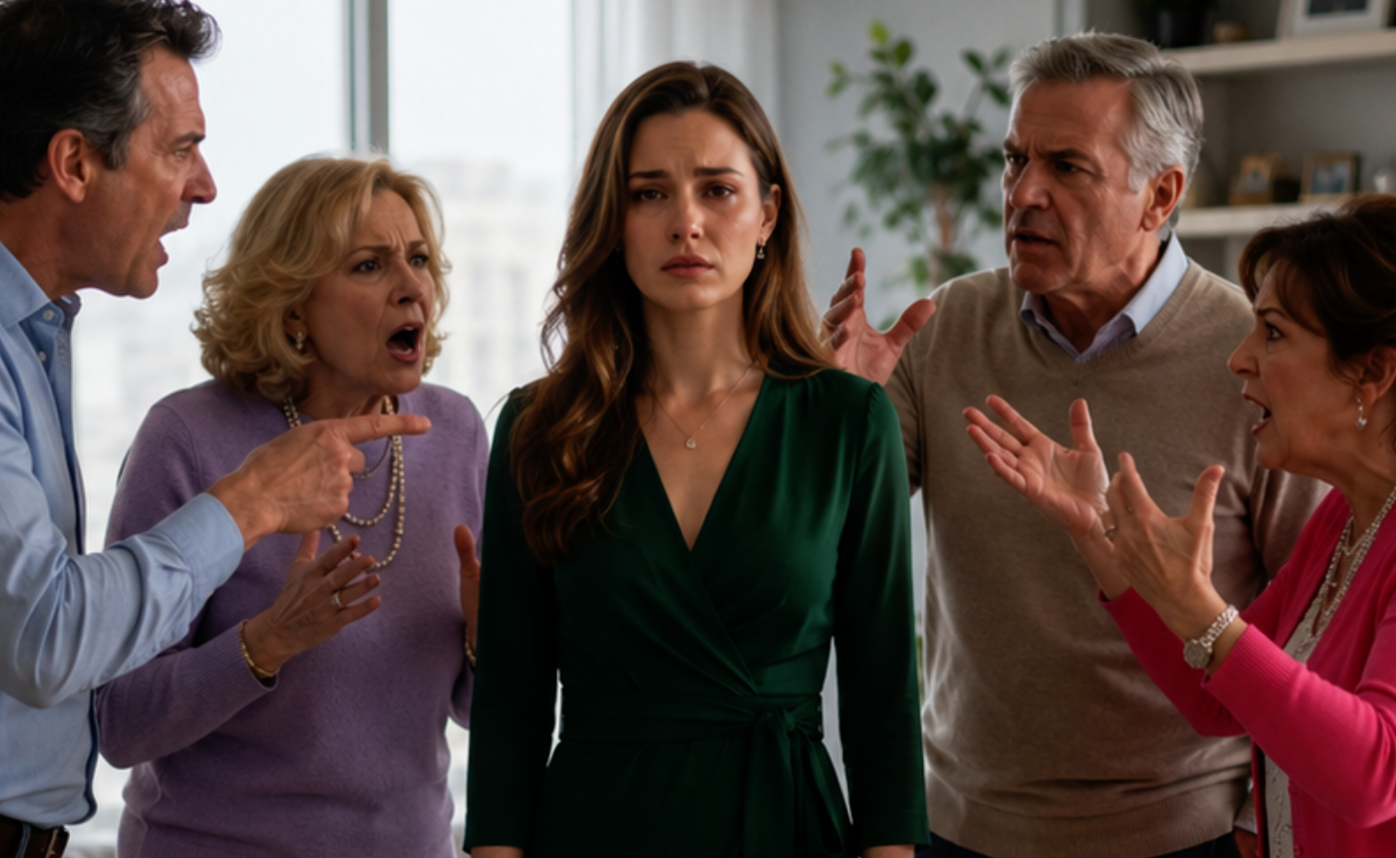
Zinaida Ivanovna got out of the car first — silently, with the expression of someone who had just been struck. She stood by the gate, looked at the nameplate, then at Lida, and said quietly but very clearly:
“I knew it. I always knew what kind of person you were.”
Lida got out after her. She stood on the roadside, holding the bag of meat that now had absolutely nowhere to go, and looked at her mother-in-law calmly.
“What did you know, Zinaida Ivanovna?”
“That you were a stranger. You were always a stranger in our family. You came along, settled in, wrapped my son around your finger — and the dacha, as it turns out, was registered in your name! Very convenient!”
“The dacha came to me from my grandmother,” Lida said. “You know that as well as I do.”
“I know!” Zinaida Ivanovna’s voice rose. “So what? It was family property! We went there for eleven years!”
“Eleven years,” Lida repeated. “Yes. I remember. Every summer. I painted the fence, weeded the beds, cooked for the whole crowd, washed the dishes — and every time I heard something from you. That the meat was marinated wrong. That the house wasn’t clean enough. That I was pale, thin, strange.”
Zinaida Ivanovna drew in a breath, but Lida did not let her get a word in.
“I’m not causing a scandal. I’m simply stating facts.”
Aunt Vera, who had been standing there the whole time like a spectator in the front row, could not hold back any longer.
“Well, aren’t you something, girl! Imagine setting up the whole family like that!”
“Vera,” Uncle Vasya said quietly.
“What — Vera?! People came, got ready, and she sold it! In secret! What do you even call that?”
“A transaction,” Lida said. “It’s called a purchase-and-sale transaction.”
Kirill had been standing by the car this entire time. Hands in his pockets, eyes on the ground. When everyone fell silent, he raised his head and looked at his wife for a long time, as if seeing her for the first time.
“Why didn’t you tell me?”
“Because you didn’t ask.”
“What?”
“You never asked me about anything important, Kirill. You announced things. We’re going tomorrow. Buy the meat. Call the garden association. For eleven years I existed as part of your logistics.”
He looked at her in silence.
“The money from the sale is mine,” Lida continued. “I haven’t decided yet what I’ll do with it. But I know for certain that I no longer want to paint someone else’s fence and listen to complaints that the meat was marinated wrong.”
Zinaida Ivanovna gasped.
“Do you hear what she’s saying?! Kirill, do you hear?!”
He heard. It was visible. Something in his face was changing slowly, the way the light changes before a thunderstorm — it is not dark yet, but it is no longer the same.
“Lida,” he finally said, “are you leaving?”
She did not answer right away. She looked at the gate with the unfamiliar nameplate, at the pine trees behind the fence, at the bag of meat in her hand.
“I’ll call a taxi,” she said. “Take the meat. No point letting it go to waste.”
She put the bag on the ground, took out her phone, and stepped aside.
Zinaida Ivanovna stared at her back. Aunt Vera was silent — for the first time during the entire trip. Uncle Vasya quietly took some sunflower seeds out of his pocket and began cracking them — carefully, almost soundlessly.
Kirill did not move. Somewhere beyond the pines, a dog barked. The taxi appeared eight minutes later.
Lida got into the back seat, closed the door, and entered an address into the navigation app — not home. Somewhere else. Where exactly was already her story, and hers alone.
The taxi carried her along familiar streets, and Lida looked out the window without a single thought — simply watching houses, shops, and people with bags flicker past. The driver was silent, which was rare, and for which she was sincerely grateful.
She was going to the city center. To a notary — not because it was urgent, but because three weeks earlier she had made an appointment for a consultation and kept postponing it. About the division of property. About how it was done when an apartment had been bought during the marriage, but the down payment had been hers, from before the marriage.
The notary turned out to be an older man with a tired face and a very tidy desk. He listened without interrupting, asked several precise questions, and said what she had already suspected: her chances were good, the documents had been preserved, and the main thing was not to delay.
Lida walked outside and stopped right on the steps. The sun shone into her face. Somewhere nearby, coffee smelled from the open door of a café.
She went inside, sat by the window, and ordered a cappuccino and a croissant — simply because she wanted to. Not because it was necessary, not because she had to hurry somewhere. She simply wanted it — and did it.
At the next table, two women were discussing a vacation. They were laughing. Lida looked at them and thought: so this is what ordinary life looks like. When you sit in a café and no one tells you that you marinated the meat wrong.
Her phone stayed silent for almost an hour.
Then a message came from Kirill: Where are you?
She finished her coffee before replying.
I’ll be home in the evening.
A minute later, another message came: We need to talk.
I know, she wrote, and put the phone away.
She returned home at half past six.
Kirill was sitting in the kitchen. In front of him stood a mug of tea that he clearly had not drunk. He looked as if he had spent several hours in tense negotiations with himself — and had not yet won.
“Sit down,” he said.
Lida took off her jacket, hung it on the hook, and sat opposite him.
“Mom called,” he began.
“I don’t doubt it.”
“She’s very upset.”
“Kirill,” Lida looked at him steadily, “I understand that your mother is upset. But right now I’m not ready to discuss her feelings. Let’s talk about us.”
He fell silent. He rubbed his face with his hands — a gesture she knew well. He did that when he did not understand how to behave.
“Do you really want a divorce?”
“I want an honest conversation. Maybe the first one in several years.”
“It wasn’t honest to sell the dacha behind my back.”
“And was it honest to announce to me that the whole family was going tomorrow and not ask whether that was convenient for me?”
He opened his mouth and closed it again.
“Eleven years, Kirill. For eleven years I was convenient. I came, met your mother, who looked at me as if I were an unpleasant necessity. I endured Aunt Vera and her comments. I cooked, cleaned, smiled. And meanwhile I worked, by the way, and earned no less than you. Only somehow you didn’t notice that.”
“I noticed.”
“No. You took it for granted. Those are different things.”
Kirill looked at the table for a long time. Then he looked at her.
“What do you want?”
“I want you to finally ask me something. Not announce it. Not inform me. Ask me.”
The conversation lasted almost three hours. Without shouting — and that, perhaps, was more frightening than any scandal. Quiet, heavy, full of pauses and unfinished tea. Kirill said he had not noticed — and that was true, which only made everything worse. Not malice. Not indifference. Just habit. Lida is there. Lida will manage. Lida will buy the meat.
At one point, he said:
“I didn’t know you felt so bad.”
“You didn’t ask.”
“You didn’t say it either.”
And that was also true. She nodded.
“I did say it. Just not as loudly as selling the dacha.”
He gave a humorless little smile. For the first time that evening.
Zinaida Ivanovna called the next morning. Lida answered deliberately, calmly.
“Lida,” her mother-in-law’s voice was different. Not the one from the gate. Drier, more formal, but without the old venom. “I want to say… You behaved badly. That is my opinion, and I will not change it.”
“All right, Zinaida Ivanovna.”
“But Kirill is my son, and I do not want his family to be broken. So…” The pause was long. “So I’m willing to meet and talk.”
Lida thought for a second.
“I’m willing too. But the conversation has to be honest. On both sides.”
Her mother-in-law was silent for a moment.
“Agreed,” she finally said, and hung up.
Aunt Vera called on her own two days later, without warning.
“Lidka, you really are something,” she said, almost admiringly. “I told Vasya: now that is a woman! He laughed.”
Lida had not expected such a turn.
“Vera Nikolaevna…”
“Oh, come on. Of course I made a scene there by the gate. But honestly, I understand you. Zinka has been like that all her life: everyone is supposed to revolve around her. I’ve had my share of it too. Hold on.”
She hung up before Lida had time to answer.
Lida stood with the phone in her hand and laughed — unexpectedly even to herself, briefly and sincerely.
She put the money from the dacha into a savings account. For now, it was simply sitting there. What would come next — a one-room apartment in her name, or a down payment on something bigger, or simply a safety cushion she had never had before — she had not yet decided.
But for the first time in a long time, she had the feeling that she would be the one deciding. Not circumstances. Not other people’s convenience. She herself.
In the mornings now, Kirill asked what she wanted for breakfast. It sounded a little wooden — like a person learning a new language and still speaking with an accent. But he asked.
Lida answered.
It was a beginning — not an ending and not a happy ending. Simply the beginning of something that did not yet have a name. But it was real. And perhaps that was the most important thing.
A month passed.
The meeting with Zinaida Ivanovna did happen after all — in a small café near the metro, at a table by the window. Her mother-in-law came in her usual cardigan, but without her usual facial expression — the one Lida privately called “I know everything better than everyone.” Instead, there was something new. Tired and almost human.
They talked for a long time. Zinaida Ivanovna did not apologize — she did not know how, that was clear. But she said something important: that she had been afraid of losing her son. That Lida had always seemed too independent to her, too closed off. That it frightened her.
“You were afraid of me?” Lida asked in surprise.
Her mother-in-law pressed her lips together, but answered:
“I was afraid that one day you would leave and take him with you.”
Lida looked at her and thought: so that was it. Eleven years of barbs, remarks, and looks — and behind all of it, simply the fear of an older woman who did not know how to speak about fear in any other way.
It did not make the past easier. But it made it more understandable.
She and Kirill went home together. He was silent all the way to the entrance of their building, then said:
“Thank you for coming.”
“It was a necessary conversation,” Lida replied.
He took her hand — awkwardly, like a teenager. She did not pull her hand away.
At their next meeting, Uncle Vasya quietly slipped her a bag of apples — from his own plot, he explained shyly. He said nothing else. But nothing else was required.
The money from the dacha was still sitting in the account. Lida opened the banking app several times and looked at the number — not with anxiety, but with a quiet, calm feeling. It was not just an account. It was the possibility of saying “no” if she ever needed to again.
And perhaps she never would.
Life is not a dacha. You cannot sell it or buy it. But sometimes you simply need to change the lock on the gate.
And hang up your own nameplate.