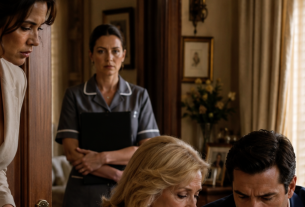
Alina was sitting on the floor in the hallway, wallpaper catalogs spread around her like a map before a long journey. Five days. In five days, a child’s voice would ring through this apartment again, and everything she had been doing for the past six months would finally have meaning.
She folded down the corner of a page showing turquoise wallpaper covered in tiny stars, then immediately unfolded it. No. Polina would choose for herself.
Her phone vibrated.
“Zhenya, you have no idea,” Alina said, pinning the phone between her shoulder and ear. “I’m standing in the hallway, and it’s white. White! Not that horrible floral pattern that had been here for twenty years.”
“Don’t start crying on me,” her sister snorted. “Wallpaper is just wallpaper.”
“This isn’t wallpaper. It’s a new life. I have a husband, I have a renovated apartment, and my daughter is coming home. I feel like someone just gave me back every game I ever lost, all at once.”
Artyom came out of the room, wiping his hands on an old T-shirt, and stopped above her, looking down at the catalog.
“Looking through your pictures again?” he said. “The renovation is finished. That’s it. Period. Enough.”
“One room isn’t finished.” Alina looked up at him and smiled. “Polina’s room. We’re going to put up the wallpaper together. She’ll choose it herself. I have no right to deprive a child of her first interior-design decision.”
“Whatever you want,” he said with a shrug and went back into the room.
The doorbell rang while she was still sitting in the same position.
Tamara Lvovna stood on the doorstep holding a flowerpot—a thick little plant with burgundy leaves, tied with a ribbon.
“Alinochka, here. This is for you. Tough as I am,” she declared, then marched inside as though she owned the place. “Finally, Tyoma has a wife and a home. I prayed for this for twelve years.”
“Thank you, it’s beautiful.” Alina accepted the pot. “I’ll put it in Polina’s room. Her window gets plenty of sun.”
“In the child’s room?” Tamara Lvovna froze for a second. “Well… all right.”
They walked through the apartment, and Tamara Lvovna tapped the walls approvingly with her finger as though testing their quality.
She lingered longest in the child’s room.
Drawings hung on the wall: a crooked little house, three figures, and a sun that took up half the sky.
Author: Vika Trel © 5507
“What’s this?” she asked.
“Polina drew it in the spring. The house, me, her, and Artyom. She drew him wearing a hat, so his head ended up looking like a watermelon, but he was flattered.”
“Mmm,” her mother-in-law said.
Artyom came in and stood in the doorway, staring at the room for a long time in silence, as though calculating the square footage.
Alina glanced at him and felt a warm wave wash over her. He was thinking. Planning. Maybe he wanted to put up shelves, or perhaps the star-shaped lamp she had dreamed about.
“Figuring things out?” she asked cheerfully.
“Figuring things out,” he answered after a pause. “There’s a lot to decide.”
That evening, after Tamara Lvovna had left, Alina called her mother. The clock showed half past ten.
“Is Polinka asleep?” she asked hopefully.
“She is, my little nightingale. She spent half the day running around the garden,” Valentina Sergeyevna replied. “Don’t be upset. You can talk tomorrow.”
“I’m already upset,” Alina admitted. “Six months without her. I’d erase those months if I could.”
“The renovation required it.”
“The renovation required it, and I agreed. Never again. The ceiling can collapse for all I care—my daughter stays with me.”
She put the phone on the dresser and stepped into the hallway.
Artyom was standing there with his arms crossed, wearing the expression of a man who had spent an hour rehearsing his opening line.
“She’s not going to live here,” he said.
“Who?” Alina asked, confused.
“Your daughter.”
Morning was sunny and treacherous.
Artyom was spreading butter on a piece of bread, carefully covering it all the way to the edges. He remained silent for about ten minutes until Alina sat down across from him.
“Your daughter isn’t staying here. Find somewhere else for her,” he said sharply. “I’ve thought everything through. She’s perfectly fine at your mother’s. Fresh air, a garden, a river.”
“Perfect,” Alina agreed. “Except I’m not there. And according to my child, I’m part of the basic package.”
“Don’t start.”
“I haven’t started anything. You did, beginning with the bread. Artyom, are you aware that I have a daughter? She didn’t jump out of a closet as a surprise. You’ve seen her. You had pillow fights with her. You bought her double ice cream because, as you said, ‘I feel sorry for her when she looks at me with those eyes.’”
“Seeing her isn’t the same as living with her.” He put down the knife. “I have a son too, by the way. And I didn’t drag him here!”
“You didn’t drag him anywhere,” Alina said calmly. “You hardly took him anywhere at all. Don’t confuse lack of love with strategy.”
“There! There it is!” He raised his voice. “The jabs have started! I knew it! I knew this would happen! I’ve had a normal life for a year, and now suddenly there’ll be a child, screaming, toys underfoot—a child who isn’t even mine!”
“Not yours,” she repeated. “Let’s remember that phrase. It says a great deal about the person who said it.”
The doorbell interrupted them.
Tamara Lvovna had come back for a bag she had forgotten, and because they opened the door to her, she stayed.
Once again she went straight to the child’s room, as though drawn there.
She picked up a photograph from the shelf: Polina in a sun hat, her cheeks covered in sand, laughing.
“She’s pretty,” Tamara Lvovna sighed. “Alinochka, let me tell you this as one human being to another. You and Tyoma need to build your own family. Your own. Not drag the past behind you. The past is like a suitcase without a handle.”
“Interesting thought,” Alina replied evenly. “Go on.”
“Well, think about it yourself. You’re newlyweds, you’ve only been married a month, and suddenly there’s a child. You won’t be able to talk or relax. At her grandmother’s, she has all the freedom in the world! We can take her during the holidays, on weekends. I’ll bake pies… make dumplings.”
“Dumplings are a powerful argument,” Alina nodded. “Tamara Lvovna, how old is your Artyom?”
“Forty-one.”
“And how many of those years did he live with you?”
“Well… almost all the time,” she said, suddenly uncertain. “After his divorce, he came back to me. He lived with me for four years.”
“Wonderful. So apparently people in this family do carry suitcases without handles. Just selectively.”
Tamara Lvovna opened her mouth, but Alina was already smiling broadly and peacefully, making it impossible to tell whether she was joking.
“I heard you,” Alina said softly. “I really did. I need to think.”
“That’s my smart girl!” Tamara Lvovna brightened. “A clever woman always listens to her husband.”
“A clever woman always listens first. Then she makes a decision. The order matters.”
Her mother-in-law left twenty minutes later, satisfied, carrying her bag and the certainty that common sense had finally prevailed in the household.
Artyom walked her to the elevator and returned almost tender.
“See?” he said. “An adult conversation. I’m not a monster. She really will be better off there.”
“Better for whom?” Alina asked.
“For everyone!”
“‘Everyone’ is a convenient word. You can hide exactly one person behind it.” She stood up. “All right. This subject is closed for today. I have things to do.”
He took it as a victory.
She took it as an intermission.
There was no point arguing further, and Alina understood that better than he did.
Artyom’s words were like the new door they had installed: attractive from the outside, hollow cardboard inside.
She decided she would no longer speak with words.
The next day, Artyom came home and found his friend Slava in the child’s room with a power drill. The old wardrobe and sagging couch had already been dismantled and bound together with tape.
“Wow!” Artyom beamed. “Slava, you really are fast.”
“The lady of the house asked me to clear out the room,” Slava replied without looking up from the screws. “I’ll have everything taken away by this evening.”
Artyom found Alina in the hallway with the phone pressed to her ear and put an arm around her shoulders.
She moved slightly away without interrupting the conversation.
“…yes, Zhenya, they’re taking the wardrobe out. No, I’m not crying, I’m happy. Yeah. Love you.”
She hung up and immediately dialed another number.
“Mom, hi. Put my nightingale on.”
“Mommy!” the voice screamed through the phone so loudly that it echoed throughout the hallway. “I’m coming! I packed my bag all by myself!”
“Good girl. What did you put in it?”
“Three seashells. And one sock. I lost the other one.”
“Perfect luggage,” Alina laughed. “Polina, you’re going to have your own room. Completely, completely your own.”
“With a shelf?”
“With two.”
Artyom listened beside her and smiled indulgently, the way people smile when they think someone is saying goodbye.
He was convinced all the packing, conversations, and shelves were merely the polite winding down of the whole project.
“She won’t be upset?” he asked afterward, good-naturedly.
“Who?”
“Your daughter. About not coming here.”
“She will,” Alina said. “Children are rarely wrong.”
“You’re speaking in riddles again!”
“I’m speaking plainly. You hear riddles. Those are two different illnesses and they require different treatments.”
He waved her off and went to watch the game.
Alina stayed alone in the empty child’s room, surrounded by bare walls, and took out a measuring tape.
The following evening, Artyom opened the door to the child’s room and froze on the threshold.
The room glowed.
There was a light-colored bed with safety rails, a desk by the window, a shelving unit, a round soft ottoman, and the same burgundy-leafed plant sitting on the windowsill.
Alina was kneeling on the floor, arranging little T-shirts on the shelves.
“Do you like it?” she asked, turning around. “Look, they assembled the shelf in an hour. And there’s a box for the seashells.”
“What is this?” he asked quietly.
“Furniture. They make it for children. You can buy it in stores.”
“What did I tell you?!” His voice shot upward. “What did I tell you, Alina?! I said she would not be here! What do you take me for?! Furniture?! I invested in this place! I carried this whole renovation! I insisted on it! I put my money into it, and you—!”
“You told me,” she nodded, carefully folding a pair of pajamas. “I remember. Word for word.”
“And?!”
“And I invited your mother for lunch tomorrow. Two o’clock. We’re having roast chicken. She likes it.”
He nearly choked.
“Why?!”
“To talk. The three of us. I need a mature, wise person who prayed for your happiness for twelve years.” Alina stood and brushed off her knees. “She can also see how the room turned out.”
“You still don’t understand what you’ve gotten yourself into!” he snapped, turning and leaving while already dialing a number.
From the room, she could hear him:
“…Mom, she’s mocking me… Mom, I told her clearly… no, she bought furniture, can you imagine… come over, explain it to her, she’ll listen to you…”
Alina finished putting away the clothes and hung the drawing of the house with four figures on the wall.
She stood there looking at it for a moment, then removed one figure—or rather, folded the edge of the page so the man in the hat disappeared behind the wall.
It was more honest that way.
Her mother-in-law arrived at 1:50, wearing beads and looking ready for battle.
Alina greeted her warmly, the way one welcomes both an honored guest and a dangerous witness.
“Come with me, I’ll show you,” she said. “Polina’s room is ready.”
“Oh!” Tamara Lvovna walked inside and involuntarily gasped. “It really is beautiful. Such a warm little room.”
“The bed has rails so she won’t fall out. The desk is for drawing—she draws a lot. Shelves for books, and the seashells will go here. And here’s your plant. It likes this spot.”
“It’s all very nice,” Tamara Lvovna gathered herself. “But you shouldn’t have done it, Alinochka. We had an agreement.”
“We didn’t have an agreement. You made a suggestion.” Alina sat opposite her and folded her hands. “Tamara Lvovna, I have one question. Just one, a very short one. You separated from Artyom’s father when he was six, didn’t you?”
“Seven.”
“Seven. Why didn’t you send him to live with your mother? Fresh air, a garden, a river. Dumplings. You had to build your own life instead of dragging the past behind you.”
The silence in the room became thick as cotton.
“Well… because he was my son,” Tamara Lvovna finally managed.
“Exactly.” Alina smiled. “Polina is my daughter. The only difference between us is that nobody ever had to explain that idea to you.”
“Don’t compare us! I was alone! I didn’t have a husband!”
“So if you had had a husband, it would have been acceptable to give your child away?” Alina asked. “Tamara Lvovna, please, stop helping your side of the argument. You’re sinking it.”
Artyom appeared in the doorway.
His face was stone, and he spoke loudly enough for both women and the entire apartment landing to hear.
“Enough! I’ll say it myself! I married a woman, not a child! Is that clear? A woman! And I have ten reasons why I made this decision and ten reasons why your daughter will live with her grandmother!”
“Go ahead,” Alina said. “I’m taking notes.”
“First: I didn’t renovate this place so someone could dirty the walls. Second: I’m tired of children screaming. I already had my own child. I’ve been through that. Third: I already pay child support. I’m not going to support somebody else’s kid too. Fourth: I need to rest at home, not raise children. Fifth: she’ll be better off with her grandmother…”
“Sixth: ‘Mom thinks so,’” Alina prompted.
“Don’t interrupt! Sixth: we need time to get to know each other as a couple! Seventh: the child will interfere with our relationship! Eighth: I don’t have any feelings for her, and I’m not obligated to pretend that I do! Ninth: I’m the man, and I decide who lives in my home! Tenth: if you don’t agree, that’s your choice!”
“Number eight is powerful,” Alina said. “That one alone wipes out the other nine.”
“I’m being honest!”
“You’re honest—with a one-month delay. Before the wedding, you had a different version of honesty: ‘Polinka needs a normal father,’ ‘I don’t mind if she calls me Dad,’ ‘We’ll make her room the best one.’ I didn’t invent those words. I listened to you say them while standing right here in this hallway.”
“The situation changed!”
“Only one thing changed: there’s now a stamp in the passport. You decided the door had closed behind me and you could take off the costume. You know, Artyom, a man isn’t someone who ‘decides who lives in the house.’ A man is someone who isn’t afraid of a three-and-a-half-foot-tall child.”
Tamara Lvovna stood up and cut in.
“So what’s your answer to us?”
Alina looked at both of them and remained silent for a moment.
“All right,” she said.
Artyom exhaled.
Tamara Lvovna lit up.
“There! That’s my smart girl! I told you, she’s a sensible woman!”
“Very sensible,” Alina agreed. “Extremely.”
Her mother-in-law began getting ready to leave half an hour later, still glowing with satisfaction.
Artyom walked her down to the car, carrying her bag. By the elevator he even kissed her on the temple.
He returned an hour later, pleased with himself, carrying a bottle of red wine and flowers he had bought on the corner.
The door opened before he could take out his keys.
Alina pushed a packed suitcase toward his feet.
Its wheels bumped over the threshold.
“What’s this?” Artyom took half a step backward.
“Your things. Everything is organized into sections. I’m very neat.”
“You… have you lost your mind? We had an agreement!”
“We did.” She nodded. “You gave me ten points. I’ll give you three. A man who doesn’t love my daughter is of no use to me. A man who changes his decisions after the wedding even though we agreed Polina would live with us is of no use to me. And a man who lets his mother decide where my child will sleep is of no use to me. Three points against ten, but mine carry more weight.”
“You said ‘all right’! You said ‘all right’ in front of my mother!”
“I said ‘all right.’ It means ‘I understand.’ And I do understand, Artyom. Completely.”
“Open the door! This is my apartment too!”
“This is the apartment where I’ve been registered since I was eighteen.” Alina tilted her head. “As for the renovation—yes, you contributed money. Send me a list of your expenses, and I’ll repay every last kopek, including the baseboards. I don’t like debts, especially debts to people who bargain over children.”
“You’ll end up alone! Who needs a woman with baggage?!”
“‘Baggage’ is your eleventh point. Thank you. I’ve added it to the collection.”
💥 “So she’s staying with us? Have you thought about what that will lead to?” Irina looked at her sister-in-law.
I Am a Strong Woman. Stories by Elena Strizh
2 days ago
From downstairs came the sound of pounding footsteps, followed by a shriek so loud that the lights in the stairwell seemed to tremble.
“Mommmyyyy!”
Polina flew up the stairs like a little tornado, clutching a bag of seashells in her fist. She crashed into Alina and wrapped herself around her.
She didn’t notice Artyom at all. She simply passed by him the way someone passes a coat rack in the hallway.
Behind her, Valentina Sergeyevna climbed the stairs, breathing heavily and carrying two bags.
She looked at Artyom for exactly zero seconds and stepped into the apartment without saying a word.
“Mommy, what about the shelf? You said there would be two!”
“Two.” Alina picked her up. “And a box for your seashells. Come on, let’s go see.”
The door closed.
The lock clicked—not loudly, but decisively.
Artyom remained standing on the landing with a bottle in one hand, flowers in the other, and his suitcase at his feet.
He had been thrown out so elegantly that he hadn’t even had time to object.
An hour later, he was sitting at his mother’s place while Tamara Lvovna paced around him, throwing up her hands.
“How?! She said ‘all right’! I heard her with my own ears! Two hours ago! Tyoma, I was so sure that a normal woman had finally taken you in!”
“She threw me out,” he repeated woodenly. “With a suitcase.”
His phone beeped.
A photograph.
Alina and Polina were sitting on the new ottoman in the bright room. The girl had her arms around her mother’s neck, and both were laughing. On the windowsill stood the little plant with burgundy leaves.
There was no caption.
“Look.” He showed his mother the screen.
“Why did you marry a woman with a child in the first place?!” Tamara Lvovna exploded. “I told you to find someone without children, without baggage! Forty-one years old, and still no sense…”
The phone beeped again.
A message from his ex-wife:
“When are you sending the child support? It’s already the fifth.”
Artyom stared at the two lines and understood that somewhere along the way, he had done something wrong.
He went through his ten points in his mind. Every one of them had seemed solid, logical, perfectly arranged.
And yet the result was this:
his mother’s couch, his suitcase against the wall, and her voice, which was about to start nagging him—and in a month would start looking for another woman for him, trying to “place” him somewhere, the way people try to find a home for a kitten.
His phone beeped for the third time.
“You betrayed my daughter. She called you Dad once. You gave up that title, and it happens to be the most honorable title a man can receive for free. I’ve filed for divorce. Don’t delay confirming it. You will never enter my home again.”
Artyom lowered his head.
Behind him, his mother was saying that he should have listened to her, that there were still normal women out there, that everything would work out somehow.
Everything had collapsed.
Everything.
THE END