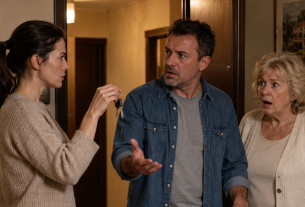
Marina even touched up her lipstick in the car before going inside. She thought it would be sweet: her husband would be sitting there with his clients, and then she would appear in a nice dress, carrying a box of his favorite éclairs from that pastry shop on Sadovaya Street where they used to go on Saturdays. Eighteen years of marriage, and suddenly she wanted to do something unnecessary and silly, the way they had when they were young.
The idea had come to her that afternoon, when Gena called and said he would be late. A business dinner with clients from Novosibirsk. Apparently, they had been trying to arrange it for a long time, and now everything had finally worked out. The Italian restaurant on Pushkinskaya, the one with the terrace.
“All right,” Marina said. “I’ll make something for myself, then.”
“Don’t wait up for me. Go to bed. I’ll be late,” Gennady replied hurriedly, as though someone nearby was waiting for him.
Marina hung up and sat in the kitchen for about five minutes, staring at the cutting board. Then she stood up, put on the gray buttoned dress her husband had once called elegant, and drove to the pastry shop.
She wasn’t suspicious. She wasn’t following him. She simply wanted to stop by for twenty minutes, leave the éclairs, kiss her husband in front of his clients, and drive home with the feeling that they still knew how to do nice things for each other.
Marina found the restaurant on Pushkinskaya quickly, parked across the courtyard, and entered from the terrace because the main entrance had been blocked off by some renovation work. A waiter carrying a tray stepped aside for her. Marina smiled at him and walked past the tables.
She saw Gena immediately, at the far wall, sitting at a round table covered with a white tablecloth. He was wearing his good shirt, the blue one he saved for special occasions, and he was saying something while leaning slightly forward, the way he only did when he wanted to make a good impression.
Sitting across from him was Lena.
Marina’s friend.
Her best friend since university. The godmother of Marina’s daughter. The woman who knew the code to their apartment building and the recipe for Marina’s signature cherry pie because she had once written it down while Marina dictated it.
And beside Lena sat a girl of about fourteen or fifteen, wearing a denim jacket, her dark hair tied back in a ponytail. She was poking at her salad with a fork and looking at Gennady the way people look at someone they see often, someone they have long since grown used to.
Marina stopped immediately, the box of éclairs still in her hands.
Gennady looked up and saw her.
His face changed into an expression she had never seen in eighteen years of marriage, not even when he wrecked her car or forgot their anniversary.
It was the face of a man who had been caught doing something that could not be explained away, joked about, or buried under enough words.
“Why did you come here?” he asked, his voice breaking halfway through the sentence.
Lena looked up and froze, holding her wineglass in midair, as though she were afraid to put it down because the sound would make the situation finally, irreversibly real.
The girl looked at Marina with curiosity. No fear. No embarrassment. There was no guilt in her eyes. She had nothing to hide, which meant no one had ever explained to her that this was the kind of situation where something was supposed to be hidden.
“I brought you éclairs,” Marina said, placing the box on the edge of the table. “Your favorite ones. From that pastry shop.”
Gena looked at the box as though it might explode.
“Marin, let me explain everything later, okay?”
“Explain what?”
She said it calmly and was surprised by her own voice, because everything inside her was already trembling, yet her tone remained perfectly steady, as though she were asking what time he was going to pick up the dry cleaning.
“Marin, please sit down,” Lena said.
“I’ll stand.”
“Please.”
“I’ll stand, Lena.”
A waiter passed by, and Marina noticed him slow down as he sensed the atmosphere. At the neighboring table, an elderly couple stopped talking.
“This is Dasha,” Gennady said.
He said it as though the name itself should explain everything.
And from the way he said it, Marina understood that the explanation would not be the kind of thing a person could recover from in a single evening.
Her legs slowly began to go numb.
“Whose Dasha?”
Gennady said nothing.
Lena put down her glass, dabbed her lips with a napkin, and looked directly at her friend. There was so much rehearsed determination in her expression that Marina immediately understood: Lena had been preparing for this conversation for a long time.
She had just imagined it happening differently.
“Mine,” Lena said. “And Gena’s.”
Dasha stopped poking at her salad.
Marina stared at the girl and began counting.
Fourteen or fifteen.
That meant it had happened right at the beginning, when Marina and Gena had only recently married, when Marina was pregnant with Seryozha, when Lena came over every weekend and helped them paint the nursery walls, and Gennady joked that Lenka was practically the third member of their family.
The third member of the family.
Marina almost laughed out loud, but caught herself and bit the inside of her cheek.
“How old is she?”
“Fourteen,” Lena answered.
“Fourteen years old,” Marina repeated.
They were not really words. They were arithmetic, assembling themselves in her head faster than she could stop it.
Their son Seryozha had been a year and a half old when this girl was born.
Back then Marina barely slept at night. She was breastfeeding. Gennady came home late and told her it was work, projects, deadlines.
Hang in there, sweetheart. It’ll get easier soon.
“You came to see me…” Marina said, staring at Lena. “You came over with pastries when Seryozha wouldn’t sleep at night. You sat in my kitchen and told me I was doing a great job, that I was handling everything.”
“Yes.”
“And you were already pregnant by my husband?!”
Lena did not look away.
For the first time in her life, Marina thought that courage could sometimes look disgusting.
“Not then. Later. Two months later.”
“Oh, well, then everything’s fine,” Marina said with a nod.
Her voice finally cracked, but she straightened and refused to lose control in front of the girl, who was looking at her with the expression of a teenager who understood that something serious was happening but had not yet learned how she was supposed to react.
Gena sat with his hands resting on his knees and said nothing.
Over eighteen years, Marina had grown accustomed to his silence.
He was silent when he was wrong.
Silent when he was afraid of a scandal.
Silent when he wanted everything to somehow disappear on its own.
“Do you pay for her?” Marina asked.
“Marin…”
“Do you pay for her? School, clothes, doctors?”
“Yes.”
“With what money?”
“Our money.”
“Our money,” Marina repeated. “Was that when you told me your bonus had been cut? Was that when you said we couldn’t afford a vacation that year? Was that when Seryozha needed braces and you said we should wait until the next quarter?”
Her husband finally looked up.
And there was no remorse in his eyes.
There was exhaustion.
That exhaustion enraged Marina more than anything else because he was not tired from guilt.
He was tired from having to hide the truth for so many years.
And now that hiding it was no longer possible, he did not look guilty.
He looked relieved.
“Are you happy?” she asked quietly.
“What?”
“You look like someone who can finally breathe again. Are you happy I found out?”
Gennady did not answer.
But from the way he rubbed his hand over his face, Marina knew she had hit the mark.
The realization was so revolting that she suddenly wanted to get outside into the fresh air.
Dasha carefully set her fork on the edge of her plate and looked at Lena.
“Mom, can I go?”
“Stay here,” Lena said.
“Let her go,” Marina said. “She doesn’t need to hear this.”
Lena looked at Marina with something resembling gratitude.
Marina almost said something that would have wiped that gratitude from her face forever, but she remained silent because the girl was still there.
And the girl was not to blame.
That was the most unbearable thing about all of it.
Everyone around her was guilty, while a child sat in the middle of it all, poking at her salad.
Dasha stood and walked toward the exit.
Marina watched her and saw the way she moved with her shoulders slightly hunched, hands tucked into the pockets of her jacket.
For one second Marina thought she was watching Seryozha walk.
The same movement of the shoulders.
The same tilt of the head.
When Dasha had left, Marina sat down in her chair because her legs would no longer support her.
“How many times have you come here?” she asked Gennady.
“Not here specifically, Marin. Once a month. Sometimes more often.”
“Once a month. For fourteen years. How many dinners is that? One hundred and sixty? Two hundred?”
“I didn’t count.”
“Well, I can count. It’s not difficult. So about two hundred times you walked out of our home and lied straight to my face. Two hundred times you told me about clients, business trips, corporate events, fishing trips, coworkers’ birthdays, and everything else?”
“Not all of those were lies!”
“Of course not. You really did go fishing sometimes, I remember. You even brought fish home. Where did you buy it, at the market on your way back?”
Gena remained silent.
And Marina realized that yes, he had bought it at the market.
Lena sat without interrupting, and there was something calculated about that too, as though she knew it was better to let Marina speak, then wait until the first wave passed.
Fourteen years of practice, Marina thought.
Fourteen years of living with another woman’s husband according to a schedule.
That was practically a university degree in patience and strategy.
“Lena, why?”
“Why what?”
“Why did you ever get involved in this? You saw how I lived. You sat in my kitchen. You knew I loved him. Were there really no other men in the world?”
Lena folded her arms across her chest and shifted slightly in her chair, as though bracing for a blow.
“I didn’t need a man. I needed him.”
“He was mine.”
“He’s not an object, Marin.”
“Not an object? Then why did you arrange everything like you owned him? A child, financial support, scheduled dinners. It sounds like a rental contract.”
Marina raised her voice, and the elderly couple at the neighboring table fell completely silent.
The waiter passing nearby abruptly changed direction.
“I didn’t want it to happen like this!” Lena said. “I really didn’t.”
“How did you want it to happen?”
“I thought it would be one time, and that would be it. But then Dasha…”
“And you decided that gave you the right to part of my husband?”
“I decided my child had the right to have a father!”
There was no defiance in her voice.
It was delivered with the polished intonation of someone who had repeated the same sentence in front of a mirror dozens of times.
Marina heard it immediately and became even angrier.
Lena was prepared.
Marina was not.
Marina had come here carrying éclairs and wearing a gray dress with buttons.
“Gena,” Marina said, turning toward her husband. “Does Sergey know?”
“No.”
“Does your mother know?”
Gennady rubbed his face again.
Marina saw his lower lip twitch.
“She knows.”
Marina leaned back against the chair.
His mother knew.
Alevtina Borisovna, who every New Year gave Marina a set of pots and told her that Marinka was the best wife she could ever have wished for her son, knew that her son had another woman and another daughter.
And she had kept silent for fourteen years.
“When she used to babysit Seryozha for us, did she already know?”
“Not from the very beginning.”
“I asked when.”
“About ten years ago.”
“For ten years your mother looked me in the eyes and knew. For ten years she came to our house for dinner and knew. For ten years she called me on my birthday and knew.”
“She didn’t want to hurt you either. You have to understand.”
“Then what did all of you want?!”
Marina’s voice finally broke.
She struck the table with her palm, making the glasses tremble.
“What did all of you want? Please explain it to me! Did you want me to quietly keep cooking borscht until retirement without ever finding out?”
The elderly man at the neighboring table turned away.
His wife made a show of staring at the menu.
“We were going to tell you,” Gennady said quietly.
“When?”
“Soon.”
“Soon? When Dasha turned twenty and came to introduce herself to me?”
Gena looked at her.
And Marina suddenly understood that he did not know the answer because he and Lena had never had a plan.
They had a habit that had lasted fourteen years and accumulated schedules, money, dinners, and a daughter.
But there was no plan.
Like a river that simply flows wherever the slope takes it.
“Do you love her?” Marina asked.
She meant Lena.
But Gennady did not answer immediately.
And from that pause Marina understood that he was deciding which of them she meant.
“I love you,” he said at last. “And I love Dasha. Those are two different things.”
“And Lena?”
“Marin, I don’t know what to call it.”
“For fourteen years you haven’t known what to call it?”
“For fourteen years I’ve been trying to make sure nobody gets hurt!”
“And how is that working out?”
He said nothing.
“No, Gena, I’m seriously asking you. How is it working out? Am I happy? Is Lena happy? Is Dasha happy? Will Seryozha be happy when he discovers that he has a sister who was hidden from him?”
Lena flinched at the word sister.
Marina noticed.
And she understood that Lena had never really thought about it.
For Lena, Dasha existed in a separate world, one where there was no Seryozha, no kitchen belonging to her friend Marina, no New Year’s pots.
And now the two worlds had collided.
For the first time, Lena could see what it looked like from the outside.
“I need to go outside,” Marina said, standing up.
She walked across the dining room, past the waiters, past the bar, past a mirror in which she caught sight of herself in the gray dress, and stepped outside.
Dasha was standing near the entrance looking at her phone.
When Marina appeared, the girl raised her head.
Several seconds of silence stretched between them, heavier than the entire conversation inside.
“Are you very angry with Dad?” Dasha asked.
Marina looked at her.
She saw Gena’s eyes.
The same color.
The same shape.
Even the same habit of narrowing them slightly after asking a question while waiting for the answer.
“Yes,” Marina said. “Very.”
“He’s a good person.”
“I know.”
“He used to read books to me when I was sick.”
Marina pressed her lips together so tightly her cheekbones ached.
Because her Gena had read books to Seryozha when he was sick too.
In the same voice.
With the same intonation.
And now it turned out that voice had never belonged only to her, or only to Seryozha.
It was shared between two families, just like the money that was always somehow short.
“Dasha, go back to your mother,” Marina said.
The girl nodded and went inside.
Marina remained alone on the pavement outside the Italian restaurant on Pushkinskaya, wearing her gray buttoned dress, without the éclairs, without the lipstick that by then had all rubbed off on her bitten lips.
She took out her phone and dialed her mother-in-law.
Alevtina Borisovna answered on the third ring.
“Marinochka, hello, sunshine.”
“Alevtina Borisovna, I know everything.”
The pause lasted four seconds.
Marina counted them.
“You know what, Marinochka?”
“About Dasha. About Lena. About fourteen years.”
Her mother-in-law fell silent.
It was so quiet that Marina could hear the television in the background, some talk show full of shouting and applause.
“Marinochka, come over.”
“No.”
“Come over. We’ll talk!”
“I have nothing to talk to you about, Alevtina Borisovna. I just needed to hear that you weren’t going to tell me it wasn’t true.”
Her mother-in-law remained silent.
Behind that silence stood ten years of protecting the secret.
Ten years of dinners.
Ten years of birthday calls.
Ten years of the word “Marinochka,” with a lie the size of an entire human life hidden behind it.
“He’s my son,” her mother-in-law said at last. “What was I supposed to do?”
“Tell me. At least tell me!”
“I was afraid.”
“And I wasn’t supposed to be afraid? I’m not allowed to be afraid?”
Marina ended the call and put the phone back into her bag.
Through the restaurant window she could see Gennady sitting at the table, rubbing the bridge of his nose while Lena leaned forward and said something to him.
Dasha had returned and was sitting beside her mother.
The three of them looked like a family.
And that was the truth.
They were a family.
A parallel one.
A spare one.
A secret one.
A family that existed in all the gaps Marina had filled with borscht, parent-teacher meetings, and evenings spent waiting for him in the kitchen.
She got into the car and started the engine but did not drive away.
She sat staring at the steering wheel, at her hands, at her wedding ring, which was slightly too large and always turned so that the stone faced downward.
Seryozha called.
“Mom, are you home? I wanted to stop by for my jacket.”
“No, I’m in town. Go ahead. The jacket’s hanging in the hallway.”
“Is everything okay? Your voice sounds strange.”
“Yes, everything’s fine, Seryozha. We’ll talk later.”
“Okay.”
He hung up.
Marina thought about the fact that somewhere in this city her eighteen-year-old son had a fourteen-year-old sister with his walk and Gena’s eyes.
And he knew nothing about her.
Marina did not yet know how she would tell him.
Or whether she would tell him at all.
Because the truth was like a stone.
You could put it in someone’s pocket.
Or tie it to their ankle.
Gennady came out of the restaurant about ten minutes later.
He saw her car, walked over, and tapped on the window.
Marina lowered it.
“Let’s go home,” he said.
“Which of the two apartments?”
“Marin…”
“Does she have an apartment? Did you buy her one?”
Gennady did not answer.
And Marina understood that he had.
It had been bought with the money she had been looking for five years earlier when they wanted to make a down payment on a country house.
Back then he had told her an investment had gone bad.
The market had fallen.
These things happened.
“Get in,” Marina said. “Let’s go.”
He got into the car.
They drove in silence.
Marina drove carefully and obeyed every traffic rule because she needed something to hold on to, and that evening the steering wheel was the only thing she could still control.
At home, she hung the keys on the hook, took off her shoes, walked into the kitchen, and turned on the kettle.
Her husband stood in the doorway for a long time, watching her.
“Are you going to leave?” he asked.
“Me? I’m going to leave? Are you seriously asking me that?”
“I mean leave me.”
“And which one of us are you going to leave, Gena? Have you decided yet, or do you need another fourteen years?”
He leaned against the doorframe and closed his eyes.
That was when Marina noticed his fingers trembling slightly.
At any other time she might have felt sorry for him.
But now pity was the last thing she could afford.
“I’m not going anywhere,” Gennady said. “My home is here.”
“And what’s over there?”
“My child is there.”
“Your child is here too, Gena. And your wife. The wife who spent eighteen years believing she was living in a real marriage when she was actually living inside a lie.”
The kettle boiled and clicked off.
In the silence the sound was so loud that both of them flinched.
Marina took out one cup, poured herself tea, and sat at the table.
Gennady stood there a little longer, then went into the bedroom.
Marina heard him sit down on the bed and heard the springs creak.
She thought that tomorrow she would have to call her mother and tell her everything.
Her mother would probably say she had always sensed there was something wrong with Gena.
And that would be a lie, because her mother adored Gennady.
Marina sat in the kitchen drinking tea and thinking about the box of éclairs she had left on the restaurant table.
The waiter had probably cleared it away by now.
Maybe tomorrow someone from the staff would eat one of the éclairs that had been meant for her husband.
And they would never know what a long and ugly story was hidden inside that sweet cream.