The documents were lying on the edge of the coffee table — a folder with ties, the kind Miron usually put away in the drawer of his writing desk. That evening, he had been in a hurry somewhere and had apparently forgotten it. Miroslava had no intention of opening it. She was simply clearing unnecessary things off the table, picked up the folder to put it back in its place, and the tie accidentally came undone.
She would have tied it back up and put it away. But the papers spilled out a little, and Miroslava automatically began gathering them — and saw the name.
Olga Viktorovna Seryogina.
Miroslava froze. She turned the page over. Read it again. Then found the next document. Then another one.
She sat on the floor in the middle of the living room of their new apartment and read the papers for about twenty minutes. Then she got up, went to the kitchen, poured herself some water, and drank the glass to the bottom. She came back. Read it again — this time slowly, paragraph by paragraph, to make absolutely sure she wasn’t mistaken.
Half of the apartment was registered in Miron’s mother’s name.
Not in Miroslava’s name. Not in both their names. In the name of Olga Viktorovna Seryogina — a person who had nothing whatsoever to do with the mortgage.
It was March outside. The snow had almost melted, but it still froze at night, and the glass was cold on the other side if you touched it with your palm. Miroslava touched it — just to feel something concrete, because inside her there was something unclear, something that had not yet formed into a definite emotion.
She and Miron had been living together for four years already. For three years before the mortgage, they had rented apartments — first a small studio in a residential district, then they moved into a decent two-room apartment closer to the center. Miron worked at a logistics company as a mid-level manager and earned about ninety thousand. Miroslava was a curriculum specialist at an educational center, earning seventy-five thousand, and sometimes took on private students, which added another twenty thousand in a good month.
They lived normally. They counted their money, saved — not quickly, but methodically. They argued about neighborhoods for a long time: Miron wanted to be closer to his parents, while Miroslava wanted somewhere with the metro within walking distance. In the end, they found a compromise. An apartment in a new building, on the fourth floor, with a good courtyard. Not perfect, but their own.
They took out the mortgage in February of the previous year. Back then, Miron said it would be better to register everything in his name — the bank had already approved the loan under his name, the interest rate was good, and there was no need to redo the application. Miroslava argued a little — she wanted to be included in the documents, so there would be shared responsibility and shared rights. But Miron explained patiently: it was just a formality, they would sort it out later, the apartment was theirs anyway. Miroslava agreed. She thought: well, we’ll transfer a share later, no big deal.
But “later” never came.
She brought up the subject a couple of times — without pressure, just saying, “Miron, let’s finally deal with the documents, make an appointment with a notary.” Every time, Miron answered the same way: yes, yes, we need to, I just haven’t gotten around to it, work has been overwhelming. Miroslava didn’t insist. She trusted him.
For a year, she transferred half of the mortgage payment — twenty-two thousand every month. Plus the renovation: they were doing it themselves, step by step. Miroslava bought the tiles; Miron bought the paint. Miroslava ordered the laminate flooring and arranged things with the contractor. Miron went to the warehouse for profiles. Together, they chose bathroom faucets and argued about the shade of the kitchen walls — Miroslava wanted light gray, Miron insisted on white, and in the end they chose something in between.
All of it was theirs together. Miroslava had never doubted that once.
Until that evening.
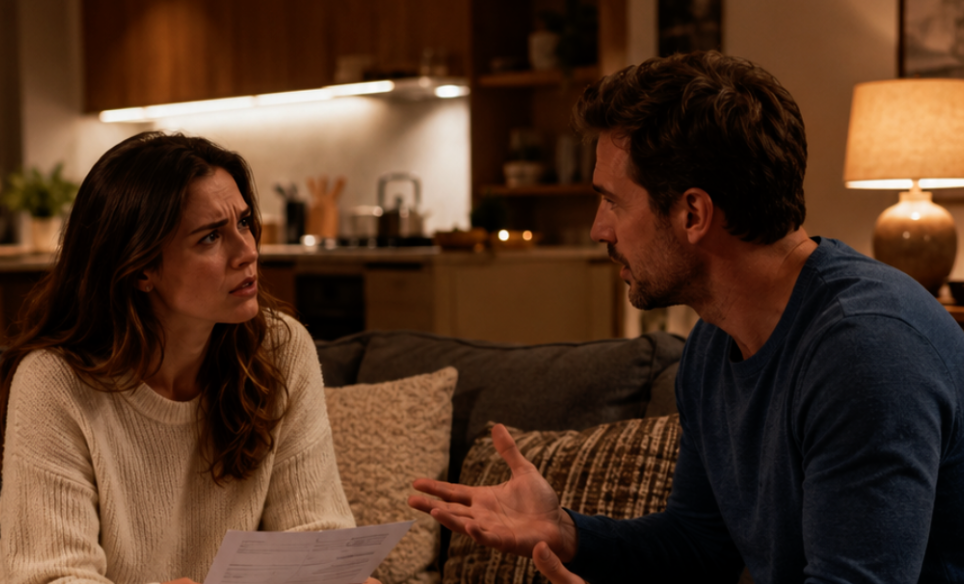
Miron came home at around ten. He opened the door and called from the hallway, “Hi, I’m home.” Miroslava did not answer. Her husband went into the kitchen, opened the refrigerator, and took something out. Then he looked into the living room and saw his wife sitting on the sofa with the documents on her lap.
He stopped in the doorway.
Miroslava looked up.
“What is this?” she asked, lifting one sheet slightly.
Miron stared at the papers for a second. Then he walked into the room and sat down in the armchair opposite her.
“You opened the folder.”
“The tie came undone.” Miroslava looked at her husband steadily. “Miron, what is this?”
“Mira, it’s…” He grimaced. “It’s not that easy to explain.”
“Olga Viktorovna Seryogina is the owner of half of our apartment. Is that easy to explain, or difficult?”
Miron rubbed his forehead.
“Mom asked me. She was afraid that if something happened to me, everything would be lost, that the apartment would end up who knows where. It was important to her to have something formal.”
“Mom asked,” Miroslava repeated. Her voice was calm, but there was something in it that kept Miron from smiling. “And you didn’t ask me.”
“I wanted to tell you later.”
“Later.” Miroslava looked at the papers. “Miron, for twelve months I’ve been transferring you twenty-two thousand. Do you remember that?”
“Of course I remember.”
“I also bought the tiles for the hallway and bathroom — about thirty thousand. Laminate with installation — forty-five. Faucets, curtain rods, light fixtures — separately. Do you remember all of that?”
“You’re blowing this out of proportion…”
“I’m blowing it out of proportion?” Miroslava tilted her head slightly. “For a year, I invested money in an apartment that doesn’t belong to me. I didn’t know that. You knew and kept quiet. What exactly am I blowing out of proportion?”
Miron stood up. He paced around the room — from the window to the door and back again. It was his habit during uncomfortable conversations: to move, so he wouldn’t have to stand still under someone’s gaze.
“Miroslava, understand. We’re family. Mom is family too. The share in her name is just a safety measure. She’s not going to claim any real control over the apartment.”
“What is she going to claim?”
“Nothing. It’s a formality.”
“A formality worth half the apartment?”
“It’s temporary,” Miron said. “When Mom calms down, when she understands that everything is stable, we’ll transfer it.”
“The way you promised before that you’d transfer a share to me?”
Silence.
Miron sat down again. He looked to the side — at the window, at the wall, anywhere but at his wife.
“Miroslava, I understand that you’re angry right now. But think about it. The apartment isn’t going anywhere. We live here. This is our home.”
“Our home is when both people are in the documents,” Miroslava said. “You and your mother have half. I have nothing. And yet I’m paying.”
“Miroslava…”
“Explain to me how this works: you get my money and her share, while I keep transferring payments and don’t ask questions?”
“It’s not like that.”
“Then how is it?”
Miron rubbed his forehead again. Something in him resisted — not with anger, but with that particular stubbornness people have when they know they’re wrong but have invested too much in their version to back down.
“Miroslava, your money goes toward our mortgage. Toward our apartment. Mom doesn’t live here and never will.”
“Then why does she need a share?”
“I told you — as a safety measure.”
“Against whom?” Miroslava placed the folder on the coffee table. “Against me?”
Miron did not answer.
And that silence — brief, literally three seconds — said more than any answer could have. Miroslava looked at her husband, and something inside her fell into place. It didn’t break; it settled exactly where it belonged: cold, clear, and without unnecessary words.
“You registered a share in your mother’s name?!” Miroslava said. “Well then, split the expenses with her too!”
“Miroslava, this isn’t serious,” Miron said, jerking his shoulder.
“It couldn’t be more serious. Olga Viktorovna is an owner. Let her pay like an owner. I’m not one. Which means I won’t be paying anymore.”
“Do you understand what will happen to the mortgage without your part?”
“I do. That’s why you should either redo the documents or come to an agreement with your mother.”
Miron stood up abruptly — so abruptly that the armchair shifted slightly.
“You want to destroy everything over a piece of paper? Over a formality? This is a marriage, do you understand? A family. You can’t just see a document and immediately do this.”
“Miron,” Miroslava said calmly, “this is not a piece of paper. It is twenty-two thousand every month. It is thirty thousand for tiles. It is laminate flooring that I spent three evenings choosing because I wanted things to be right. It is my year.” Miroslava paused. “You hid information from me about the documents for the apartment I was investing money in. For a year. That is not a formality. That is deception.”
“I didn’t deceive you.”
“You hid it.”
“Those are different things.”
“No,” Miroslava said. “They are the same thing.”
Miron looked at her. Then he lowered his gaze. He went into the kitchen — she heard the tap open and water rushing. Miroslava remained seated in the living room.
She thought about how many times over the past year she had felt a slight unease — how he dodged conversations about the documents, answered vaguely, changed the subject. Every time, she had told herself: well, he’s busy, well, later. She hadn’t wanted to start a conflict over nothing. Only it turned out the conflict hadn’t been over nothing — she simply hadn’t known what exactly lay beneath it.
Miron came back. He sat down at the table, not in the armchair — at the dining table, as if he needed the distance.
“Miroslava, let’s talk calmly,” he said. “I’m willing to transfer it. Give me time to have a conversation with my mother. I need to explain it to her.”
“How much time?”
“Well… a month. Maybe a little more.”
“A month,” Miroslava repeated. “Miron, you put this conversation off for a year. First about my share. Now about your mother. You want me to give you another month?”
“It’s reasonable not to rush…”
“I’m not going to wait,” Miroslava said. “And I’m not going to pay the mortgage this month either. You want to solve the document issue — solve it. When you do, and I see my share in the papers, I’ll go back to making payments.”
“That’s blackmail.”
“That’s my money,” his wife replied. “And I have the right to decide where it goes.”
Miron looked at her for a long time. Then something in him changed — the part that had been trying to negotiate seemed to grow tired.
“You’re making a problem out of something that isn’t a problem,” he said. “The apartment is ours. Mom doesn’t claim the housing. Everything is fine. You just don’t understand how this works.”
“Explain it.”
“Miroslava, come on, you’re an adult. Family helps each other. Mom was afraid; I gave her peace of mind. You pay into the family budget. Nobody is stealing anything from anyone.”
“Miron,” Miroslava said, “you just said I pay into the family budget. But I’m not in the documents. So I pay — but I have no rights.”
“The rights of a wife…”
“The rights of a wife end the moment the husband decides that it’s more convenient that way.” Miroslava rose from the sofa. “I saw these documents. I understand what is written there. And I understand that over the course of a year, you had many chances to tell me the truth. You didn’t.”
Miron fell silent.
“I’m going to Yana’s,” Miroslava said. “I need to think.”
“Right now?”
“Right now.”
She packed her bag quickly — not everything, only what she needed for a few days. She took the documents too — not all of them, only the ones related to the payments. She had bank statements on her phone; she checked. Miron stood against the hallway wall and watched his wife put on her coat.
“Miroslava, don’t leave like this. Let’s talk properly.”
“We talked,” Miroslava said, fastening her jacket. “You explained your position. I understood.”
“And?”
“And I need to think.”
She left. The door closed behind her without a slam — the lock simply clicked.
Yana’s place was warm and smelled of something boiled — buckwheat, perhaps. Her friend opened the door, saw Miroslava’s face, and immediately stepped aside to let her in.
“What happened?”
“I’ll tell you. Give me tea first.”
They sat in the kitchen until one in the morning. Miroslava talked, Yana listened and sometimes asked short clarifying questions. Then they took out a laptop and started calculating. Twenty-two thousand multiplied by twelve — two hundred sixty-four thousand in mortgage payments. Plus renovation costs: Miroslava reconstructed them from memory and from messages with stores — tiles, laminate, installation, fittings, light fixtures, curtains. Altogether, it came to about one hundred twenty thousand.
In total — almost four hundred thousand rubles invested in an apartment where Miroslava was not an owner in any form.
“Can this be proven?” Yana asked, looking at the numbers.
“The transfers — definitely. The receipts — I have some, and I need to search my email for the rest.”
“You need a lawyer.”
“I know.”
Yana opened the browser.
“I have a contact. Svetlana Arkadyevna — family law, very good. I’ll write to her in the morning and arrange a meeting.”
Miroslava nodded. She looked at the screen with the numbers, then out the window — at the dark street and the scattered streetlights.
“How are you, really?” Yana asked.
“I don’t know yet,” Miroslava answered honestly. “I’m not especially angry. It just feels like I’ve been looking in the wrong direction for an entire year.”
“You were looking where people look when they trust.”
“Maybe.” Miroslava wrapped both hands around her mug. “I just thought we had agreed on one thing, but it turned out we had agreed on different things.”
Miron called three times that night. Miroslava didn’t answer — not out of anger, simply because she wasn’t ready for a conversation. In the morning, a message came: Come back, we’ll talk. I’m ready to sort this out.
Miroslava replied briefly: When I have a lawyer, we’ll talk.
They met with Svetlana Arkadyevna two days later. The lawyer turned out to be a woman of about fifty, laconic and precise — she asked questions to the point, without being distracted by anything unnecessary. Miroslava told her everything. She laid out the bank statements, screenshots of transfers, and several receipts she had found in her email.
“The situation is not simple,” Svetlana Arkadyevna said after reviewing the papers. “The apartment is registered in your husband’s and his mother’s names. Your mortgage payments are a contribution to marital property. Under the law, when dividing property, the court takes into account each party’s actual contribution, including confirmed payments.”
“So I can get the money back?”
“Part of it, yes. Not all of it, but a significant part, if the claims are drafted properly.” The lawyer made a note. “The renovation is more complicated: you’ll need receipts, correspondence with contractors, proof of payment. Gather what you have. Don’t invent what you don’t.”
“I understand.”
“Have you already decided about divorce?”
Miroslava was silent for a second.
“Yes.”
“Then we act in parallel: a divorce petition and a claim for division of property taking your investments into account. Olga Viktorovna will also be involved in the process as a third party.”
Miroslava filed for divorce a week later. By that time, Miron had come to Yana’s several times — Miroslava spoke with him downstairs by the entrance, without inviting him up. Miron spoke in different ways: once he pleaded, once he got angry, and once he came looking like a man who had made a decision.
“I’m ready to transfer a share to you,” he said during their third meeting. “Mom agrees.”
“Miron,” Miroslava replied, “I’ve already filed for divorce.”
He was silent.
“Because of a document?”
“Because of the year you hid it.” Miroslava stood three steps away from him, and there was neither anger nor pity in her — only exhaustion and something like clarity. “You could have told me in the first month. You could have told me after six months. I would have been angry, we would have argued, but you could have told me. You didn’t. And every time I brought up the documents — you dodged it.”
“I was afraid of your reaction.”
“That is honest,” Miroslava said. “But it is not an excuse.”
Miron stood there a little longer. Then he nodded — like a person who had understood something he had not wanted to understand — and went to his car.
The court process dragged on for four months. At first, Miron disputed almost every point — not aggressively, more out of inertia, as if he hoped Miroslava would grow tired and back down. Olga Viktorovna came to one hearing and tried to explain to the court that the share had been a family safety measure, not a claim to property. Svetlana Arkadyevna calmly asked her: if it was a safety measure, why had the wife not known about it for a year? Olga Viktorovna had no answer.
In the end, the court recognized Miroslava’s contribution as confirmed and ordered Miron to pay her an amount covering most of the mortgage payments and part of the renovation expenses. Not all of it — some receipts really had not been preserved — but enough for the difference to matter.
When Miroslava came out of the courthouse, Svetlana Arkadyevna shook her hand and said simply:
“You held up well.”
“Thank you,” Miroslava replied.
It was warm outside — early July already, and the trees were in full leaf. Miroslava walked to a bench near the fountain and sat down. She took out her phone. Opened the banking app and looked at her balance. The money under the writ of execution would come later, but the fact of the decision was already here.
She had rented an apartment a month earlier — small, on the outskirts, but convenient. The landlady turned out to be a normal woman; they signed the contract without unnecessary fuss. The first thing Miroslava did when she moved in was place a small potted plant in the kitchen. Just because she wanted to.
Yana wrote that evening: So how did it go?
Miroslava answered: Fine. I won.
Yana sent back a long string of symbols where some meaning could still be guessed, and Miroslava smiled.
She opened the notes on her phone — the list she had made at the very beginning of all this. The first item was: deal with the documents. Miroslava put a check mark next to it.
The second item: rent my own place. Check mark.
The third: do not invest money in anything where my name is not included. This was not so much an item on a to-do list as a rule. She did not cross it off — she simply circled it.
On the way back, she stopped at a store and bought proper food — not in a rush, but calmly, with a shopping cart, choosing what she liked. She paid. Went outside with her bags.
That evening, she cooked something simple, ate, and washed the dishes. She looked out the window — at the courtyard, at the children’s playground, at the swings. A light was on at the neighboring table in a neighboring apartment, and someone there was also living their own life, and no one else particularly cared.
Miroslava put the kettle on. Took out a mug. Poured the tea.
Everything was hers — the mug, the silence, the decision about what to do next. Not much, but enough to begin.