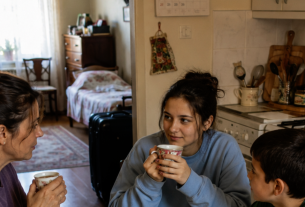
“Take your shoes off, quickly. I’ve just washed the floors. I don’t live on a highway,” Nina Vasilyevna’s voice came from the room, so confident, as if she hadn’t come as a guest, but had been registered there since morning, paid the utilities, and even argued with the plumber about the riser.
Olga froze in the hallway with two supermarket bags in her hands. Her fingers cramped from the weight. Her back ached after her shift as if someone had screwed a rusty self-tapping screw into it. There was only one normal human thought in her head: a shower, silence, and not seeing anyone for at least an hour.
But instead of silence, her apartment was filled with that very domestic noise that later makes people’s eyelids twitch: the television was blaring, dishes were clinking in the kitchen, someone was laughing with a stranger’s laugh, as if celebrating a successful robbery.
Along the wall were unfamiliar bags, checkered duffels, boxes, a child’s plastic laundry rack — although there were no children within twenty meters. On the rug lay a pair of men’s size-forty-five sneakers, dirty as someone’s conscience.
Olga slowly lowered the bags to the floor.
“What is this?” she asked into the emptiness, although she already understood everything.
Sveta, the wife of Viktor’s younger brother, poked her head out of the kitchen. Her cheeks were red, Olga’s apron was on her body, a ladle was in her hand, and on her face was the expression of a woman who had settled in so well in forty minutes that in a little while she would start rearranging the furniture.
“Oh, Olya, you’re home? We’re making soup. Nina Vasilyevna said you have a big pot, a good one, thick-bottomed. We didn’t have anything like that in our rental.”
“You no longer have a rental,” Olga said dryly. “Am I understanding correctly?”
Her mother-in-law slowly came out of the room, wiping her hands on a towel that, of course, was not hers either.
“You understand correctly. Roma and Sveta have nowhere to live. The landlord sold the apartment, gave them a week, and that’s that. We decided they’ll stay here for now. In the big room. It’s empty anyway. Two rooms are enough for you and Vitya. I don’t know why you worship empty square meters.”
Olga looked at her the way people look at a utility bill after the holidays: without illusions and with growing fury.
“We decided? Who is ‘we’?”
“Family,” Nina Vasilyevna answered with pleasure. “Normal people help in situations like this. Or do you, as usual, have your own rules for everyone?”
Roman’s voice came from the sofa in the living room. He was sprawled there in sweatpants, flipping through channels, not even trying to pretend he felt awkward.
“Olya, don’t start right away, huh? The day’s been lousy enough as it is. We’ve got nowhere to go right now. Vitya said we’d stay a couple of months, I’ll find a job, we’ll pay off the debts, and move out. Like normal people.”
“Like normal people?” Olga even gave a short laugh. “Like normal people is when you call and ask. Not when I come home and find a whole camp with pots in my apartment.”
Viktor appeared from the bathroom, wiping his hands so hastily it looked as if he had been washing not his hands, but traces of a crime.
“Olya, why are you starting from the doorway? Can we be calm? I wanted to tell you, it’s just that you were at work, then Mom arrived, then Roma and Sveta, all their things, nerves…”
“So you decided not to warn me at all? Excellent plan. Husband of the year, truly.”
Viktor sighed, looking at her with that expression people use when asking you not to make a scene, even though the scene had already been arranged without you.
“Listen, the situation is complicated. They really have nowhere to go. We can’t throw them out on the street, can we? You’re not a monster.”
“Don’t substitute concepts, Vitya. I’m not a monster. I’m a person who came into her own apartment and saw that other people were making decisions about it without her.”
Nina Vasilyevna snorted.
“Oh, listen to her. ‘Her own apartment.’ How long are you going to play that trump card? You’ve been married for five years, by the way. Your husband isn’t a lodger here either.”
“My husband is not a lodger,” Olga agreed. “But he is not the head of the housing department either.”
Sveta put the ladle on the table with the offense of a person who had not been allowed to finish playing mistress of the house.
“Olya, why are you being like this? It’s not like we came here out of joy. Do you think this is pleasant for us? Everything is falling apart for us as it is. Roma has no job, I slave away at a pickup point for pennies, the landlord threw us out. Nina Vasilyevna said family would help. If I were in your place, I would understand.”
“It would be hard for you in my place,” Olga said. “There, you first have to buy this apartment yourself, pay off the remaining mortgage, renovate it, pay for the furniture, and only then listen to speeches about how ‘family helps.’”
Roman tore himself away from the remote and stood up.
“Hey, enough showing off. You’re not the only one who’s had to hustle in life. Vitya contributed too. With his hands and with money. So don’t act like we came to your museum.”
“What exactly did he contribute?” Olga turned to her husband. “Come on, Vitya. Say it out loud. I’m genuinely interested. Especially the part about money.”
Viktor grimaced.
“Why bring up accounting right now?”
“Because other people’s suitcases have already been brought in here. This is exactly the time for accounting.”
Nina Vasilyevna went on the attack, as always moving from morality to insults while bypassing common sense.
“God, how petty you are. Everything is about money with you. That’s why you don’t have children, by the way. You count everything, measure everything, weigh everything. You never built a family because your heart is cold.”
Olga slowly turned her head toward her.
“Don’t you dare get into things that don’t concern you.”
“What doesn’t concern me?” her mother-in-law flared up. “My son walks around crushed because beside him is a woman with an expense spreadsheet instead of a soul. You can’t even help relatives, greedy as a cashier before an audit.”
“Mom,” Viktor threw out nervously, “don’t…”
“No, I will!” she cut him off. “Let her hear it. Everything for herself, everything under herself. Her apartment. Her money. Her life. Then what does she need a husband for? For show?”
Olga was silent for several seconds. And that silence was dangerous: not screaming, not hysteria, but the silence of a person who has already made a decision inside, while everyone else still thinks out of habit that they can pressure her.
“Good,” she said. “Then let’s also stop doing things for show. Who gave you permission to occupy the big room?”
“I did,” Viktor answered, already realizing it was the wrong answer, but too late.
“Who gave you permission to touch my things?”
“No one touched anything…”
“My apron is on Sveta. My towels are with Nina Vasilyevna. My pot is on the stove. My television is in Roma’s hands. Again: who gave permission?”
Roman smirked.
“Why are you acting like an investigator? We’ll stay for a while and leave.”
“No,” Olga said. “You won’t stay.”
Sveta blinked.
“What do you mean?”
“I mean exactly what I said. Pack your things and leave.”
Silence hung in the air, the kind after which everyone’s posture suddenly changes. Even the television seemed to quiet down.
“Are you out of your mind?” Roman was the first to recover. “We’ve already arrived.”
“Congratulations. Now leave.”
“Olya, stop it,” Viktor hissed. “Don’t turn this into a circus.”
“You already turned it into a circus without me. I’m simply closing the show.”
Nina Vasilyevna stepped closer.
“Who do you think you’re talking to like that? I’m thirty years older than you.”
“And?” Olga asked tiredly. “Does that give you the right to move people into my apartment?”
“Into your shared apartment!” her mother-in-law snapped.
“No,” Olga said. “Into mine.”
And without raising her voice, she walked toward the nearest suitcase.
“Olya, don’t touch that!” Sveta squealed. “There’s a dinner set in there!”
“Wonderful. It will have something to remember on the stairwell too.”
She rolled the suitcase to the door, opened it, and put it out on the landing. Roman rushed after her.
“Are you even normal?! There are things in there!”
“Yes. Yours. Outside is a more appropriate place for them.”
The second duffel hit the tile with such a sound that someone behind a neighboring door cautiously clicked open the peephole.
“Vitya!” Sveta shrieked. “Are you going to do something or not?”
Viktor grabbed Olga by the elbow.
“Enough! You’re crossing every line!”
She sharply pulled herself free.
“You crossed the lines when you came here without asking. Now listen carefully. Either in five minutes all your relatives are outside the door on their own, or I call the district police officer and explain that strangers entered my apartment and refuse to leave. Choose an option, peacemaker.”
“Who do you think you’re scaring?” Roman laughed, but without his previous ease. “This is my brother’s home too.”
“Should I show you the documents?” Olga asked. “Or is it enough for now that you’re here with no legal standing and insolent faces?”
Nina Vasilyevna turned blotchy red.
“You little filth. Who needs you with your apartment? Vitya, tell her! Put her in her place!”
And then Viktor snapped. Not threateningly, not manfully, but the way people snap when they have considered themselves clever for too long and suddenly realize their plan is sinking.
“Because it’s impossible to live with you!” he shouted. “Everything always has to be your way! Everything under control! You can’t even breathe without reporting! My mother and brother asked for help, and you immediately become hysterical! You’re the reason no one comes to you like a human being anymore!”
Olga looked at him closely, almost calmly.
“Now that is interesting. Continue.”
“What is there to continue? Everything is clear!” Viktor jerked his chin. “I’m not furniture here. And you shouldn’t be the only one making decisions in a family. This is my family, my relatives. And if they need help, they will live here. I said so.”
“So you ‘said so’ in an apartment you didn’t buy?”
“I’ve lived here for five years!”
“Many cockroaches live longer,” Olga cut him off. “That doesn’t grant them ownership rights.”
Sveta gasped. Roman cursed. Nina Vasilyevna crossed herself as if her personal iconostasis had been insulted.
“That’s it,” Olga said. “The conversation is over. Out.”
She picked up another bag. Roman lunged to intercept it, but Viktor stopped him.
“Wait.”
Something different suddenly sounded in his voice. Not anger. Calculation.
“All right, Mom, Roma, go out for now. I’ll talk to her myself.”
“Vitya, are you serious?” Sveta protested.
“Go out, I said.”
The relatives crawled out into the stairwell with curses, noise, and the look of people being expelled from a family estate. Nina Vasilyevna managed to call Olga shameless, barren, stone-hearted, and a couple of other words usually spoken by people unaccustomed to paying for their own accommodation. Finally the door slammed shut.
The apartment became quiet. Unpleasantly quiet. Like after a fight that has not yet been acknowledged as a fight.
Viktor stood in the corridor, his hands shoved into his pockets.
“Happy?” he asked. “You humiliated me in front of everyone.”
“You?” Olga asked. “Funny. You humiliated yourself perfectly well. I only switched on the light.”
“Do you understand that after this we won’t be able to live normally anymore?”
“And before this, in your opinion, we could?”
He looked at the floor, then at the wall, then anywhere except at her.
“You always thought you were above all of us. Especially my family.”
“No. I always thought adult people should take responsibility for their own lives. For some reason, your family always found that thought offensive.”
“Because you don’t understand what relatives are!”
“But I understand very well what parasitism is.”
The doorbell rang. Once, briefly, businesslike.
“Don’t tell me your mother forgot another bag,” Olga threw out and went to the peephole.
On the landing stood a young man with an envelope and a tablet.
“Olga Vladimirovna? Registered letter. Please sign.”
Viktor jerked so sharply as if he had been shocked.
“Give it here,” he said, stepping toward the door.
But Olga had already opened it, quickly signed, took the thick yellow envelope, and slammed the door before he had time to move in.
“What is it?” Viktor asked too quickly.
She opened the envelope. Several sheets, official font, a copy of a statement of claim, a court notice. Olga read the first line, the second — and felt not a blow, no. The opposite. An unpleasant, cold clarity. Like when you can’t understand for a long time where the leak in the apartment is coming from, and then finally see the crack.
“So that’s what this is,” she said.
“What?” Viktor’s voice went dull.
“You filed a lawsuit for division of property.”
He was silent.
“And judging by today’s circus, you were counting on me freaking out, leaving the apartment, and all of you settling here as ‘temporarily residing relatives.’ So that later you could pretend I left on my own, while you peacefully lived in the family home. Beautiful. Even too beautiful for you alone. Was this your mother’s idea?”
“Don’t start,” he muttered.
“No, explain it. I would very much like to hear exactly how I drove you to the necessity of squeezing out half of an apartment I bought before marriage.”
He lifted his head.
“And are you sure it was before marriage? Are you sure everything there is as ironclad as you think?”
Olga looked at him and suddenly even smiled. Not cheerfully. With pity.
“So that’s what you were betting on. That I would get scared.”
“I have rights,” he said with emphasis. “We lived together. Did renovations. I invested. And in general, legally speaking, it’s not so clear-cut.”
“Really?” Olga went into the bedroom, pulled out the bottom drawer of the dresser, took out a dark-blue folder, and came back. “Well, let’s examine this ambiguity.”
She threw the folder onto the cabinet between them.
“Here is the purchase agreement. The date. The registry extract. Payment receipts. Bank statements from the account where the money had been sitting before our wedding. Here is a notarized certificate. Here is the remaining mortgage balance, which I also paid off myself. And now you can tell me exactly with what part of your body you divided something that never belonged to you.”
Viktor opened the folder. He turned one page, then another, then a third. His face turned gray, like February snow by an apartment entrance.
“When… when did you prepare all this?”
“When I realized you too often had ‘unexpected’ expenses for your brother. Then when you suddenly started asking who was registered here, who owned the place, where the documents were kept. And completely finally when your mother asked three weeks ago whether we had ever thought of ‘expanding by selling this apartment.’ She asked so carefully, as if it wasn’t her asking, but the weather.”
“You didn’t trust me,” he forced out.
“And I was right not to.”
He slammed the folder shut.
“All right. Fine. The apartment didn’t work out. But don’t think you’ll come out of this all innocent. I can tell people a lot of interesting things. About what kind of wife you are. About how you talk to people.”
“Tell them,” Olga nodded. “Especially about how I didn’t let your brother climb onto my neck. That really is a terrible trait.”
“You’re being clever now, but you’ll end up alone.”
“Better alone than in this family choir conducted by your mother.”
He stared at her for a long time, angrily, as if trying to find the familiar Olga who would keep silent for the sake of peace. But that Olga had ended about twenty minutes ago, along with the first suitcase on the stairwell landing.
“Should I pack my things?” he finally asked.
“Yes.”
“Right now?”
“Yes.”
“And you’ll just cross everything out like that?”
“No, Vitya. You crossed it out. I simply stopped erasing after you.”
He went into the bedroom, opened the wardrobe, and began throwing clothes into a bag with the deliberate carelessness men use to cover humiliation. Olga stood by the window and suddenly caught herself feeling not pain, not tears, not the familiar “maybe we can still talk,” but an empty place inside. Clean. Like a room after an old broken wall unit has been removed.
“Leave the keys,” she said without turning around.
“I’ll come back for the rest.”
“By agreement. Not with your mother, but with me. And not with your brother as a support group.”
“You’re such a…”
“The exit is over there.”
He threw on his jacket and picked up the bag.
“You’ll regret this later,” he said from the doorway.
“Possibly. But not in the way you’re dreaming of.”
When the door closed, Olga sat down right in the hallway on the bench and laughed. Briefly, nervously, angrily. Not from happiness. From the absurdity. From the fact that for five years she had tried to preserve a family, while the other side had been conducting internal negotiations over square meters the whole time.
Two days later, Nina Vasilyevna called.
“Pick up the phone, I know you’re home.”
Olga answered.
“I’m listening.”
“I’m calling you nicely. Don’t ruin Vitya’s life. Withdraw the papers from court, make peace, and stop starting a war.”
“I didn’t start the war.”
“Oh, don’t start. A man stumbled. It happens. You’re no gift either. Dry, prickly, everything by the ruler. He withered with you.”
“And that’s why he decided to sue me for the apartment?”
“Because he felt humiliated! A man needs ground under his feet.”
“Then let him earn his own ground, Nina Vasilyevna. That usually helps.”
“You’ll finish him off, do you understand? He already doesn’t have a proper job, and now he has no housing either.”
“Notice, he has neither of those things not because I kicked him out. But because he is an adult man whom everyone kept carrying in their arms. Including you.”
“Don’t you dare teach me!”
“I’m not teaching. I’m stating facts.”
“You think because you have money, you defeated everyone? You have no happiness and never will.”
“And you think that if you gather as a crowd, you can declare someone else’s property yours. That doesn’t work either. You’ve already tested it.”
In court, Viktor arrived with the face of a martyr. Beside him was his mother in a black jacket, as if she had come not to a civil hearing, but to a funeral for her son’s pride. Roman also dragged himself there, although he was about as useful as a cracked stool: noise, but no support.
“Your Honor,” Viktor began, “during the marriage, I invested substantial funds and labor into improving the disputed property…”
Olga sat next to her lawyer and thought about how some men can suddenly remember the word “substantial” when the matter is no longer marriage, but square meters.
The lawyer leaned toward her.
“Stay calm. The artistic part will end soon.”
When Nina Vasilyevna was given the floor, she got so carried away it was as if she had finally stepped onto the stage she had always dreamed of.
“I helped them from the first day! I brought money! I personally bought appliances for them! I was like a real mother to this home!”
The judge looked up.
“Do you have supporting documents?”
“What documents between our own people? We did things like decent people!”
“I see,” the judge said with the facial expression doctors have when listening to advice about garlic for pneumonia.
Roman butted in:
“Vitya did everything there! The walls, the wiring, everything…”
“The electrician was officially hired,” Olga’s lawyer said calmly. “Contract, receipt, work completion certificate. They are in the case file.”
Roman fell silent.
Then came dates, statements, payments, the registry, certificates. Bare, boring documentation — murderous for other people’s fantasies. The judge flipped through the papers, asked short questions, and with every question Viktor became smaller. He deflated not as a person, but as the version of himself he had so carefully sold to his family: “I’m the owner here too.”
After the hearing, on the courthouse steps, Nina Vasilyevna couldn’t hold back.
“Happy?” she snapped. “You got what you wanted? Left a man with nothing?”
Olga stopped.
“That’s not true. He had his pants on. When he left, definitely.”
“You’re venomous.”
“And you spent too long confusing kinship with a license to take what belongs to someone else.”
“Who will need you like this?” her mother-in-law asked viciously. “Your age, your character, no children. Sit alone in your apartment then and hug your documents.”
Olga looked at her almost calmly.
“You know what’s funniest? I used to be terribly afraid of being alone. Then I saw who exactly I was living with and understood: sometimes being alone is not a punishment. It is a sanitary measure.”
A month later, she put the apartment up for sale. Not because she couldn’t live there. She could. But walls absorb other people’s meanness too quickly. Later you walk into the kitchen — and the table is the same, the kettle is the same, but in your head comes back the image of Sveta in your apron explaining where she would put her jars of grains. Not an apartment, but a museum of family lies.
A buyer appeared unexpectedly quickly — a woman of about forty, with a teenage daughter, calm, collected, without unnecessary chatter. They looked over the rooms, asked normal questions, and did not bargain on principle.
Already at the notary’s office, when the papers were almost ready, the buyer suddenly said:
“May I ask a strange question?”
“Try,” Olga replied.
“Did there used to be… a noisy family here? A man, his mother, his brother? We were just viewing another apartment, and a neighbor there told us about you — not by name, of course. That the owner had thrown her husband’s relatives out of the home along with their suitcases. She said it was a rare sight.”
Olga involuntarily smiled.
“It happened.”
The woman nodded, paused, and suddenly said quietly:
“You did the right thing. In my time, I didn’t throw them out. I endured until I had to ask permission to put a kettle in my own kitchen. Then divorce, courts, my daughter’s nerves. So… not everyone gets that kind of decisiveness right away.”
And for some reason, that simple phrase struck harder than the entire victory in court. Not because someone praised her. But because for the first time in a long while, someone looked at what had happened not as a scandal, not as “oh, family quarrels,” but as normal self-defense. Without romance. Without “you should have given in for the sake of peace.” Simply: you did the right thing.
The new city was closer to the south, brighter, drier, easier to breathe in. The apartment was smaller than the old one, but cozier. The balcony looked out onto a courtyard with acacia trees and a shop where, after a week, the saleswoman already knew which bread Olga bought in the evenings. In the mornings, Olga made coffee and suddenly caught herself not listening for whether someone had opened the door with a key, whether yet another “relative in trouble” was coming, whether a heavy conversation about help, duty, and blood was about to begin.
Six months later, Viktor called. The number was unfamiliar, but she recognized the voice immediately.
“Hi.”
“Let’s suppose.”
“I’m not calling to get everything back. Don’t worry. I… just wanted to say I went too far back then.”
“Back then — when exactly? When you sued me? Or when you moved your brother in? Or when you pretended it was all out of love for family?”
He was silent.
“All of it at once.”
“I see.”
“Mom barely talks to me now. Roma and I have fallen out too. They thought I would still manage to win something from you in court, and then we’d all separate beautifully. And when it didn’t work out, it turned out they didn’t especially need me by myself.”
Olga looked out the window at the courtyard wet after watering.
“And did that discovery surprise you?”
“Honestly, yes. Only now did I realize I spent all that time living between you and them, thinking I was a peacemaker. In reality, I was a coward. I lied to Mom about one thing, to you about another, just so I wouldn’t have to decide anything directly.”
“Finally, at least one honest sentence from you.”
“I’m not asking you to forgive me. It’s just… you were right back then.”
She wanted to answer sharply, bitterly, as usual. But instead, she suddenly said:
“Vitya, do you know what your main problem was? You considered it cruelty whenever a person set boundaries. But that is not cruelty. It is adulthood. No one at home explained that to you.”
There was a long silence on the other end.
“Probably,” he said.
“Well, live with that ‘probably.’ It’s already more than you had before.”
She ended the call and sat motionless for several more seconds. Not from agitation. From clarity. The most unpleasant turn in this story turned out to be the most useful one: she had not been betrayed because she was not soft enough, not convenient enough, or not wife enough. She had simply been surrounded by people for whom convenience had always mattered more than respect. And when she stopped being convenient, they revealed themselves completely, without makeup.
That evening, she went out onto the balcony with a cup of hot herbal infusion. Down below, someone was arguing over parking; in the neighboring window, a woman was shaking out a blanket; from the bakery came the smell of dough and cinnamon. Ordinary life, without fanfare. And it was precisely in that ordinariness that there was something almost luxurious.
Olga smiled at her own thoughts.
Before, she had thought family meant enduring. Now she knew for certain: family means people do not enter your home as if it were prey. And they do not call it love or help when behind it hides a banal attempt to bite off a fatter piece.
She took a sip, looked at the warm windows across the way, and for the first time in many years felt neither guilt, nor anxiety, nor the obligation to save anyone. Only a strange, calm respect for herself.
As it turned out, that really had been worth paying for with her entire past.