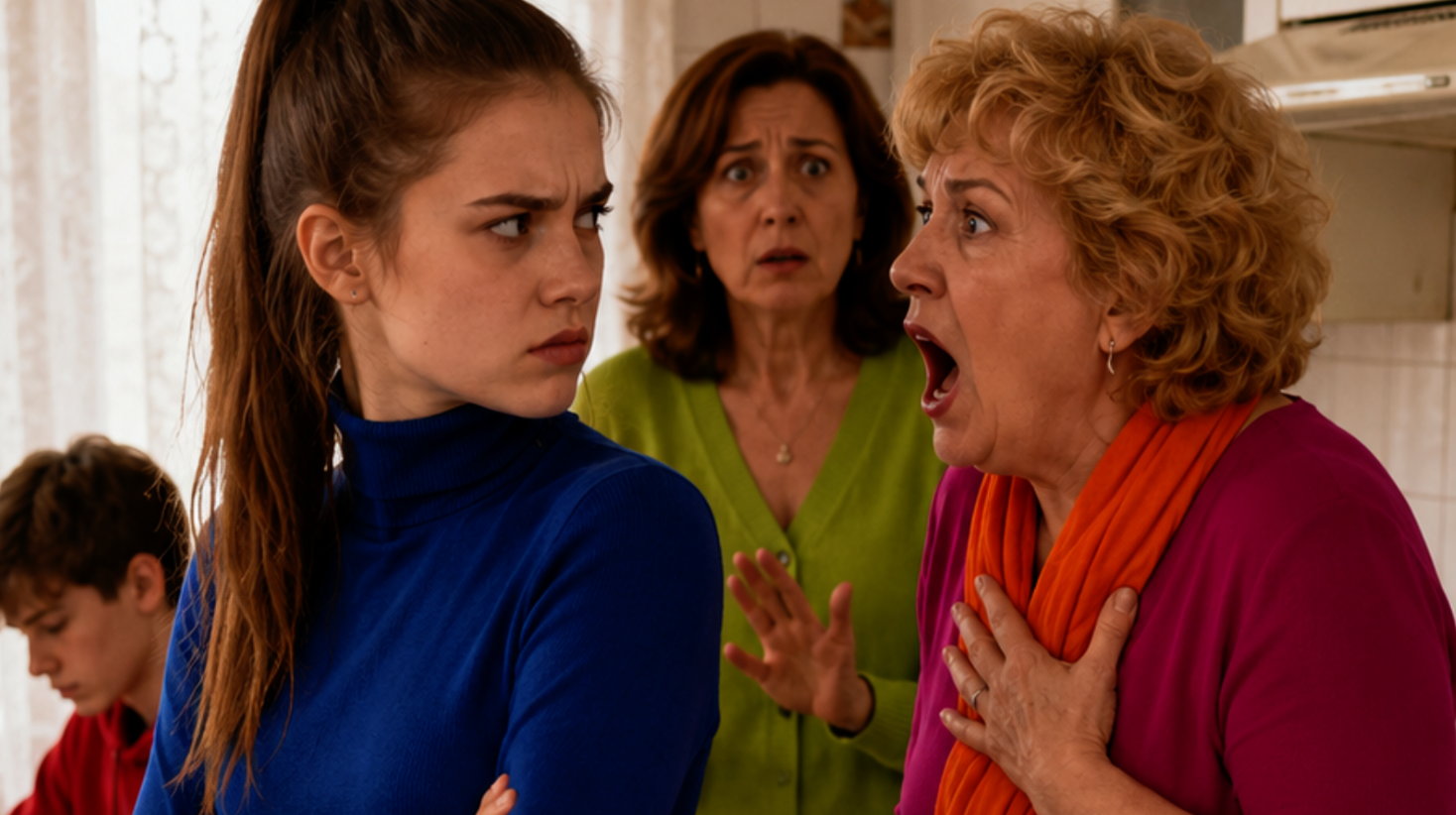
“Don’t carry the boxes upstairs. Stack them downstairs. We’ll put a folding bed for Yulia in the far room, and the boy can have the armchair by the window. My pots go straight into the upper kitchen cabinet — it’s more convenient there,” Nadezhda Sergeyevna commanded loudly, as if she had not arrived at someone else’s house, but had finally returned to her rightful property.
Marina stopped at the gate with a bag from the hardware store in her hand and, for several seconds, simply watched this movie she had never bought a ticket for. A Gazelle van stood in the yard. Suitcases, a child’s bicycle, and plaid bags were piled near the terrace. Dirty footprints marked the new tiles. Someone’s towel was drying on the railing.
She did not even get angry right away. At first there was only a dull, unpleasant astonishment — the kind where the mind is still trying to be polite and find an explanation, while the heart has already understood that someone is treating you like an idiot again.
“Did I miss something?” she asked so calmly that she hardly believed herself.
Her mother-in-law turned around, adjusted her headscarf, and smiled the smile that usually made Marina’s jaw start aching.
“Oh, the lady of the house has arrived. Well, wonderful. Look how perfectly everything has worked out: your house is big, Yulia is in a terrible financial situation right now, and dragging a child from one rented corner to another is no life. Besides, we’re family. We’re not strangers.”
“Family,” Marina repeated. “Only for some reason the decision was made without me. Is that also the family way?”
Anton climbed out of the van. He did not come over. As always, he began from a distance, wearing the expression of a man who had been forcibly dragged into a diplomatic mission between two nuclear powers.
“Marina, don’t start right at the gate. Let’s not make a scene. We simply discussed that, for the time being, this was a reasonable option.”
“We? Who is ‘we’? You, your mother, Yulia, and apparently the Gazelle driver? Because I did not take part in that discussion.”
Yulia, thin, tense, and forever offended by the entire world, was already standing on the steps, clutching her son to herself.
“You always talk as if you get to decide everything alone. Anton isn’t some tenant here, by the way. He’s your husband. Does his word mean absolutely nothing?”
Marina slowly placed the bag on the bench.
“It does. But not more than mine. And this house was bought with my money. The land is registered in my name. So the question is simple: who gave you permission to move in?”
“What a vulgar tone,” her mother-in-law grimaced. “A smart woman doesn’t make scenes in the street. We could have gone inside, sat down, and talked. I only want what’s best for you, by the way. A big house is no joke. Cleaning, cooking, the child will grow up — it would be livelier. I would help you. Yulia could help with dinner. Everyone would live like normal people.”
“Living like normal people means not breaking into my house under the disguise of helping,” Marina cut her off. “Turn your bags around and leave.”
“Are you out of your mind?” Yulia flared up. “Where are we supposed to go in the evening with a child? To the train station? Would that make you happy?”
“Don’t try to turn me into a monster. You came here not because you had nowhere else to go, but because you decided to force your way in. Those are different things.”
Anton finally came closer.
“Marina, let’s be calm. Mom isn’t moving in to live off you. They’ll stay for a couple of months until Yulia gets back on her feet. Five rooms, for God’s sake. Why are you clinging to walls?”
“I’m not clinging to walls, Anton. I’m clinging to boundaries. And respect. You could have discussed this with me. In advance. With your mouth. But you chose to present me with a fact. Which means you were counting on me to swallow it.”
“Because it’s impossible to discuss things like this with you!” he snapped. “You immediately take a stance. Always. With you, it’s either your way or no way.”
“How convenient. Especially when you want to use someone else’s hands to settle your relatives into your wife’s house.”
Nadezhda Sergeyevna theatrically threw up her hands.
“Listen to her, Yulia. Her husband’s mother is already just ‘relatives’ to her. As if we swept her street and should be grateful for it. Marina, you think far too much of yourself. Family means sharing, not counting who paid for how many nails.”
“Excellent. Then share your apartment, not mine.”
Silence hung over the yard. Even the boy stopped scraping his shoe against the step.
Anton spoke more quietly now.
“You’re going too far.”
“No. I’m finally not bending.”
“Fine,” he snapped. “What do you suggest? That my sister drag herself and her child through rented places while you sit here alone in your palace airing out your principles?”
“I suggest one thing: no one moves into my house without my consent. Not your mother, not your sister, not your entire parents’ committee.”
“Did you hear that?” her mother-in-law turned to her son. “That is who she is. That is her true worth. We have always been a thorn in her throat.”
Marina gave a short, bitter laugh.
“No, Nadezhda Sergeyevna. What has always been a thorn in my throat was never your poverty or your problems. What I couldn’t stand was your usual calculation: show up with the face of a victim, settle onto someone else’s property, and call it family support.”
“Anton, say something to her!” Yulia cried. “Or are you going to stand there like a stump again?”
Anton looked at Marina as if she were the one destroying his life, not he hers.
“All right. Mom, Yulia, load everything back for now. I’ll talk to her.”
“Not ‘for now,’” Marina said. “For good. And we’ll talk without an audience.”
Forty minutes later, the yard was empty. The Gazelle left. As a farewell, her mother-in-law promised that Marina would come running to them herself one day, begging for help. Yulia hissed something about a heartless bitch. Anton entered the house last.
“Happy now?” he asked, tossing his keys onto the dresser. “You put on a circus for the whole village.”
“I did? Was I the one who brought a crowd here with bundles?”
“You could have handled it more gently.”
“And you could have been a husband instead of your mother’s courier.”
He sat down tiredly on the edge of the sofa and rubbed his face.
“Marina, I honestly thought you would understand. Yulia is struggling. Mom is worried. Everyone is on edge.”
“And I have it easy? Working like a dog for five years, taking out loans, checking on builders, running between the office and the construction site, just so one morning I could wake up not as the owner of my home, but as an attachment to your family dormitory?”
“Don’t exaggerate.”
“I’m not exaggerating. I’m saying out loud what you keep carefully wrapping in the word ‘family.’”
That night, he apologized. For a long time. Clumsily, but persistently. He said he had been stupid, that his mother had pressured him, that he had simply wanted to please everyone and everything had turned into a mess.
Marina lay beside him and listened to that familiar male arithmetic: betrayal minus responsibility equals “I’m sorry, I got confused.” From exhaustion, she almost stopped arguing. She wanted only one thing — silence.
In the morning, she was woken by the smell of fried onions and unfamiliar voices downstairs.
Marina went down to the kitchen barefoot and stopped in the doorway.
Yulia was sitting at the table, feeding her son porridge. Nadezhda Sergeyevna was bustling around the stove in Marina’s apron. Anton was drinking tea and did not even raise his eyes.
“What is this?” Marina asked.
Her mother-in-law turned first.
“Don’t start first thing in the morning. We decided everyone was wound up last night. Anton opened the door. Peacefully. And he did the right thing. I’ve already put soup on. No need to waste the day.”
“Anton, look at me.”
He raised his eyes. And in them was the vilest thing of all — not shame, not fear, but a request for her to swallow everything for him again.
“Marina, let’s not get hysterical. They came. They sat down. What now, throw them out?”
“Yes,” she said. “Exactly. Throw them out.”
Yulia slammed the spoon down.
“Who do you think you are, anyway, throwing us out? A wife? Has a crown grown on your head?”
“I am the person you have been trying, for the second day in a row, to turn into furniture in her own house.”
“You’re greedy over square meters?” her mother-in-law shouted. “You greedy, cold woman! Anton, I told you right away: she loves no one but her money!”
Marina walked right up to the table.
“Listen carefully. You have ten minutes. Gather your things and leave. That’s all. Anton — you too.”
“Have you completely lost your mind?” he jumped up. “You’re threatening divorce over such a trifle?”
“This is not a trifle. A trifle is breaking a mug. Bringing your people into my house while I’m asleep is already a diagnosis.”
“You’ll regret this later.”
“Most likely, I’ll only regret putting up with it for so long.”
Nadezhda Sergeyevna’s voice rose to a shriek.
“Son, don’t just stand there! She is throwing you out of your own house!”
Marina smiled without joy.
“Not his. And that, apparently, is the main reason for all this haste.”
What followed was a scandal without beautiful pauses. Her mother-in-law clutched at her heart. Yulia screamed that Marina was raging out of envy toward everyone who had real family. Anton first tried to persuade her, then accused her, then promised that she would end up alone and finally understand everything.
Marina stood by the door, looked at the clock, and repeated the same thing again and again:
“Things. Now. Quickly.”
When they finally spilled out into the yard, she locked the door, called a locksmith to change the locks, and, for the first time in a long while, sat down not from helplessness, but simply because she could.
An hour later, a neighbor from the building where Nadezhda Sergeyevna had lived before called.
“Marina, sorry for interfering. The tenants are moving into their place, and they’re asking what to do with the leftover junk on the balcony. I only called you because I had your number. They said the whole family had already moved into the new house. That the matter had been settled long ago.”
Marina was silent for a moment.
“When are the tenants moving in?”
“Today. They said the contract starts on the first of the month. What happened? Didn’t you know?”
“Now I do, Tanya. Thank you.”
She hung up and stared for a long time out the window at the yard, still damp from being washed. So there it was — the whole unexpected gift of fate. Not spontaneous pity. Not “temporarily.” Not pressure from his mother.
Everything had been decided in advance.
They had not asked her. They had carefully, in the family way, tried to push her out of the right to her own life.
Marina suddenly felt not pain, but some kind of sober relief. When the truth reaches its full ugliness, strangely enough, it becomes easier to breathe. There is no need anymore to doubt, to look for guilt in yourself, to remember the good days, or to bargain with your own pride.
She stood up, took the unfamiliar apron from the back of the chair, threw it into a trash bag, and said into the empty kitchen:
“Well, there it is. And I thought my family was falling apart. Turns out there hadn’t been one here for a long time.”
And with that simple, angry, almost ordinary phrase, the house truly became hers for the first time.