“We’re going to have a baby…” I breathed the words softly, almost in a whisper, afraid of frightening away the fragile, unbelievable happiness that was filling me from within with a golden glow.
I stood in front of the huge mirror in the hallway, nervously fixing a stray lock of hair that had escaped my high hairstyle, rehearsing this moment for the hundredth time. Three, two, one…
The scrape of a key in the lock sounded like the starting pistol at a race. Click. The heavy metal door opened softly, letting into the apartment the damp, sharp scent of autumn rain, wet leaves, and his cologne — a complex fragrance with notes of expensive tobacco, sandalwood, and bitter chocolate.
Oleg came in, tiredly shaking drops of water from his cane umbrella. He looked exhausted: his shoulders slumped, his tie loosened, shadows lying in the corners of his eyes.
“Hi,” he kissed me on the cheek, but somehow mechanically, in passing, without even looking me in the eye. “I’m tired as a dog. The boss is raging again, end of the quarter, everyone’s on edge. Is there anything quick to eat?”
“There is,” I smiled mysteriously, feeling my heart pounding somewhere in my throat. “And not just something to eat. Tonight we’re having a special, festive dinner.”
Oleg froze with one shoe in his hand. His eyebrows — thick, dark, sable-like, the ones I loved to stroke in the mornings while he was still asleep — climbed upward in surprise.
“Festive?” He frowned, searching his memory for dates. “Did I forget something? Our anniversary? No, that’s in October… Mom’s birthday? No, in May, we gave her that vacation package… Your name day?”
“No, Seryozha. I mean Oleg…” Out of nervousness, I almost called him by the name of the main character in the book I had been reading all day to calm myself. “It’s… our celebration. A surprise. Go wash your hands and come into the living room. Something special is waiting for you.”
I had set the table in the living room at the highest level. I had taken out the family porcelain we saved for special occasions and lit tall twisted candles in silver candelabras. In the center of the table, his favorite roast duck with Antonovka apples and prunes filled the room with its aroma — a dish that had taken me half a day to prepare. Beside it stood a bottle of collectible red wine from 2015. For him. I could no longer have even a drop.
I put on my best dress — dark blue, velvet, with an open back — the one he had given me last New Year in Paris.
We sat down at the table. The candle flames danced in the glasses. Oleg ate with appetite, praising the duck and the sauce, but I could see his thoughts were somewhere far away. Probably in his spreadsheets and reports. Every now and then, he glanced at the phone lying beside him, its screen lighting up periodically with notifications.
“Oleg,” I gently covered his broad hand with mine. His palm was warm, familiar, with a callus from his pen on the middle finger. “Put the phone away. Please. At least for five minutes.”
Obediently, though reluctantly, he turned the gadget face down.
“All right. The suspense has dragged on, Marish. Tell me already, what happened? Did you find Captain Flint’s treasure? Are we being evicted? Or did you buy a handbag for a hundred thousand?”
I took a deep breath, filling my lungs with as much air as I could. From the pocket of the jacket hanging on the chair, I took out a small velvet box tied with a scarlet satin ribbon and handed it to him.
“Open it.”
Oleg, with a faint smirk, thinking there were cufflinks or a watch inside, pulled the end of the ribbon. The bow came undone. He lifted the lid.
Inside, on a white silk cushion, lay it.
A simple plastic test strip.
With two clear, bright, undeniable red lines.
For a second, the room became so quiet that I could hear my own heart beating — thump-thump, thump-thump.
I waited.
I waited for him to jump up, knocking over his chair, scoop me into his arms, and spin me around the room. We had waited for this for eight years. Eight long, agonizing years of doctor visits, endless tests, hormonal pills that made me nauseous in the mornings, disappointments, hysterics in the bathroom, tears into my pillow when the next “red days” arrived with merciless punctuality.
We had prayed at holy places, gone to Matrona, drunk all kinds of herbal mixtures… And now — a miracle. All by itself.
The doctor at the women’s clinic, a stern elderly woman, had said it was incredible, one chance in a million, but the fact remained. Six weeks pregnant. A heartbeat could be heard. Our baby.
Oleg looked at the test.
One second. Two. Ten.
The smile slowly, horribly slid off his face like wax from a melting candle. His face turned gray, ashen, stone-like. His eyes narrowed into two prickly slits. His jaws clenched so tightly that the muscles worked beneath his skin.
“What is this?” His voice sounded dull, alien, metallic.
“It’s our baby, Olezhenka!” I laughed nervously, happily, still failing to notice the terrible change in his face. Happiness had veiled my eyes. “Can you imagine? It happened on its own! A miracle! The doctor said it happens when the body lets go of stress, when you stop obsessively waiting…”
He slowly raised his head.
There was no joy in his eyes. No tenderness.
There was ice. Cold, prickly ice of hatred and disgust.
“Whose child is it, Marina?” he asked quietly, separating the words with pauses.
I froze. The smile stiffened on my lips in a foolish, inappropriate grimace.
“What do you mean… whose? Yours, of course. Ours. Are you… joking? If this is a joke, it’s a stupid one.”
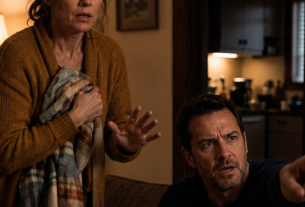
“I’m asking you, who did you get that bastard from?” he suddenly roared like a wounded animal, jumping up from the chair and knocking over a glass of wine.
A dark burgundy stain began slowly spreading across the snow-white starched tablecloth like fresh blood.
“Oleg! Have you lost your mind?” I pressed myself into the back of the chair, wrapping my arms around my shoulders. I suddenly felt physically cold. “What are you talking about? What do you mean, ‘got it from someone’? We… I’ve only been with you… I love you!”
“Don’t lie to me!” He grabbed the box with the test and hurled it against the wall with force. The plastic cracked and flew apart in pieces. “Don’t lie, you bitch! I know. I know everything!”
“What do you know?” I whispered, feeling the floor disappear from under my feet, the world around me starting to spin in a mad kaleidoscope.
“I’m infertile!” he shouted in my face, spraying spit. “Do you hear me? I. Am. Infertile. Completely. Sterile. I’m empty!”
Silence hung in the room.
A ringing, dead, cottony silence.
Only the antique clock on the wall ticked, counting the seconds of a collapsed life. And wine dripped from the table onto the carpet.
Drip. Drip. Drip.
“H-how?” I asked, stammering, feeling my lips go numb. “Where… Why don’t I know?”
“That’s where!” He began pacing around the room nervously, clutching his head. “Three years ago. Remember? You were whining all the time, hysterical because we couldn’t conceive, saying you were defective, that the problem was you. Mom insisted then. She said, ‘Olezhenka, go get tested, at least we’ll know who the reason is.’ So I went. To Professor Grossman, a scientific luminary, Mom’s old acquaintance.”
I remembered that time. Galina Petrovna, my mother-in-law, a domineering woman with eternally pursed lips, really had shown unusual, suspicious concern back then. She had always been cold to me, considered me a “penniless girl” from the provinces, a “gray mouse” unworthy of her “golden boy.” But suddenly she became concerned about grandchildren and started taking us to doctors.
“And?” I whispered. “You told me everything was normal with you! You showed me a certificate…”
“I lied!” he shouted, stopping in front of me. “I forged that damn certificate in Photoshop! Because I didn’t want to upset you! I pitied you, you fool! I thought you’d leave me if you found out I wasn’t a man, that I was empty! The professor said: azoospermia. A complete absence of swimmers. Zero chance. Zero point zero! I accepted it. Decided we would live for ourselves, maybe adopt later. And you…”
He came right up to me. His face twisted with revulsion, as if he had seen a rotting corpse in my place.
“And you, apparently, didn’t accept it. You solved the problem quietly, didn’t you? With whom? That fitness-club trainer of yours, that brainless musclehead? Or that courier who brought you flowers on March 8 and made eyes at you? Or maybe with the neighbor Vadim while I was working myself to death on business trips? Confess! Who is the father?”
“Oleg! Shut up!” I slapped him.
A ringing, desperate slap, into which I put all my pain and insult.
“How dare you?! I never… With anyone… I breathed only for you! This is a mistake! Your professor made a mistake! Doctors make mistakes, tests get mixed up!”
He caught my hand and squeezed my wrist painfully, almost to the point of cracking. His eyes filled with blood, the veins on his neck bulging.
“Mistakes? Professor Grossman doesn’t make mistakes. He’s a world-renowned geneticist! He had a clinic in Switzerland! But ‘faithful wives’ make mistakes often. You slipped up, Marina. You slipped up because of your greed for motherhood.”
He threw my hand away with disgust, as if he had dirtied himself.
“You have two options. Listen carefully, because I won’t repeat myself. Option one: tomorrow you go to a clinic and have an abortion. You clean that little bastard out of yourself. You bring me a certificate. Then maybe I’ll be able to forgive you. With time. We’ll forget this like a bad dream.”
I felt sick. A lump rose in my throat.
Have an abortion? Kill our long-awaited, prayed-for, already beloved child?
“Never,” I said firmly, looking straight into his eyes. “I’m going to give birth. This is my son. And yours, you idiot! Yours!”
“Mine?” He let out a bitter, barking laugh. “Well, good luck in fantasyland. Then option two. Pack your rags and get out. Right now. This minute. I don’t want a trace of you here.”
“But… where?” I looked helplessly at the windows, beyond which rain was lashing down. “It’s night outside. This is my apartment too… We’re registered here…”
“This is my mother’s apartment!” he barked. “Bought with her money, registered in her name! You’re nobody here and your name means nothing. You’re registered in your backwater hole, in your mother’s Khrushchev-era apartment. Get out! Or I’ll throw you out by force, by the scruff of your neck, like a kitten.”
At that moment, a key scraped in the lock again.
The door swung open, and there she appeared on the threshold.
Galina Petrovna.
Like a demon summoned by scandal, or a vulture that had sensed carrion. She lived in the neighboring building and had apparently “accidentally” decided to drop by for salt at ten o’clock at night.
“What’s all this noise, and no fight?” she sang, entering the living room and instantly scanning the situation with a sharp gaze: the overturned glass, the wine stain, my tear-streaked face, her son’s fury, the shards of the test on the floor.
“Mom, she’s pregnant,” Oleg threw out without looking at her.
Galina Petrovna clasped her hands theatrically, affectedly, like a bad actress in a soap opera.
“Oh, what joy! Finally! The Lord has heard our prayers! And why are you both… so gloomy?”
“By her lover, Mom!” Oleg interrupted. “You know. I can’t. Grossman said it then… You saw the conclusion yourself!”
My mother-in-law’s expression changed instantly. The mask of good nature fell away, revealing her true face — the face of a predator. Open gloating appeared in it.
“A-a-ah…” she drawled, triumphant notes sounding in her voice. “Well, I knew it. I always told you, son: still waters run deep. She looks so modest, an innocent little lamb, eyes downcast, but really… A whore is a whore. It’s in the breed. So you got knocked up, did you? And decided to hang it around your husband’s neck? Found yourself a rich fool?”
She turned to me, planting her hands on her hips.
“Well, why are you standing there, ‘Mommy’? Doesn’t your conscience bother you? Pack your things. Come on, come on, move. The last thing we need is to raise and feed someone else’s bastards. This is a respectable apartment. Intelligent people live here.”
I looked at the two of them.
At the husband I had loved for eight years, with whom I had shared a bed, dreams, bread.
At his mother, who had drunk my blood for years in tiny sips.
And I understood: I had no place here.
I never had.
To them, I was a foreign element, a temporary dependent, an incubator that had turned out defective — and now also “unfaithful.”
Silently, I turned and went into the bedroom. I took the old suitcase down from the mezzanine. I threw things in any which way — jeans, sweaters, underwear, books. My hands were shaking so badly I could not get sleeves into the suitcase, tears covered my eyes with a solid veil, but I bit my lip until it bled so I would not sob out loud.
I would not give them that pleasure. They would not see my weakness.
When I passed through the hallway with the heavy suitcase and a bag over my shoulder, Oleg was sitting in the kitchen, his head in his hands, staring at one spot. Galina Petrovna stood in the doorway, arms crossed over her chest like a prison guard.
“Keys on the side table,” she ordered dryly.
I placed the set of keys on the polished surface with a clatter.
“And don’t even think about filing for child support,” she hissed poisonously at my back. “We’ll do a DNA test. And then I’ll disgrace you in front of the whole city. I’ll tell everyone what a tramp you are. No decent family will ever take you in again.”
“We’ll definitely do one,” I said, turning around.
My voice sounded unexpectedly firm, even to me. Steel had appeared in it.
“Definitely. It will be the first thing I do after the birth. And then, Galina Petrovna, you will be very ashamed. If you even have a conscience.”
I stepped out into the cold, rainy night.
The door slammed shut behind me with a clang, cutting off my past life.
The next six months were hell.
Real, personal hell.
I did not go to my mother in the provinces — I did not want to upset her; she had a bad heart. I called Svetka, my school friend. Kind soul that she was, she let me stay on the fold-out sofa in her one-room apartment in Chertanovo until I found a place.
Money was tight. All our savings remained on Oleg’s cards, to which I had no access. I worked like a damned woman right up until maternity leave — translated texts at night, took side jobs, worked as a courier despite morning sickness and my growing belly. I saved on food, bought the cheapest products, wore out old clothes.
Oleg filed for divorce a week later. We were divorced quickly through a magistrate’s court: “no property disputes, no children.” I did not tell the judge about the pregnancy. Why? So he would think I wanted to hold on to a man with my belly?
I wanted to erase Oleg from my life.
Wipe him out.
Forget him.
Sometimes, at night, when Mishka — I already knew it would be a boy and had named him Mikhail — kicked inside my stomach, I cried. Resentment burned my insides like acid.
How could he?
How could he believe some three-year-old piece of paper instead of me, his wife, with whom he had lived for eight years? How could he throw me out onto the street pregnant, at night, in the rain? Had he never loved me at all?
But then I would wipe away my tears.
“You have to be strong, baby,” I whispered into the darkness. “We don’t have a dad. But we have each other.”
Galina Petrovna called me a couple of times from unknown numbers. She breathed into the receiver and said vile things:
“So, have you given birth to the little freak yet?”
“God will punish you.”
I silently blocked the numbers.
Mishka was born on time, exactly on the due date. Healthy, loud, a sturdy little chubby boy. 3,800 grams, 54 centimeters. The birth was hard and long; I thought I would die from pain and loneliness.
But when they placed that warm, wet little bundle on my chest, when he opened his cloudy blue eyes and looked at me… the pain disappeared.
And I cried.
Because he was Oleg’s copy.
The same slightly hooked nose, the same shape of ears, the same dimple in the chin, the same dark hairs on the crown of his head.
Genetics is a stubborn thing.
“Well, Daddy,” I thought, stroking my son’s back. “Now we’ll see who beats whom. You wanted the truth? You’ll get it.”
Svetka came to discharge me from the hospital. No flowers, no balloons, no limousine, no happy father with a camera. Just an Economy taxi and a bouquet of asters bought near the metro.
A week after discharge, barely recovered, I called Oleg myself. My hands shook, but I forced myself to dial the number that had once been saved as “Beloved.”
“Hello,” I said dryly. “I gave birth. A son.”
A long, heavy silence hung on the line. I could hear his breathing.
“Congratulations,” he finally forced out. His voice was hoarse. “Did you name him after your lover?”
“His name is Mikhail. And I demand a genetic examination. Establishment of paternity.”
“You… you still dare to demand?” He choked with outrage. “Do you have any conscience at all? You want money? Decided to milk me? Hang another man’s child on me?”
“I want the truth, Oleg. Truth and justice. You screamed that you were sterile. That Professor Grossman was a god. Let’s test your god. If the test shows the child is not yours, I’ll disappear, write a waiver of all claims, and never bother you again. If the child is yours, you will publicly apologize to me. And acknowledge your son.”
“And child support?”
“And child support. By law. Twenty-five percent.”
“Fine,” he muttered viciously. “I agree. Only so I can rub your nose in your lie. So you’ll leave me alone once and for all with your scams. I’ll choose the clinic myself. The most expensive one, independent. So you don’t bribe anyone there.”
“Choose. I don’t care. You can’t fool DNA.”
We met three days later at an independent molecular genetics center. Oleg did not come alone, but with his “support group” — his mother.
Galina Petrovna looked combative: in a new little hat, her lips pursed. She looked at the bundle with Mishka as if he were a biological weapon or a pile of garbage.
“At least show me what you gave birth to,” she hissed through her teeth, not coming closer. “I bet he’s dark-skinned? Or red-haired?”
I silently folded back the corner of the blanket. Mishka was asleep, hilariously puffing out his lips and frowning in his sleep.
Galina Petrovna looked — and turned pale.
She saw it too.
That dimple.
The signature, “purebred” Kuznetsov dimple she had been so proud of in her son.
In the procedure room, they took a swab from the inside of Mishka’s cheek with a cotton bud. Mishka did not even wake up, only smacked his lips. They took biological material from Oleg too. He was pale, nervous, his hands trembling slightly. He tried not to look at the baby.
“The result will be ready in three business days,” the nurse said, sealing the test tubes. “You’ll receive an SMS.”
I spent those three days in a strange, icy calm. I knew the truth. I was not worried.
But them… I imagined them twitching, discussing, preparing their victory speech.
Let them be afraid.
On the appointed day, we gathered again in the clinic lobby. The doctor, a young serious man, brought out a thick sealed envelope with the laboratory logo.
“Who will open it?”
“I will.”
Oleg practically snatched the envelope from the doctor’s hands. His hands were shaking so badly the paper rustled.
He tore the edge. Took out the form with colored diagrams and stamps. His eyes ran over the lines.
His face stretched. Then flushed in blotches. Then turned white as chalk. He read it again. And again. His lips moved silently.
Then he slowly raised his eyes to me.
There was animal, primal horror in those eyes.
And incomprehension.
“99.9999%,” he whispered. “Probability of paternity… 99.9… How? This can’t be… Grossman said… Zero percent… Azoospermia… A mistake…”
“Give it here!” Galina Petrovna tore the sheet from his hands.
She stared at the numbers. Read them. And sank right onto the leather couch, clutching at her heart, dropping her purse.
“This… this is a mistake…” she babbled with bloodless lips. “A forgery! You bribed them! This can’t be! Olezhenka is infertile!”
“It can,” I said calmly, feeling the triumph of justice. “Science doesn’t lie, Galina Petrovna. And now, Oleg, explain one thing to me. How did your praised Professor Grossman diagnose you with ‘complete infertility’ if here he is — your son? With your dimple, your eyes, your DNA?”
Oleg was silent.
He was crushed. The reality he had believed in sacredly for three years, the foundation of his life, had collapsed in an instant. He stood like a stunned bull at a slaughterhouse.
And then I noticed a detail.
A small one, but important.
I noticed how Galina Petrovna’s eyes were darting around. How feverishly she was tugging at the handle of her expensive handbag. How beads of sweat appeared above her powdered upper lip.
She did not look surprised.
She looked… caught.
Terrified to death.
It dawned on me.
The puzzle came together.
“Galina Petrovna,” I asked quietly, but loudly enough for everyone in the lobby to hear. “You wouldn’t happen to know how this happened, would you? You were the one who recommended that doctor. You were the one who cared so much. You and Oleg went to get the results back then, three years ago…”
“Me? No! What nonsense are you spewing, you wretch!” she shrieked, but her voice broke into a rooster-like squeal and betrayed her completely.
Oleg slowly, very slowly, turned to his mother. His gaze cleared.
“Mom?” he asked. “You were the one who picked up the test results. I was in a meeting then. You brought me the envelope with the conclusion. You said, ‘Be strong, son.’”
“Son, well, it happens… Doctors make mistakes… Laboratories mix things up…” she began wriggling, looking away.
“No, Mom. Grossman is your classmate. You said he was the family’s best friend. You said he could be trusted like yourself. Let’s go to him. Right now.”
“Where?” she asked in fright, pulling her head into her shoulders. “Why? There’s no need…”
“To Grossman. I want to look him in the eye. And you. And find out the truth.”
We went.
All together.
It felt like a surreal film, a bad dream. Me with the baby in the car seat, pale Oleg behind the wheel, and Galina Petrovna trembling in the back seat.
Professor Grossman’s clinic was elite and private. Marble, gilding, leather sofas, quiet classical music. The professor himself, an impressive gray-haired man with gold-rimmed glasses, received us without an appointment after seeing Oleg’s distorted face as he burst into the office, bypassing the secretary.
“Boris Ignatievich,” Oleg threw two documents onto his polished desk: the old crumpled infertility report and the new DNA test. “Explain. What does this mean?”
The professor looked at the papers over his glasses. Then at Oleg. Then shifted his gaze to Galina Petrovna, who was huddled in the corner near the door, trying to merge with the wallpaper.
“Well…” The professor took off his glasses and began wiping them with a handkerchief, buying time. “Medicine is not an exact science… The colleagues in the laboratory back then may have made a mistake… Mixed up test tubes… Human factor…”
“Borya, don’t lie!” Oleg suddenly barked so loudly the glass in the cabinet trembled. “You broke my life! You destroyed my family! I threw my beloved pregnant wife out onto the street because of your rotten piece of paper! I lived for three years thinking I was disabled, that my family line would end! Tell the truth, bastard! Or I’ll call the police right now, the prosecutor’s office, the media! I’ll destroy you! I’ll have your license revoked! I’ll file a complaint for fraud and criminal negligence!”
The professor turned pale. His hands shook. He looked at Galina Petrovna pleadingly.
“Galya… I told you it was a bad idea… I warned you…”
“What idea?” Oleg loomed over the desk, grabbing the professor by the lapels of his coat. “Speak!”
“Your mother…” The professor sighed, understanding that denial was useless. “She asked me. Begged me. Said you had gotten involved with some… unsuitable woman. A provincial climber. A pauper. That she was ruining your life. That she only wanted your money and your registration. Galina Petrovna was certain that this Marina would give birth and tie you down with a child, take the apartment. She asked me to write a fake infertility report so you would stop trying to have children. She was sure that if there were no children, Marina would leave on her own. Or you would leave her. And you, Oleg, were healthy as an ox. Your spermogram was perfect. Good enough to send into space. Forgive me, Oleg. I’m an old fool. I gave in to the persuasion of an old friend…”
The office became quiet.
Only Oleg’s heavy, hoarse breathing could be heard. He released the professor’s coat as if it were contagious.
He slowly turned to his mother.
“You…” he croaked. “You knew? You arranged all of this? You paid him to lie to me that I couldn’t have children?”
Galina Petrovna suddenly stopped being afraid. She straightened, adjusted her little hat, and a fanatical, insane fury flashed in her eyes.
“Yes! I knew! And I don’t regret it!” she screamed, spraying spit. “I was saving you! Saving you from her! She is no match for you! A barefoot village girl, no family, no background! I wanted happiness for you! For you to find a normal girl, from our circle, with an education, with a dowry! I wanted grandchildren from a worthy woman! And this one… latched on like a leech! And she gave birth out of spite! On purpose!”
“You’re a monster, Mom,” Oleg said quietly, staring in horror at the woman who had given birth to him. “You’re not a mother. You’re a monster. You destroyed my life. You stole three years of happiness from me. You wanted to kill my son — you demanded an abortion!”
“I wanted what was best!” she shrieked.
“Get out,” Oleg said. “Get out of my sight. I don’t want to know you.”
He turned to me.
I stood by the window, holding Mishka to me, and watched this performance with cold, detached interest.
Oleg came over to me and fell to his knees. Right onto the marble floor, dirty from street shoes. Tears stood in his eyes. He cried without shame.
“Marina… Marinochka… Forgive me… I didn’t know. I swear, I didn’t know! I’m a fool. A blind idiot. I believed them… Forgive me, I beg you. Let’s start over? We have a son… Mishka… Look at him…”
He tried to take my hand, reached toward the child with trembling fingers.
I looked at him.
At the man who had betrayed me.
Who had believed not me, but a fake piece of paper.
Who had thrown me out into the rain.
Who had allowed his mother to humiliate me and demand the murder of our child.
Did I love him?
Perhaps somewhere very deep, at the bottom of my soul, the embers of that feeling still smoldered.
But respect had died.
It had burned to ash that evening when he threw the test against the wall.
And without respect, there is no love. No family.
“No, Oleg,” I pulled my hand away and took a step back. “There will be no starting over. You made your choice back then, in the hallway. You believed her, not me. You betrayed me. You trampled me. A broken cup cannot be glued back together — it will cut your hands.”
“But our son! A child needs a father! A complete family!” He grabbed the edge of my coat.
“The child will have a father. On the birth certificate. And child support. Twenty-five percent of all your income. Including under-the-table bonuses and dividends. I’ll make sure of it personally. I’ll hire the best lawyers. But to see you, live with you, sleep with you… I can’t. I’m disgusted.”
I adjusted the blanket over Mishka, who was sleeping sweetly, unaware of the passions boiling around him.
“Goodbye, Oleg. And tell your mother ‘thank you.’ She got what she wanted. We divorced. You’re free. You can look for someone ‘worthy.’”
I turned and walked toward the door, my heels clicking across the marble.
“Marina! Wait! Don’t go!” he shouted after me, still on his knees. “I’ll fix everything! I’ll prove it!”
I did not turn around.
I stepped outside.
The rain had stopped. The sun was shining brightly, blinding my eyes as it reflected in the puddles. I breathed in the fresh, clean air with my whole chest. I held my son close.
“It’s all right, Mishka,” I whispered to him, kissing his warm forehead. “We’ll make it. We’re strong. At least now we know exactly who we are. And we have our whole life ahead of us. An honest life. Without lies, without betrayal, without monsters wearing the masks of relatives.”
I called a Comfort taxi.
Now I could afford it — I knew Oleg would pay.
For everything.
And behind me, in the elite clinic with the golden sign, the lives of two people were collapsing — two people who had imagined themselves the arbiters of other people’s destinies, but had turned out to be nothing more than pathetic deceivers left with nothing.