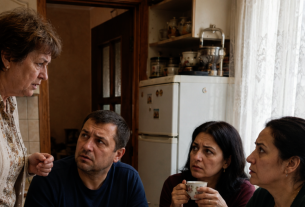
The apartment hummed with the vague, muffled noise of a celebration that had gone wrong. The air was thick with the smell of cooling roast meat, expensive perfume, and sharp tension. I stood in the doorway of the living room, clutching a sweat-damp napkin in my hand, feeling every cell in my body vibrate with humiliation.
For the fifth time.
For the fifth time that evening, her thin, piercing voice cut through the general noise like an icy needle and reached my ears:
“ Margarita, dear, who cuts potatoes like that? Are you completely useless with your hands? Just like my late daughter-in-law. She was a fool too, couldn’t even lay a fork straight.”
A chuckle.
Not from everyone, of course. From her loyal sister, Aunt Varya, and from the neighbor, the lawyer woman, who was watching me with poorly hidden curiosity. My husband, Alexey, pretended not to hear, burying himself in his phone. His ear had turned red. He always blushed when his mother crossed the line.
But he never stopped her.
I saw their faces: relatives, friends, Alexey’s colleagues. In their eyes I could read awkward pity, quickly lowered glances, the desire to sink through the floor. To them, I had always been an eternal misunderstanding — the wife of successful Alexey, too simple, too sincere, too “not from their circle.” The one who didn’t know how to choose the right wine for fish and whose laugh was sometimes too loud.
But “useless-handed fool” was no longer about wine.
That jab went straight to the core.
I had spent the entire day in the kitchen, trying. The beets in the vinaigrette had been diced perfectly, and the beef stroganoff was exactly “like her mother’s,” the recipe for which she had “accidentally forgotten” to give me, but miraculously found for all the guests in the middle of dinner.
After her words, silence fell like a heavy, sticky curtain. She smiled, adjusting her pearl necklace, pleased with the effect. Her small, bright eyes caught my reaction, searching for a crack, a tear, a flash of anger that could then be presented as hysteria.
And something inside me broke.
Not cracked — broke, exactly like a dry branch underfoot, with a quiet, final snap somewhere inside my skull. All the blood drained from my face, then rushed back again, but not as heat. It felt like cold, liquid metal.
I stopped being Margarita, Alexey’s wife, someone’s daughter-in-law.
I became simply a vessel filled to the brim with quiet, absolute rage.
I took a step forward. The creak of the parquet under my heel sounded loud as a gunshot. Every gaze fastened onto me.
“Allaiza Petrovna,” I said.
My voice sounded strangely even, without a tremor, almost casual. I saw her flinch at the full name.
Her name was Liza. Elizaveta Petrovna. Allaiza had been the name of her long-dead, despotic grandmother, whom she remembered with superstitious horror. How did I know that? By accident, in her own house.
She tried to keep her mask in place.
“What nonsense are you talking, Rita? Had too much at dinner again?” she threw out sarcastically, glancing around at the guests.
I came closer and stopped one step away from her. I was taller, and now, standing straight, I felt that difference with my whole body.
“You have just publicly insulted me for the fifth time this evening,” I said slowly and clearly, so everyone could hear. “You called me a useless-handed fool. In front of everyone. In my home.”
“Our home,” Alexey corrected quietly, without raising his head.
“Our home,” I repeated, without taking my eyes off my mother-in-law. “I spent the entire day preparing this dinner. I took time off work to get everything done. You contributed nothing except criticism.”
“I was teaching you!” she threw up her hands, playing offended innocence. “But apparently, not everyone is blessed with ability!”
Absolute, deafening silence hung in the living room. Even the refrigerator in the kitchen seemed to be holding its breath.
My mother-in-law’s face first turned white as chalk, then filled with a deep crimson flush. Her mouth opened, but no sound came out. She stared at me with wide eyes, in which an impossible mixture of horror and furious rage was raging.
She — Allaiza Petrovna in miniature, the pillar of the family, the dictator in pearls — had never heard anything like this in her life.
“You… you dared…” she breathed, choking.
“I didn’t dare. I warned you,” I cut her off coldly. “Directly, in front of witnesses. So that later there are no misunderstandings. You think I’m a fool? Fools don’t warn people. Fools endure. I am not a fool. And I do not intend to endure anymore.”
I swept my gaze over the table.
The guests sat as if paralyzed. Their faces showed not horror, but shock bordering on stunned disbelief. And — strangely enough — in the corners of some people’s eyes, people whom she had also once “kept in line,” there flashed something like wild, delighted surprise.
Alexey raised his eyes to me. There was primal fear in his gaze, but not for me.
For his mother.
For the collapsed world order.
“Rita, have you lost your mind? Apologize immediately!” he said hoarsely, rising to his feet.
“For what?” I asked calmly. “For setting boundaries? She will apologize. For five insults. Publicly. And then maybe we can continue dinner. Like civilized people.”
My mother-in-law seemed to regain the power of speech.
“I will never!.. I came into my own home! My son! Alexey, do you hear what she is allowing herself to do? Throw her out! Immediately!”
Alexey’s eyes darted between us like a trapped animal’s. He was not ready. Not ready to choose. Not ready to be “the man” in this situation, because all his childhood and adult life, “the man” had been her.
And then something happened that no one expected.
Not even me.
The chair beside my mother-in-law scraped. Her brother, Uncle Misha, rose from it — a retired colonel, a stern and silent man. He slowly walked around the table and stood beside me.
Not beside her.
Beside me.
“Liza,” he said in his deep bass, looming over his sister. “Shut up.”
She gasped as if she had been slapped across the face.
“Mikhail! What are you doing?”
“I said shut up. I’m tired of it. All your life you’ve been ordering everyone around. ‘Fool,’ ‘useless-handed’…” He snorted contemptuously. “The girl worked all day in the kitchen, and all you do is wag your tongue. And the food is excellent. Your endless nitpicking is enough. Apologize.”
That was the turning point.
If Alexey had stood up, it would have been the continuation of a war. But Uncle Misha had stood up — an authority in her world, the patriarch whose opinion she secretly feared.
Her universe cracked.
She looked at her brother, and a battle began in her eyes. Pride, rage, the fear of public collapse… and a cold, rational fear of being left alone, without the support of the clan.
She had lost the battle, and now she had to save face.
Slowly, with great difficulty, she turned her head toward me. It seemed as if her neck had gone wooden.
“Forgive me… Rita,” she forced out.
The words came to her with agonizing effort, as though she were swallowing broken glass.
“I… lost my temper.”
“Five times in a row?” I clarified gently, not releasing her gaze.
She pressed her lips together so tightly they turned white.
“I… was wrong. It will not happen again.”
I nodded.
I did not smile. I did not say, “It’s fine, these things happen.”
I simply nodded, accepting her surrender.
“Thank you,” I said and turned to the table. “Who wants tea? And we still haven’t tried the cake. It’s homemade, by the way, not store-bought.”
For the first few seconds, no one moved. Then Uncle Misha cleared his throat loudly, returned to his seat, and said:
“I’ll have some, Ritulia. With a splash of cognac, if there is any. Excellent beef stroganoff, by the way. Better than our late mother’s, by God.”
And then it began.
As if a dam had burst.
Voices sounded, dishes clinked, chairs moved. The conversation, timid at first and then more and more lively, switched to neutral topics: work, summer plans, the neighbor’s new car.
But the energy in the room had changed completely.
The tension had not disappeared, but it had transformed. Now there was respect in it.
Respect for me.
I walked around with the teapot, poured tea, and smiled. My hands were not shaking. I did not go near my mother-in-law. She sat straight as a stick, sipping cold tea in tiny gulps and staring at one point.
Her kingdom had collapsed in an instant.
Alexey kept glancing at me secretly, and in his gaze, through the remnants of confusion, there was something new. Not fear. Not anger.
Astonishment.
And possibly a glimmer of the very respect that had been so lacking.
The guests began to leave early, under polite excuses. They said goodbye to me warmly, shaking my hand; some even hugged me.
“Stay strong,” whispered the wife of one of Alexey’s colleagues into my ear, and in her eyes there was genuine admiration.
Uncle Misha, as he was leaving, patted me on the shoulder.
“Well done. My sister had gotten far too full of herself. It was time.”
When the door closed behind the last guest, a thick and meaningful silence settled over the apartment.
My mother-in-law silently, without looking at anyone, put on her coat and picked up her handbag.
“I’m leaving,” she said in an icy tone.
“Mom, maybe you should stay?” Alexey began uncertainly.
“No. I have nothing more to do here. Goodbye.”
She threw the word into the air and left, slamming the door loudly.
We were left alone.
Alexey stood in the middle of the living room, among dirty dishes and empty glasses, helpless as a little boy.
“Why did you do that?” he asked at last. “In front of everyone… You made a scene…”
“She made the scene,” I said quietly, beginning to collect plates. “Five times. I simply ended the performance. You could have stopped it at any moment. But you didn’t.”
“She’s my mother! She’s not young, she has a difficult character…”
“I have a character too, Alexey. And I have dignity. And I have a limit. Today it was reached.”
He was silent, looking at me. Then he sat down on a chair and lowered his head into his hands.
“What happens now? She won’t forgive this.”
“I don’t need her forgiveness. I need her respect. Or, at the very least, her fear. Today I got both.”
“So you showed everyone who the man of the house is, right?” Bitter irony sounded in his voice.
I put down the tray with the dishes and came over to him. I sat beside him, making him look at me.
“No, Alyosha. I showed who the mistress of the house is. Who is ready to defend her peace, her work, and her boundaries. A ‘man’ is not the one who shouts the loudest or hits the hardest. A ‘man’ is the one who takes responsibility for peace in his own home. Today, I took that responsibility. Because you refused to.”
He turned away, but he did not argue.
That was small, but important progress.
The cleanup took more than an hour. We did it in silence, each lost in our own thoughts. But it was not a hostile silence. It was the silence of reassessment.
The icy crust of fear and unspoken words that had been building between us for years had been blown open today with dynamite. Now we had to clear away the shards and see what remained under the ice.
As I was drying the last plate, Alexey said quietly:
“Uncle Misha was right. The beef stroganoff was excellent.”
There was no sarcasm in his voice. No flattery.
Just a statement of fact.
And in that simple phrase, I heard the beginning of a new conversation.
A conversation between equals.
Lying in bed, in complete darkness, I thought about her face at the moment my threat had been spoken. About the bottomless horror in her eyes.
Not fear of physical violence — I would never have dared raise a hand against her.
It was fear of something else: that her weapon — words, poison, manipulation — had suddenly broken against another force, a new force she did not understand.
The force of a direct, rough, undeniable refusal to play by her rules.
I did not show who the man of the house was.
I showed that, at last, the house had a mistress.
And from now on, that mistress would be me.
And the first thing I would do tomorrow was repaint that ridiculous living room.
There were far too many ghosts in it.
It was time for new colors.