“You need to be friends with me, Anechka. I’m a forgiving woman, but I have a good memory,” Tamara Pavlovna said the phrase with her usual almost sickly-sweet smile, carefully straightening the lace napkin on the table.
Her eyes, however, remained cold and sharp. Anna, who at the time was still a very young wife, barely twenty-six, sincerely believed in the power of diplomacy. She nodded, smiled back, and mentally told herself that for Pasha’s sake, she would do everything she could to become, if not a daughter to this woman, then at least someone close to her.
She and her husband had settled in the next courtyard over — a comfortable mortgage apartment, which Anna, incidentally, paid for half of herself, despite the difference in income between her and her husband. Tamara Pavlovna was present in their lives every single day. She came over without calling, brought homemade preserves, gave advice on how to arrange the furniture, and tirelessly repeated her signature phrase about friendship. Pavel, Anna’s husband, preferred not to get involved in women’s matters.
“Anya, well, Mom is complicated. She’s from the old school. Just nod, agree with her, and then do things your own way,” he would brush her off, burying himself in his laptop.
Her father-in-law, Nikolai Ivanovich, played the role of furniture in this one-woman theater. A tall, lean man with a perpetually tired look, he was always somewhere in the background: fixing a radio, doing crossword puzzles, silently drinking tea. Anna thought he had long ago accepted his wife’s dictatorship and had lost his voice sometime in the previous millennium.
But the illusion of “friendship” began to crack already in the first year of marriage.
The first public humiliation happened at a family dinner celebrating Pavel and Anna’s wedding anniversary. Anna prepared for that day as if she were defending a thesis. She spent half the night marinating meat according to a complicated recipe, baking a cake, and setting the table with expensive porcelain. The apartment was shining, and the aromas were so mouthwatering that the neighbors could practically be heard swallowing.
The relatives had already taken their seats when Tamara Pavlovna floated into the hallway with a bulky bag. Right there at the table, ignoring her daughter-in-law’s crystal salad bowls, she began setting out her own scratched plastic containers filled with vinaigrette and fried cutlets.
“Help yourselves, my dears!” the mother-in-law announced loudly, drowning out the music as she generously placed cutlets on her son’s plate. “Our Anechka is such a high-flying bird, standing at the stove is beneath her status. I stopped by their place yesterday, and Pasha was ironing his own shirt! So I thought, at least I’ll feed my son some normal food before he gets an ulcer from all those ready-made meals and your sushi.”
An awkward silence hung over the table. The relatives exchanged glances. Anna felt her cheeks flush. Her signature meat dish sat abandoned on the platter, growing cold.
“Tamara Pavlovna, but I cooked everything myself…” she tried to object quietly.
“Oh, come on, Anya! You need to be friends with me. I’ll at least teach you how to make a rich borscht instead of this grass with nuts,” her mother-in-law laughed disarmingly, looking at her daughter-in-law with a clear, innocent gaze.
“I mustn’t ruin the celebration,” Anna’s temples throbbed. “She’s an elderly woman. Maybe this is just her clumsy way of caring. I need to be wiser and not respond with aggression.”
But that evening, when the guests had left, Anna broke down. She was washing dishes, swallowing angry tears, and tried to get through to her husband.
“Pasha, why did you stay silent? She made me look like a useless housewife in front of your entire family! You know perfectly well that you ironed your shirt once in the entire year!”
Pavel sighed heavily, taking a beer out of the refrigerator.
“Anya, you’re always making a mountain out of a molehill. Mom is just caring, she has a thing about food. So she brought cutlets — that just means you’ll have to cook less next time. Please, I’m begging you, don’t take it to heart.”
Two years later, Anna received a serious promotion and became head of the finance department. There was more work, but her income increased several times over. One weekend, Pavel asked his wife to take his mother some hard-to-find blood pressure pills.
Anna was returning from a business brunch. Her hair was perfectly styled, she wore a strict but expensive suit, and in her hand was a designer handbag she had allowed herself to buy with her first large bonus. In her mother-in-law’s living room sat the “women’s council” — three of Tamara Pavlovna’s closest retired friends, with whom she discussed TV shows and neighbors.
“Oh, girls, here comes my daughter-in-law. She’s a businesswoman now!” the mother-in-law exclaimed, accepting the bag of medicine. She looked Anna up and down with a fake smile. “Look at what a fashionista she has become! That handbag probably costs as much as two of my pensions, doesn’t it?”
Her friends nodded, pursing their lips.
“And she has no time to give me grandchildren — she’s too busy building a career,” Tamara Pavlovna sighed tragically, now addressing her audience. “At her age, we were already taking two children to school and boiling diapers. But here it’s all for herself, all for her darling self, all for clothes. Well, never mind, my Pasha is patient. Another man would have slammed his fist on the table long ago, but mine endures it. Isn’t that right, Anechka? Don’t worry, you need to be friends with me. I’ll teach you how to put family first.”
Anna stood in the middle of that чужая living room, breathing in the suffocating smell of Corvalol and old furniture.
“There is no friendship,” she realized. “And there never was. This is just a game in which I have been assigned the role of punching bag. No matter what I do — earn money or bake a pie — I will always be the loser.”
That evening in the car, Anna did not even cry. She simply stared out the window at the streetlights flashing past.
“Pasha, today your mother scolded me in front of her friends because we don’t have children. And she made you out to be the victim.”
Pavel jerked the steering wheel nervously.
“My God, Anya, again? She just needed to show off in front of the old ladies, to look like some wise sufferer. They have different values, they live in a different world! Be smarter. Keep quiet. Is that so hard for you?”
Anna said nothing. That was when she understood that in this marriage she was completely, utterly alone.
One day, Anna was holding a difficult planning meeting at the office. Eight of her subordinates were sitting in the glass conference room, and the issue of distributing the annual budget was being discussed. Anna spoke firmly, throwing out numbers and keeping the room under tension.
The conference room door flew open without a knock. Tamara Pavlovna stood in the doorway wearing her favorite burgundy beret, triumphantly jingling a set of keys. Security on the first floor had let her through out of habit — Anna herself had once carelessly arranged a permanent pass for her.
“Anechka, I brought the keys to the country house. Pasha asked me to!” her mother-in-law sang out across the entire open office.
The employees froze. Anna slowly stood up, feeling cold sweat run down her back.
“Hello, Tamara Pavlovna. I’m in a meeting. Please leave them at reception.”
But her mother-in-law had already stepped inside, curiously studying the silent managers.
“Oh, look at you giving orders here!” the mother-in-law laughed good-naturedly. “Girls, boys, don’t be afraid of her. She’s only such a terrifying boss here. At home yesterday she couldn’t even start the new washing machine and called me in a panic, asking where to pour the detergent! You need to be friends with me, everyone — I’ll tell you all her secrets!”
The employees lowered their eyes; someone coughed nervously. The authority Anna had built for years turned to ash because of one manipulative little joke. Anna led her mother-in-law out into the corridor, holding her by the elbow, but Tamara Pavlovna only pulled her arm away and said, “You’re so nervous. You should take some vitamins.”
That evening, a scandal erupted. But instead of supporting his wife, Pavel went on the attack.
“Why did you even get her a pass back then?” he shouted, pacing around the kitchen. “You should have told security not to let her in! You allow her to treat you this way yourself, and then you complain to me! What am I supposed to do, shut my mother’s mouth?”
“My safe place no longer exists,” Anna thought in horror, looking at her husband’s distorted face. “If I answer harshly, I’ll become hysterical. If I stay silent, they’ll keep wiping their feet on me.”
For Nikolai Ivanovich’s sixtieth birthday, the entire large family gathered. Despite the deep resentment she carried, Anna spent a lot of time and money finding the perfect gift for her father-in-law — a collectible Japanese spinning rod he had once mentioned in passing a couple of years earlier.
When it was time for toasts, Anna stood up and sincerely, warmly presented the gift. Nikolai Ivanovich, usually stingy with emotions, suddenly lit up. He carefully took the rod, stroking the handle, and smiled for the first time that evening.
Tamara Pavlovna could not bear that the attention had gone to someone other than her. She sighed theatrically, adjusted her hair, and loudly delivered her final nasty remark for the whole room to hear.
“Oh, of course, she paid him off. Giving expensive gifts doesn’t require much brains, especially when you have money, while your husband endures everything at home. You would be better off giving our Pasha some attention, Anya, instead of buying these pieces of metal. I’m still waiting for the day you become a proper wife, not just a neighbor who comes home to sleep in the apartment. I keep telling you, you need to be friends with me, but you keep bristling, keep showing your pride…”
Pavel, as usual, lowered his eyes into his plate, diligently poking at his salad with his fork.
Anna felt everything inside her turn to ice. She looked at her husband, at the smirking relatives, at her smug mother-in-law. She made a decision. She would stand up now, silently take her purse, call a taxi, and never return — not to that apartment, and not to her marriage.
Anna had already placed her hands on the table to stand up when suddenly there was a terrible crash.
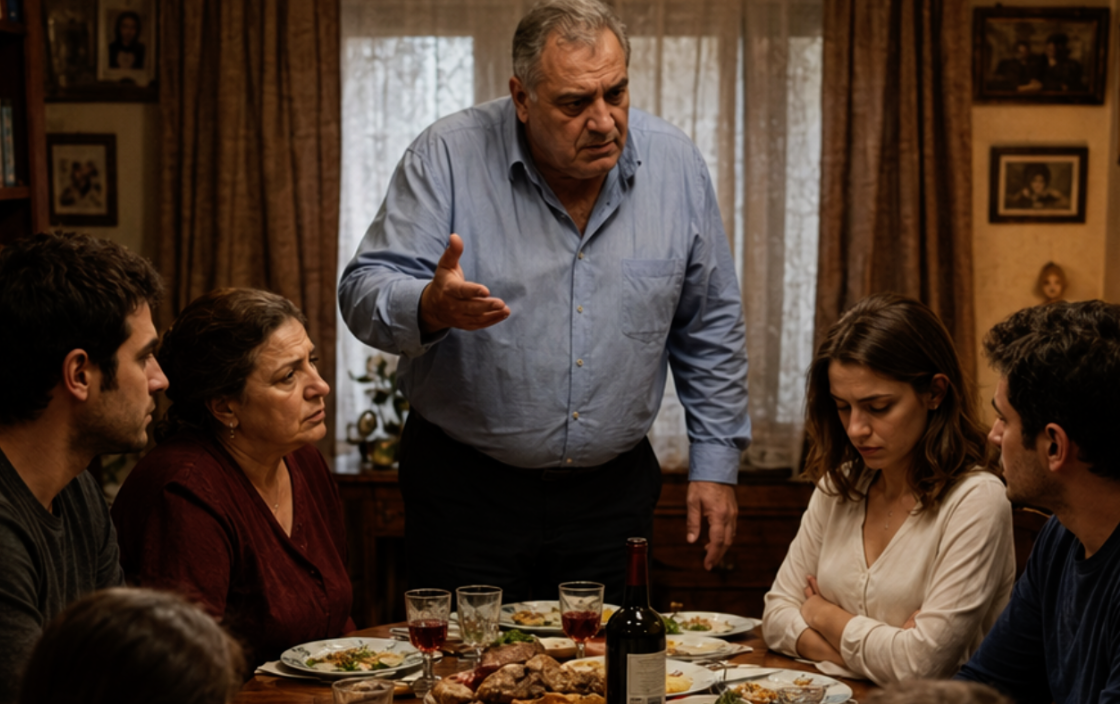
Nikolai Ivanovich had slammed his enormous fist down on the oak table with all his strength. Glasses rang, and a fork that had fallen to the floor gave a pitiful clatter.
Her father-in-law rose. Red patches spread across his face, and his eyes, usually dull, now flashed with lightning.
“Shut up, Tamara!” Nikolai Ivanovich’s voice, which no one had ever heard louder than a mumble, now thundered through the entire room. “Close your mouth and don’t open it again!”
The mother-in-law choked on air from shock.
“Kolya, what are you doing… in front of the guests…”
“I said be quiet!” he roared so loudly that the neighbor’s dog behind the wall seemed to fall silent. “Five years! For five years you’ve been eating this girl alive every chance you get! You make her blood boil, and out of respect she has never once said a bad word to you! Anya is the only person in our family who has achieved something with her own mind. And she is an excellent wife to my son. And you, Pashka” — the father-in-law turned his heavy gaze toward his shrinking son — “are a spineless fool. Sitting there, chewing your snot, while you allow your mother to disgrace your wife in front of everyone.”
Nikolai Ivanovich swept his heavy gaze over the silent guests, paused on his pale wife, and said sharply:
“Here’s how it will be, Tamara. One more time… if I hear even one crooked word aimed at Anya, you’ll spend the rest of your life ‘being friends’ with your own reflection in the mirror. Or with the wall. Do you understand me? I’ve said everything.”
He sat down, carefully smoothed the napkin on his knees, and added calmly:
“Please pass me the herring under a fur coat.”
Tamara Pavlovna sat in shock. She gulped air like a fish thrown onto the shore, but for the first time in her life, she had nothing to say. The guests were in complete stupor. Anna sat there, afraid to move, and only looked at her father-in-law with gratitude. He gave her a barely noticeable wink.
The outcome of this story turned out to be unexpected for everyone except, perhaps, Nikolai Ivanovich himself.
The next day, Tamara Pavlovna activated her favorite manipulative tactic — “deaf offense.” She declared a total boycott of her husband. She stopped talking to him, stopped making him breakfast, and demonstratively went into another room, hoping that after a couple of days he would crawl back on his knees begging forgiveness for his public outburst.
But what happened was something Tamara Pavlovna had never expected: her husband turned out to be… absolutely happy.
The boycott became an unexpected vacation for him — like a stay at a sanatorium. He enjoyed the perfect silence in the apartment. Nikolai Ivanovich calmly watched sports channels, fried himself his favorite eggs with lard, which his wife had forbidden him to eat for years, and every weekend he eagerly got ready to go fishing, stroking his new Japanese spinning rod. After a month of this life, he even looked younger.
For Pavel, this situation was also a cold shower. After receiving a public slap in the face from his father and seeing that Anna truly had been on the verge of divorce, he abruptly changed his behavior. Now, if his mother tried to make even a passing jab at his wife over the phone, Pavel cut the conversation short and hung up.
As for Tamara Pavlovna herself… she never picked on Anna again. Not in front of others, and not in private. During their rare meetings, a cold but reinforced-concrete neutrality now reigned. No syrupy smiles, no plastic containers, and no phrase about “friendship.”
Anna understood one important thing: the illusion of friendship with toxic people is a trap. Politeness, intelligence, and attempts to “understand” are always perceived by them as weakness and a green light for new cruelty. Sometimes, in order to earn respect and defend your boundaries, you don’t need to try to be friends. You simply need someone nearby who is not afraid to slam his fist on the table.