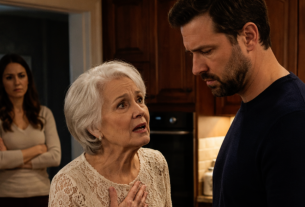
Victor was yanking the zipper of his bag shut as though he were fighting with it. It kept catching, and he tugged at it with increasing fury, refusing to look at his wife. On the table lay the tickets, two vacation vouchers, and a list of medications written in Valentina Petrovna’s large handwriting.
“You’ve already packed,” Marina said quietly. “You’re going away with her. Just the two of you. And you’re telling me an hour before you leave.”
“What, was I supposed to call a family meeting?” Victor snorted. “Her blood pressure keeps spiking, and her heart’s acting up. She needs fresh air and treatments. Nothing’s going to happen to you. You’re healthy as a horse.”
“I’m your wife, Vitya. You could at least have asked me.”
“Asked you,” he mimicked. “We have money for two people, understand? Two! Where am I supposed to get a third voucher for you, pull it out of thin air?”
His mother appeared in the doorway, her lips tightly pursed. She wore the expression of someone who believed the entire world personally insulted her on a daily basis. She gave a long, theatrical, suffering sigh.
“Marinochka, there’s no need to be offended,” she said sweetly. “You’re young. You can endure it. I endured things my whole life, and look at me—I’m still alive.”
“You hear what she’s saying?” her husband said, stabbing a finger into the air. “Endure it. What, are we starving you here? The refrigerator is full, the television works. Sit at home and enjoy the peace and quiet.”
“Enjoy the peace and quiet,” Marina repeated. “All right. I’ll try.”
“That’s my good girl,” he muttered, failing to notice even a trace of the venom in her voice. “You’ll transfer money whenever I ask. I’ll text you. Mother’s medication comes first. Everything else can wait.”
“Of course. Her medication comes first.”
He grabbed the bag, nodded to his mother, and headed for the door. Valentina Petrovna rustled after him, tossing another “Don’t sulk” over her shoulder. The door closed with the same heavy thud Marina had heard a thousand times before.
And there, in the suddenly empty hallway, she realized that her eyes were dry.
Completely dry.
She did not feel like crying. Not even a little.
The first few days passed with a strange ease. Marina would wake up and lie in bed for a long time, listening to the fact that no one was calling for her. No one tapped a cup reproachfully against a saucer. No one criticized the way she sliced bread.
In the evenings, she came home without flinching at the sound of a key turning in the lock. She cooked what she liked, rather than what was “good for Vitya’s stomach.” She ate slowly by the window, and to her surprise, she felt good.
Her phone only came to life when there was some practical matter to discuss. Victor called briefly and matter-of-factly, as though dictating an invoice.
“Did you transfer the money for the pills?” he asked instead of saying hello.
“I did.”
“You didn’t send enough. There are more treatments, and they prescribed massage for Mother. Send more.”
“Vitya, how are you doing? How are you feeling?”
“I’m fine,” he snapped. “Just send the money and stop getting emotional. I’m not here on vacation. I’m taking care of my mother.”
“I understand,” she said. “I’ll send more.”
He hung up without saying goodbye. Marina set the phone on the windowsill and caught herself thinking with calm clarity: in five days, he had not asked how she was even once.
Not once.
And strangely enough, it did not hurt.
It was almost funny.
On the sixth day, something burst beneath the sink, and the kitchen flooded within minutes. Marina rushed around with towels, shut off the valve, and called the first number she found on a notice posted near the entrance to the building. The man on the phone promised to arrive in twenty minutes—and kept his word.
Andrei turned out to be a calm man with amused eyes. He inspected the flood, grunted, and crouched beside the cabinet.
“Well,” he said. “The diagnosis is simple. The pipe got tired of living. It happens. We all have days like that.”
“Is it serious?” Marina lowered the towel to the floor.
“It’s just one of those everyday problems,” he replied without turning around. “Serious is when there’s no one around to fix it. But you have me. So take a breath.”
He worked skillfully and without rushing, exchanging a few brief remarks with her as he went. Half an hour later, everything was dry and quiet. The only sound was water dripping from the towels into a bucket.
“All done.” He wiped his hands. “It’ll last longer than some people’s promises.”
Marina opened her mouth to answer and suddenly felt her chin begin to tremble. The tears came on their own—foolish and badly timed—simply because someone had spoken a kind, human sentence to her without wanting anything in return.
“Oh.” She turned away. “I’m sorry. It’s not because of the pipe.”
“I figured,” Andrei said gently. “Pipes rarely make people cry. People do that more often. Where’s your kettle?”
“Over there. But you don’t have to…”
“I don’t have to do anything for anyone.” He smiled. “I just want some tea. And drinking alone is bad manners.”
He made tea as though he had been in her kitchen a hundred times. He placed a mug in front of her, sat across from her, and did not pry with questions. And because his silence contained neither reproach nor demands, she found it easier to breathe.
“Thank you,” she said. “You have no idea.”
“I do.” He placed a business card on the table. “If anything else gets tired of living, call me. And I don’t mean only pipes. Sometimes people also need someone to shut off the valve.”
A few days later, they ran into each other in the park entirely by chance. Andrei was walking with a book tucked under his arm, and Marina was wandering without any particular destination. They nodded to each other, started talking, and before they knew it, they had made two full circuits around the path.
“Are you always this unflappable?” she asked.
“Not always.” He smiled. “But I learned something a long time ago: the thing that drains the most energy isn’t work. It’s trying to please people who have already decided they don’t need you. I fired myself from that job.”
“That’s a good way of putting it.”
“It isn’t mine,” he admitted honestly. “We are only as unhappy as we keep telling ourselves we are. I simply try to live by that rule.”
That same evening, a message arrived from Victor:
“We’re staying another week. Mother feels better here. Send more money.”
Marina read it and felt neither pain nor longing.
Only a strange, light sense of freedom.
Two days later, a key suddenly moved in the lock—unexpectedly and ahead of schedule. Victor stormed into the hallway, red-faced and heavy-footed. Valentina Petrovna shuffled in behind him with her lips tightly pursed.
“Well, well,” he drawled from the doorway. “Where is he?”
“Who?” Marina asked calmly.
“Don’t play stupid!” Victor roared, flecks of saliva flying through the lamplight. “I’ve heard everything! The neighbor from the third floor saw some man coming here! While I was suffering over there with my mother, you were here throwing yourself at another man?”
“I told you, I told you,” his mother said, nodding rapidly and pressing a hand to her heart. “I could feel it. My heart knew.”
“A man came here,” Marina said evenly. “He repaired the pipe. The valve cracked, and the kitchen flooded. He fixed it.”
“The pipe!” Victor burst into an ugly, guttural laugh. “You expect me to believe that fairy tale? What pipe? I can see right through you! Feed her, clothe her all her life, and the first chance she gets… Disgusting!”
“You didn’t ask me once in two weeks how I was doing here,” she said. “Whether I was even alive. But you found out about a man immediately.”
“What was there to ask about you?” he shouted, advancing toward her. “Where would you go? You’re sitting here with everything handed to you! I made you out of nothing…”
“Finish the sentence.” She stepped toward him instead of backing away. “What did you make me into, Vitya? A convenient piece of furniture?”
He faltered for a moment, as though he had walked into a wall where he had expected empty space. His habit of shouting at a silent wife suddenly failed him.
His wife was no longer silent.
“All these years, you lived as though I were an accessory to your mother,” Marina said quietly but firmly. “I was always in second place. First came her blood pressure, her heart, her grievances. Then, if anything was left over, came me. Well, I’m not waiting for my turn anymore.”
“What?” her husband gasped. “You… Who do you think you’re raising your voice at? Me?”
“At you.” She nodded. “I’m not waiting for you anymore. Not from the health resort. Not at all.”
Valentina Petrovna let out a cry and collapsed dramatically onto a stool, fanning herself with one hand. Victor stood in the middle of the hallway and could not think of anything to say.
The following weeks were something he tried to turn into a siege. Sometimes Victor called with threats, sometimes he came to plead, and sometimes he lost his temper and started shouting again. Marina answered briefly and calmly, and her composure enraged him.
“What have you done?” he screamed into the phone. “You’ve humiliated me in front of the entire building! People are laughing at my mother!”
“They aren’t laughing at your mother because of me, Vitya.”
“You’ll come back!” His voice rose to a shriek. “Where else are you going to go? What are you going to live on? You think anyone besides me is waiting for you? Without me, you’re nothing!”
“You have a very high opinion of yourself,” she said. “And even if I am nothing, at least that nothing finally belongs to me.”
Victor refused to stop. He buried her in messages. One moment it was, “Let’s talk like civilized people,” and the next, “You’ll come crawling back on your knees.” Greed and fear battled inside him, and both were losing.
“We’re dividing the apartment!” he declared when they met. “Everything gets split fifty-fifty! I’m not giving you anything for free, understand?”
“What exactly are you planning to divide?” Marina shrugged. “The apartment belongs to my mother. Go ahead and try.”
“Where are you going to go without me?” He loomed over her, saliva landing on his collar. “You’ll regret this, I promise you! You’ll come running back like a good little girl!”
“Change the record,” she said. “You’re starting to repeat yourself.”
Things developed slowly with Andrei, without dramatic declarations. They met, walked together, and sometimes simply sat in silence.
“You never rush me,” she observed one day. “Why?”
“Why would I?” He smiled. “You don’t cook something good over high heat. I’ll wait as long as necessary. The only people who rush are those who are afraid they’ll be exposed.”
Three months passed.
On a sunny Sunday, Marina stood beside the large window in her apartment, holding a warm mug and thinking that this was it—her own life. A life no longer postponed until later, no longer begged for, no longer second on someone else’s list.
Her phone gave a brief chime.
“Want to take a walk? The weather is being shameless. It’s practically demanding to be enjoyed.”
She smiled and began getting ready, because now she was free to choose for herself.
Meanwhile, in another apartment—his mother’s apartment—Victor sat staring at the phone she no longer answered. He reread his own messages about how she would “crawl back” and “have nowhere else to go,” and slowly, painfully, the truth began to sink in.
No one was coming crawling back.
Behind the wall, Valentina Petrovna was groaning about ingratitude, while Victor stared at a single point and calculated how much the divorce would cost him, what he would live on, who would now carry his mother’s medications and listen to her endless complaints.
The conclusion was simple.
He was alone.
And with his own hands, he had driven away the only person who had silently carried all of it for years.
He clenched his teeth, scrolled through the unread messages on the screen, and tormented himself over every word he had said—words he could never take back.