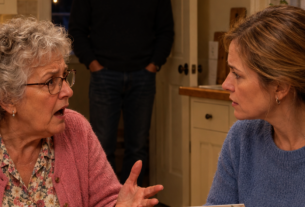
Larisa had learned to enter the apartment quietly, as though apologizing for the very fact that she had come home. Beside the door lay a dark burgundy rug with a fringe—something belonging to her sister-in-law, Tamara, which no one was supposed to touch unnecessarily. Larisa had once brought home her own cheerful rug decorated with sunflowers, only to find it rolled up in the storage room the following day. Since then, she had always placed her handbag strictly on the shelf and lined up her shoes with their toes facing the wall, exactly as things had been done before she arrived.
“Lara, you’ve hung the towel on the left hook again,” a voice called from the kitchen. “The left one is Misha’s. How many times do I have to explain it?”
“I’ll move it. Don’t be angry,” Larisa replied gently. “I was just in a hurry. I was taking Misha out for a walk.”
“‘In a hurry,’” Tamara mimicked her. “Everyone is in a hurry, but there is only one proper order.”
Larisa moved the towel and smiled at her son, who was pulling off his jacket. Misha looked up at her, and there was a silent question in his eyes that she was not yet able to answer. She merely stroked his head and whispered that everything was fine.
“Mom, can I spread my toy cars out on the carpet?” the boy asked.
“You can, sweetheart, but let’s use the little rug in the corner,” she suggested quietly.
“Absolutely not,” Tamara’s voice cut in again. “The carpet is new. It’s only two months old. He can play in his own room. It doesn’t matter if he damages the floor in there.”
“He’s five. He wants to be where the adults are,” Larisa tried to object, keeping her voice even.
“And I want the carpet pile to remain intact,” Tamara snapped. “This is my apartment and these are my rules. If you don’t like it, there is plenty of room elsewhere for your creativity.”
Sergei was sitting nearby, scrolling through something on his phone. He did not even raise his head when Tamara said those words. Larisa looked at her husband, hoping for at least one word or gesture of support. He merely shrugged and muttered that his sister had a point.
“Seryozha, at least say something,” she asked softly.
“What am I supposed to say?” he replied. “Toma is right. The carpet really was expensive. He can play in his room. It won’t kill him.”
Larisa took her son into the children’s room and sat on the floor beside him, helping him build a garage for his toy cars. She stroked his hair and tried to convince herself that these were only small things. For years, she had lived within these walls like a guest who had neither her own hook nor her own place beside the mirror.
“Lara, dinner is at seven, no later,” came Tamara’s voice from the hallway. “And only give Misha juice in a cup while he is in the kitchen. If he spills it on the rug, you’ll be the one cleaning it, not me.”
“All right,” Larisa answered calmly. “I’ll keep an eye on him.”
“‘I’ll keep an eye on him,’” Tamara scoffed. “I hear that every day, but stains still keep appearing.”
That evening, Larisa chopped vegetables on the separate cutting board she had been assigned, as though she were a stranger. The large, convenient board was considered the “family board,” while Larisa was given a small one with a crack along the edge. As she chopped, she thought about how a person could grow accustomed to anything, and the thought filled her with sadness. Still, she smiled again and called everyone to the table as though the table belonged to her too.
On Saturday, they drove to the country house, and Larisa entertained her son with fairy tales for the entire journey so that the road would seem shorter. The country house was also Tamara’s domain. Every garden bed and every jar on every shelf had its permanent, inviolable place. Nikolai Petrovich met them at the gate, hugged his grandson and gave his daughter-in-law a kindly wink. He was the only person in the family who looked at Larisa without perpetual suspicion.
“Did you bring the pie?” Tamara asked first as she came out onto the porch. “I hope it’s still warm.”
“I baked it this morning and wrapped it in a towel,” Larisa replied, handing her the bundle. “It should have stayed warm.”
“It’s cold,” her sister-in-law announced as soon as she unwrapped it. “Cold as a stone. Who carries a pie all this way and expects it to stay warm?”
“We can heat it in the oven. It will only take two minutes. I’ll do it now.”
“I’ll do it myself,” Tamara snapped. “Otherwise, you’ll make a mess of my entire oven.”
Larisa said nothing and went to the washbasin to clean Misha’s hands. The boy had stained his knees while crawling along the path after a cat, and Tamara noticed immediately. She threw up her hands as though something irreparable had happened.
“What did you dress the child in?” she exclaimed. “Light-colored trousers at a country house! Do you have any sense at all?”
“They’re his favorite ones. He asked to wear them,” Larisa explained. “They can be washed. It’s nothing serious.”
“‘They can be washed,’” Tamara mimicked her again. “Everything is easy for you. Clothes cost money.”
During lunch, Larisa volunteered to peel the zucchini simply to keep her hands busy and avoid listening to more criticism. Yet even then she did something wrong—according to the lady of the house, she cut the peel too thickly. Tamara snatched the knife from her and began showing her how “normal people” did it, clicking her tongue in disapproval.
“This is how you do it, thinly,” she grumbled. “You’ve thrown half of it away with the peel. Money down the drain. Everything is money down the drain with you.”
“I understand. Thank you. I’ll try to be more careful.”
“You’ve been trying for five years, and it hasn’t done any good,” Tamara sighed.
As Nikolai Petrovich walked past, he touched his daughter on the shoulder and quietly told her to calm down. Tamara brushed her father aside like an irritating fly. Larisa thanked him with her eyes and returned to the vegetables.
“Dad, stay out of it,” Tamara said. “I’m putting my own house in order.”
“Toma, you aren’t putting anything in order,” the old man observed calmly. “You’re breaking another person and reshaping her to suit yourself. There is a difference.”
“The difference is that I feed all of you and wash your clothes, and I receive no gratitude at all!” she flared.
Larisa listened and held on to her smile the way someone holds a heavy bag—stubbornly, until the hand begins to ache. She had hoped that the day would pass without a storm, that they would sit together and laugh like a normal family. Sergei, of course, remained silent, poking at his salad with his fork and looking away.
Lunch was drawing toward tea when Sergei suddenly cleared his throat and announced something that silenced everyone at the table. He said that Larisa’s parents had decided to give the young family an apartment of their own and that they would be moving in a week. He said it quickly, as though plunging into cold water. Larisa looked at her husband gratefully. For the first time in a long while, he had spoken aloud about something that mattered to her.
“What apartment?” Tamara asked slowly, her spoon frozen in her hand. “What gift? This is the first I’ve heard of it.”
“A two-bedroom apartment not far from the city center,” Sergei replied. “Lara’s parents found a good opportunity and helped us. They wanted it to be a surprise.”
“A surprise?” his sister-in-law’s voice rose sharply. “You arranged everything behind my back, and now you call it a surprise? I fed you and took care of you, while you were plotting behind my back!”
“There was no plot,” Larisa said calmly. “It simply worked out this way. We wanted to tell you at the right moment.”
“The right moment!” Tamara sprang to her feet. “That money should have been saved for the child’s education, not wasted on walls! You already have a roof over your heads. You live here with everything provided for you. What more did you need?”
“We needed a home of our own,” Larisa answered without raising her voice. “A small one, any kind at all, but one that belonged to us.”
“‘One that belonged to us!’” Tamara was almost choking. “You can’t take a single step without me! Who collects Misha from kindergarten when you’re busy? Who makes the soup? So now the old people are no longer useful and can be thrown away?”
“No one is throwing anyone away,” Sergei said wearily. “Toma, calm down. We are moving. It is perfectly normal.”
“Normal?” She pointed a finger at her brother. “Your wife has twisted your mind, and now you dance to her tune! You’re not a man—you’re a doormat!”
Nikolai Petrovich stood and took his son by the arm, leading him toward the barbecue grill. Larisa could hear the old man speaking quietly but firmly. He said it was time for Sergei to grow up, that a man built a home of his own instead of hiding behind the back of a despotic sister. Sergei nodded, and for the first time, he held his back straight.
“Dad, I just didn’t want a scandal,” he tried to explain beside the grill.
“And you got a scandal anyway,” his father answered. “Only you also lost your dignity in the process. Don’t retreat now. You made a decision, so follow through with it.”
Meanwhile, Tamara paced around the veranda, her words becoming increasingly bitter and vicious. She clutched at her heart, rolled her eyes, and then began attacking them again. Saliva glistened on her lips, and her voice rose into a shriek. It was the fury of a mistress of the house who was losing her unpaid servant.
“I did everything for them, and they stabbed me in the back!” she shouted. “I put up with that disheveled woman in my home for years!”
“I can hear every word,” Larisa said quietly. “And I will remember it.”
“Remember whatever you like!” Tamara waved her away.
Larisa looked at her for a long moment with a clear, steady gaze, and the smile finally disappeared from her face. Something inside her closed peacefully, like a book that had been read to the end. She understood that there was nothing left to explain and no one worth explaining it to. The realization actually made her feel lighter.
Tamara dramatically put on her jacket and went to complain to a neighbor who lived two properties away. They could hear her sighing loudly by the gate about “shameful ingratitude” and “young people these days.” The neighbor, a quiet woman, merely agreed politely while glancing toward the veranda with obvious sympathy for Larisa. Larisa gathered Misha’s toys into a bag and calmly began packing their things.
“Are you leaving already?” the neighbor asked, stopping by for a moment. “Tamara has caused quite a commotion.”
“We’re leaving,” Larisa nodded. “She has the right to make a scene. And we have the right to live the way we choose.”
“Stay strong, dear,” the neighbor whispered. “I’ve been watching all these years. Life here hasn’t exactly been sweet for you.”
“Thank you. From now on, I’ll buy my own sugar and put it wherever I want.”
Just before they left, Tamara returned and stood beside the car. She looked at her brother’s wife with such contempt that words were almost unnecessary. But Tamara would not have been herself if she had remained silent, and she finally released everything that had been building inside her.
“If you’re leaving, then leave completely,” she said through clenched teeth. “Don’t look for a way back. I’ll lock the doors.”
“Go ahead,” Larisa replied evenly. “I’ll open my own doors. I’ll have doors of my own now. Can you imagine that?”
“You’ve become insolent,” Tamara hissed. “You used to lower your eyes, at least.”
“I used to be a guest in someone else’s home,” Larisa said as she got into the car. “A guest smiles and remains silent. I’m tired of smiling according to someone else’s schedule. It is deeply unpleasant.”
The car pulled away, and Larisa did not look back once. In the rear seat, Misha swung his legs and asked whether it was true that he would now have a room of his own and be allowed to spread his cars across the hallway floor. Larisa said it was true and that he could put them anywhere he liked, even on the ceiling. The boy laughed, and his laughter was the best music she had heard all day.
“Do you regret it?” she asked her husband when the country house disappeared around the bend.
“No,” Sergei replied, placing his hand over hers. “Forgive me for remaining silent all these years. I thought silence would keep things peaceful.”
“Quiet doesn’t always mean peaceful,” Larisa observed gently. “Sometimes the quietest place is a battlefield where everyone has already surrendered.”
“Where did you learn to say things like that?” he asked with a smile.
“From life,” she shrugged. “I’ve spent a great deal of time in silence. Silent people become good at thinking.”
On the way home, she called her mother and briefly described the scene at the country house. As always, her mother advised her not to act rashly, to understand the other side and to endure the difficult period. Larisa listened and nodded.
“Sweetheart, family requires patience,” her mother said. “Tamara will calm down, and you’ll make peace.”
“Mom, I’ve already given away years’ worth of patience in advance,” Larisa replied with a faint smile. “Now I’m going to live on borrowed happiness. And I think I’ll be able to repay the debt.”
The walls of the new apartment were bare, the furniture was still packed in boxes, and a naked lightbulb hung from a wire in the ceiling. Yet Larisa could breathe there as though a tight band that had constricted her chest for years had finally been removed. She spread her sunflower rug beside the entrance—the same rug she had once found rolled up in someone else’s storage room.
“Mom, can I jump in here?” Misha shouted from the empty room.
“You can, sweetheart,” Larisa called back. “You can do anything here. This is our home.”
They ate dinner while sitting on boxes, using a candle because they had not yet installed the chandelier and the bare bulb turned out to be burned out. Sergei opened a can of something simple, Misha laughed and scattered cookie crumbs across the floor, and no one scolded him. Larisa looked at the scene and laughed with them, freely and loudly.
While unpacking, she found an old teapot in the corner of one of the boxes. Tamara had once given it to them for their anniversary—the only gift from her that had not come with a reproach. Larisa turned it over in her hands, feeling bitterness and warmth mingle in her chest. Then she placed it on the windowsill, where everyone could see it.
A few days later, the telephone rang, and Tamara’s name appeared on the screen. Larisa looked at it calmly and did not answer immediately. The voice on the other end was unusually quiet, almost ingratiating.
“Lara… how is Misha?” her sister-in-law asked. “He isn’t sick, is he? I baked some shangi pastries and thought I might bring them over.”
“Misha is healthy. He’s running around,” Larisa answered evenly. “Thank you, but we’re managing on our own now. We can manage the pastries too.”
“Lara, I’m not a stranger,” Tamara’s voice trembled. “Don’t call me by my name as though I were an outsider. I’m family.”
“Tamara, family isn’t someone who feeds you. Family is someone who does not humiliate you,” Larisa said quietly. “For years, you called me disheveled and treated me like a guest. I simply remembered what you taught me.”
“I didn’t mean any harm. That is simply my personality. You were used to it.”
“I was,” Larisa agreed. “That is why I left. You become accustomed to bad things without noticing, and then one day you stand there unable to remember who you are. I don’t want to become accustomed to it anymore. Misha loves you, and you will still be able to see him. But things will be different now. There will be no more rugs that belong to someone else.”
She ended the call gently, without anger. On the other end, Tamara was left in silence, sitting alone at the large table that had once been surrounded by people. Sergei now visited his father, but not her. Nikolai Petrovich increasingly remained silent in his daughter’s presence.
“Seryozha, have you spoken to your sister?” Larisa asked later.
“I have,” he nodded. “I made peace with my father, but with Toma… She keeps talking about money and ingratitude. I’m tired of listening to it.”
“Don’t rush her. But don’t betray yourself again either. We have built a home. Now we must protect it.”
The weeks passed, and the new apartment stopped looking like an empty box. Curtains appeared—curtains Larisa had chosen herself, which no one removed and sent to the storage room. A hook was installed for Misha’s towel exactly where it was convenient for him, rather than where someone else’s rules demanded.
Tamara, meanwhile, sat in her perfectly tidy apartment, where every object knew its proper place, and she did not know where to place herself. Her brother’s wife no longer called. She saw her nephew once a month, and even then only for an hour. Her brother spoke to her coldly, and her father shook his head. She wandered from room to room across her flawless parquet floor, which no one was left to stamp on.
“How did this happen?” she muttered aloud to no one. “The house used to be full of people and noise, and now it’s so lonely I could howl. I only wanted what was best. I only cared about order…”
She sat on the edge of the sofa and then rose again, unable to find a place for herself. The words she had thrown at her sister-in-law now echoed back from the empty walls. Everything she had valued—authority, control, other people’s hands working in her garden—had crumbled, and there was nothing with which she could put it back together.
“Because of a carpet… because of a hook… because of a cold pie,” Tamara whispered, clutching the very towel that had once hung from the left hook. “You foolish old woman. You had everything, and you drove them all away yourself. Everyone is gone, and I’m left here with all my precious order. Who needs this order now?”
She would fall silent and then begin the same quiet, pointless argument with herself all over again. There was no more shrieking and no wounded outrage from the mistress of the house—only a dull reproach directed at no one.
She had tried to force everyone to live according to her wishes, and in the end, she was left alone.
And there was absolutely no one she could ask how it had happened.