“Mom! Come here! Someone’s living in our apartment!”
Nina was carrying two bags and a bucket of apples, while Yurka stood by the bedroom door with his back to her. Just from the way he was standing, she could tell he wasn’t joking.
“Yurka, take your shoes off!”
“Mom, just come here!”
image
Their building stood beyond the little park: nine stories, two entrances. Nina and Valera lived on the seventh floor, while Klavdia Petrovna lived one floor below in a one-room apartment with her own mother.
They had returned from the country house a day earlier than planned. It had been raining for three days straight, the water supply to the garden plots had been shut off, and Valera had said there was no point in getting soaked, so they might as well go home.
Nina set down the bucket, pulled off her wet jacket, and walked into the bedroom.
A dress that did not belong to her was hanging over the back of a chair. A makeup bag lay on the dressing table. Near the window, in the spot where Nina usually kept the ironing board, stood a suitcase. And judging by the tights drying on the radiator beside it, the suitcase had not arrived that day.
“Mom, whose stuff is that?”
“Go wash your hands.”
“But whose is it?”
“Yura!”
The boy shuffled away down the hallway.
Nina remained where she was for another moment, then went back into the entrance hall and finally noticed what she had walked past a minute earlier.
A pair of slippers stood beside the coat rack.
Strangers’ slippers.
And not the ones she kept in the cabinet for guests. These belonged to someone. Worn-in, with the backs crushed flat.
Valera dragged a sack of potatoes across the threshold, straightened up, looked at his wife, and then past her toward the bedroom, where the unfamiliar dress still hung over the chair.
“Well?”
“Call your mother.”
“Why?”
“Call her, Valera.”
He called from the kitchen, and Nina could hear every word. It was a prefabricated apartment building with thin walls, and Klavdia Petrovna had only one son.
“Mom, there’s somebody’s suitcase in our bedroom… What Ksyusha? Tanya’s daughter? Mom! Mom, wait! Why didn’t you tell us?”
Nina listened from the hallway, then walked over and took the phone from her husband.
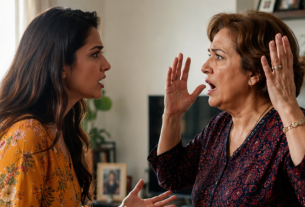
“Hello, Klavdia Petrovna. It’s Nina. I’ve come home and found someone else’s things in my bedroom. Explain to me who is living in my apartment.”
“Ksyusha, Tanya’s girl!” Her mother-in-law sounded irritated, as if she were the one who had been caught off guard. “You saw her at the funeral! She came here to study, so I let her stay there. You were supposed to be at the country house until Sunday!”
“We came back early.”
“So you came back! She’s not going to eat you alive!”
“Klavdia Petrovna…”
“And where was I supposed to put her?” her mother-in-law shouted. “At my place? My mother is bedridden! I barely have enough room to turn around even during the day!”
Nina put the receiver down on the table and stepped out onto the balcony, even though rain was blowing in.
She stayed there until her hands went cold, and all that time one little word kept turning over and over in her mind:
Let.
She had let her in.
She hadn’t asked. Hadn’t called. Hadn’t warned them.
She had simply unlocked Nina’s home with her key.
Nina’s home was not orderly in the sense of everything being covered in protective cloths or arranged along decorative runners. It was orderly because everything had its place and its time.
Groceries were bought from a list. Money was divided into envelopes. Trips to the country house began on Thursdays and came with a prepared menu. Yurka’s after-school activities, Valera’s work shifts, bills, vaccinations, winter tires—Nina kept all of it in her head, and rather than making her head ache, it gave her peace.
She often told her girlfriends:
“Girls, disorder is the hardest job in the world. Until you sort it out, you’re carrying all of it around on your back.”
There was only one thing she could not stand: when everything had already been decided for her and all that remained was for her to agree.
It went back to childhood. There was no mystery about that.
Nina’s mother was easygoing and kind, but she lost everything: keys, money, certificates, winter boots, notes from school. Her father appeared and disappeared, and whenever he appeared, he came with presents and grand plans that had vanished by the next morning.
In fourth grade, Nina started keeping a notebook.
What needed to be bought. What needed to be handed in. When the parent-teacher meeting was.
Everyone at home laughed at that notebook, but without it, nobody could find anything.
That was how it had all started.
Nina and Valera had worked long and hard to buy their apartment. They counted every ruble, saved, sold Valera’s garage, borrowed money from Nina’s sister, and spent three years paying it back.
Back then, Klavdia Petrovna lived in her own one-room apartment on the other side of town. She visited on Saturdays. When Yurka started kindergarten, she came more often, so they gave her a key so that if Nina was delayed, she wouldn’t have to sit with the child out in the stairwell.
Nina’s mother-in-law was neither cruel nor overly sweet.
She had raised Valera alone. She had been widowed when he was eight, had worked wherever she could, and eventually ended up at the hospital laundry.
She accepted Nina calmly, without tears or interrogation. She watched Nina set the table once and said only one word:
“Capable.”
Klavdia Petrovna did not know how to give compliments, but Nina carried that single word with her for years like a medal.
The spring before last, her mother-in-law had moved closer. She exchanged her old one-room apartment for one in the same building, one floor below Nina and Valera.
She had done it because of her mother.
Back then, Grandma Fenya could still walk around the apartment, holding on to the walls, although she was already confusing day with night and calling for her long-dead husband.
Then, the previous winter, she became bedridden.
It happened almost overnight, within a single week. She fell in the bathroom, spent some time in the hospital, came home—and never got back on her feet.
Klavdia Petrovna did not tell anyone.
Valera did not find out immediately, and not from her. A neighbor mentioned it by accident on the stairs. He called his mother and shouted at her, and she listened before replying:
“Finished shouting? Feel better now?”
Since then, she rarely went farther than the grocery store.
She came upstairs only occasionally, and when she did, she stayed for ten minutes at most before getting up in the middle of a conversation.
“I’d better go. She’s alone down there.”
Nina visited them on holidays. She brought pie, sat for a while, talked about the weather, then went back upstairs.
There was only one flight of stairs between the two apartments, yet they saw each other less often than strangers who happened to meet by the mailboxes in the same building.
Ksyusha arrived a little after eight in the evening, soaked through, carrying a grocery bag containing a loaf of bread, a packet of tea, and three eggs.
“Hello…” she said, stopping just inside the doorway.
“Hello. Take your shoes off.”
The girl did and remained standing in the middle of the hallway, unsure where to put the bag.
She was thin, with short hair and hands reddened from the cold. She stood as if she had no right either to sit down or to leave.
“Aunt Klava told me you wouldn’t be back until Sunday…”
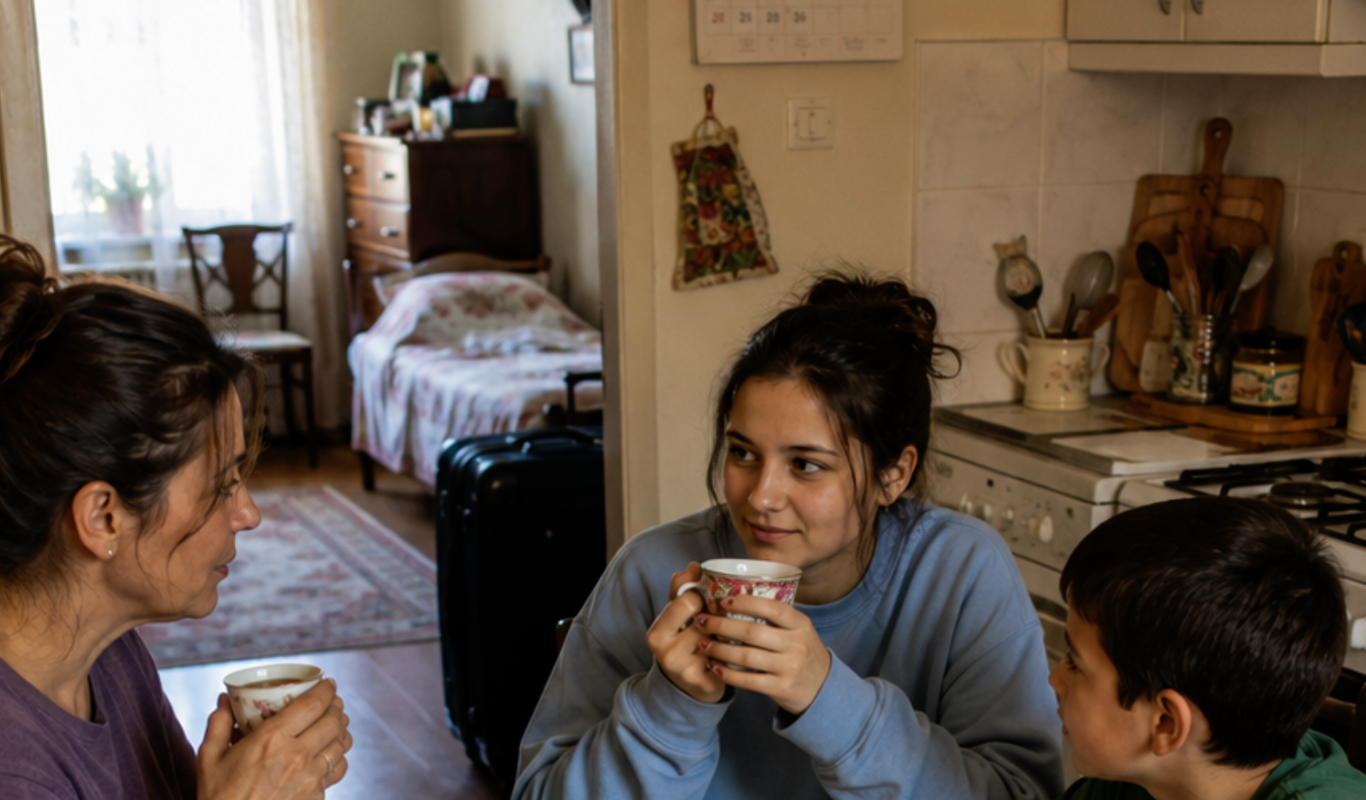
“We came home early. Come in. We’ll have some tea.”
The three of them drank tea together: Nina, Ksyusha, and Yurka, who perched on a stool and could not stop staring at their guest.
Ksyusha explained that she had been accepted into school and classes began on the first of the month. They had not been given dormitory rooms yet and were being told there might be places by winter. Her mother had stayed back in the district with the younger children, while Ksyusha had come to stay with her grandmother—but there was no room at her grandmother’s place.
“So what are you to us?” Yurka asked.
“Me?” Ksyusha thought. “Grandma Fenya is my grandmother. Aunt Klava is my mother’s sister. So I guess I’m your… sister or something?”
“My second cousin aunt!” Yurka cried delightedly. “Mom, I have an aunt and she’s seventeen!”
“Yura, stop chattering.”
“I’m very quiet,” Ksyusha told Nina. “I’m hardly ever here. I leave in the morning and come back in the evening. And I wash my own dishes…”
“I can see that you’re quiet.”
“I’ll clean everything up!”
“Ksyusha.”
“Yes?”
“You’re a good girl. But this is my bedroom. And nobody asked me.”
Ksyusha put down her cup and flushed instantly, all the way to her neck.
“I thought you knew…”
“I didn’t.”
“I’ll leave tomorrow!”
“Not tomorrow.”
Nina took her cup and poured her some more tea.
“Stay until we find somewhere for you. Some women at my job rent out rooms. I’ll ask around.”
That night, Valera sat up in bed and spoke into the darkness.
“You could have handled it differently.”
“How?”
“Well… you could have just let her stay.”
“She’s our guest, not a tenant! Valera, we have two rooms and a child. Have you thought about where she’s supposed to sleep? In the living room where you watch television until one in the morning?”
“Mom wouldn’t have done it for no reason.”
“Your mother didn’t do it for no reason,” Nina agreed. “She took a key and moved someone into my home whom I’ve seen once in my entire life. And I found out from my child.”
Valera lay back down and turned toward the wall.
The next morning, he left earlier than usual and skipped breakfast.
He loved his mother with that heavy kind of filial love that contains a great deal of guilt and very few words. Whenever something sharp wedged itself between his mother and his wife, he became deaf to both of them and left for work early.
That week, Ksyusha slept on the sofa in the living room.
Valera watched television with the sound off and went to bed earlier than everyone else.
They found Ksyusha a room on Wednesday.
Nina called everyone she knew at work.
The women only threw up their hands.
“Try finding a room these days! And for a student! And cheap!”
Eventually, through two acquaintances, they found one with a woman in a nearby neighborhood. It was clean and inexpensive, and there was a direct bus to Ksyusha’s school.
Nina went there herself to inspect it.
She spoke to the landlady herself.
She wrote down the phone number in her notebook herself and underlined it.
Everything had been done correctly.
And by nightfall, the correctness of it all had given Nina a headache.
Ksyusha left on Thursday after classes.
Yurka carried her suitcase downstairs. He walked beside her all the way to the bus stop without saying a word, then finally asked:
“Will you come visit?”
“I will.”
“When?”
“When I’m invited,” Ksyusha said.
Nina slipped a jar of jam into her bag. She wanted to say something warm, something kind.
But the words stuck inside her.
That evening, Nina went down one floor and rang the bell.
The door opened quickly.
Klavdia Petrovna stood there in a bathrobe with a towel over one shoulder, her sleeves wet to the elbows. She had been washing her mother’s hair.
“What do you want?”
“The key.”
Her mother-in-law silently disappeared into the room. Nina heard her rummaging through a drawer. She came back and placed the key in Nina’s palm.
“Here. And don’t worry, I won’t come up to your place anymore.”
“Klavdia Petrovna, that’s not what I meant!”
“I understand perfectly. Go. My mother hasn’t been fed.”
The door closed.
Nina stood on the landing for a moment, then went upstairs. All the way to her own door, she had the feeling that someone was staring at her back.
Autumn began, and silence settled between them.
Her mother-in-law stopped coming upstairs.
She did not call even once—not casually, not for practical reasons.
Yurka went downstairs on his own. He brought back candy and told Nina that Grandma Fenya had called him Vitya again and that Aunt Klava had repaired the iron and actually fixed it.
“Mom, did you and Grandma Klava have a fight?”
“Don’t make things up.”
“Then why—”
“Yura, eat!”
Valera spoke to his mother briefly on the telephone, always in the kitchen with the door pulled nearly shut.
Nina never asked.
In fact, there were many things Nina did not ask during those weeks.
And because of it, their home became the sort of place that made you want to escape outdoors despite everything being perfect: clean, quiet, dinner at seven, everything in its proper place—yet nobody felt like coming home.
One day, Nina caught herself standing on the landing between the floors, listening.
Downstairs, water was running.
It wasn’t even about help.
Klavdia Petrovna had hardly helped them at all during the past year. How could she, with her bedridden mother?
But as long as her mother-in-law had walked up and down those stairs, the household had somehow stood properly.
Without her, it felt as though an entire wall of the house had collapsed.
And nobody seemed to notice except Nina.
Yurka’s birthday came at the end of September.
Nina baked two cake layers, made several salads, and invited three boys from his class. The table was full, the candles were blown out, everything went exactly as it should.
Later, when the boys had gone home, Yurka turned a new flashlight over and over in his hands and asked without looking up:
“Mom, why didn’t Grandma Klava come?”
“She has your great-grandmother. She can’t leave her alone.”
“She didn’t even call.”
“She will.”
“Did you call her?”
Nina gathered the plates without answering.
Then she spent the entire evening angry—at herself and at the boy for asking something that would have been better left unasked.
At the beginning of October, Nina got sick.
Nothing serious, just a cold, but she stayed in bed for three days. Valera was working shifts, and she still had to get up to cook dinner for her son.
Before Grandma Fenya had become ill, Klavdia Petrovna would have come upstairs on days like these. She would arrive without calling, put a pot on the stove, ask whether Nina had any lemon, then leave again without even taking off her coat.
Now nobody came.
Everything was functioning exactly the way Nina herself had arranged it.
And yet she lay in bed listening, hoping to hear a door slam downstairs.
In October, Yurka began disappearing after school.
He would come home, throw down his backpack, grab something to eat, and run downstairs. Sometimes he did not return until nine or even ten.
“Where have you been?”
“At Grandma Klava’s.”
“And what do you do there?”
“Nothing. I read to Grandma Fenya, and Ksyusha listens.”
“You read to whom?”
“My great-grandmother! She gets bored lying there. She likes it when I read loudly.”
“Yura, eat and go do your homework.”
After that conversation, Nina scrubbed the entire kitchen, ironed all the laundry, then sat at the table until midnight.
Then on Thursday, Yurka still had not come home by ten.
Nina threw on a cardigan, went down one floor, and rang the bell.
Nobody opened immediately.
Klavdia Petrovna’s hallway was dark, but light spilled from the room, and from the doorway Nina could see everything.
Grandma Fenya lay on the bed against the wall, facing the door.
Klavdia Petrovna stood on one side of her, Ksyusha on the other, both holding the corners of a bedsheet.
Yurka sat on the floor beside the radiator with an open book on his knees, waiting until he could continue reading.
“One, two…” Klavdia Petrovna said.
They pulled.
Grandma Fenya groaned.
“Easy, Grandma, easy. Just a second,” Ksyusha said.
Nina stood motionless.
Then she noticed more.
A mattress by the window, neatly made.
A pile of textbooks on the windowsill.
A basin under the bed.
A clothesline stretched across the entire room.
“Close the door,” Klavdia Petrovna said without turning around. “There’s a draft.”
Ksyusha lifted the old woman, supported her, tucked the sheet beneath her, then whispered something in her ear.
Grandma Fenya laughed.
They finished changing the sheet.
Yurka was sent home.
Ksyusha went to wash her hands.
Nina walked into the kitchen and sat down, even though nobody had invited her.
Klavdia Petrovna followed, put the kettle on, and sat opposite her, laying her large hands, reddened by water, on the oilcloth-covered table.
“Well?”
“Ksyusha lives here with you?”
“She does. Since September. Didn’t Yurka tell you?”
“He did,” Nina said.
“But how? In one room?”
“Just like this. On a mattress by the window. She does her homework in the kitchen. I don’t turn the light off on her.”
“Klavdia Petrovna…”
“Did you come here to ask questions or to talk? Ask, then.”
“Couldn’t you have asked me?”
Klavdia Petrovna did not answer for a long time.
The kettle boiled. She took it off the stove, poured two cups, and pushed one toward her daughter-in-law.
“And what would you have said?”
“I would have said: let’s think about where she can stay.”
“Exactly!” her mother-in-law said. “Let’s think about where. But I wanted it differently.”
“How?”
“I wanted you to come home from the country house and find the girl sitting there. Alive. Warm. And I wanted you to look at her and say yourself, ‘Stay, Ksyusha.’ That’s what I wanted.”
Nina put down her cup.
“So you were testing me!”
“I was,” Klavdia Petrovna said evenly. “And you failed.”
“Klavdia Petrovna!”
“What did you expect?”
Her mother-in-law looked directly at her without blinking. Her voice was not angry. It sounded exhausted all the way down to its foundations.
“I’ve known you for eight years. You’re a good wife. You’re raising your son well. Your house is more orderly than any home I’ve ever seen. But you live your whole life by lists. This goes here, that goes there, this we’ll think about later. But people don’t arrive according to a list! A person shows up soaked through, carrying a plastic bag, and that person has nowhere to sleep tonight!”
“I found her a room.”
“You did,” her mother-in-law said. “A good room. I went to see it. But what was she supposed to pay for it with? Tanya sends me what she can, but how much can she send? Their farm closed down.”
Nina said nothing.
“She came back to me herself a week later,” Klavdia Petrovna continued. “She stood on the landing with her suitcase and said, ‘Aunt Klava, I can sleep on a mattress. I’m small.’ So the three of us have been living together ever since. She helps me turn Mother over. I can’t do it alone anymore. My back…”
“And why didn’t you tell me a single word?”
“Did you come down here?”
Then, through the open doorway, a soft but perfectly clear voice came from the other room.
“Klava! Stop biting her head off.”
Both women fell silent.
Grandma Fenya rarely spoke anymore, and half the time she confused people’s names. But whenever she got them right, everyone listened.
“Nina!” she called. “Come here.”
Nina went into the room and sat on the chair beside the bed.
The old woman looked tiny and dried up, but her eyes were clear. Under that gaze, Nina instinctively sat straighter.
“You’re right to guard your door, girl,” Grandma Fenya said. “A woman has every right to lock her own door. Just look through the peephole first and see who’s standing outside. That’s all.”
She closed her eyes.
The conversation was over.
Both women understood that without another word.
Nina returned upstairs close to midnight.
Valera was still awake.
“Where were you?”
“Downstairs.”
“And?”
“Valera.”
Nina sat on the edge of the bed without taking off her clothes.
“She’s living on a mattress down there. Since September. She and your mother turn Grandma Fenya over together because your mother’s back is bad.”
Valera sat up.
“Mom never said anything about her back.”
“Not a word.”
They sat in the darkness and remained silent for a long time.
Both felt miserable.
But one thing was good:
For once, they were silent about the same thing.
On Saturday, Nina went downstairs carrying her notebook.
Klavdia Petrovna looked at the notebook and was about to smirk, but Nina sat down at the table.
“Go ahead and laugh. I don’t know how to do things any other way.”
“All right. Talk.”
“Ksyusha is moving upstairs with us. Into Yurka’s room. Yurka can move into the living room. He’s been asking for it anyway because the sofa and television are there.”
“Nina…”
“Wait. In the evenings, Ksyusha will come downstairs and stay with Grandma Fenya while you take a bath, run errands, sleep—whatever you want. And from Saturday night to Sunday, I’ll stay here overnight. The whole night. So you can get one proper night of sleep.”
“You won’t manage.”
“I will.”
“You don’t know what it’s like.”
“I’ll learn,” Nina said. “On Monday I’ll go to social services and find out what caregiving assistance she qualifies for and what paperwork we need.”
Then she placed the key on the oilcloth.
“And here. Take this back. Just call before coming upstairs, all right? Not because of rules. Just so I know who I’m opening the door to.”
Klavdia Petrovna picked up the key, held it in her fist for a moment, then slipped it into the pocket of her robe.
“Ksyusha is going to study,” she said after a pause. “Don’t turn her into a full-time nurse.”
“I won’t.”
“You’d better not.”
“Klavdia Petrovna.”
“What?”
“I failed the test back then,” Nina said. “Can I retake it?”
Her mother-in-law turned toward the stove and began noisily moving things around for no reason at all.
“Want some tea?” she asked.
They moved Ksyusha upstairs that very day.
Yurka carried his boxes into the living room looking so happy that Nina could not help laughing.
Valera and Nina carried Ksyusha’s suitcase together.
They decided to leave the mattress downstairs.
Just in case.
Nina remembered her first Saturday night shift for a long time.
Grandma Fenya woke three times.
First she called for Klava, then Vitya, then her own mother.
Just before dawn, she suddenly recognized Nina and asked for water.
Nina fed her water from a spoon and remained sitting beside her until sunrise, thinking about everything at once and nothing in particular.
At six in the morning, the first wet snow of that autumn began falling outside.
Klavdia Petrovna came out of the room where she had slept for nine uninterrupted hours. The first thing she did was go to the bathroom.
When she emerged, her hair was wet and she looked ten years younger.
“Well?” she asked.
“We survived!”
“That’s what I thought.”
Nina went to social services on Monday, just as she had promised.
They listened to her, gave her a list of documents, and explained that an application had to be submitted for a person to be officially recognized as needing care. After that, someone would come and assess the situation in person.
They came.
They looked.
They accepted the application.
The process moved slowly, but it moved.
And the paperwork was not even the most important part.
The important thing was that now there were four people carrying one burden instead of one person carrying all of it.
The winter was hard, but not in the same way as the previous one.
Now the weight was divided.
Valera drove to the pharmacy and carried water upstairs whenever the building’s supply was shut off.
Ksyusha spent evenings downstairs and read classified advertisements from the newspaper aloud because Grandma Fenya liked them better than books.
Yurka memorized half a story about a sea captain.
And on Saturdays, Nina slept during the day so she could stay awake all night.
In February, Grandma Fenya suddenly asked for pancakes.
Klavdia Petrovna made an enormous stack, and all of them ate together standing in the tiny kitchen because there had never been enough chairs for four people there.
Ksyusha lived with them until summer.
Then she was finally given a place in the dormitory and moved out.
For the first month, she came running back almost every other day until Nina finally told her irritably:
“Live over there already. Come visit on Saturdays.”
Yurka would grow up and tell people that in childhood he had had two grandmothers and one seventeen-year-old aunt.
And the day after Ksyusha moved upstairs, Nina stopped by a household-goods store and bought a pair of slippers.
Blue ones. Small.
At home, she placed them on the shelf in the hallway beside her own and called Ksyusha over.
“These are for you.”
“For me?! Why? I already have some…”
“You have your own,” Nina said. “These are the ones that stay here.”
She pointed toward the cabinet.
“The guest slippers are in there.
Those aren’t for you.”