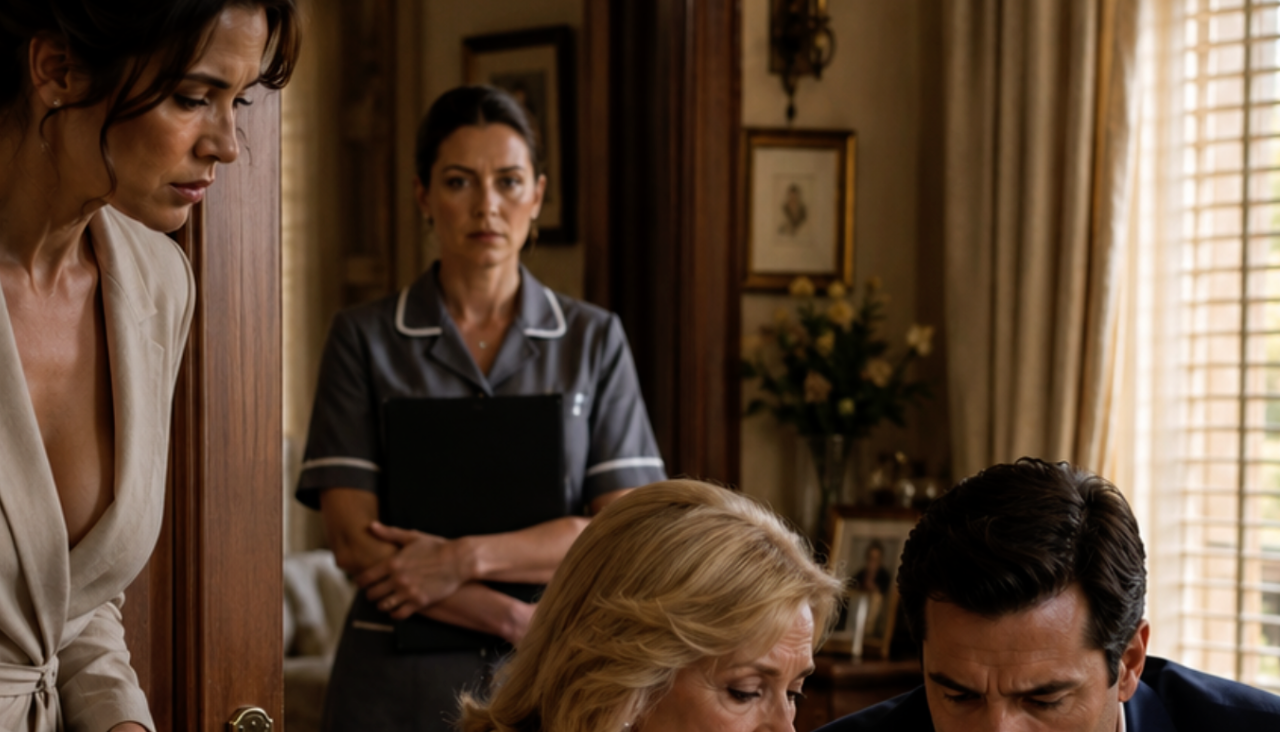
Dasha stood in the financial director’s office, staring at the contract that had turned her life upside down. At the bottom, beneath the line marked “Responsible Officer,” was her surname. The letters were neat, slanting slightly to the right—just the way she had been taught to write at school. But Dasha knew one thing for certain: she had never signed it.
“Do you understand that falsifying a document involving a substantial amount can carry a serious prison sentence?” Rodion Borisovich, the head of security, sounded tired, like a man who had already grown weary of explaining the obvious.
Dasha turned the contract over. In the upper-right corner, barely visible in pencil, someone had scribbled a date. It did not correspond properly to any calendar month.
“Rodion Borisovich, I was at the airport that day. My vacation started on the twenty-third. I still have the tickets and my boarding pass. I could not have signed this contract.”
“Dasha, we’ve worked together for years,” he said, removing his glasses and wiping them with a handkerchief. “I remember when you first started here. But you have to understand: this document was submitted to the tax authorities, and it has caused serious problems. Someone has to be held responsible.”
“Not me.”
She said it calmly, even though everything inside her was trembling. A draft came from the window, and gray raindrops crept down the glass. The office was silent except for the faint whistle of a kettle somewhere in the kitchen.
Dasha left the office clutching a copy of the contract. She knew that behind her sat a man who believed she was guilty. Somehow, that was worse than the accusation itself.
It felt like a verdict.
At home, silence greeted her. Viktor was sitting in the kitchen scrolling through his phone.
“Why are you late again?” he asked without looking up.
“They accused me of forging a signature today,” Dasha said quietly. “On a contract I never signed.”
Viktor put down his phone and looked at her with little interest.
“You’re the clever one in this family. You’ll figure it out. Put the kettle on.”
Dasha swallowed hard. She wanted to scream, but restrained herself. During four years of marriage, she had grown accustomed to her husband refusing to involve himself in her problems.
But this wasn’t about a broken washing machine.
She was facing a criminal charge.
“Viktor, it was your mother.” The words escaped before she could stop them. “She was the only person who had access to my computer when we visited you in June. She was the only one who could have gotten into the accounting database.”
“Don’t drag Mom into this!” Viktor jumped to his feet, knocking his chair back against the wall. “It’s your own fault for leaving your computer without a password. Why did you suddenly decide you need someone to blame anyway? They haven’t even fired you!”
“They’re accusing me of a crime, Viktor. A criminal offense!” Dasha raised her voice. “Do you understand what that means?”
He waved her off.
“You’ll deal with it. You’re strong and independent, remember?”
The words hit her like a slap.
Dasha closed her eyes. She saw her mother-in-law’s smiling face and those familiar eyes that had always regarded her with cold mockery.
Margarita Petrovna.
A woman who had never accepted her daughter-in-law. A woman who, at every family dinner, would ask with poisonous sweetness, “So, how’s that career of yours going? Still just an accountant?”
And now there was this signature.
Dasha walked out of the kitchen, feeling the familiar mixture of hurt and anger beginning to boil inside her. She could no longer stay in that house.
She threw on her jacket and grabbed her bag.
“Where are you going?” Viktor shouted.
“To find the truth.”
“Idiot,” she heard him mutter after her.
The office greeted her with emptiness and the cold glow of emergency lights. Dasha went up to her floor and turned on her computer.
She needed the document issue log.
She knew that contracts requiring signatures were processed through the administrative office. If the signature was fake, there had to be an original somewhere—a document from which her signature had been copied.
The night cleaner appeared in the doorway.
It was Aunt Valya, a woman of about sixty with a kind, wrinkled face. She had worked at the company for more than fifteen years and knew every entrance, every exit, and every corner of the building.
“Dashenka, why are you still here?” she asked, leaning on her mop.
“Working, Aunt Valya.”
The cleaner remained silent for a moment before asking quietly:
“Looking for something?”
“I’m trying to find out who could have forged my signature.” Dasha herself didn’t know why she was saying it aloud. “On a contract I never signed.”
Aunt Valya frowned.
“Take a look in that cabinet.” She nodded toward an old wooden shelving unit beside the window. “Your mother-in-law’s office used to be here. Margarita Petrovna’s. She retired ten years ago but never took all her things with her. A couple of weeks ago, I found the key to her old drawer behind the windowsill.”
Dasha froze.
Her heart seemed to jump into her throat.
“How did you know that was the cabinet I needed?”
Aunt Valya merely smiled, her eyes glinting.
“I see everything, Dashenka. I’ve been washing these floors for fifteen years. I know all the secrets.”
She held out a dark key with a jagged edge.
Dasha opened the cabinet.
On the top shelf, among old folders, lay a diary. Its cover was a faded raspberry color, its corners worn with age. On the inside cover was a handwritten dedication:
“To Margarita, from Mom. Treasure what you have.”
Dasha opened it.
Her mother-in-law’s handwriting was small and compact. The entries covered the previous ten years.
But what Dasha found on a page from May of that year made her blood run cold.
“Today I saw Viktor leaving a restaurant with that woman. I recognized her—his ex. They were laughing and holding hands. My son is a cheater, but he is still my son. I will not allow Dasha to destroy the family. She must leave on her own. If necessary, I will help her leave gracefully.”
Below it, in smaller writing:
“The signature. The idea will work. She’ll never be able to prove anything.”
Dasha sank into a chair.
Her legs would no longer support her. Her head was ringing.
She understood now.
This was not merely an act of spite.
It had been a carefully planned operation.
Her mother-in-law wanted to get rid of her daughter-in-law, and she had chosen a forged signature as her weapon.
A criminal case.
Prison.
Their child staying with his father.
And beside the father—his ex.
And Viktor?
He knew.
All this time, he had been on his mother’s side.
Dasha stood up. She put the diary into her bag and returned the key to Aunt Valya.
“Thank you,” she whispered.
“Don’t thank me, sweetheart. I was a daughter-in-law once too.” The cleaner shook her head. “My mother-in-law, may she rest in peace, tried to make my life unbearable too. But I survived. And so will you.”
Dasha stepped outside.
The rain had stopped, and the sky was clearing.
For the first time in a long while, she felt that she had someone supporting her.
Real, human support.
Not the kind you expect from your loved ones, but the kind that sometimes arrives unexpectedly—from someone who simply happens to pass by while you are suffering.
The next day, Dasha went to see a lawyer.
Tatyana Sergeyevna listened to her, leafed through the diary, and compared the dates.
“This isn’t enough,” she said. “We have to prove the signature was forged. We’ll need a forensic handwriting examination. And we have to determine exactly how she copied your signature.”
“I know how.” Dasha reached into her bag. “I found this this morning in an old folder near the printer.”
She placed a printout on the desk.
It was a photograph of her computer screen taken on the evening of June eighteenth. The screen showed her account in the accounting database. Beneath it was a login window with the password saved.
“Margarita Petrovna came to the office on June sixteenth. I saw her in the hallway myself. She said she had come to visit some former colleagues. But I think she actually downloaded my documents. She may even have taken a sample of my signature from the database—a scanned approval sheet.”
“Or simply photographed it,” the lawyer said thoughtfully. “But how did she get access?”
“She’s on good terms with people in accounting. Especially Klava from HR. Klava could easily have given her the password to a guest account. And if my computer was left unlocked… I often stepped away without locking the screen. I did that on that day too.”
The lawyer nodded.
“All right. Now we need to file a police report. And you should prepare yourself for a difficult fight. Your husband, I take it, will not be a witness on your behalf.”
“My husband is a traitor.”
Tatyana Sergeyevna was silent for a moment.
“Then prepare yourself. There will be a trial. And your mother-in-law will deny everything.”
A week later, Dasha was summoned for a face-to-face interrogation with Margarita Petrovna.
By then, the investigator had already requested a forensic handwriting examination. The case was moving forward, and Dasha could feel the truth slowly but inevitably forcing its way to the surface.
Her mother-in-law remained confident.
She sat opposite Dasha with her hands folded neatly in her lap and looked at the investigator with an expression of offended innocence.
“Dashenka, I simply cannot understand how such an idea could have entered your head!” Margarita Petrovna pressed a hand dramatically to her chest. “Why would I frame you? You are the mother of my grandson, after all!”
“You wrote in your diary that you wanted me gone,” Dasha replied calmly, even though everything inside her was seething. “You knew about Viktor and his ex. You decided to help your son.”
“What diary?” Her mother-in-law raised her eyebrows. “I have never kept a diary in my life! You made the whole thing up!”
“It’s your handwriting, Margarita Petrovna. The experts will confirm that.”
Her mother-in-law turned pale.
But she quickly regained her composure.
“Even if I did write something, those are private notes with no legal significance. And your accusations are slander!”
The investigator raised a hand.
“We have security-camera footage from the office on June sixteenth. You entered the building at 2:32 p.m. and left at 2:58 p.m. During that time, Dasha was away from her workstation. Her office was unlocked.”
“I came to visit an old friend,” Margarita Petrovna snapped.
“Klava?” Dasha could no longer restrain herself. “Klava was on vacation that day. She wasn’t even in the office. We checked the attendance records.”
Margarita Petrovna froze.
This time, her mask cracked.
“I didn’t know…” she muttered.
“But you knew the password,” Dasha continued. “A guest account under your login was activated that day. Three files were downloaded from the accounting database through that account, including a scan of my signature. The network administrator has given all the records to the police.”
Her mother-in-law tapped her fingers against the table.
Something changed in her face.
The innocent expression disappeared, replaced by cold calculation.
“It’s a coincidence,” she finally said. “In court, I’ll prove that you fabricated all of this.”
“No, you won’t, Margarita Petrovna,” a voice came from the doorway.
Aunt Valya entered the room.
She was still wearing her work smock and carrying a bucket, but she stood with the same straight-backed posture of someone who was not accustomed to bowing before anyone.
“You have a witness,” she told the investigator. “I saw this woman go to one of the computers in accounting on June sixteenth. She was copying documents onto a flash drive. I was cleaning the corridor at the time and saw her through the glass partition.”
Margarita Petrovna sprang to her feet.
“She’s lying! She’s hated me all her life!”
“I didn’t know you until that day,” Aunt Valya answered calmly. “But I know what it means to see someone else in trouble. And I know what justice means. You tried to send your daughter-in-law to prison on a false accusation. You’re not going to get away with it.”
The investigator nodded.
“Your statement has been recorded. Margarita Petrovna, I suggest you contact an attorney.”
Dasha exhaled.
Only then did she realize how tense she had been.
Her hands were trembling, but inside her spread a feeling that resembled freedom.
Someone believed her.
Someone had stood on her side.
The investigation lasted two months.
The forensic examination confirmed that the signature was forged.
More than that, it had been copied from a file stored in the company database under the name “approval sample.”
Dasha remembered it immediately. She herself had uploaded the file three years earlier while teaching her coworkers how to use the electronic document-management system.
Her mother-in-law had found that file and turned it into a weapon.
The trial was brief.
Margarita Petrovna tried until the very end to appeal to everyone’s sympathy, but the facts spoke for themselves. Because of her age, she received a suspended sentence.
But the most important thing was that her guilt had been proven.
For Dasha, that was enough.
“I don’t wish you harm,” Dasha said when they happened to meet in the courthouse corridor. “I simply want you never to interfere in my life again.”
Her mother-in-law stared at her with hatred.
“You’ll regret this. Viktor will find himself a real wife anyway.”
“That’s his choice.” Dasha straightened her shoulders. “And my choice is to live honestly and freely.”
She walked away.
A door slammed behind her, and in that sound she seemed to hear the end of her old life.
Dasha divorced Viktor within a month and a half.
He didn’t argue or resist.
Only at the very end, after signing the papers, did he suddenly ask:
“What about the apartment? Maybe we should sell it and split the money?”
“The apartment is mine.” Dasha calmly placed the documents into a folder. “You didn’t earn it.”
“There you go again.” He grimaced. “You’ve always been good at keeping score.”
“And you’ve always been good at lying,” she replied. “Goodbye.”
He left, slamming the door.
Dasha stood silently for a minute and then walked over to the window.
It was raining again outside—a fine autumn rain.
She looked at the gray buildings and wet trees, and for the first time in a long while there was no heaviness in her chest.
Three months later, Dasha changed jobs.
A new company. New management. Different responsibilities.
She moved into a one-bedroom apartment closer to the city center.
Every morning, she stepped onto the balcony, breathed in the cold air, and reminded herself that she had only one life now.
Her own.
She called Aunt Valya occasionally to ask how she was doing.
One evening, the older woman called her first.
“Dashenka, you won’t mind if I come over with a pie, will you?” she asked. “I baked an apple charlotte, and there’s no way I can finish it alone.”
“Of course, come over.” Dasha smiled. “I’ve just made some tea.”
They sat in the kitchen drinking tea and eating apple charlotte while Aunt Valya told Dasha how, forty years earlier, her own mother-in-law had tried to turn her husband against her.
She told her how she had survived it, raised two children, and eventually understood one important truth:
Family is not always about blood.
Family is made up of the people who believe you.
“That’s how it is for me too,” Dasha said. “My own family is still small. Me and… hope.”
“How’s your little boy doing?” Aunt Valya asked gently.
“Kostik started school.” Dasha smiled. “He misses me, but he’s doing all right. We’ll spend the weekend together.”
“That’s good. And don’t be angry with your former mother-in-law. She punished herself. Her son has turned his back on her, she doesn’t see her grandson, and now she’s all alone with that diary of hers.”
“I’m not angry,” Dasha said thoughtfully. “I almost feel sorry for her. She fought so hard for her son, and in the end she lost everything.”
“But you found yourself,” the old woman said with a smile.
Dasha nodded.
Outside the window, snow was falling.
The first snow of the year.
Large flakes settled softly on the windowsill and melted.
Her heart was peaceful.
She thought about her mother-in-law’s old diary, which was still stored on the upper shelf in her apartment.
She had never returned it or thrown it away.
Not out of revenge.
She kept it as a reminder that even the most skillfully constructed lie is afraid of one simple thing:
The truth.
And she thought about something else too.
There is always someone in life who will come up to you and say, “I believe you.”
If it isn’t someone related to you, then perhaps it will be someone who washes the floors in the hallway—and yet somehow sees straight through everything.
They finished their tea.
Aunt Valya left, leaving behind warmth and the scent of apples in the kitchen.
Dasha washed the dishes, turned off the light, and sat beside the window with her cup.
The snow kept falling.
It covered the old footprints and wrapped the streets in a white blanket.
Dasha watched it and thought that tomorrow morning she would get up early, take her son to school, go to her new job, and in the evening call Aunt Valya for no particular reason—simply to talk.
Life went on.
A real life.
Not one invented by someone else.
Her own.
And in that life, the forged signature was no longer a sentence.
It was simply a line from the past.