Thirty-eight-year-old Igor sat at the kitchen table, leisurely finishing his steak with the confidence of a man completely at home. After chewing the last bite, he casually placed several stapled A4 sheets in front of his wife, as though it were the most ordinary thing in the world.
“Dasha, just skim through it and sign on the last page,” he said gently, without looking away from his smartphone, where he was scrolling through the news feed.
Thirty-three-year-old Dasha set down her cup of tea and picked up the papers. It was a standard residential lease agreement. Her eyes moved over the lines. Under the section marked “Property,” printed clearly in black and white, was the address of her personal two-room apartment on Prospekt Mira—the apartment she had owned before the marriage. The apartment she had bought herself.
Under “Tenant” was a name she did not recognize: Ilya Sergeyevich Smirnov. But farther down, in the section containing the details for monthly payments, Dasha was astonished to find her husband’s bank card number.
“Igor, what is this? Who is Ilya Smirnov? And why is he listed in a lease agreement for my apartment?”
Igor locked his phone and looked at his wife with the condescending expression adults sometimes use when explaining something obvious to a child.
“He’s a distant nephew on my mother’s side,” he replied in a smooth, reassuring voice. “Great kid. He got into university on a state-funded place, but they didn’t give him a dorm room this year. No vacancies. My aunt called Mom crying, saying the boy would have to go back home because they couldn’t afford to rent privately. Then I remembered that Slavik is living alone in your two-room apartment. The second room is empty anyway. There’s tons of space. So I offered my aunt a perfect solution.”
“What solution?” Dasha’s voice became unnaturally calm.
“A completely rational one.” Igor smiled with satisfaction, clearly proud of his resourcefulness. “Ilya will live in the second room and pay a symbolic thirty thousand a month. That’s nothing compared to market prices, so it’s good for him. Slavik won’t be so lonely either. And that thirty thousand can go toward paying off my car loan. Admit it, the arrangement is perfect. Assets shouldn’t sit idle, Dasha. We kill two birds with one stone and help the family at the same time. Sign it. The kid is arriving with his things tomorrow.”
Dasha stared at her husband, unable to believe what she was hearing.
Igor had not tried to take control of her apartment on the very first day. No. He had appropriated what belonged to someone else one millimeter at a time. He took tiny bites, each time hiding behind beautiful words about family, helping relatives, and “common sense.”
First, just give us the keys.
Then, ignore the mess.
And now, silently hand everything over so his debts could be paid.
When Dasha and Igor had married a year and a half earlier, Dasha had moved into his apartment. She had decided not to rent out her own two-room apartment for the time being. She wanted to freshen it up with some cosmetic renovations and keep it as an untouchable backup plan.
Her personal safety net.
The quiet invasion had begun six months earlier.
Igor’s younger brother, Slavik, had once again stormed out of a job, fallen out with his mother, and found himself with nowhere to live except two sports bags. Igor had approached his wife wearing such a guilty expression that he looked as though he were asking her to take in a homeless kitten.
“Dasha, let Slavik stay in your apartment. Just for a month,” her husband had pleaded earnestly. “The guy needs time to breathe and get his thoughts together. He has no money to rent a place. Your apartment is standing empty gathering dust anyway. That’s irrational. We’re family. We have to help each other. We’ll cover the utilities for that month from our joint budget.”
Dasha was accustomed to seeking compromises, and she did not want to ruin her relationship with her mother-in-law during the first year of her marriage.
So she gave in.
She handed over the keys.
One month quietly turned into six.
Slavik did not simply fail to move out.
He did not even look for a proper job.
Instead, the thirty-year-old man-child decided to become a “crypto investor” and an electronics repairman. Disassembled computer towers, reels of wire, old monitors, and graphics cards began pouring into Dasha’s once clean and bright apartment. The smell of soldering flux and cheap energy drinks soaked into the wallpaper.
The apartment turned into a cross between a junkyard and a garage.
The electricity bills tripled.
But the most outrageous part was that throughout those six months, Dasha herself continued paying all the utility bills.
A month earlier, when she had finally tried to raise the issue of evicting her brother-in-law firmly, Igor had skillfully turned the whole situation upside down.
“Dasha, you’re acting like a dog in the manger,” he lectured his wife with faint contempt. “The guy is building a business and trying to get on his feet! He needs time to become profitable. What do you care about a bunch of empty concrete? You don’t live there anyway! We’re a family. We should be above this petty, narrow-minded nonsense. You can’t throw your own brother out onto the street just so an apartment can stand empty.”
At the time, Dasha had swallowed her resentment and decided to give Slavik a little more time.
She tried to find some logic in her husband’s words. She believed that family really should support people who had stumbled.
But today’s lease agreement was the final straw.
Igor had not simply allowed a relative to stay there temporarily out of compassion.
Step by step, he had turned his wife’s personal property into a free family hostel, a coworking space for his brother, and now a cash cow as well.
Without the slightest embarrassment, he intended to funnel income from someone else’s property into payments on his own car.
A car which, incidentally, had been prudently registered in his mother’s name “so there’d be nothing to divide if anything ever happened.”
Dasha pushed the agreement toward the edge of the table.
Her face revealed nothing.
“I’m not signing anything, Igor,” she said evenly. “There will be no student nephews living in my apartment. And your brother Slavik has to vacate it by the end of this week. I’m planning to start renovations there.”
Igor put down his phone.
His eyebrows drew together.
The mask of the easygoing master of the house rapidly began to slip.
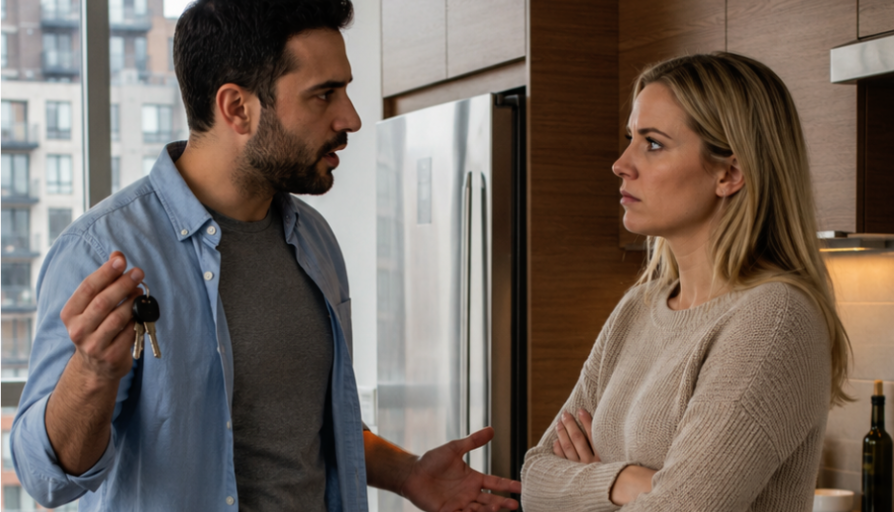
“I don’t understand,” he said through clenched teeth. “Is this some kind of joke? I already promised my aunt.”
“It isn’t a joke. I’m stating a fact.”
Igor was a master of conversations like this. He always appealed to “logic” while quietly substituting one concept for another.
But this time, Dasha was prepared.
“Igor, your brother has lived there for six months,” she began. “Completely free of charge. He has turned my living room into a warehouse for burned-out motherboards. He uses electricity around the clock. And for all six of those months, I’ve paid the utilities from my salary because your businessman still hasn’t ‘turned a profit.’ And now you’ve decided to turn my apartment into a family dormitory so some other kid can pay off your car loan? The loan for a car registered in your mother’s name? Don’t you think this has gone far beyond ordinary nerve?”
Igor’s eyes narrowed.
He switched to his favorite tactic: aggressive self-righteousness.
“There you go again, dividing everything into ‘yours’ and ‘mine’!” he shouted, slamming his palm against the table. “Dasha, we’re married! In a normal family, there is no word ‘mine.’ There are shared resources! I buy our groceries. I take you on vacations in that very car! I contribute to our household! And you’re hoarding empty square meters that bring absolutely no benefit to the family.”
“Benefit to whom, Igor?” Dasha shot back coldly. “Your relatives? Your budget?”
“Our budget!” her husband barked. “If we don’t use a resource for the good of the family, that means you simply don’t consider us a family. Slavik is my brother. Ilya is our blood. You’re not willing to share?”
Dasha looked at the man with whom she had once planned to spend the rest of her life and felt nothing but profound disappointment.
He genuinely believed what he was saying.
Her husband sincerely regarded her apartment as his personal investment portfolio, something he had every right to manage. He handed out keys like some feudal lord and collected tribute.
“You know, Igor,” Dasha said, rising from the table and picking up her cup. “Maybe you’re right about one thing. Assets really shouldn’t sit idle.”
Igor exhaled with satisfaction.
He had decided his logic had worked again, that his wife had finally surrendered under the weight of his arguments.
“Exactly, Dasha. You have to think rationally. The agreement is on the table.”
He stood up, tossed a pen onto the papers with disdain, and headed toward the bedroom.
At the doorway, he turned around and delivered his favorite ultimatum.
“You have the night to think about it. Either you sign, or I draw my own conclusions about what the word ‘family’ means to you. Your choice.”
Igor walked away convinced that the toxic guilt he had so generously planted would break his wife by morning, just as it had before.
But this time, he had made a catastrophic miscalculation.
Morning began in silence.
Dasha did not apologize.
She made coffee, got dressed, and said dryly to her husband as he stood in the hallway tying his necktie:
“I heard you yesterday. Leave the papers on the table.”
Igor adjusted his collar while smirking smugly at his reflection in the mirror.
He was absolutely certain he would come home that evening and find her signature on the agreement.
But Dasha did not go to the office.
The previous evening, she had messaged her boss and taken two unpaid days off.
She had serious work to do—setting up exactly the sort of “rational processes” her husband loved talking about so much.
She knew her brother-in-law’s schedule.
Every Wednesday, Slavik went to the electronics market to buy specialized parts and did not return until evening.
It was the perfect opportunity.
At ten o’clock that morning, Dasha stood outside the door of her apartment.
Beside her, a gloomy locksmith shifted from foot to foot with a toolbox in his hand. A short distance away, two sturdy men from a professional cleaning service that also offered express packing services were smoking.
“Change the lock,” Dasha calmly instructed the locksmith.
Once inside, Dasha nearly felt sick.
There was no trace of the apartment’s former immaculate cleanliness.
The hallway was littered with pizza boxes. Coils of cables lay directly on the hardwood floor in the living room. Old computer cases were piled in the middle of the room, while crumpled bedding covered the sofa.
“Guys,” she said, turning to the cleaners. “Here are heavy-duty cardboard boxes. Pack absolutely everything that isn’t screwed to the floor or the walls. All these wires, circuit boards, monitors, clothes, dishes—everything. Pack it carefully so nothing gets broken. We have two hours.”
They got to work.
Room by room, the men packed Slavik’s possessions into large, sturdy boxes and sealed them with tape.
Meanwhile, Dasha paid the locksmith, who had already installed a new secure lock and handed her a set of keys.
By one o’clock, the apartment was completely empty.
The entire life of the thirty-year-old “crypto investor” fit into twelve large boxes stacked in a pyramid in the hallway.
Dasha ordered a cargo taxi, paid for the loading, and gave the driver the delivery address:
the apartment she shared with Igor.
At three o’clock that afternoon, Dasha was sitting in a conference room at a major real-estate agency.
Across from her sat a realtor and a representative of a large chain of dental clinics.
“The apartment is completely vacant. I have the keys,” Dasha said, pulling the contract closer. “Just as we discussed over the phone yesterday.”
The realtor nodded.
“That’s correct, Darya Alexandrovna. The clinic is renting your apartment for three years to house its chief physician, who is relocating from another city. It’s a strict corporate lease. The clinic assumes full financial responsibility for the condition of the renovations and all property inside. Payments will be made quarterly and exclusively by bank transfer into your personal deposit account.”
Dasha carefully read every clause.
Then she picked up the pen and added her sweeping signature.
She had done exactly what her husband had taught her to do.
Dasha had put her asset to work.
As rationally, profitably, and securely as possible.
Igor returned from work completely exhausted.
He turned the key in the lock, pushed open the door, and froze on the threshold.
It was impossible to step into the hallway.
Cardboard boxes and a rolled-up mattress blocked the passage from the coat rack all the way to the living room.
Beside them, pale-faced Slavik sat on the little shoe bench, clutching his hair with both hands and staring blankly into space.
Igor remained frozen in the doorway, looking first at the boxes and then at his brother.
“What’s going on here?” His voice trembled as panic began to break through. “Slavik, why are you sitting here? What’s with all this stuff?”
Slavik looked up at his brother with lifeless eyes.
“Your wife threw me out, Igor,” he muttered resentfully. “I came back from the market, and there were new locks. The concierge told me Dasha packed everything and had it brought here in a truck. She unplugged my mining rigs…”
Igor yanked off his shoes, stepped over a box filled with wires, and stormed into the kitchen.
Dasha was sitting at the table.
A cup of green tea stood in front of her.
She was completely calm.
“What the hell have you done?!” Igor roared, forgetting all about his velvet-smooth tone. Red blotches spread across his face. “You threw my brother onto the street like a dog?! Have you lost your mind?!”
Dasha leisurely took a sip of tea.
“I didn’t throw him onto the street, Igor. I sent him to his own brother,” she replied evenly, looking directly into her furious husband’s eyes. “I simply listened to you. You were very convincing yesterday. You were absolutely right. Assets shouldn’t sit idle. Economic selfishness is wrong.”
She took a corporate lease agreement from a folder and placed it on the table.
Beside it, she put a stamped bank statement confirming that a substantial deposit had been credited to her account.
“So today I rented the apartment to a corporate client—a large dental clinic. For three years, under a contract with strict insurance protections. The money has already been deposited into my personal account. My asset is no longer sitting idle.”
Igor grabbed the contract.
His eyes raced over the lines, and with every passing second he realized that the free gravy train had been shut down permanently.
“What clinic?! What three years?!” he shouted, nearly choking with outrage as he crumpled the paper. “What about Slavik?! What about the nephew?! We agreed that the resource would be used for the family! To pay off my loan!”
Dasha smiled.
“Exactly, Igor. For the family,” she said with a nod. “And since, as you correctly pointed out yesterday, there’s no such thing as ‘mine’ in a normal marriage, only ‘ours,’ your brother’s boxes are now standing in our hallway. We’re family, after all. We can’t throw someone out onto the street. You can let him sleep in our bedroom. When the student nephew arrives, we’ll put him here in the kitchen and buy him a folding bed. There’s tons of space. Resources are shared, remember, Igor? And from now on, you’ll pay the loan on your mother’s car yourself. From your own salary.”
Igor stood there with his mouth open.
His own pseudo-rational philosophy—the philosophy he had used for years to pressure his wife—had just come flying back at him like a boomerang.
Now his personal comfort, his peace and quiet, and his home life were being destroyed by his own relative.
“You… how could you?” he hissed. “You deliberately destroyed everything. You’re not a family.”
Dasha rose from the table.
She walked over to the dresser, opened the top drawer, and took out another folder of documents.
Printed divorce petition forms.
She placed them on top of the crumpled lease agreement.
“If you don’t like living by your own rules, Igor,” Dasha said coldly as she headed toward the kitchen door, “you can draw those conclusions you were talking about yesterday. I’ve already prepared the divorce papers. Your choice.”
Igor froze in the middle of the kitchen.
He stared at the divorce papers, then at the bank statement for an account he could not access.
From the hallway came the miserable rustling of cardboard boxes as Slavik tried to find his toothbrush among the wires.
The free resource had been shut down forever.
People who like living at someone else’s expense rarely make their intentions obvious.
No one simply says to your face, “Give me your apartment.”
They take possession of what belongs to you one millimeter at a time—quietly and almost imperceptibly.
First, they ask for a tiny favor:
“Just give me the keys for a month.”
Then the deadline shifts:
“Well, let the guy stay a little longer. What do you care about an empty apartment?”
And eventually, the freeloader becomes so accustomed to enjoying comfort at your expense that he genuinely starts to regard your property as his own.
Grand words such as “family,” “shared budget,” and “common sense,” when used by people like this, are nothing more than lockpicks for your wallet.
The trick is easy to recognize.
If someone carefully keeps their own property beyond your reach while happily managing yours—and then tries to shame you for being greedy—you are simply being used.
What do you think?
Was Dasha right to turn her husband’s own argument about “shared resources” against him?