Kira stepped out of the apartment building and stopped for a second, breathing in the spring air. In her hands were a folder containing documents and a rolled-up newspaper; in her mind was a mixture of anxiety and excitement. Today, she had finally signed the lease for her second apartment. It wasn’t in a new building and didn’t have a luxury renovation, but it was well maintained, bright, and located in a good neighborhood—the perfect option for the young family who had agreed to move in at the end of the month. The rent promised a steady addition to her income, and Kira was pleased that she had managed to arrange everything without rushing or unnecessary stress.
She had inherited the apartment from her grandmother. Her grandmother had written a will two years before her death, clearly stating that the apartment was to go exclusively to her granddaughter. No one else.
After completing the inheritance paperwork, Kira spent several months going there after work and putting the place in order. She replaced electrical outlets, touched up the walls, and hired repairmen when necessary. She handled everything herself and paid for it with her own money. Her husband hadn’t helped—by then, he was already her ex-husband.
image
Her divorce from Anton had happened quietly, almost without tears. They simply realized they were tired. Tired of living while constantly waiting for something to change, tired of loans, tired of arguing about who was supposed to contribute more.
When Kira left, she demanded nothing. She took only what belonged to her: her one-bedroom apartment, where she now lived. Her grandmother’s three-bedroom apartment had remained empty.
Until today.
That evening, she stopped by a store to buy fruit, cheese, and a bottle of wine for dinner. She wanted to celebrate her small victory. After all, she had arranged the deal herself, found the tenants herself, and made it through everything on her own.
Independence seemed to her like something fragile and precious, something that needed to be protected.
“Kira!” a voice suddenly called from behind her. “What a coincidence!”
Kira turned around.
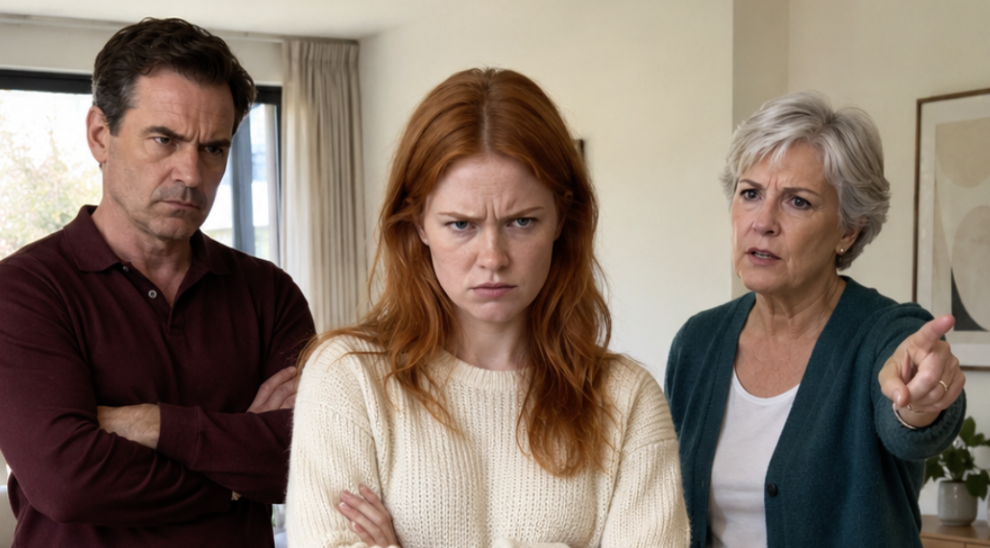
Alina, Anton’s sister, was quickly approaching her. Tall, dressed in an expensive jacket, with a perfect manicure, she radiated beauty salons and an abundance of free time. She had the same smile and the same slightly narrowed eyes as her brother.
But Alina possessed a special talent of her own: she could make any request sound not like a request, but like a moral obligation for the person she was speaking to.
“Listen, you’re exactly the person I wanted to see!” Alina said, hugging her far too tightly. “We need to talk.”
“Hi. Did something happen?”
“No, no, everything’s fine…” She pretended to hesitate, even though she had clearly been working her way toward this conversation from the beginning. “You’re on your own now, without Anton… But I heard you have two apartments. One of them came from your grandmother, right?”
Kira tensed.
She already knew where this was going.
“Yes,” she replied briefly.
“Listen… Since you have another apartment, it wouldn’t hurt to share!” Alina laughed with forced casualness and held out her hand as if Kira were already about to place the keys in it. “You understand, Alexey and I got married, and it’s cramped living with our parents, especially with the baby. And meanwhile, you have an entire three-bedroom apartment just sitting empty. Or is it not empty anymore?”
Kira felt a chill run down her spine.
It seemed like an ordinary conversation, but Alina’s tone left no real choice. If Kira didn’t want to look greedy, she was expected to give in.
“I rented it out,” Kira said calmly. “I signed the lease today. The tenants are moving in at the end of the month.”
“Oh, come on!” Alina’s eyes widened. “Why are you acting like we’re strangers? We’re practically family! You could’ve told me. I would’ve come to you earlier. We could pay you a little. Or you could just let us live there. Things are genuinely very difficult for us right now.”
“I’m not obligated to,” Kira said, lifting her chin. “Do you know how much I put into those repairs? How much effort and money it took? The apartment isn’t ‘just sitting there,’ Alina. It’s my property.”
“Sure, it’s yours. But you understand that people need to help each other these days. Besides, you’re doing fine. You’re alone, you don’t have children. You don’t need that much space all to yourself.”
Those words hit hard.
Alone. Childless. You don’t need it.
How easy it was for other people to decide what should happen to someone else’s life simply because that life didn’t resemble their own.
“Alina,” Kira said quietly. “Please leave. And don’t say things like that to me again.”
“You’ve changed,” Alina said reproachfully. “You used to be normal.”
“I used to let people take advantage of me. That’s not the same thing.”
Kira turned around and walked away.
She could hear Alina muttering something indignantly behind her, but Kira didn’t look back.
At home, she sat by the window without turning on the lights. The bottle of wine remained unopened in the shopping bag.
Her good mood had disappeared like steam rising from a cup.
Because she understood that this story was only beginning.
Alina wouldn’t give up.
The question was whether Kira would have enough strength to stand her ground.
Her phone rang about an hour later.
The screen displayed Anton’s name.
Kira stared at it without answering. She had no desire to hear his voice again—that patronizing calmness that always concealed a request disguised as a “suggestion.”
On the third call, she finally answered.
“Hi, Kir. It’s me.”
“I can see that.”
“Did you talk to Alina?”
“I did.”
“She probably came on a little strong. But they really are in a difficult situation. Our parents keep complaining, there isn’t enough space, and money is tight. We thought…”
“You thought too?” she interrupted. “That you could take advantage of the fact that I don’t shout, make scenes, or threaten people?”
“No, that’s not what I mean,” he said quickly. “It’s just… you could help. You don’t live in your grandmother’s apartment anyway. And Alina is my sister. Help her. It wouldn’t be forever.”
“And what am I supposed to tell the tenants? Sorry, my relatives suddenly decided they want the apartment, so you can go live on the street?”
“Well… the lease could be terminated. Or you could simply not renew it.”
Kira gave a bitter smile.
It was as if he had forgotten that she was no longer the woman she had been two years ago.
She wasn’t going to say, “Fine.”
She wasn’t going to make concessions out of guilt or obligation.
Now she knew how to defend her boundaries.
“No, Anton. I’m not giving the apartment to Alina. Or to you. Not temporarily and not permanently.”
“So you’re willing to rent it to complete strangers but not help your own family?”
“You said it correctly. Your family. You’re nobody to me anymore.”
He fell silent.
Then he said quietly, almost pityingly:
“You’ve become cruel, Kira.”
“And you’ve always preferred whatever was most convenient for you.”
She hung up.
The next morning, Alina’s car was parked outside Kira’s building.
Alina rushed toward her before Kira even had time to close the entrance door behind her.
“I can’t believe you seriously refused us. We’re family! What am I to you, some stranger?”
“Alina,” Kira stopped walking, “you are nobody to me anymore. And truthfully, you were never really my family. You always treated me like an accessory that came with your brother. And now you simply see my apartment as a convenient solution to your problems.”
Alina’s face turned red.
“Fine,” she said. “If you don’t want to settle this nicely… We’ll see how you explain to the family why you threw a mother and her baby out onto the street.”
“I didn’t throw anyone out. And I’m not going to explain anything to anyone.”
“I’ll explain it, then. Everything. To everyone. Let them see what kind of person you really are, Kira.”
A couple of days later, the messages started coming.
First, her former mother-in-law wrote:
“How can you not be ashamed of yourself? You’re willing to leave your own family out on the street just to make money.”
Then Anton’s aunt:
“No one expected this from you. We thought you were a person with a heart.”
One of their mutual acquaintances even posted a story online with a pointed remark:
“Some people have two apartments and still can’t bring themselves to share.”
Nothing was said directly, but the meaning was obvious enough.
Kira disabled comments. She left every family group chat. She blocked Alina’s number.
But deep down, she could feel that the storm wasn’t over.
It had merely gone quiet for a few hours.
A week later, she received a notification on her phone: someone had filed a complaint with the management company regarding her grandmother’s apartment.
“Illegal rental.”
“Unsanitary conditions.”
“Noisy tenants.”
It was almost funny considering that nobody had even moved in yet.
Kira went to the homeowners’ association office and explained the situation. Everything was cleared up.
But one thing had become obvious: Alina wasn’t simply offended.
She had decided to wage war.
After listening to the whole story, Kira’s friend Lena said:
“Whatever you do, don’t give in. People like that are waiting for you to surrender. They don’t care about fairness. They care about getting what they want. Remember how she treated you during the divorce?”
Kira nodded.
She remembered.
She remembered Alina saying things like, “You were lucky to have your own apartment, so what are you complaining about?”
She remembered how, after the divorce, Alina had tried to lecture her:
“You’ll never find a decent man now. It’s your own fault for letting Anton go.”
“So stay the course,” Lena said as she poured tea. “You’re doing the right thing. You don’t owe them anything.”
By evening, Kira realized that yes, the situation was unpleasant. And yes, it was difficult to have people spreading lies about her.
But living under someone else’s control again would be far worse.
Renting out the apartment wasn’t merely a financial issue.
It represented her independence.
Her boundaries.
Her self-respect.
She wasn’t obligated to share something she had built and maintained herself.
When the tenants finally moved in, Kira brought them a few small things: new curtains, a kettle, and several blankets.
She did it willingly.
Because she wanted to.
Because she could.
Two days later, Alina appeared at Kira’s door again.
No warning.
No phone call.
She simply rang the doorbell at nine in the morning on a weekend, knowing perfectly well that Kira would be home.
Her face showed either exhaustion or another carefully planned performance.
In her hands was a plastic folder filled with papers.
“We need to talk,” Alina said as though nothing had happened. “I don’t want to fight. I came in peace.”
Kira remained silent, refusing to open the door any wider.
“I feel bad about how everything happened. And you were right—I came at you too aggressively…” Alina stepped closer. “But Kira, I really am in trouble. Alexey is having problems at work. The baby has diathesis, we’re constantly going to doctors, and money is disappearing faster than we can earn it. Our parents can’t take it anymore. We genuinely can’t cope.”
“I’m sorry you’re going through that,” Kira replied calmly. “But none of it has anything to do with me.”
“Why are you like this?” Alina’s voice trembled. “You’ve changed beyond recognition. Seriously. You used to be normal, and now you’re like a stranger. Cold. Distant. As if you’re deliberately taking revenge for something.”
“I started protecting my boundaries,” Kira said with a shrug. “That isn’t revenge. It’s adult life. Everyone is responsible for themselves.”
“Have you ever thought that helping someone is about basic human decency?” Alina frowned. “That refusing isn’t just a refusal—it hurts people? Especially family?”
“I have thought about it,” Kira nodded. “Have you ever thought that demanding someone else’s property is called entitlement?”
Alina jerked back as though the words had physically struck her.
She remained silent for a few seconds before raising her eyes and thrusting the folder toward Kira.
“Fine. Then we’ll do this differently. Alexey and I found out that you registered your grandmother’s apartment entirely in your own name. But your grandmother said while she was alive that she was going to leave something to Anton too. We can even find witnesses. And a lawyer told us we could challenge the inheritance. Or at least demand compensation. It doesn’t necessarily have to go to court. We can settle this peacefully—you just give us our share.”
Kira took the folder and opened it.
Inside were printouts of unclear documents, several statements, and photographs of Anton with her grandmother.
Legal value: zero.
Emotional pressure: maximum.
“Are you serious?” Kira asked quietly.
“Completely serious. If you won’t let us live there, then give us part of it. It’s only fair. We’re family.”
“We’ve already discussed this. We are not family.”
“So it’s all about money to you?” Alina sneered. “Got it.”
Kira handed the folder back without opening the door any wider.
“Take it to court. Try to prove that Grandma changed her mind. Good luck.”
“So you’ve decided to take this all the way?” Alina said, narrowing her eyes.
“I haven’t ‘decided’ anything. I simply don’t allow people to take advantage of me anymore. And that is permanent.”
Alina left, angry and humiliated.
And surprisingly, she never came back.
No calls.
No messages.
No anonymous complaints.
Apparently, she had finally realized that she wouldn’t squeeze another cent out of Kira.
A week later, something happened that finally put an end to the whole situation.
Lena called her.
“Kira, have you seen Alina’s story? It has you, the apartment, and some ridiculous nonsense.”
Kira opened the app.
Alina had posted a photograph with the caption:
“That’s how life is: some people have everything, while others have nothing. But not everyone has a conscience.”
Underneath were dozens of sympathetic comments.
But this time, it didn’t hurt Kira.
She simply took a screenshot and forwarded it to a lawyer.
“I’d like to know whether this could be considered defamation,” she wrote.
The response came quickly:
“Yes. And if there are any more ‘publications’ like this, save the evidence and we’ll proceed formally.”
Kira had no intention of wasting her time on lawsuits.
But now she possessed something she hadn’t had before: confidence in her right to say no.
Without excuses.
Without guilt.
A couple of months later, Anton sent her a message:
“Sorry about my sister. I didn’t get involved because I honestly didn’t know what to do.”
Kira read it.
And deleted it.
Without replying.
Now, the only people in her life were the ones she personally chose to let into it.
And the apartment?
It provided a stable income.
Kira saved the money. She didn’t waste it on whims and didn’t brag about it.
But with each passing month, she felt more certain that she had done the right thing.
She had accomplished something that had once seemed impossible.
She had stood up for herself.
On her birthday, Kira invited her friends over and finally placed that same bottle of wine—the one she had never opened that night—on the table.
They laughed, remembered silly stories, and made plans for the summer.
At one point, Lena said:
“You know, you could’ve given in. You could’ve said, ‘Fine, they’re relatives, I’ll put up with it.’ And eventually you would’ve ended up trapped in the same old pattern again. But you didn’t. You stood your ground.”
Kira smiled as she looked at the candles on the cake.
“At some point, I simply realized something: just because I have a roof over my head and some extra living space doesn’t mean someone else gets to occupy it simply because they’re shameless enough to demand it. Literally and metaphorically.”
Now she knew that her “no” had value.
And no one but Kira herself would ever decide what that value was.